Showing posts with label Napoleon. Show all posts

Monday, September 26, 2016

Map Monday: United States of Europe by Zek Sora

Zek Sora returns to Map Monday, this time with a map without zombies (shocking, I know). I present the "United States of Europe":
In this timeline, Napoleon decides to preserve the preserve the Continental System rather than conquer anymore of Europe. Although Zek does not go into too much detail in the description that went with the map, my guess is that Napoleon never invaded Russia in this alternate history. Eventually the Continental System evolves into a more centralized European Union-esque organization known as the "United States of Europe".

To be fair, this is perhaps one of the more plausibly optimistic timelines involving a victorious Napoleon. Direct French control of most of Europe probably wouldn't have lasted long, but uniting them under a confederation where France was essentially the leader among equals could have worked. While I am curious to know how the USE governs its colonial possessions (since they apparently do have some according to the map), I still found this 1868 hybrid political/election map to be a good way of presenting the alternate history. I also like the color pallet Zek uses, which is similar to some of his other maps.

Honorable mentions this week go out to "World War 2.5" by RvBOMally and "Union of Islamic Republics" by Doctor President.

* * *

Matt Mitrovich is the founder and editor of Alternate History Weekly Update, a blogger for Amazing Stories, a volunteer interviewer for SFFWorld and a Sidewise Awards for Alternate History judge. When not exploring alternate timelines he enjoys life with his beautiful wife Alana and prepares for the day when travel between parallel universes becomes a reality. You can follow him on Facebook, Twitter, Tumblr, DeviantArt and YouTube. Learn how you can support his alternate history projects on Patreon.

Monday, April 4, 2016

Map Monday: Kingdom of Illyria by Keperry

Being partly Serbian, I am always curious about alternate histories involving the former Yugoslavia. The popular scenario is to have the different ethnic groups work out their differences sometime in the 20th century and still be a unified state by the present. A twist on this theme, however, is the "Kingdom of Illyria" by Keperry:
In this timeline, Napoleon dies at the height of his power leaving his empire to continue on for a short while before collapsing as one by one all the Bonapartist states overthrow their monarchs, except for Kingdom of Illyria. They are the Byzantine-esque successor state to Napoleon's empire, pushing a version of Napoleon's ideology to keep the loose federation of Croatians, Germans, Italians and Slovenians together. In the scenario that went with the map its mentioned that the Kingdom already lost the southern half of its territory, so I am assuming places like Bosnia, Serbia and other Yugoslav states were included as well in this kingdom.

As I said before it is an interesting twist on the concept of Yugoslavia, whether Keperry intended it to be or not. Although its doubtful such a kingdom would survive for long in its timeline, at least it gave us a nice Inkscape map to look at. Not bad for Keperry's first MotF entry.

Honorable mentions this week go out to "Let's Split: the End of the Kingdom of Belgium" by Iserlohn and "Ulster Rising: Irish Alt History in a shade of Orange" by KapiTod. If you want more mappy goodness, check out this 1937 map imagining how Japan might attack the west coast of the United States, via Slate.

* * *

Matt Mitrovich is the founder and editor of Alternate History Weekly Update, a blogger for Amazing Stories, a volunteer interviewer for SFFWorld and a Sidewise Awards for Alternate History judge. When not exploring alternate timelines he enjoys life with his beautiful wife Alana and prepares for the day when travel between parallel universes becomes a reality. You can follow him on FacebookTwitter and YouTube. Learn how you can support his alternate history projects 

Wednesday, July 8, 2015

What If Wednesday: The British Republic, No Iraq War and the Hong Kong Diaspora

For this What If Wednesday, I have THREE short scenarios for all of you based on news articles I shared with you last week. Lets begin with...

#1: What if Napoleon turned Britain into a republic?

Last month Martin Kettle complained on The Guardian of liberalism and democracy's defeat after Napoleon lost the Battle of Waterloo. While criticizing the anti-liberty forces that came to power after Napoleon's final defeat, he also shared this tidbit from Napoleon himself regarding what would he have done if he had successfully invaded England:

I would have hastened over my flotilla with two hundred thousand men, landed as near Chatham as possible and proceeded direct to London, where I calculated to arrive in four days from the time of my landing. I would have proclaimed a republic and the abolition of the nobility and the House of Peers, the distribution of the property of such of the latter as opposed me amongst my partisans, liberty, equality and the sovereignty of the people.

As great as this sound to British republicans, I am not convinced Napoleon would have done this. He had tendency to put his family into positions of power rather than establish republics. Even if he really meant to create a republic in Britain, to do so after a victorious Waterloo was extremely unlikely, but I have already said as much elsewhere. If Napoleon had successfully invaded and conquered England, he would have likely put some family member or willing stooge up as king, but this king would only survive on his throne as long as Napoleon was alive. After Napoleon died I expect his empire would have collapsed around him. Now perhaps the rebellious British may welcome back the Hanoverians, but then again they could easily form a republic instead, much like the French did after Napoleon III was overthrown. Then again there are probably more plausible points of divergence for a British republic than any involving Napoleon.

Once again thanks to Bill Weber for recommending this article to me. Don't forget to check out his contributions to The Update.

#2: What if the United States does not invade Iraq in 2003?

Maybe this what if is a little too soon to speculate on, but God knows we hear people do it on the Internet all the time. A recent example is from Robert Farley who speculated on The National Interest about what would happen if the United States had not invaded Iraq in 2003. Among other things, Farley argued that without the Iraq War the Middle East may have been more stable with Hussein's Iraq acting as a buffer to the influence of Iran, the United States would have been free to focus fully on Afghanistan (maybe even destroying the Taliban in the process) and the US could have had access to more advanced military technology than it does today.

That all being said, Farley's article is more thought experiment than counterfactual as he doesn't have a specific point of divergence, instead relying on "saved game" analogy from the computer game Civilization. Thus Frank P. Harvey's argument in his book Explaining the Iraq War that presidents tend to follow the foreign policy of their predecessor regardless of what they said on the campaign trail, means that simply starting over won't cut it. The United States will invade Iraq if all the circumstances that led to it still happen, thus the choices Bush, Gore or whoever else is in the White House could make would be severely limited. In fact, Frank said in an interview I conducted with him that perhaps the only way to avoid the Iraq War was to somehow avoid 9/11 as well.

That is pretty much all I am going to say about that scenario, since the issues stemming from the Iraq War and the 9/11 terrorist attacks are still touchy subjects. So lets move on to our last, and most bizarre, what if...

#3: What if the UK settled 5.5 million Hong Kong Chinese in Northern Ireland?

Owen Bowcott of The Guardian reported that in 1983, at the midst of The Troubles, someone in the British government suggested settling the then 5.5 million inhabitants of Hong Kong in Northern Ireland before it reverted back to Chinese control in 1997. If this sounds like a joke...it was, or at least that was how it was treated through the official channels. It was simply an attempt at some levity by people trying to resolve an extremely difficult situation. Then again, what if someone did take the plan seriously?

To be honest, it is completely unlikely the plan as is would have been carried out. Moving a population of 5.5 million people to an area that today only supports 1.8 million people sounds like utter madness. My guess is the plan would be paired down simply to generous aide packages to any Commonwealth country that would take in any Hong Kong Chinese who wanted to leave. Would all 5.5 million choose to go? Probably not, but enough might go that China might not bother with the "one country, two systems" and today Hong Kong would be far less capitalist and democratic. That being said, Hong Kong is an important part of China's economy and if some or most of its population immigrates to the Commonwealth nations, China's present day economy in this alternate timeline could be weaker.

And what about the Chinese populations that settled in the Commonwealth? How would they effect their new homes and how would the original inhabitants take to their new neighbors? I have no idea, so I will leave that speculation to someone more knowledgeable than myself. If you have any ideas or comments for any of the above what ifs, please let us know in the comments.

* * *

Matt Mitrovich is the founder and editor of Alternate History Weekly Update and a blogger on Amazing Stories. Check out his short fiction. When not writing he works as an attorney, enjoys life with his beautiful wife Alana and prepares for the inevitable zombie apocalypse. You can follow him on Facebook or Twitter.

Wednesday, June 17, 2015

What if Wednesday: Napoleon is Victorious at Waterloo

With tomorrow marking the 200th year anniversary of the Battle of Waterloo, expect to see a lot of content this week regarding Napoleon from many sources, including counterfactuals about what would happen if he was victorious. In fact the speculation has already begun. For example, Phillipp Saure posted an article on Yahoo! where historian Helmut Stubbe da Luz suggested that if Napoleon won the Battle of Waterloo, he would have reconquered Europe and extended his empire to China. This massive French Empire would be an enlightened dictatorship that would prevent the worlds wars or the rise of Nazism.

Now I freely admit there are many people out there who are brighter and know a lot more about Napoleonic history than me, but Helmut's scenario sounds amazingly optimistic. I find it hard to believe that the rest of Europe would after being defeated in a single battle just shrug their shoulders and say: "Well I guess we all have to speak French now". Remember this battle was fought not when Napoleon was at his height, but when he had just returned from his exile and was trying to regain what he had lost. Even if he had been victorious at Waterloo, there would still be a long campaign through Germany and the rest of Europe, giving his enemies time to recover from their defeat and try again. Plus the Royal Navy wouldn't disappear if Wellington was defeated and I am sure they will have something to say if Napoleon tried to conquer China.

At best a victory at Waterloo would hurt the resolve of the Seventh Coalition to continue the war. A negotiated peace recognizes Napoleon as the ruler of France and gives him some influence over neighboring countries. It is foreseeable he would build up his forces to try and conquer Europe again, but with his OTL death just a few years away, it is unlikely that would ever happen. Napoleon II would thus succeed his father and while it is difficult to speculate on what he would be like as a ruler, it is possible he wouldn't immediately set off to bring all of Europe under the French heel, especially when there are easier and more valuable targets in Africa, Asia and the Americas.

As time goes by it would become increasingly difficult to imagine how European history would change. What would future Bonaparte rulers be like? Would France evolve into a constitutional monarchy like Britain or would the Bonapartes be overthrown in a violent revolution like what happened in Russia? At this point it is pretty much open to your imagination. Let me know what you think in the comments below.

The great thing about Napoleon is that there are a lot of potential PODs out there besides a victory at Waterloo. For example, maybe he adopted steam technology for his navy and created a steampunk alternate history where everyone spoke French instead of English. Here at The Update, we have featured a lot of alternate Napoleon histories including Napoleon conquering England with zombies, veterans of the Grand Army carving out an independent state in Louisiana, Napoleon fleeing from his exile on St. Helena and settling in America and Napoleon using the knowledge gained from his adventure while time travelling to finally conquer Europe once and for all. Go check them out and tell us what you think.

* * *

Matt Mitrovich is the founder and editor of Alternate History Weekly Update and a blogger on Amazing Stories. Check out his short fiction. When not writing he works as an attorney, enjoys life with his beautiful wife Alana and prepares for the inevitable zombie apocalypse. You can follow him on Facebook or Twitter.

Monday, May 25, 2015

Map Monday: League of the Defiant by Zalezsky

I like finding new alternate cartographers and featuring their work on Map Monday. Case in point, Zalezsky and his map of the "League of Defiant":
There really isn't a lot of background about this scenario given to us by Zalezsky. Essentially several Native American tribes unite to stop European encroachment on their lands and with the help of Genoese traders gets the guns to actually stop them. Through success and setbacks, everything eventually comes to a climax at the Battle of Watala...or Waterloo. If you haven't figured it out from the map itself, that name alone should really give you hint of what era of history this scenario is paralleling. It is very subtle and I love it. The story is told from the art itself and the detail is great (go here to see a map you can zoom in on).

Honorable mentions this week go out to Rvbomally's "Empire of the Sun" and Bruce Munro's "World of the Yiddish Policeman's Union" (see a longer description here). Don't forget to check out the map of the most popular book set in each state. If you want to submit a map for the next Map Monday, email me at ahwupdate at gmail dot com with your map attached and a brief description in the body of the email.

* * *

Matt Mitrovich is the founder and editor of Alternate History Weekly Update and a blogger on Amazing Stories. Check out his short fiction. When not writing he works as an attorney, enjoys life with his beautiful wife Alana and prepares for the inevitable zombie apocalypse. You can follow him on Facebook or Twitter.

Wednesday, January 21, 2015

Book Review: Jonathan Strange & Mr Norrell by Susanna Clarke

With BBC's upcoming adaptation of Susanna Clarke's Jonathan Strange & Mr Norrell, I decided to prepare for the mini-series by actually reading the book it was based on. Even without the adaptation, I probably still would have gotten around to Clarke's debut novel. It is a critically acclaimed work of historical fantasy that has delighted fans from almost every corner of speculative fiction and I can now count myself as one of the many who praise this book.

Jonathan Strange & Mr Norrrell tells the story of magic's return to England. In this world it is a accepted fact that magic is real, but people have been unable to practice it for centuries. That all changes when the reclusive gentleman, Mr Norrell, brings all the statues in the cathedral of York to life. After this feat of magic he travels to London to aide the government in their war against Napoleon and he gains the trust of the ministers when he brings one of their number's wife back from the dead. As interest in magic increases, a young gentleman named Jonathan Strange decides to pursue a career in magic and shows such a natural talent for it that even the friendless Mr Norrell agrees to take him on as a pupil. The two magicians, however, quarrel and Strange sets off on his own independent research into dangerous fields of magic that could bring about the doom of many.

Jonathan Strange & Mr Norrell was an intriguing fantasy story that also had a realistic portrayal of magic. The characters were complex and even the most wretched of them had certain aspects that you could admire. There are plenty of historical cameos that alternate historians can enjoy and reading about Strange's service in Wellington's army during the Peninsular War and at the Battle of Waterloo made me want to pick up some military fantasy to see how Clarke's depiction of war magic compares to more recent examples. The book has an old fashioned writing style, but fans of Dickens or Austen will appreciate Clarke's obvious interest in English literature.

The book, however, can be dull at times. The paperback copy I read clocked in at 1006 pages, which is an unusual length for a speculative fiction book. Much of the story actually focuses on the mundane aspects of early 19th century life, with plenty of criticism directed against the English class system. Casual readers who were looking for an action-packed fantasy epic are going to be severely disappointed. Even I thought the last third of the book could do with some culling, but that is really the only major issue I had with the book. The final conclusion was worth all the build up, even if in retrospect we could have done without some of it.

I am hesitant, however, to classify Jonathan Strange & Mr Norrell as an alternate history. In spite of the existence of magic, history mostly parallels our timeline. The real difference to history is presented mostly through the footnotes of the book. During the Middle Ages a magician known as the "Raven King" conquered Northern England and ruled it for 300 years before disappearing. There is an amusing comment by one character who says many countries have myths about a king who will return, but England is the only country where it is part of the constitution (should the Raven King ever return Northern England will revert back to his control). Nevertheless, I can see why it is not listed in Uchronia and "historical fantasy" is probably a better label than alternate history.

Despite its length and lack of alternate history content, I can still recommend Jonathan Strange and Mr Norrell. It is an engaging story with surprising depth, just don't let its size scare you. It is certainly worth your time.

* * *

Matt Mitrovich is the founder and editor of Alternate History Weekly Update and a blogger on Amazing Stories. Check out his short fiction. When not writing he works as an attorney, enjoys life with his beautiful wife Alana and prepares for the inevitable zombie apocalypse. You can follow him on Facebook or Twitter.

Monday, January 12, 2015

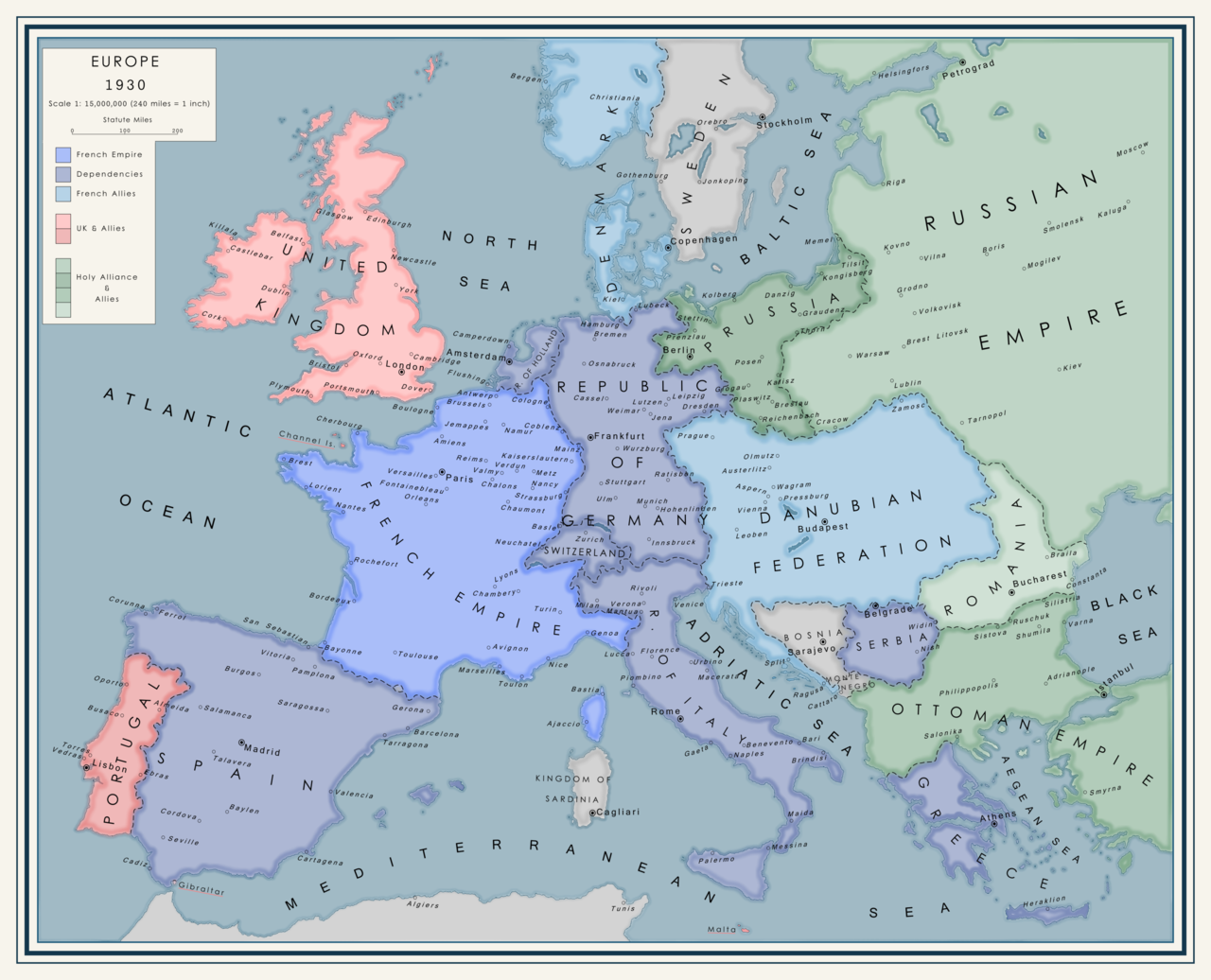
Map Monday: Premier Empire by Lynn Davis

Sorry again for the aborted Map Monday last week. I hope today's offering appeases the Alternate History Gods so they protect me from my evil computer demons. Lets take a look at "Premier Empire" by Lynn Davis (a.k.a. PlatoonSgt, ToixStory):
In this universe Napoleon treats his allies better and eventually forces Britain and Russia to a final negotiated peace. Things go well for France until Napoleon dies and his son makes a mess of things. This requires another Napoleon to rise up and subdue Europe, but by diplomacy not conquest. By 1930, France is still the most power nation in Europe, but its power is waning against the Russian-led Holy Alliance and Anglo-American pact. Its an interesting take on a popular subject (especially in French language alternate histories). Its certainly a French wank, but Lynn allows for the ups and down associated with empires and the France in this scenario is certainly in a decline.

The map itself is well done. The borders aren't just copy and pasted from other maps and the colors differentiate the different blocs without making it too busy. An excellent map from one of my favorite alternate cartographers.

Honorable mentions this week go out to Justin Avey for his "United Provinces of the Netherlands" (you can also see it over at his blog). I also recommend you check out Cool Maps of Fictional Literary Places by Rachel Cordasco at Book Riot. If you want to submit a map for the next Map Monday, email me at ahwupdate at gmail dot com with your map attached and a brief description in the body of the email.

* * *

Matt Mitrovich is the founder and editor of Alternate History Weekly Update and a blogger on Amazing Stories. Check out his short fiction. When not writing he works as an attorney, enjoys life with his beautiful wife Alana and prepares for the inevitable zombie apocalypse. You can follow him on Facebook or Twitter.

Friday, April 4, 2014

Review: Napoleon in America by Shannon Selin

What if Napoleon's epilogue wasn't set on St. Helena, but instead in America? That is the question asked in Shannon Selin's new novel Napoleon in America.

In 1821, Napoleon is rescued again from exile by the pirate Jean Lafitte. After a brief stay in New Orleans to recover from an illness, he decides to travel around America on a scientific expedition. Meanwhile, people everywhere are speculating on what he will do next. The Holy Alliance fears he will try again to conquer Europe. French revolutionaries believe he is only moments away from returning to their shores to overthrow the Bourbons. The Emperor of Austria believes he may try to reunite with his son, Napoleon II, and place him on the throne of France. The Americans just hope he will live a quiet life like his brother Joseph Bonaparte and not stir up trouble.

It becomes quite clear, however, that Napoleon has no intention of living a peaceful life in America. Unhappy with the Americans for their incessant interest in making money, he tries for one last grand campaign. Building an army of French expatriates and American adventurers, he leads a filibustering expedition into Texas to establish a new French colony.

Napoleon in America is a well researched alternate history, without any alien space bats. It had a large caste of historical characters without, as far as I can tell, many fictional characters to crowd them out. Indeed I was happy to learn that Napoleon himself was a fast eater, a trait that I share with him. I also enjoyed Selin's use of newspaper clipping and letters written in the parlance of the time that helped give the reader an idea of the state of the world. I would be remiss if I did not mention that the cover art won an award recently.

The book, however, did have some weaknesses. Selin uses an old fashioned writing style, with a lot of tell and not enough show. This isn't a bad thing since it read as if she was emulating other works of fiction written during the same time period. Nevertheless, the amount of background information, which I still applaud as a sign of a well-researched alternate history, probably could have been parred down in some parts of the book. I also wanted more details on exactly how Napoleon escaped this time as it was presented as a fait accompli and thus I felt I missed out on a potentially interesting action scene.

I still enjoyed Napoleon in America and recommend it to all except for the casual alternate historian. The writing style and wealth of information might scare off some people, but I think others may enjoy what happens when the le petit caporal arrives in the New World.

* * *

Matt Mitrovich is the founder and editor of Alternate History Weekly Update and a blogger on Amazing Stories. Check out his short fiction. When not writing he works as an attorney, enjoys life with his beautiful wife Alana and prepares for the inevitable zombie apocalypse. You can follow him on Facebook or Twitter.

Tuesday, February 18, 2014

6 Common Mistakes Every American Revolution Alternate History Makes

Although American Civil War and World War II histories dominate the English-speaking world, stories about a stillborn United States are still quite common. Whether it happens because the Thirteen Colonies lose the American Revolutionary War or else the political upheaval that led to their independence is avoided through diplomacy, all the timelines lead to a world where North America from the Arctic to the Rio Grande remains under the Union Jack.

While these timelines have merit, both professional and fans authors often make the same mistakes, historical misconceptions and omissions again and again. To prevent this from happening in the future, here is a list of common mistakes found within American Revolution what ifs...

Florida
At some point, whatever government is created for British North America, they will want Florida. Sometimes they just take it or other times they buy it. Either way Florida will stop being Spanish not long after the POD. Except why would they need Spain need to hand it over in the first place? This is a mistake I find again and again with alternate American Revolution timelines and it needs to stop...now.

Here is what history tells us: at the end of the French and Indian War/Seven Years War, Florida was ceded to Britain and was split into West and East Florida. The two Floridas remained loyal to Britain during the Revolutionary War, but in the end were ceded back to Spain after they had sided with the rebellious colonists. Much later West Florida rebelled against Spanish rule and was annexed by the United States, while East Florida was ceded to the United States in 1821.

In a timeline where Britain retains control of the Thirteen Colonies, Florida would have remained British because Spain would either have no war to join or else would have been on the losing side. The two Floridas would be components of whatever government is created for British North America and might even have special status in those versions that had a war since they had remained loyal. So please stop making this mistake before I start tearing my hair out.

Louisiana and the Great Plains
As British North America grows in these timelines it expands westward and (usually around 1803) decides it wants the port of New Orleans and the rest of the Great Plains. This proves quite simple since they usually just take it from those dastardly French (curse them!). But why would the French be there in the first place?

This does not happen as often as the Florida problem, but still often enough I feel I should address it. As we know, France ceded New Orleans and the Great Plains to Spain, who added it to the Viceroyalty of New Spain (a.k.a. Mexico) at the end of the French and Indian War/Seven Years War. The territory remained under Spanish control until 1800 when France took back the territory under Napoleon who dreamed of building an empire in the Americas. A slave revolt in Haiti caused the Emperor to scrap those plans and instead sell the territory to the young American republic.

Having Louisiana become French again in a timeline where there is no United States assumes a lot events of OTL will still happen as scheduled, including the French Revolution and the rise of Napoleon. Even if they did happen (which I will discuss later) it is hard to believe that Napoleon would want such a huge tract of land only lightly populated by Europeans that was surrounded on the north and east by the British. Most likely he would look elsewhere for his overseas empire and leave the land to the Spanish. Nevertheless, there is no guarantee that the British Americans wouldn't want the strategic port of New Orleans, but it is still possible the land we know today as the "Louisiana Purchase" might be part of Mexico in one of these alternate timelines.

French Revolution and Napoleon
Speaking of the French, who incidentally were big supporters of the rebels, they end up in these timelines never spending all that cash propping up the Americans and thus never have the ton of debt that brings the French Revolution upon the royal houses of Europe. Enlightened monarchies continue to govern the world with democracy being nothing more than a quaint Ancient Greek custom and a young Corsican artillery officer dies of old age without anyone ever knowing his name

Of course, when has history ever been that simple? France's support of the Americans was just one of many causes that brought on the French Revolution and the lack of a Revolutionary War won't hand wave them away either (and its not like the monarchy would take all the extra money they saved to help the lower classes). Even a failed rebellion could still be disastrous for Louis XVI's rule if he still decided to intervene. The events and names might be different, but the French Revolutions could still happen and the chaos caused could allow a man like Napoleon to rise to power.

I admit one of the unwritten rules of alternate history is that nothing is inevitable, but we still need things to be plausible. A POD around the 1770s is not enough time to butterfly away an event that happened in 1789. In all likelihood, instead of defending New Orleans from the British, we could see Andrew Jackson take Orleans while leading an army of Red Coats. We have to remember that a good alternate history has to plausible and certain PODs will effect some historical events, but not others.

Canada
In these timelines, the great Dominion of British North America stretches from sea to shining sea. Members of Parliament gather in the capital, Georgetown (named after the great King George III), to celebrate another year as the most important member of the Empire. No one notices the politicians from the far northern provinces, but it is not like these men from the lightly populated, snowy wilderness have ever contributed anything significant to the Commonwealth. Right? RIGHT?!?!

One of the greatest flaws of American Revolution alternate histories is that they tend to be written by...well, Americans. These authors, however, remain surprisingly ignorant of the OTL British North America, or to put it another way, Canada. These timelines gloss over the northern half of British North America as almost if it doesn't matter and instead read more like an American history where everyone speaks with a British accent. This is especially important with timelines where recognizable historical figures still make cameos, but you rarely see Canadian VIPs in positions of importance.

While I will admit that the center of power might shift to the south in an enlarged British North America, how can one of the world's largest economies and most cultural diverse OTL countries not have an impact at all in a world where America remained under British rule? The city of Toronto alone is the fourth largest city in North America, which would make it the third largest city in a British North America (beating out my hometown of Chicago) and making it a significant region in politics. I guess what I am trying to say is that ignorance of Canadian history is not an excuse for your implausible alternate history.

Native Americans
Another group who is ignored in these alternate histories (and history in general for that matter) are Native Americans. In timelines where the Thirteen Colonies stay British, their history tends to parallel OTL history, that is if the author decides to mention them at all. Essentially they remain non-entities in these universes.

Now the Native Americans were treated rough by most Europeans, but the British did try to normalize relations with the tribes with the Royal Proclamation of 1763, which established the Indian Reserve that stretched from the Great Lakes to West Florida. The proclamation was controversial to the colonials and was one of the causes of the American Revolution. Most Native Americans east of the Mississippi sided with the British during the Revolutionary War and after the war were eventually driven west and forced to settle in reservations far from their ancestral homes.

In these alternate histories, however, it is unlikely the British would radically change their policy to Native Americans if they maintained control of the lands east of the Mississippi. In fact we might see the British grant autonomy to the most powerful and loyal tribes, much like the princely states of India of OTL. This policy might even be carried west if British North America expands that far leading to an ethnically diverse North America where Native Americans exercise more political power than they did in OTL. That sounds like a much more interesting alternate history to me.

The British Empire
Above is a political map of the world of The Two Georges, with the British Empire in red. Despite some loses in Africa, the British Empire is excessively larger than it was in OTL. In fact, most American Revolution alternate histories lead to an enlarged British Empire. But how plausible is it for the British Empire to be this large?

In a world where the Thirteen Colonies stay British, the Crown would need (if I can quote the late Warren Zevon) lawyers, guns and money to maintain their rule. If they are spending these resources on British North America, they would not be able to spend it elsewhere. Consider how different the history of Australia would be. Before the American Revolution, thousands of criminals had been sent to the Americas by the British. After the loss of the Thirteen Colonies, the British found replacement colonies in Australia. In a world, however, where they never lost their original penal colonies, there would be less interest about settling Australia and thus all or some of it could have been gobbled up by another Europe power.

The same can go for other important British colonies as well. A world without the French Revolution and/or Napoleon (if they for some reason do not happen) would not give the British the excuse to take South Africa from the Dutch. Plus considering the economic potential of the lands that make up the OTL USA and Canada, it might not be India that will gain the title of "jewel in the crown" of the British Empire. In fact this same economic potential might even give some alternate leaders the motivation to try and break from the empire and could potentially cause an earlier collapse of the British Empire.

Conclusion

All of the above are either outright mistakes, historical misconceptions or overlooked people/ideas that are common to American Revolution alternate histories. The best way to avoid them, in my humble opinion, is to do your research when you set out to create your timeline. Remember, as Mark Twain once said: "It's not what you don't know that kills you, it's what you know for sure that ain't true."

* * *

Matt Mitrovich is the founder and editor of Alternate History Weekly Update and a blogger on Amazing Stories. His new short story "Road Trip" can be found in Forbidden Future: A Time Travel Anthology. When not writing he works as an attorney, enjoys life with his beautiful wife Alana and prepares for the inevitable zombie apocalypse. You can follow him on Facebook or Twitter.

Wednesday, February 12, 2014

Preview: Napoleon in America by Shannon Selin

I have a new book to add to the review pile. It is called Napoleon in America and is written by author Shannon Selin. Here is the synopsis from Amazon:
What if Napoleon Bonaparte had escaped from St. Helena and wound up in the United States? 
The year is 1821. Former French Emperor Napoleon has been imprisoned on a dark wart in the Atlantic since his defeat at Waterloo in 1815. Rescued in a state of near-death by Gulf pirate Jean Laffite, Napoleon lands in New Orleans, where he struggles to regain his health aided by voodoo priestess Marie Laveau. Opponents of the Bourbon regime expect him to reconquer France. French Canadians beg him to seize Canada from Britain. American adventurers urge him to steal Texas from Mexico. His brother Joseph pleads with him to settle peacefully in New Jersey. As Napoleon restlessly explores his new land, he frets about his legacy. He fears for the future of his ten-year-old son, trapped in the velvet fetters of the Austrian court. While the British, French and American governments follow his activities with growing alarm, remnants of the Grande Armée flock to him with growing anticipation. Are Napoleon's intentions as peaceful as he says they are? If not, does he still have the qualities necessary to lead a winning campaign? 
If you enjoy alternate history or 19th century historical fiction, Napoleon in America is for you. 
Those interested can check out an excerpt here and also read Shannon's guest post at The Little Reader Library. In the meantime, stay tuned for my future review.

* * *

Matt Mitrovich is the founder and editor of Alternate History Weekly Update and a blogger on Amazing Stories. His new short story "Road Trip" can be found in Forbidden Future: A Time Travel Anthology. When not writing he works as an attorney, enjoys life with his beautiful wife Alana and prepares for the inevitable zombie apocalypse. You can follow him on Facebook or Twitter.

Friday, October 11, 2013

The Louisiana Purchase Revisited Part 2: How to Establish an “Empire of Humanity” in the New Century

Guest post by Thomas Christian Williams. Read Part 1.

Napoleon Invades Louisiana. Those three simple words came to me as an idea for a novel in the mid-1990s when Jacques Chirac, then-President of the French Republic, tried to outlaw use of the English Language in France.

In that pre-9/11 era, the United States was the undisputed master of the world, an unrivaled “hyper-puissance” in terms of military, economic and political power: the Soviet Union and the Berlin Wall both lay in ruins, capitalism, democracy and free trade were sweeping the planet, and English had replaced French as the world’s number one second language.

The French Republic, by contrast, was in a sour mood.

After a month long general strike in 1995, President Chirac yielded to union pressure and canceled a modest reform the heavily indebted Social Security system. Not surprisingly, all reform ground to a halt for the remainder of Chirac’s 12-year term: unemployment stayed high, the debt got worse and the rest of the world kept on speaking English.

Worst of all, the French social model—once vaunted as a model for the world—was clearly on its last legs. Jean-Jacques Rousseau had lost the “ideological” war to Adam Smith. Socialism was dead. The ruthless traders of Wall Street had won the day.

What was a confirmed Gaullist to do?

France was tottering on the edge of irrelevance largely due to its own hand—the hyper-centralized super state that had ruled the country for centuries was the source of the problem. And what was Chirac’s response? To outlaw English? That’s just more of the same.

Besides, what the hell was the government doing telling the people what words they could use? It was Orwellian in scope and diversionary in practice.

It was against this backdrop that the three word plot-idea struck me—Napoleon Invades Louisiana. To my admittedly Anglo-Saxon mind it was much too late—Jacques—to try and outlaw English. If France really wanted to prevent English from displacing French as the linga franca du monde Napoleon Bonaparte shouldn’t have sold Louisiana to Thomas Jefferson. What he should have done was to send French troops to occupy Louisiana and thus prevent the Americans from building their coast-to-coast English-speaking empire.

That was my original thought.

But for reasons I outlined in Part 1, I finally decided such a scenario was impossible. So how to write an Alternate History novel based on those three simple words?

The answer came from an unexpected source—Constantin-Francois Volney, a once famous French philosopher and politician.  A protégé of Benjamin Franklin, Volney was a member of the first National Assembly. He took the Tennis Court Oath and sat on the committee that wrote the first French constitution. Introduced to each other by Franklin in Paris, Volney and Jefferson soon discovered a shared affinity for philosophy.

Years later, in the mid-1790s when Volney was on a visit to the United States, he dropped by Jefferson’s mountaintop residence in Virginia and it was there the two men entered into a conspiracy. Jefferson, then-Vice President under John Adams, proposed that he translate Volney’s controversial political treatise Ruins of Empires (Les Ruines—1791) into English.

Volney’s Ruins is controversial for several reasons. In the first section of the book, Volney proposes a universal principle that explains the rise and fall of nations:

Empires Rise If Government Allows Enlightened Self-Interest to Flourish

This anti-Chiracian principle was written as a direct challenge to Jean-Jacques Rousseau’s contention that the General Interest—as determined by the Infallible Legislator—is the guiding light of a nation. In the modern day it means that France’s cherished Social Model is destined to fail—and for this exact reason Volney’s work is not taught in French schools.

In the book’s second section, Volney traces the history of the world’s major religions, questions the existence of god, and concludes with an appeal for all nations to adopt the principle of separation of church and state. Quite obviously, this section of the book speaks directly to the religious-based conflicts afflicting our species today.

Jefferson said he wanted to translate Volney’s Ruins of Empires because the American people needed instruction in the Enlightenment principles upon which the United States was founded.  But he insisted on complete anonymity due to the book’s controversial religious content.  Since he was running for president in 1800, Jefferson knew his opponents would attack him as an atheist if he were linked directly to Volney’s heretical book.

The first edition of the Jefferson translation, completed with the help of Joel Barlow, was published in Paris in 1802.  The translation then went through numerous reprints during the 19th century and was read by the likes of Abraham Lincoln, Walt Whitman and Thomas Cole.  Jefferson’s role in the translation project, revealed by French academic Gilbert Chinard in 1923, remains a little-known and little-understood facet of the Jefferson oeuvre, even among modern day specialists.

Since no one else on the planet seemed interested in all this, I decided to use this factual background to create the “turning point” for my Alternate History novel English Turn: Napoleon Invades Louisiana.

In my fictional scenario, Bonaparte’s agents steal Jefferson’s manuscript by mistake, thus threatening Jefferson’s anonymity.  When Volney confronts the Premier Consul about the theft Bonaparte ridicules Volney as “an ideologue” and kicks him in the stomach. Fed up with Bonaparte’s petty rages and anti-republican ambitions, Volney enlists the support of a sympathetic general, Jean-Baptiste Bernadotte, a Bonaparte rival who had just been offered command of an expedition to Guadeloupe, the French sugar island then under the control of escaped slaves.

Conspiring together, Volney and Bernadotte sail the expedition directly to New Orleans.  Once there, they overthrow the Spanish governor and set up a republican government based on the principles in Volney’s book. Volney also sends emissaries to President Jefferson to propose a peace treaty based on the cession of Upper Louisiana to the United States and free trade on the Mississippi River.

Naturally enough, Volney’s treachery triggers Bonaparte’s Corsica-bred desire for revenge.

Leaving a brother in charge of France, Bonaparte sails to New Orleans, sneaks through the British blockade disguised as a slave and overthrows Volney’s rebel government. Volume 1 ends with Bonaparte’s coronation in Saint Louis Cathedral, the church located on what is today called “Jackson Square.”

This might sound like classic Alternate History, but it really isn’t.  If anything English Turn is Alternate Future.

Conceived as a response to Jacques Chirac and written in the post-9/11 era, English Turn is a metaphor for what’s happening on this planet right here and now today—clash of civilizations, religious conflict, the rise of capitalism, democracies and free trade, the emergence of the Arab Spring—all these contemporary events are folded into a single mind-warping history-changing epic adventure.

As a bonus, English Turn introduces modern readers to Volney’s Ruins of Empires, a forgotten classic in Western literature which provides a roadmap to help our species establish a peaceful, prosperous and enduring “Empire of Humanity” in the new century.

* * *

Thomas Christian Williams works in the political section of the U.S. Embassy in Paris, France.  His first novel, English Turn: Napoleon Invades Louisiana, is available on Amazon.  He is currently working on a second novel: Kash Kachu (White House): In the desert southwest about a thousand years ago, two half-brothers fight for control of an ancient holy city racked by drought, famine and disbelief.  Join him on Twitter @RuinsofEmpires.

Friday, October 4, 2013

The Louisiana Purchase Revisited Part 1: What If Napoleon Bonaparte Sent the Leclerc Expedition to Louisiana?

Guest post by Thomas Christian Williams.

Spain’s secret retrocession of Louisiana Territory to France in 1800 gave Napoleon Bonaparte a unique opportunity—to challenge the United States for control of North America.  For three long years the ambitious Premier Consul held the destiny of the New World—perhaps the entire world—in his all-encompassing hands.  Then, faced by the return of war with England and unable to send troops to occupy the territory military, Bonaparte spun around faster than an alligator and sold Louisiana to Thomas Jefferson.

Didn’t Bonaparte see the long-range consequences of his hasty decision?  Could the territory, reinforced with French troops, have withstood a British blockade and American invasion?  What would the world look like today if Bonaparte had gone to New Orleans himself to establish a New French Republic in the very heart of North America?

After many false starts Bonaparte gave the job of occupying Louisiana to General Claude Victor in June 1802.  Victor’s expedition, comprised of some 3000 troops, assembled in the port of Helvoet Sluys near Rotterdam that fall and winter.  But logistical and weather concerns delayed Victor’s departure until the following spring.  And by then it was too late.  Bonaparte had made his decision.  Louisiana was sold and the Victor expedition never set sail.

From an alternate history viewpoint, Bonaparte’s best opportunity to occupy Louisiana came about a year and a half earlier during the fall of 1801.  The Peace of Amiens ending the war with England had just been signed, eliminating the threat posed by the Royal Navy.  The way was open for Bonaparte to rebuild France’s New World Empire, composed largely Saint Domingue (Haiti) and Guadeloupe, two once-lucrative sugar islands, and now Louisiana.

Which to occupy first?  Both Saint Domingue and Guadeloupe were under the control of former slaves and there was a powerful Creole lobby in Paris (including Bonaparte’s wife Josephine) clamoring for the return of their “property.”  As for Louisiana, Bonaparte had yet to receive legal title to the territory due to an irritating clause in the retrocession treaty that required him to obtain an Italian province for the Duke of Parma, Louisiana’s disposed regent.

As is often the case, greed trumped vision.  Setting aside the Louisiana option for the moment, Bonaparte sent an expedition comprised of some 20,000 troops to Saint Domingue in an ultimately futile attempt to return the blacks to slavery.  This expedition, headed by General Charles Leclerc, Bonaparte’s brother-in-law, represented the Premier Consul’s best opportunity to occupy Louisiana with a powerful force of crack troops.  This possibility, however remote, was a cause of concern in both London and Washington, D.C.

True enough, such a sneaky action would have enraged the Court of Madrid—but so what?  Respect for diplomatic niceties was never Bonaparte’s strong suit.  And besides, what could Spain have really done about it if a powerful French army had occupied New Orleans just a tad before the legal transfer of Louisiana had been finalized?

An intriguing question arises at this point: What if Bonaparte had somehow known the Leclerc expedition to Saint Domingue was destined to fail?  Might he have decided to send Leclerc directly to New Orleans instead?

Enter a once famous French philosopher and politician, Constantin-Francois Volney, author of the controversial book Ruins of Empires, a post-Enlightenment review of human history anonymously translated into English by Thomas Jefferson.

Asked for his opinion before Leclerc set sail, Volney advised Bonaparte that the Saint Domingue expedition was destined to fail for three reasons: the blacks would launch a guerilla war against the French occupation army, yellow fever would decimate Bonaparte’s white-skinned troops and the British crown could, at the drop of a tricorn hat, impose a blockade upon the island due to the Royal Navy’s command of the high seas.  For good measure Volney added that French colonists had always failed in all their North American endeavors because “they spend all their time gossiping with each other or chasing Indian girls” while the Anglo-Saxons work in the fields.

Enraged by this insolent analysis, Bonaparte dismissed Volney as a “philosophical dreamer” and ordered the expedition to proceed anyway, a decision which led to Leclerc’s death and the near-total destruction of his army due to guerilla war and yellow fever, just as Volney predicted.  On the flip side, if Leclerc had gone directly to Louisiana instead, a war with the Americans would almost certainly have followed.  Even so, Leclerc’s 20,000 troops would have had time to prepare defensive positions both above and below New Orleans, a formidable barrier as the British later discovered at the Battle of New Orleans in 1815.

So what prevented Bonaparte from seeing the opportunity of sending Leclerc directly to New Orleans?  The simple truth is Napoleon Bonaparte was never a true “republican” who believed in representative government, free trade and freedom for oppressed peoples including the slaves.  From the very beginning Bonaparte planned to reestablish the Old Regime—including its mercantile-based colonial empire—only with his own Corsica-born clan seated at the top of the pyramid.

Hence, for alternate historians, what seems like the most obvious choice for Bonaparte to make—to send Leclerc to Louisiana rather than Saint Domingue—is in fact quite impossible due to Bonaparte’s insatiable personal ambitions.  Bonaparte was Bonaparte after all—don’t ask a scorpion to stop acting like a scorpion.

In short, blinded by his own greed, Bonaparte never considered doing what many French alive today wished he had done: sailed to New Orleans to found a New French Republic, thus preventing the construction of today’s world-dominating American Empire.

(End of Part 1.  In Part 2, Volney establishes a New French Republic in Louisiana, thus provoking Bonaparte to sail to New Orleans to overthrow Volney’s rebel government.)

* * *

Thomas Christian Williams works in the political section of the U.S. Embassy in Paris, France.  His first novel, English Turn: Napoleon Invades Louisiana, is available on Amazon.  He is currently working on a second novel: Kash Kachu (White House): In the desert southwest about a thousand years ago, two half-brothers fight for control of an ancient holy city racked by drought, famine and disbelief.  Join him on Twitter @RuinsofEmpires.

Friday, February 22, 2013

March of the Eagles is Ready for War!


Last Tuesday, Paradox Development Studio and Paradox Interactive released their latest strategy/wargame March of the Eagles. The game is now available from major digital distributors for $19.99.

In March of Eagles you take control of one of the great powers of Europe and push for land and naval dominance at the height of the Napoleonic Wars. According to Paradox, March of the Eagles is friendly to wargame newcomers, while still having the streamlined diplomacy perfect for cutthroat scheming for both newcomers and veterans alike. Players fight and negotiate over a historical topographic map in full 3D with a complete view of Europe. The game also features a multiplayer allowing for 32 players to play at once.

Check out the launch trailer below:
If you are still not sure about March of Eagles, don't fret. A demo for March of the Eagles, Paradox’s newest wargame, is now available on Steam for those of you that want to give an army a test drive before taking up the reins of power.

The demo limits you to playing Prussia, the great central European power sandwiched between the might of France and the inexhaustible hordes of Russia. All single player capabilities as well as the tutorial and the hints system are included in this demo. There are no multiplayer capabilities, and saved games have been disabled.

If you want to learn more about how the game was made, you can read all the March of the Eagles developer diaries Paradox has made available.

Will history play out as before or will take humanity down a different path? If you do play the game, let us at The Update know. Submit your review to ahwupdate at gmail dot com and your thoughts will be shared with all of our readers.

* * *

Matt Mitrovich is the founder and editor of Alternate History Weekly Update, a blogger on Amazing Stories and a volunteer editor for Alt Hist magazine. His fiction can be found at Echelon PressJake's Monthly and The Were-Traveler. When not writing he works as an attorney, enjoys life with his beautiful wife Alana and prepares for the inevitable zombie apocalypse. You can follow him on Facebook or Twitter.

Thursday, December 13, 2012

Liberty, Tyranny, Empire and Republic: Napoleonic Alternate History

Guest post by Tyler “Tbguy1992” Bugg.
It’s been a while since I have been able to find the time to write an article for the Update. However, with school mostly out of the way, and now we are approaching Christmas, it’s time for me to talk about an Alternate History subject close to my heart, the man known as Napoleon.

So, if you want to write an Alternate History in this era, where do you begin? The Napoleonic Wars, by loose definition, lasted from 1799, when Napoleon mounted a coup to become the First Consul of the Republic, until 1815, when he was finally defeated at the Battle of Waterloo, and sent to St. Helena to live out his days, not to mention that Napoleon served with the revolutionary armies before this point as well. So, we can boil it down to almost 20 years of near constant warfare in Europe, Africa, India and the high seas.

The most important nations in this struggle were the naval and economic power of Great Britain, and the land and populous power of France. All the other nations, including Spain, Austria, Prussia, Russia, the Italian city states and German principalities and the Ottoman Empire were part of shifting alliances with one or the other throughout this period. Only once, in a short period between 1802 and 1804, were France and Britain not directly at war.

So, where to begin…

First, the two sided nature of the conflict in the early years. From the beginning until at least 1808, Napoleon was unstoppable when two armies faced off against each other. Using the reformed military structure of the republic, where the army was organized into self-contained corps and divisions lead by highly capable generals, but all under the strategic and tactical genius of Napoleon and his staff. When facing off against the armies of the other powers that had not changed since Marlborough was fighting in Europe almost 100 years before, as well as using outdated tactics that played right into Napoleon’s hands, meant that wherever Napoleon went, he was victorious.

On the other side, Britain controlled the seas. The Royal Navy was unmatched even before this conflict, with only France as its closest rival. The Revolution, however, decimated the French Navy’s officer corps, as the nobles who were the highest officers in the navy all fled from the terror of the guillotine and Revolutionary justice. Without his most able officers, Napoleon’s navy was confined to port, while the Royal Navy was able to not only protect England (after all, as one admiral told the House of Lords: "I do not say, my Lords, that the French will not come. I say only they will not come by sea") they were able to disrupt French trade with the outside world, as well as interfere in the peripheries of the French Empire at will. The British never had to rely on a large army (after all, British gold paid the other continental powers to fight for them!), but where this small, highly trained force was sent it won, usually because they were facing generals other than Napoleon.

So, as time and time again has proven, such as in the Seven Years War in the 1700s, as well as the World Wars, when a land power, and a naval power fight, the land power usually has the shorter end of the deal, while the naval power, usually the United Kingdom, has the advantage of both time and resources. The land power must either try to take the British on their own watery turf, or starve and force them into submission. Napoleon tried both routes: the first case resulted in the disastrous Battle of Trafalgar (which is the basis for my own Napoleonic Timeline), which prevented the French navy from ever affecting the course of the war, and then the Continental System, where all British trade with Europe would be banned. This was partially successful, but it ended up hurting the French more than the British. After all, as the premier industrial power in the world, British goods were cheaper than anything the French could produce, not to mention that other goods could only be gotten outside of Europe and not reproduced in any other way.

The second, and perhaps more important factor, was the onset of “Victory Disease.” After Austerlitz in December 1805, Napoleon was feeling almost invincible. After all, wherever he went, he won. This lead to his decision to invade Spain in 1808, nominally to get at Portugal for breaking the Continental System, but then to solidify France’s domination over Western Europe. However, this lead to an expensive sideshow, where more and more French troops were sent to Spain, while the hardy peasants, with British guns and money, were able to mount a successful guerrilla war, while Arthur Wellesley, soon to be of Waterloo fame, lead a British army to bolster the Spanish.

However, Spain was nothing compared to what the ill-fated decision to invade Russia meant. Again, the Continental System, and Russia’s continued noncompliance, convinced Napoleon that he must invade the massive nation. What was supposed to be a quick invasion: capture the main towns, destroy the Russian army, and make the Czar see sense, turned into a bloody slog, to end up barely seeing the army they were to defeat, and then arriving in Moscow to find the city in flames. Forced to retreat by the same route they came, which had been stripped of food an resources, Napoleon at last arrived back in Poland, where he started, with less than 100,000 of the massive 600,000 men force he set out with.
After 1812, it was all downhill. Despite moments of brilliance, Napoleon was now outmatched by her enemies, both materially and with new tactics to counter Napoleon’s. The enemies arrayed against Napoleon, while not fighting better than him, fought well enough. After being sent to Elba, to rule over the insignificant Mediterranean island, Napoleon made a comeback in early 1815, rallied another army, and marched into modern day Belgium… and was defeated in the “damn near thing” at Waterloo.

So, as usual when making an alternate history, the point of divergence is the first point. So, let’s take a look at a couple of the more well-known ones: Trafalgar and the invasion of Russia.

Trafalgar is a popular POD (and the one I use for French Trafalgar, British Waterloo) because that was the point in which the Royal Navy was truly the ruler of the waves. For over a hundred years after, not one other nation could rival Britain and its navy. With this, they were able to colonize and control a quarter of the world and a quarter of the world’s population. So, what if Trafalgar went another way? And how?

Well, despite what many think, Trafalgar would have meant very little. For one thing, even if the French did defeat the fleet under Horatio Nelson, there were more powerful squadrons in home waters, and that would mean that another fleet, say Admiral Cornwallis blockading the Brest Fleet, would have been able to destroy the French fleet. But, let’s continue on the Alternate History path, and say that Admiral Villeneuve and the French-Spanish combined fleet was able to defeat both Nelson and Cornwallis. Then what? Well, most would say, Napoleon would try to invade England.

Unfortunately, they would be wrong. Just a few days before, Napoleon won one of his greatest battles, at Ulm, which is in Austria, half a continent away. The army that Napoleon had assembled for the invasion of the island was turned East as Austria and Russia were assembling a force to attack, so the greater threat had to be dealt with.

But, again, let’s play the Alternate History Game. The Royal Navy is defeated, and the army is ready to invade Southern England. Chalk up another victory for Napoleon!

And then an even worse defeat than in Russia. I shall explain.

First of all, the fleets under Nelson and Cornwallis are not the only ships England has. They have dozens more of the powerful ships of the line, all they have to do is be gathered together. So, England is invaded, the powerful French army is destroying all in its way, because Napoleon will do that. However, the Royal Navy should be able to regain its strength, and sail down the channel, blowing every French ship they can see out of the water. Napoleon would be trapped in England, and, barring an escape like he pulled off when the Royal Navy blockaded his army in Egypt in 1799, Napoleon and his army will be captured. Napoleon’s Waterloo would occur 10 years earlier, and when he was still at the height of his tactical genius.

Even if Napoleon did escape and make it back to France, Russia and Austria are still assembling an army. With most of his best troops trapped in England, what kind of an army can Napoleon bring together? Well, it will be like the army he assembled in Waterloo: a few veterans that were sent home, and a National Guard (more like a hastily trained reserve than the National Guard of the United States is today). He might be able to get some victories, but not the decisive, crushing victories he’s known for.

The more likely outcome, and the one I went with, is that Britain at last throws in the towel. After all, it’s getting expensive to fight all these battles, and propping up ineffectual allies. And, if Napoleon can challenge the Royal Navy, then what good is there spending money on this? England will agree to peace terms, and then Austria, Prussia and Russia will be alone. However, this will not mean sudden peace. This will just mean that the rest of the 19th Century will be a continuous series of wars like the 18th Century before. However, given time, Napoleon will be able to build a new colonial empire, and industry to rival Britain. In just the few years Napoleon led France, they made an enormous leap forward in industry, and I can foresee this continuing when the attention of the Empire is not on fighting for its life and expansion.

So, with Trafalgar taken care of, the invasion of Russia in 1812 is the next most popular Napoleonic Wars. However, to say that Napoleon decides not to invade Russia will be a stretch. The main reason is Napoleon’s personality. He was a vengeful man, much like Hitler would be 140 years later. The slightest insult to him, and by extension, his empire, will be met with overwhelming force. Haiti, which broke away from France after King Louis XVI lost his head, was invaded in 1803 to disaster, and later Prussia faced this in 1806, Spain and Portugal in 1808, and then Russia in 1812. However, the one thing Napoleon did not take into account during these invasions was that they were unlike Western and Central Europe. There, if you defeat the army and occupy the capital, they will give up, as Prussia and Austria did. In Russia, as well as Spain, the capital wasn't as important, and the army could retreat and not have to face the powerful French army. So, with French forces pushing both to capture the capital and destroy the army, they were not prepared for a longer campaign, the problem that many people who invade Russia face.

So, what can be done? Well, perhaps an adviser suggests that, instead of invasion, maybe Russia be added to the Continental System as well, and have their goods and resources blocked from being sold in Europe. Since Russia is still developing from their feudal society, this will affect them strongly. Without being able to buy the materials from England or France, both because of Napoleon and blockade, I could see the Czar either actively opposing France, being defeated time and time again whenever an army is assembled, or bowing to French pressure. However, the first course seems more plausible, but, eventually, they will have to give up. Britain can try all it wants, but they will be unable to provide much assistance to Russia.

All in all, perhaps the most important thing about Napoleonic era Alternate Histories is how much influence Napoleon himself had. No man in that time was able to excite and terrify the people of Europe any more than he was. A conqueror, a law giver and an idol, Napoleon Bonaparte perhaps goes to show how one man can change the world. His tactics and triumphs continue to be studied as the epitome of maneuver and battle, and the law code he established is the basis for most of modern Europe’s legal system. Having brought France to the point of continental domination, Napoleon is seen as a hero and a villain: the man who brought the golden light of the French Revolution to the subjected people of Europe, and as a tyrant who destroyed liberty. Which is right? I’m not sure. However, there is no denying that, 200 years after his disastrous retreat through Russia, Napoleon still holds a place in the history books that will not be erased anytime soon.

* * *

Tyler Bugg, who goes by “Tbguy1992” on the Internet, is an aspiring writer, a history student, gamer, and Canadian. You try to figure out what he likes best. His first published work, “Enigma to Paradox” will be in the upcoming short story anthology, Substitution Cipher, available December 18.