Showing posts with label American Civil War. Show all posts

Friday, August 21, 2015

Book Review: The IX by Andrew P. Weston

I really wanted to enjoy The IX by Andrew P. Weston. It had a really cool concept. Humans on the verge of death are pulled from different eras of the past by a powerful alien entity to fight an army of seemingly endless murder machines, all the while having to overcome the cultural and language barriers to become an effective fighting force. Sounds like a fun action romp with a level of sophistication. Its in the execution, however, that the book lost me.

We learn that an alien race, called the Ardenese, which are described as really tall humanoids with large foreheards (sort of like the aliens from This Island Earth) are on the verge of extinction. Another alien race of energy beings who feed off the bio-electrical fields generated by other organic beings (sort of like the aliens from Final Fantasy: The Spirits Within), known as the Horde, are winning their war against the Ardenese, who are holed up in their last city. The Ardenese, however, have a plan. They will upload their minds into an incredibly advanced super-computer, called the Architect, that will scour space and time to discover an alien race that can fight for them until the Horde is defeated and they can repopulate their plant.

Of course, that race is humanity, and at first the Architect only pulls humans from our distant future, but their advanced energy weapons have no effect on the Horde. A lucky break happens, however, when it is discovered that the Horde are obliterated by contact with iron. Thus when the ninth wave of human draftees are brought in, they come from eras of time where iron is still used in their weapons. These include, the Ninth Legion of Rome from 120 AD, a US Calvary Regiment from 1860 and a special forces squad from the mid-21st century.

Even with the time travel, alternate history content is minimal or non-existent depending on how you perceive the history being presented by Weston. Let me explain: the characters from 1860 include a US Cavalry company and several Native Americans on their way to negotiate a peace treaty for Senator Lincoln with an alliance of the Cree, Lakota, Sioux and Apache. They are prevented from doing so after rogue members of the company lead them into a trap because there is grand conspiracy involving the aforementioned tribes and several southern states (due to Sam Houston's involvement) who want to overthrow the US government.

Where do I begin? First off, Lincoln was never a senator. Second, those tribes are scattered between Canada and Northern Mexico and all speak different languages, so the chances of them forming some alliance like the one described in the book is implausible. Plus, the Lakota are actually a sub-group of the Sioux, but the author makes it very clear throughout the book that they are a separate tribe. Third, Sam Houston as governor of Texas actually opposed his state's secession from the Union during the American Civil War so the idea of him being part of some coup attempt seems far-fetched. Finally, Weston seems to imply to real reason the Civil War began was because the Southerners and Great Plains Indians were just trying to overthrow a central government they didn't believe in anymore, which is a troublesome theory about that period of history for someone to have in my opinion.

Now this may be the alternate history, but there really is no clear point of divergence and they do come from the same timeline as the Ninth Legion. To be fair Weston did a better job of presenting the history of the Legion. There are some historians who believe they disappeared in modern-day Scotland, even if there is evidence that the whole or portions of the legion survived on the continent. Problems occur with his description of the Caledonians they were fighting before being taken to Arden. One tribe is called the Iceni, which is actually the name of tribe that inhabited modern-day Norfolk during the Roman occupation of England, and while my preliminary research does show they occasionally practiced cannibalism, the description in the book of groups of them stopping to feast on wounded Roman soldiers like zombies from The Walking Dead was just too silly to take seriously. They also referred to themselves as Caledonians, which is wrong since "Caledonia" was the name the Greeks/Romans gave to modern-day Scotland and the native inhabitants would have called themselves something else.

Besides the bad history, how was the rest of the book? Well, not good. The book is poorly written with too much tell and not enough show. There was also a lot of "As You Know, Bob" moments where one character explains to another character some aspect of the story that both should already know. This is done to provide important exposition to the reader, but it is also not how people normally talk to each other. In fact, most of the dialogue is stilted. This wouldn't be so bad if the book was heavier on the action, which Weston writes pretty well, but most of The IX is just talking about things that are just boring. Even the inner thoughts of the characters are uninteresting and, to be frank, it was hard to tell when they were doing that. Sometimes the inner monologues were in italics, as is traditional in most books, but other times they weren't in italics or highlighted in any way to differentiate them from the rest of the text.

The characters from the future are bland and indistinguishable from each other, despite many coming from time periods centuries apart. Even the characters from the past come off more like stereotypes instead of well researched characters, although they are amazingly smart and are somehow able to point out obvious things about the enemy that the future humans, who have been fighting them for much longer than the new arrivals. Also everyone seemed to have taken the fact that they will never see their homes or loved ones again fairly well and drop old animosities almost instantly so they can fight in a war they've never asked for. Ignoring the psychological impact of what the Ardenese did to the humans it dragged into their war was a grave omission in my opinion. Instead what we do get is overused tropes like ancient aliens and hand-waving issues such as language barriers thanks to magical technology.

To be completely honest, I didn't finish this book. I gave up on it after I was more than halfway done. What was the last straw for me was when I was forced to read a five page memo on how an iron ore mining operation was going. From the context of the book, the memo was being proofread by a character before he sent it to his superiors. I'm sorry, but that is just lame. I know background info is both important and difficult to express to readers in an entertaining way, but their are ways to do it. Take a “Hot Night at the Hopping Toad" by SM Stirling. Although not my favorite story in The Change, it still presented what life was like in a post-apocalyptic college town through the eyes of two likable and interesting characters who were catching up with each other over dinner and drinks at a local bar. Then, just to keep things interesting, there is bar fight, someone dies and a murderer needs to be uncovered. Stirling added conflict to make his story interesting and I never saw the conflict in The IX. The Horde never seemed like a real threat and from what I did read, I never even saw them kill a single human. Without real conflict, it is hard to have a good story.

Despite what I said above, I'm once again the lone voice of dissent in a sea of praise. The IX has a ton of good reviews on both Amazon and Goodreads that I just don't understand. Maybe the book picks up in the second half, but if a book can't hold my attention after 300 pages, I don't see any reason to continue with it. I will admit that when there is action happening the book can be enjoyable and Weston certainly praises the work of soldiers in this novel, so if you like that then go ahead and pick up a copy. Otherwise, I can't recommend The IX. I can, recommend, The Misplaced Legion and its sequels by Harry Turtledove, which has similar themes to The IX and is better written.

* * *

Matt Mitrovich is the founder and editor of Alternate History Weekly Update, a blogger on Amazing Stories and a Sidewise Awards for Alternate History judge. When not writing he works as an attorney, enjoys life with his beautiful wife Alana and prepares for the day when travel between parallel universes becomes a reality. You can follow him on Facebook, Twitter and YouTube. Learn how you can support his alternate history projects on Patreon.

Monday, April 20, 2015

Weekly Update #187

Editor's Note

I had these grandiose plans Thursday and Friday night to record a new video for the channel, do some writing for the blog or maybe even start the long process of cutting 40% of my Sideways in Time paper to meet their recently announced word count. Instead, on both days, I collapsed on the couch and drifted in and out of consciousness before moving to the bed and succumbing to sleep. Its tough having a full time job while trying to be a writer. Even the weekends are no longer the havens of free time because all the things I put off doing during the week that now need to be done before it is too late.

I realize complaining about how tough my life is causing a symphony of tiny violins to be played, but its really frustrating sometimes. The sick part is no one is making do the projects I mentioned above...well, no one except me. I want to do that work and I am putting the pressure on myself to get it done. Not sure how I feel about it exactly, its just a very weird experience. Thankfully I was able to get a few things done on Saturday. I hope you enjoy what I managed to produce.

And now the news...

Videos for Alternate Historians

Actually, except for Liberland, there really isn't much to report from last week. So let's go straight to last week in videos. First up, everyone's favorite YouTuber (for now...*evil laughter*) Cody Franklin shows us what he think a world where the South won the American Civil War would like on the Alternate History Hub:
Speaking of America, lets take a look at all the different iterations of the first Avenger himself, Captain America, with Lindsay Ellis:
Let's be honest, beating Nazis is what America does best!

Links to the Multiverse

Books & Short Fiction


29th Arthur C. Clarke Award Shortlist Announced at Geek Syndicate.
Coming Soon: GESTAPO MARS by Victor Gischler at SF Signal.
Coming Soon: GHOSTS OF KARNAK by George Mann at SF Signal.
A few of my book synopses by Greg van Eekhout at Writingandsnack.com.
Free Extract of Battalion 202: Set Britain Ablaze by Jonathan Doering at Alt Hist.
Gideon Smith – the Graphic Audio productions at Postcards from the Hinterland.
Inspirations for the Steampunk World of The Diamond Conspiracy at B&N.
The Parallel Worlds of Poul Anderson’s Operation Chaos at Black Gate.
Review: We Install and Other Stories, by Harry Turtledove at Seattle Book Mama.
Review: William Shakespeare’s Phantom Of Menace by Ian Doescher at Bookish Antics.
Some comments on the Hugos and other SF awards by Eric Flint.

Counterfactuals, History & News

5 Creepy Crimes From History No One Can Explain at Cracked.
The Checklist Of What Had To Go Wrong For Apollo 13 To Fail Is Insane at io9.
The Dark Truth Behind California's Strangest Tax Exemption at io9.
The forgotten man who almost became president after Lincoln at Yahoo!
How the Ottomans Ruined the 20th Century by James A. Warren at The Daily Beast.
How the Walter Scott Shooting Would Have Been Reported if the Video Didn't Exist at NBC.
Men Are More Likely to Go Back in Time and Kill Hitler Than Women Are, Says Study at Vice.
MicroCon 2015: Dictators of the world unite at world summit of micronations at The Independent.
What If Lincoln Had Lived? by Eric Niiler at Discovery.
What is Spaceflight History? at DSFP's Spaceflight History Blog.

Film & Television

5 Reasons Conspiracy Shows Don't Work Today by C. Coville at Cracked.
The 10 Best alternate-reality episodes from non-sci-fi TV shows at io9.
Jonathan Strange Team on How the Project Ended up on TV at The Hollywood Reporter.
Quentin Tarantino’s ‘The Hateful Eight’ Opens Fire With Teaser Trailer at CBR.
Review: Outlander 1.10: A Glimmer of Paradox at Paul Levinson's Infinite Regress.

Graphic Novels & Comics

DC Comics Will Revive TV's Revolution For One Final Story at io9.
Why Do Big Comic Crossovers Always Have To Be About Alternate Universes? at io9.

Interview

Jonathan Barnes at My Bookish Ways.
Steven H Silver at The Qwillery.

Podcasts

Ratchet Retrocast Episode 49 – To Live Long and Prosper at The ESO Network.

* * *

Matt Mitrovich is the founder and editor of Alternate History Weekly Update and a blogger on Amazing Stories. Check out his short fiction. When not writing he works as an attorney, enjoys life with his beautiful wife Alana and prepares for the inevitable zombie apocalypse. You can follow him on Facebook or Twitter.

Sunday, February 1, 2015

Black Alternate History Month

This year, I am going to be scheduling posts a little differently. I have experimented with theme months before to varying degrees of success, but have never been serious about keeping it going by coming up with new themes. My research into genre, however, has shown that alternate history is often dominated by "great men" who win (or lose) military battles, while being created mostly by white, American males.

So in 2015, I am going to try and highlight different perspectives on alternate history, spending more time on overlooked events and minority voices. Since February is Black History Month here in the United States, I thought this would be a perfect opportunity to cover Africa-American alternate history and creators.

Although I give a lot of credit to Turtledove for introducing me to alternate history, one of the first non-Turtledove books I read was Lion's Blood by Steven Barnes. Called one of the most unusual alternate history novels ever published by Emily Stamm of io9, Lion's Blood showcased a world where civilization flourished in Africa and the Middle East, while Europe remained barbaric and primitive. In this timeline, black Africans have colonized what would have been North America, using white slaves sold to them by Viking raiders for the heavy labor.

What made Lion's Blood significant was that it did not just create a mirror universe like the film White Man's Burden. Barnes set out to make this world as plausible as possible and while there are some parallels and squashed butterflies to be found, you still get a unique world that shows off Barnes' skill as world builder. In fact I still haven't read the sequel, Zulu Heart, for that very same reason. Its not that I did not enjoy Lion's Blood, its that I am afraid to sequel will ruin the original for me.

Of course if you ask alternate historians (which I have) to recommend works of alternate history written by or based on African-Americans, most would recommend Terry Bisson's Fire on the Mountain. In this timeline, John Brown's raid on Harper's Ferry touches off a massive slave rebellion that has wide reaching consequences for the entire world. Cory Doctorow called it "one of the best alternate histories I've read" and said it showed a different side to the usually absurd Bisson. Successful slave rebellion alternate histories like this aren't unheard of (see the "The Lions are Asleep This Night" by Howard Waldrop or, hell, the real world Haitian Revolution), but if we speak of blacks as slaves, then our minds usually turn to the American Civil War.

Despite what certain revisionist historians would like you think, you can't discuss the Civil War without covering slavery and that applies to alternate history as well. Works by African-Americans on the subject include the recent The Impeachment of Abraham Lincoln by Stephen L. Carter (which at one point had Ron Hogan of Tor questioning whether alternate history was entering the mainstream) or the humorous and controversial mockumentary, C.S.A.: The Confederate States of America, directed by Kevin Willmott. Even Turtledove used black POV characters, such as Scipio, in his epic Timeline-191 series.

Yet African-Americans are usually either portrayed as having it worst off that our timeline (with good reason) or not mentioned at all in an American Civil War alternate history, especially in those featuring an independent Confederacy. In fact, I find later to be a worse portrayal as it confines an entire people's experience to the footnotes. This has often come up when reading web original alternate histories on the subject, but even mainstream publications are not exempt from this omission. Perhaps someone will write about this odd phenomenon in the future...

So for the month of February I am going to try and shine a light on African-American alternate history by not only posting articles on the subject or talking with African-American creators, but also highlighting news I come across on the Weekly Update and any other news posts I write in the coming weeks. If you would like to participate in some way, whether as a guest poster or an interviewee, contact me at ahwupdate at gmail dot com. Thanks and I hope you guys enjoy our exploration of this corner of our favorite genre.

* * *

Matt Mitrovich is the founder and editor of Alternate History Weekly Update and a blogger on Amazing Stories. Check out his short fiction. When not writing he works as an attorney, enjoys life with his beautiful wife Alana and prepares for the inevitable zombie apocalypse. You can follow him on Facebook or Twitter.

Friday, January 30, 2015

RIP: Suzette Haden Elgin (1936-2015)

It is with a heavy heart that I must announce the passing of Suzette Haden Elgin after a long battle with dementia. For those who do not know her, Elgin is an American science fiction author and linguist who founded the Science Fiction Poetry Association and is an influential figure in the field of science fiction constructed languages. She has one work of alternate history recognized by Uchronia, the short story "Hush My Mouth".

Published in multiple anthologies and languages, "Hush My Mouth" is set in the world where both sides of the American Civil War refused to use black soldiers and thus the war dragged on many years longer than in our timeline. Eventually the black slaves revolted and expelled the whites from the South and form a "New Africa". The various factions, however, could not agree on what should be the official language of the country, each preferring their own tribe's native language. Thus they are forced to use English, the language of their enslavers, because of their pride. Nevertheless, one group protests this decision by refusing to speak a single work until the New Africans choose their own language.

"Hush My Mouth" captures Elgin's background as a linguist and when I first read it in The Mammoth Book of Alternate Histories, I considered it one of the best entries in that anthology. I was hoping to reread it in preparation for a review I planned to write in February and so I was shocked to learn of Elgin's passing. Someone who can make such a beautiful. yet effective, message is certainly a treasure and her death is a loss to us all.

Monday, January 26, 2015

Map Monday: Union of American Federal Republics by Rvbomally

I love a good dystopia and Rvbomally writes and draws some of the best dystopias. Check out his "Union of American Federal Republics" if you do not believe me:
In this world the federalism of the Constitution is replaced by a Soviet-esque federation complete with autonomous ethnic and religious republics. This came about after the assassination of Abraham Lincoln, Andrew Johnson and William H. Seward, which led to not only the aforementioned new divisions, but also a one party state that is only nominally a democracy where minorities are trapped in impoverished autonomous republics unable to escape. Rvbomally only gave a brief description of this timeline, but it still sounds rather grim. The map itself is simple, yet effectively portrays the dark road its author has taken America down. Take some time to really look at the map and you will see a lot of tiny changes that speak volumes.

Honorable mentions this week go out to "TL-191 Undone" by Marshal Braginsky on Counter-Factual.net and the "United American Commonwealth" by Frezeit on AlternateHistory.com. You should also check out [t]he map of the continental United States that contains an elf making chicken by Mark Frauenfelder at BoingBoing and 10 Rules For Making Better Fantasy Maps by Lauren Davis on io9. If you want to submit a map for the next Map Monday, email me at ahwupdate at gmail dot com with your map attached and a brief description in the body of the email.

* * *

Matt Mitrovich is the founder and editor of Alternate History Weekly Update and a blogger on Amazing Stories. Check out his short fiction. When not writing he works as an attorney, enjoys life with his beautiful wife Alana and prepares for the inevitable zombie apocalypse. You can follow him on Facebook or Twitter.

Thursday, December 18, 2014

1914: Christmas Truce or Christmas Peace

Guest post by William Weber.
The centennial anniversary of World War I has drawn attention to the Christmas Truce of 1914, a series of spontaneous cease-fires along the Western Front where soldiers on opposing sides sang songs and played football. These brief expressions of camaraderie and goodwill stood in marked contrast to the carnage of the preceding months and the next four years.  The British firm Sainsbury’s in cooperation with the Royal British Legion has recreated this famous moment in a short video.

Scholars are revisiting why the “Great War” occurred and lasted much longer than expected. For example, Stephen Walt’s “It’s Not the Guns of August – It’s the Trenches of October” examines the “July Crisis” that sparked the war, and lists strategic factors that prolonged the fighting: neither the Triple Alliance, nor the Triple Entente could deliver a decisive blow; both sides were industrial powers with large populations and diverse economies; their war aims increased over time; their politicians defended “sunk costs” by promising to deliver success as the fighting continued; censorship and propaganda convinced citizens that victory was just around the corner; and military establishments proved difficult for civilian governments to control, proclaiming there was “no substitute for victory.”

British historian B.H. Lidell Hart’s 1932 book The British Way in Warfare also investigated why the war lasted longer than expected from an strategic-operational vantage point that Americans marking the sesquicentennial of the American Civil War will find insightful.  His third chapter, “The Sign Post That Was Missed,” notes that European military planners built their doctrines on the Prussian campaigns against Austria in 1866 and France in 1870. They favored “the prompt application of superior force in a direct manner with little trace of guile.” In particular, the French assessed that moral superiority (elan) of their troops would overcome any inferiority in numbers. Hart judged that they were saved from their folly by German General von Moltke’s tinkering with and clumsy execution of the Schlieffen Plan.  He made the German left flank too strong for the French to drive back and the right flank too weak to encircle Paris in a timely fashion.  The result was the First Battle of the Marne and a long war.

Hart asked “What might have been the effect, and the difference, if military thought in pre-1914 Europe had been nourished on a comprehensive study of 1861-65 instead of on 1866-71? He argued that the Union operations in the West, far from the cockpit of the war in the mid-Atlantic, were more decisive in securing the North’s victory. Farragut’s capture of New Orleans and Grant’s victory at Vicksburg split the Confederacy in half. The Union’s strategic sequel, the opening of the Chattanooga gateway to Georgia, the granary of the South, made defeat “hardly avoidable” and led to Sherman’s capture of Atlanta. Hart then concluded that the collapse of the Confederate army was “due to the emptiness of its stomach reacting on its morale and (to) bad news from home.”

He speculated that had European military planners studied the American Civil War, they might have realized that “a quick decision in such a conflict of nations was but a bare possibility, which could only be fulfilled by adopting a truly subtle strategy to lure the opponent into a trap . . . On  a higher plane an adequate study of the American Civil War would also have warned the General Staffs of Europe to expect and prepare for a long war, even though they hoped for a short war.” If so, the Christmas Truce might have been a Christmas Peace.

* * *

William Weber is the author of Neither Victor Nor Vanquished: America in the War of 1812 (Potomac Press, 2013).

Wednesday, August 13, 2014

Blessed are the Peacemaker​s: A Shattered Nation Novella

Guest post Jeffrey Evan Brooks.

Most alternate history stories dealing with the American Civil War focus on specific military events.  We like to focus on the nitty-gritty details of individual battles, imagining what might have happened if John Reynolds had been just a little late on the first day at Gettysburg, if Benjamin Cheatham had blocked the Columbia Pike at Spring Hill, or any number of other counterfactual scenarios.  These questions are a great deal of fun. They also serve to remind us just how easily history could have been very different.

In most Civil War alternate history fiction, the story ends when the fighting ends. Less common are counterfactual tales that explore how the world would have been different in the aftermath of a different outcome to the conflict.  Once the bullets stop flying and the long-term “butterflies” need to be considered, constructing an imaginary alternate history becomes much more difficult.  In these stories, the end of the war marks the beginning, rather than the conclusion, of the real story.  If we envision the Civil War ending differently, usually with an independent Confederacy, we have to stretch our imaginations to cover another century-and-a-half.  We have to ask ourselves what an independent Confederacy would have meant for slavery and long-term race relations, the balance of power on the global stage, and daily life in both North and South.  What would have been the postwar relationship between the Union and the Confederacy?  How would the Confederate and Union economies be different than they were historically?  If one really puts his mind to it, one could even try to imagine how music, art, and literature would be different.

When I wrote Shattered Nation: An Alternate History Novel of the American Civil War, I knew I wanted to take the story beyond the end of the war and explore what an independent Confederacy would have meant for the subsequent history of both America and the wider world.  That exercise in imagination started last month, when I published Blessed are the Peacemakers: A Shattered Nation Novella.

Had the Confederacy succeeded in establishing its independence, it makes sense to assume that the war would have ended in the traditional manner: a peace conference between representatives of the two governments.  Blessed are the Peacemakers brings readers to that conference, which takes place on neutral ground in Canada.  Readers watch events unfold through the eyes of John C. Breckinridge, former Vice President of the United States and successful Southern general, who is now serving as a Confederate delegate to the peace talks.

In my opinion, there were only two realistic possibilities for a Southern victory in the American Civil War. The first was a better showing by the Confederacy in 1861-62, leading to European recognition of the Confederacy.  The other would be outlasting the Union and inflicting such heavy losses upon it that a “peace through exhaustion” occurs in 1864, with Lincoln being ousted from the White House by Northern voters. Shattered Nation explores the latter scenario, the point of divergence being Joseph Johnston remaining in command of the Army of Tennessee and winning a tremendous victory over Sherman at the Battle of Peachtree Creek.

This is a critical point, for a Confederate victory scenario in 1864 is vastly different than a Confederate victory scenario in 1862.  Most important of all is the fact that the Emancipation Proclamation took effect on January 1, 1863, making the abolition of slavery a Union war aim and beginning the process of freeing huge numbers of slaves.  By mid-1864, hundreds of thousands of slaves had been set free and many thousands had joined the Union army.  Aside from slavery, the two years between 1862 and 1864 saw greater centralization of authority in Richmond at the expense of the Confederate state governments, a greater harshness and brutality introduced into the war on both sides, and a realization that America as it had been could never be restored, no matter who won the war.  Keeping this in mind was crucial in framing the attitudes of the characters who made up the convention delegates.

As I began writing, I asked myself what the most divisive issues at such a peace conference would be. Some were obvious.  How would the armies disengage?  Where would the border between the two nations lie? Since, in the Shattered Nation timeline, the Confederate victory takes place after the Emancipation Proclamation has been enacted, how would the delegates approach the subject of the thousands upon thousands of slaves freed by it?

As I wrote, issues that would have seemed minor and technical from the perspective of history, but which would have been vitally important to the participants at the time, kept popping into my head.  Some occurred to me while following news of the Scottish independence referendum campaign in the United Kingdom, which can be viewed as a test case for two countries splitting apart.  Others popped into my head simply by doing thought experiments.  If I was a Union or Confederate peace delegate sitting at that table, what would I have demanded and expected to get?  I also bounced ideas off of my fellow posters in the discussion forum at AlternateHistory.com, getting lots of very useful feedback.

As part of my research, I began pouring over the text of treaties from the eighteenth and nineteenth centuries. The idea then occurred to me to write out an actual treaty, which could be included at the end of the novella as an appendix to the story.  It was a fun experience, though I imagine most people would find it boring. Such is the quirky life of the history-obsessed.

I was excited to write John C. Breckinridge as a character.  I deliberately left him out of Shattered Nation (aside from a very brief cameo near the end), because I wanted to use him as a major character in later writings.  I have always felt that he is one of the least appreciated figures of American Civil War.  He played a crucial role in the political events before 1861 and he became one of the outstanding generals on either side who had had no prewar military training.  As a Kentuckian, he had a unique ability to see the war from the perspective of each side.  Few men encapsulate the American Civil War, in all its tragedy and drama, as well as John C. Breckinridge.  We’ll be seeing more of him in future Shattered Nation books.

Blessed are the Peacemakers is intended to serve as a bridge between Shattered Nation and its sequel, House of the Proud, which is about a third of the way to completion and which I hope to publish in 2015. I’m excited about the future course the Shattered Nation series will be taking.  I am doing preliminary research and outlining for future novels that will take the alternate timeline up to the 1960s, as well as some that take place during the Civil War in regions other than Georgia.  There will also be more novellas like Blessed are the Peacemakers, including one that explores the postwar life of Abraham Lincoln.

I’m quite proud of Blessed are the Peacemakers and hope that the alternate history community enjoys it. Now, on to the next book!

* * *

Jeffrey Evan Brooks is the author of Shattered Nation: An Alternate History Novel of the American Civil War.

Thursday, November 14, 2013

Pivotal Points in North American History - An Alternative View

Guest post by John R. Stuart.

When one examines the history of North America and examines the pivotal points and critical moments on that timeline there are numerous moments when history of the continent could have veered off the current course and taken the world in entirely different directions.

I believe critical moments can be placed more within the British history of North America than in U.S history. One can hypothesize forever on what the world would have looked like if the British had successfully quashed the American Revolution. Would this have caused a tighter British grasp on the Canadian colonies to the north?

Another key event in the history of North America which is often forgotten is the all important British victory in Quebec in 1759 when English General Wolf and his Highland warriors climbed the challenging cliffs and defeated the French forces before the gates of Quebec City. Often overlooked, this important battle was the death knell of French military power in North America. Had the French defeated this expeditionary force and maintained control of Canada, would the British have been more inclined to provide the men and military force to keep their control of the American Colonies. Historians could speculate that if England had not won the battle for Quebec so easily, they might have seen the Americans as more worthy opponents and increased their armed forces accordingly.

Historians can also postulate that the winning of the American Civil War by the Federal forces set the U.S.A on its current course In a horrific war which lasted for 4 years the Civil war was the crucible that forged the American military spirit and is in my opinion the key element in all future American military thought and politics.

But as a fan of alternate history, perhaps we should look closer at that war. Numerous novels have discussed and speculated on how different the course of the Civil war would have been if Stonewall Jackson had not only died prematurely, or had been in command of the Confederate forces instead of Robert E. Lee.

Can anyone believe that Jackson would have botched the command of the Rebels at Gettysburg? Can anyone believe that Jackson would have send Pickett’s nine brigades across a mile of open fields at Gettysburg into the concentrated guns of Meades’s men on Cemetery Ridge?

Up until this point in the war the Confederates had delivered numerous defeats against their enemy. An enemy that was better supplied and had a significant advantage in numbers. The primary difference - the Confederate forces had vastly superior command structure. So again, why did Lee allow Pickett’s charge to occur and lead to the ultimate defeat of the Confederate army? I would speculate that Lee simply believed his men were superior soldiers. Many believe and would suggest that if James Longstreet had been in command as opposed to Lee the outcome at Gettysburg would have been much different. Longstreet had vehemently disagreed with Lee over the tactics employed at Gettysburg and had warned of the consequences of such an attack against Cemetery Ridge.

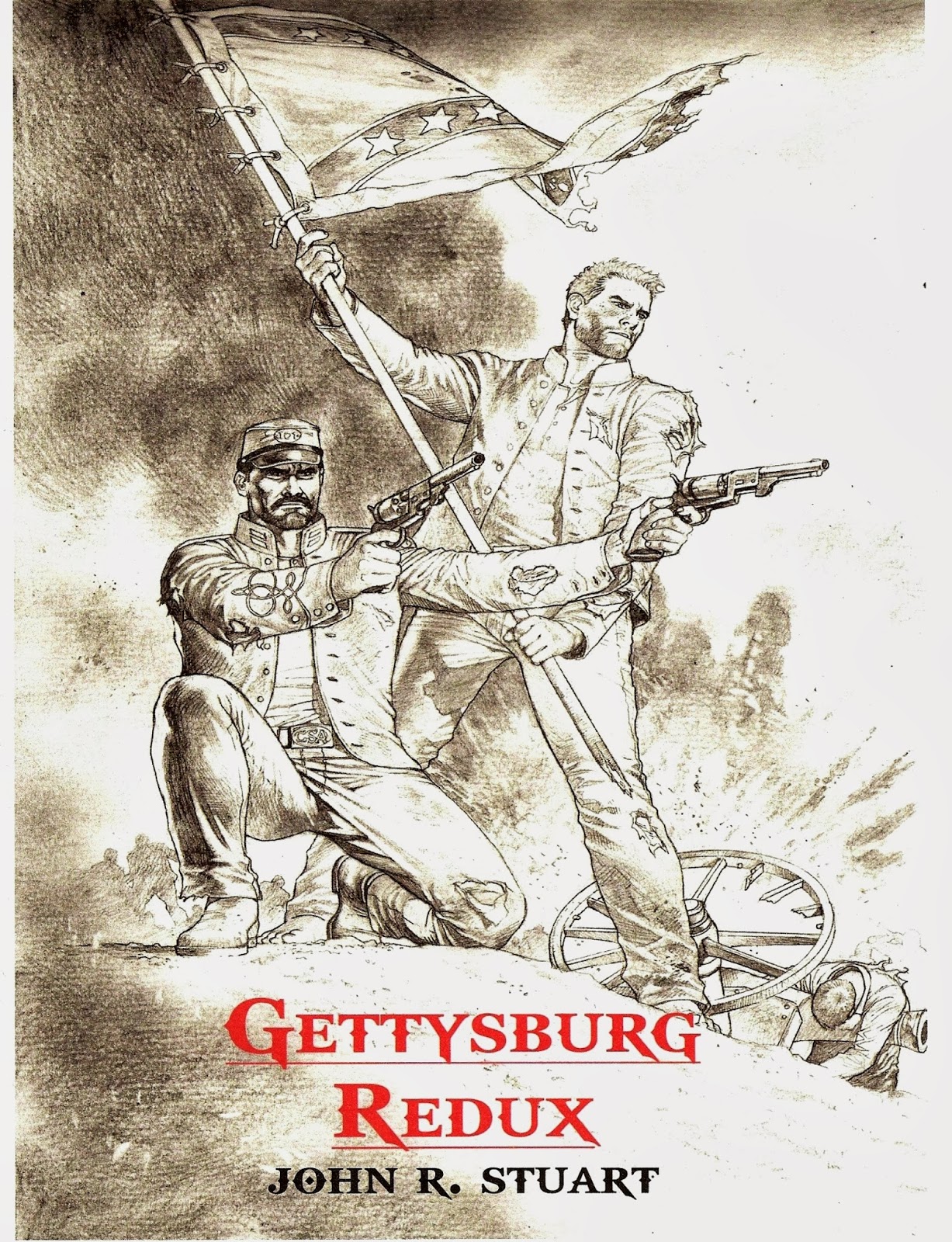
In the first novel of my series Rebel Empire - Gettysburg Redux, I changed the course of history and shifted the command of the Rebel forces to the other key Confederate General- James Longstreet.

As important as Gettysburg, but greatly over looked is the significance of the Métis Red River Rebellion in western Canada in the late 1860’s. This rebellion leads to the formation of the province of Manitoba and the creation of the North West Mounted Police. Had Louis Riel survived the subsequent North-West Rebellion of 1885 the history of Canada would likely have been far different. If the 2nd Métis rebellion had been fruitful I believe the English would have been able to foresee the future inevitable fragmentation of their mighty empire.

Combine the concepts of a Confederate victory in the Civil War and a hostile Métis force still active in Canada you have the premise for my 2nd novel - Rebels & Desperados.

Here is the prologue:

In 1888 a delicate peace exists between the Confederate States of America and the United States of America. To the north Britain has retained by force of arms their control of Canada and the forces of the Métis and the rebels of western Canada continue their battle for independence. Great Britain remains mired in a long drawn out conflict with France which has seen the two counties at war for five years.

Since the C.S.A won their independence in 1863 they have continued to flex their military might and have expanded the Confederacy by their conquest of the northern half of Mexico, now known as the State of South Texas. After the second Slave revolt of 1885 President James Longstreet has issued the Confederate Emancipation Proclamation making slavery illegal in the Confederacy. With the annexation of California in 1870 the Confederate Empire has expanded to both the south and north-west.

The United States of America has assumed a strict stance of Isolationism and its power has shrunken dramatically since the end of the Civil War in 1863. To the north, the Montana and Dakota territories, as well as the war torn Canadian Districts of Alberta and Assiniboia are havens for outlaws, desperados, rebels and renegade Indians. The British Empire has lost the first two rebellions fought against the Métis in Canada and now west of Manitoba they hold only a narrow strip of land thirty miles wide on either side of the Canadian Pacific Railroad. In the north central section of North America the region consisting of Montana, Dakota, Alberta, and Assiniboia are considered to be ‘The Disputed Zone’, often referred to as the Cauldron.

* * *

John R. Stuart is the author of the series REBEL EMPIRE, book 1 - GETTYSBURG REDUX (eBook 2012), and book 2 - REBELS & DESPERADOS (eBook 2013).

Wednesday, October 30, 2013

Shattered Nation: An Alternate History Novel of the American Civil War

Guest post by Jeffrey Brooks.

Excepting perhaps only the Second World War, no event history has generated as much counterfactual speculation as the American Civil War. As we are now moving through the sesquicentennial of the conflict, with battlefields overrun by tourists and reenactors, it's no surprise that alternate historians are yet again focusing on the struggle that tore America apart one hundred and fifty years ago.

Some of the more common points of divergence have been the springboard for successful alternate historical writing. Harry Turtledove created perhaps the most profitable AH series ever written out of the question of what might have happened had Robert E. Lee's Special Order 191 had not been lost during the Maryland Campaign of 1862. More recently, R. E. Thomas has written an interesting and entertaining novel imagining what might have been had Stonewall Jackson not died of the wounds he received at the Battle of Chancellorsville. Many books have focused on how history might have been different had the Confederates won the Battle of Gettysburg or Britain entered the war as a result of the Trent Affair.

My novel - Shattered Nation: An Alternate History Novel of the American Civil War - tackles another popular Civil War point of divergence in imagining a scenario in which Jefferson Davis does not replace Joe Johnston as the commander of the Army of Tennessee during the Atlanta Campaign of 1864.

The considerable majority of Civil War alternate history writing focuses on points of divergence during the first half of the war (i.e. up to the summer of 1863). Conventional wisdom maintains that the South had no chance whatsoever to win the war once they had been defeated at Gettysburg and Vicksburg, if indeed they ever had a chance to win the war at all. I disagree, maintaining that the South's chances for victory were as good, if not better, in 1864 than they had been in 1863. Once the possibility of foreign intervention had been ended by the Emancipation Proclamation, the South had only one way to achieve victory: wear down the North's will to continue the war and persuade them to quit. That, in turn, could only happen in the Northern people kicked the Lincoln administration out and voted in an administration that would make peace. 1864, unlike 1863, was an election year.

In retrospect, we can see that the Confederate armies were melting away from attrition, which would lead to a Southern military collapse in 1865. Yet it must be stressed that this was far from obvious at the time. In 1864, the Army of Northern Virginia was holding the Army of the Potomac at bay and inflicting enormous casualties upon it. Fiascoes like Cold Harbor and the Crater were exposing incompetence in the Northern armies. Jubal Early drove Union forces out of the Shenandoah Valley, came close to capturing Washington itself, and sent a major Union city up in flames. Union attempts to gain control of Florida and Louisiana had ended in disaster and Nathan Bedford Forrest remained undefeated in Mississippi. Morale on the Northern home front was plummeting and, in August, Lincoln himself stated that he was likely to be defeated by the Democratic nominee, George McClellan, in the upcoming election.

It was the capture of Atlanta by William Tecumseh Sherman in early September that turned the tide of the war and, more importantly, the tide of public opinion. That victory, in turn, was made possible because Davis replaced Johnston with the more aggressive John Bell Hood, who proceeded to fight and lose three major battles against Sherman in little more than a week. The South lost more than ten thousand men at a moment when it needed every man it could get. After a month of siege and maneuver, Hood was chased out Atlanta. Lincoln had the military victory he needed to rally public opinion back to his side and coast to a comfortable electoral victory two months later.

Could Johnston have succeeded where Hood had failed? This question has been controversial since the moment Johnston was relieved and it sparked a bitter postwar feud between rival partisans of the two generals, which was as much a dispute between Johnston and Davis and between Johnston and Hood. Some maintain that Johnston, a much more cautious and meticulous commander than Hood, would have avoided the heavy losses Hood sustained and thereby held Atlanta beyond the November election. Others assert that Johnston was too reluctant to fight and would have abandoned Atlanta rather than see his army put at risk.

Some have maintained that, even had the Confederates held Atlanta and had McClellan won the 1864 election, it would not have mattered. After all, McClellan was a War Democrat who repudiated the "peace plank" of the Democratic National Platform immediately after becoming the nominee. But it's worth pointing out that McClellan pledged to continue the war only after he received the news that Atlanta had fallen; had Sherman been defeated and had Atlanta remained in Confederate hands, he might have sung a different tune. Moreover, as the historian Albert Castel points out, the political pressure from the Copperheads to implement a ceasefire with the South would be hard for McClellan to resist and it would have been more or less impossible to resume the war when negotiations had failed (and they would have failed). Even worse for the North, Republicans not not feel that the war was worth fighting under a McClellan administration, since the emancipation of slavery would probably have been dropped as a Union war aim.

Could Johnston have defeated Sherman and held Atlanta? Could a Democratic victory in the 1864 election have lead to Confederate independence? Those are the questions my novel seeks to explore and I hope it represents a worthwhile contribution to alternate history literature.

* * *

Jeffrey Evan Brooks graduated from Texas State University with a double B.A. in history and political science and an M.A. in history. He currently lives in Manor, TX, just outside Austin. In addition to writing, he teaches life skills to students with special needs at Anderson High School in Austin. His website is www.jeffreyevanbrooks.com and he can be reached at jeff at jeffreyevanbrooks dot com.

Wednesday, July 24, 2013

The Andrew Wyly Film Company Acquires Rights to How Few Remain by Harry Turtledove

Here is some great news for alternate historians: the Andrew Wyly Film Company recently acquired the film rights to four books authored by Harry Turtledove: How Few Remain, The Great War: American Front, The Great War: Walk in Hell and The Great War: Breakthroughs. No word yet about the rest of the series or whether the infamous Jake Featherston will make an appearance.

For those who don't know, the series takes place in a very different America starting in 1881 with How Few Remain and ending in 1944 with In at the Death. The events occur in an alternate history where the Confederate States of America didn't lose the American Civil War. The point of divergence happens on September 10, 1862 during the American Civil War when General Robert E. Lee's Special Orders 191, which detailed Lee's plans, are not found by Union soldiers, leading to Confederate victory at the Battle of Antietam (or Sharpsburg in this timeline). Lee goes on to capture Philadelphia, earning the Confederate States of American diplomatic recognition from both Britain and France, thus winning the war (known as the War of Secession, see how much changes because of one forgetful errand boy).

Most of our readers know who Harry "The Master of Alternate History" Turtledove is, but for casual alternate historians should know that Turtledove is an award-winning author credited with bringing alternate history into the mainstream and known for a writing style that has a strong military theme. This blogger personally credits Turtledove for getting him interested in alternate history, an origin story I believe I share with several of you.

Andrew Wyly, the man behind the acquisition, says he is passionate about Turtledove's works due to his interest and background in history. "I'm looking forward to utilizing my skills as both a filmmaker and historian to bring audiences an entertaining twist on American History while maintaining the integrity of the novels," Wyly stated. Andrew, who has a BA in history from Denison University, founded the Andrew Wyly Film Company in 2007. Blood Shot, his first feature film, was completed last year along with his first book, Texas Got It Right! with his father, Sam Wyly.

Wyly is currently meeting with several studios and networks to find the right partner to develop and produce a 10 episode mini-series starting with How Few Remain. You can learn more information at HowFewRemain.com, but this alternate historian is already geeking out about the possibilities. We here at The Update wish Andrew the best of luck.

* * *

Matt Mitrovich is the founder and editor of Alternate History Weekly Update and a blogger on Amazing Stories. His new story "The Enchanted Bean" can be found in Once Upon a Clockwork Tale from Echelon Press. When not writing he works as an attorney, enjoys life with his beautiful wife Alana and prepares for the inevitable zombie apocalypse. You can follow him on Facebook or Twitter.

Wednesday, June 26, 2013

Stonewall Goes West: The Alternate History as Historical Fiction

Guest post by R.E. Thomas.

Stonewall Goes West (on sale for $2.50 from July 1 to July 4, to commemorate Gettysburg, Vicksburg and the 4th of July) is the story of the man who was arguably the Confederacy's greatest military hero, Thomas J. Jackson, surviving his wounding at the Battle of Chancellorsville and going on to lead the South's western armies in the later years of the war against one of the North's great generals, William T. Sherman. Odd as it may appear, the idea behind the book was born out of a moment of annoyance and dissatisfaction.

One day in 2005, I was marking time in a Civil War internet forum before a flight, and for the umpteenth time the idea of Jackson surviving his death at Chancellorsville, going to Gettsyburg, and winning the war there was under discussion. Several problems plague such a scenario, and I discuss some in the introduction of Stonewall Goes West, and others on my blog. But the foremost issue in my mind is how the idea has been so flogged into gelatin over the last century and a half that no approach to it can be both imaginative and realistic.

My solution was to sidestep Gettysburg altogether, and in doing so I stuck closely one of the key rules of alternate history: make your changes small ones. Jackson was severely wounded at the Battle of Chancellorsville, lost his left arm, and died of infection. Yet most soldiers who endured such amputations during the Civil War survived, so in my story Jackson does too, spending the summer of 1863 recuperating in Virginia rather than at a little crossroads town in southeastern Pennsylvania. When Braxton Bragg, the commander of the South's main western army, resigns in late November 1863, Jackson has returned to duty and covered himself with fresh glory at the Battle of Second Kettle Run just the month before. Historically, Confederate Jefferson Davis was so displeased with his options for replacing Bragg that he wrestled with the decision for weeks. If Jackson, by that time a general of worldwide renown, were still alive, his choice would have been almost a no-brainer.

The What If As Historical Fiction

In writing Stonewall Goes West, I aspired to produce a work of alternate history as historical fiction, meaning I wanted to explore real historical issues in telling a fictitious story. In my mind, that contrasts with the alternate history as a work of science fiction or fantasy. With many stories, the alternate history side of things is creating a setting that is both familiar and exotic at the same time, and however detailed that setting might be, it is still just the setting. Nothing is wrong with that approach, but to a large extent the setting might as well be Romulus or Westeros, which also borrow heavily from familiar historical concepts to create a fictional setting.

The point of good historical fiction, on the other hand, is to bring the past alive, explore historical issues, and sometimes also to put the reader inside the personalities of very real people. This is what authors like Colleen McCullough, Bernard Cornwell, and Sharon Kay Penman do, and the "what if" story can do the same thing. Even when an alternate history isn't strictly rooted in the past, it can still explore serious historical issues, as Robert Harris did by setting his detective thriller Fatherland in the Nazi Germany of 1964. One doesn't get that historical value from, say, a drama set in a 1770s world where the Aztec Empire is stronger than ever and encroaching on the 13 Colonies.

Jackson Lives

Stonewall Goes West keeps with that historical fiction spirit by exploring the two aspects of the Civil War that fascinate me most. Virtually every Civil War buff is drawn to the military side of what was the largest war that was ever fought on American soil, and first and foremost the story is a fast-paced, battle-driven thriller. Along the way, I also wanted to explore military issues ranging from the common soldier's experiences to the practicalities of feeding, moving, and directing a large army in the field. I also felt showing all these things to the reader could only help but enhance the historical realism of the story.

Leaving battle, strategy, and technical issues aside, I am also drawn to the colorful array of personalities the war brought to the fore. As I thought through the idea of Stonewall Jackson at the head of the Army of Tennessee, I realized that my fictional mixture brought out possibilities so wonderful that I wanted to read about them, and that is how I came to write it in the first place. The Army of Tennessee was and remains infamous for the poisonous relationships between its generals, and putting Jackson into that situation let me create a new chemistry that solved some problems while creating others, mixing him with friends and enemies both old and new.

In particular, the story allowed me to create an entirely new dynamic to the Civil War in the West. The South's western armies were always the hard luck outfits of the war, burdened with squabbling, second-rate leadership who could sometimes win on the battlefield, but then were forced to retreat despite it. Putting Stonewall Jackson in charge and allowing him to develop a team of (mostly) reliable subordinates from among the western Confederacy's star players let me change all that. Finally, the Army of Tennessee received some of the first team talent it always so richly deserved.

The changes also created an intriguing parallel along the way. If Grant and Lee were the best generals of the North and South respectively, then Jackson and Sherman were the #2's. In my story while Grant and Lee slug it out in Virginia, Sherman and Jackson duel for the fate of the Confederate heartland. Even as Jackson must make Leonidas Polk, Nathan Bedford Forrest, and Patrick Cleburne work for him, across the table is Sherman waiting to match wits with him. And for his part, Sherman has his own cast of helpers and miscreants to manage.

* * *

R.E. Thomas is the Managing Editor of The Whiskey Reviewer, a freelance boxing and travel writer, and holds degrees in history and international relations. He has previously published a book about Port wine, and Stonewall Goes West is his first novel. The book is the first installment in a trilogy, with the sequel Mother Earth, Bloody Ground due out in the late spring/early summer of 2014. You can find Thomas on his whiskey website, his Facebook page, and his blog.

Thursday, May 16, 2013

The Confederat​ion Web Series Kickstarte​r

An intriguing new Kickstarter called The Confederation has caught my attention. It is a proposed web series set during the 1960's in a world where the South won the American Civil War. The story follows a squad of Confederate female snipers fighting in the Cuban War and a group of former slaves. You can check out the trailer here.

The point of divergence for this timeline is the Battle of Puebla in Mexico, May 5th 1862. In our timeline, the Mexicans win the battle, but in The Confederation timeline, the French win the battle, setting off a chain reaction that unintentionally alters the course of the American Civil War. The producers picked Puebla because it had, at least on the face of it, no influential role in the outcome of the American Civil War. They are firm believers in the butterfly effect, which is refreshing.

The producers hope to raise funds in order to produce the first season of the series and they are asking for $50k, which will be used to cover costs involved with creating and distributing the series, including travel and lodging expenses, paying the cast and crew, location fees, advertisements and equipment.

They plan to create at least eight episodes that will be distributed on Blip.tv, which is home to shows like  Red vs Blue. Each episode will be between 10 to 15 minutes long. The series will be in black and white, but will have some items (ex. flags) in color, similar to the style of Robert Rodriguez's Sin City or Gary Ross' Pleasantville.

$50k certainly sounds like an ambitious goal, but I am curious to see this web series get made. With so much alternate history television being made in the UK, it would be nice to watch a show that us Yanks can access. Good luck to the producers and as for the rest of you, go check out their Kickstarter.

* * *

Matt Mitrovich is the founder and editor of Alternate History Weekly Update, a blogger on Amazing Stories and a volunteer editor for Alt Hist magazine. His fiction can be found at Echelon Press, Jake's Monthly and The Were-Traveler. When not writing he works as an attorney, enjoys life with his beautiful wife Alana and prepares for the inevitable zombie apocalypse. You can follow him on Facebook or Twitter.

Tuesday, December 11, 2012

Review: By Force of Arms by Billy Bennett

Guest post by A.J. Nolte.
Let me confess at the outset that I do not like negatively reviewing books. As an aspiring author who has yet to finish my first novel, I always try to give the benefit of the doubt to those who have. Let me also say that By Force of Arms, Billy Bennett's sweeping history of the Second American Civil War that never was, is not an entirely a bad book. All that said, there are a couple of really glaring flaws that will, I think, probably deter a lot of readers from buying the book.

The premise of the book is actually a pretty common starting point for Confederate victory scenarios: the survival of Stonewall Jackson after the Battle of Chancellorsville, his more aggressive actions on the first day of Gettysburg, total Confederate victory in the Battle of Fredericksburg and the intervention of the European countries to push Lincoln to the negotiating table. So far its plausible, and unlike many modern alternate historians, Bennett does not over-estimate the British willingness to lend the Confederates a helping hand. While you see a lot of alternate historians (cough, Turtledove, cough) envisioning a permanent strategic alliance between Britain and the Confederacy, I think this dramatically under-estimates the anti-slavery sentiment of the British public, and over-estimates Britain's willingness to get involved in North American affairs. Britain might go so far as to urge a diplomatic resolution to the conflict to tweak the Americans' tails on the cheap and give them something close to home to worry about, but openly allying with the Confederacy to the extent of actually sending troops to North America just does not seem plausible to me, and Bennett gets this right.

As the story moves forward, we find the north ready for a fight once again in 1869, with Confederate intervention in Mexico as the pretext. I also give Bennett some points here for the way in which he integrates new technologies onto the battlefield. The Gatling gun and breech-loading rifle certainly would have revolutionized warfare, and I doubt generals on either side, whose most recent experience with warfare would have been the Civil War of 1863, would really have understood the changes these new weapons would bring. Finally, on the positive side of the book, I actually found Bennett's characters to be interesting. From Buffalo Soldiers to Confederate scientists, war corespondents to members of the French Foreign Legion, Bennett did a good job inventing credible characters out of whole cloth.

Now, to those flaws I mentioned. First and foremost, this book really, really needed a content editor.  The occasional spelling and grammar mistakes I can live with, although other readers may have a lower pain threshold in this regard. When they occur on a very regular basis, and are combined with basic copy editing mistakes, it can become distracting. For example, part of the scenario rests on the premise that pro-Confederate Ohio congressman Clement Vallandigham wins the 1864 election, and guts the Union army (we'll come back to plausibility in a moment). Yet, later in the book, McClellan is listed as the President elected in 1864. This is probably an editing mistake left over from an earlier draft, but I found it confusing, and distracting.

On the one hand, Vallandigham being elected is fairly implausible. Even when a country loses a war, it does not tend to support those who opposed it. So McClellan's election is more plausible, but less likely to yield the result the author wants. There are a lot of bad things you can say about Little Mac, and I've said most of them, but the one thing I could never see him doing is gutting his beloved Army of the Potomac, which served, not incidentally, as the base of his power in 1864. I actually think the most likely outcome of the 1864 election would be a moderate, pro-war Democrat winning, maybe Dan Sickles for example if he performed well at Gettysburg, or a less radical Republican like William Seward taking the helm.

This leads me to the second, and in my view, most major flaw with By Force of Arms. I excluded several characters from my positive description above, and that was deliberate. Like the scenario itself, I am not sure the actions of Bennett's real historical people are actually plausible, and I think this owes something to the author's pro-Confederate slant. Let me clarify this point a bit. Bennett makes a conscience effort not to sugar-coat the racism throughout Confederate society, and one certainly doesn't get the impression that he thinks a victorious Confederacy would have been a utopia. I do think, however, he sees a pro-union bias in much of the American Civil War alternate history out there, and in trying to balance this, over-corrects. As a result, major portions of the book just don't pass the plausibility test for me.

I recognize this is sort of a hard line to draw with alternate history, and I also confess I'm a good bit more sympathetic to the Union than the Confederacy, and certainly more sympathetic to it than the author, so this may color my judgment. Nevertheless, it seems to me that all the major Union politicians and generals make horrible decisions which also happen to be out of character. Let's begin with the first union actor which does things that make no sense: the general electorate. Certainly, I can understand the desire to pick a war hero after the humiliation of defeat and, equally importantly, the economic and political weakness of the Vallandigham administration. Picking William T. Sherman, however, seems to have more to do with the author's desire to portray the U.S. President as a cartoon villain, complete with conspiratorial meetings with New York financiers and broad expansions of executive power. There are a host of staunchly anti-Confederate figures who would have made sense as victors in the 1868 election: Thaddeus Stephens, Charles Sumner, or generals such as John C. Fremont. However, the idea of a subordinate commander in the western theater who, as of 1863, hadn't earned the controversial notoriety he did during the 1864 campaign, steam-rolling his way into the White House is a little far-fetched.

This pales in comparison to the other bad decisions Union characters make in this book, seemingly without reason. Take the most egregious example: U.S. Grant, who is quite logically put in charge of the whole war effort, decides to concentrate the entire Union army into one massive hammer attacking Virginia. Sure, Grant believed in Union victory by attrition, and took personal command of the OTL force in the east. I could certainly see him doing something similar in a second Civil War scenario. However, the idea that he would simply allow the Confederates a free shot at California and basically ignore the  the western theater—where he spent the vast majority of his  military career including his service in the Civil War, is a little hard to swallow.

In addition to the often baffling decisions of Union generals, the Confederates never make any mistakes. Bennett doesn't account for "victory disease", the well-established phenomenon that winning armies often get over-confident and over-extended. Additionally, it tends to be the case that armies which lose wars have a better record of rapidly adopting innovations than armies that win. Add all this to the very traditional military culture of southern officers at the time, and it seems to me the Confederates adapt too quickly, and adopt new technologies far too readily, while the Union generals talk about lessons from the last war, but command with about the level of competence they showed in 1862.

On the whole, then, I thought the premise of By Force of Arms was interesting and decently plausible, the characters were good and the description of changes in warfare was well thought-out. For me, though, the book was just too badly-edited and unabashedly pro-Confederate. A more balanced perspective with the editing problems of this book, or a pro-Confederate narrative without some of the serious editing issues, would have probably gotten a better review. As it is, I think if a dash of "lost cause" fiction is your thing, you might be able to overlook some of the editing and content issues. Mr. Bennett is an author who shows some promise at imagining alternate impacts to alternate history scenarios. Unlike the Union army of his books, I hope his next offering will be able to overcome some of the weaknesses of this book.

* * *

A.J. Nolte is a PHD candidate in international relations at Catholic University and an aspiring sci-fi and alternate history writer . He is knowledgeable in Byzantine, medieval, ACW, Cold War, Islamic and post-colonial history. Also, he'll read almost anything once if it's got an airship in it.

Wednesday, October 10, 2012

Review: Clementine by Cherie Priest

Guest post by Matthew W. Quinn.
It’s Matthew W. Quinn again, and I’ve got another review for you. It’s Cherie Priest’s Clementine.

Set in Priest’s Clockwork Century universe, the novel tells the tale of former Confederate spy Maria Isabella “Belle” Boyd who finds herself in the employ of the famous (or infamous) Pinkerton National Detective Agency in Chicago.

For starters the novel, published by Subterranean Press, is a quick read. It’s exactly 201 pages. I’m surprised there was even a hardback edition issued it’s so short, but then again, it is written by Priest, one of if not the major author of steampunk. Although the short length precludes subplots and lots of depth, many readers won’t mind.

Secondly, the novel starts out with a bang. Air pirate and escaped slave Croggon Beauregard Hainey is chasing after his airship, which has been stolen from him, in another (stolen) airship. No boring expository beginning here, but straight to the fun.

I also liked how each chapter begins with the name of the main character, be it Hainey or Boyd. And when the characters meet, there’s a bit of humor. Chapter Eight, for example, is titled “Our Players are Compelled to Collaborate.” I actually laughed upon seeing it.

The novel also introduces some interesting concepts, including a tiny dirigible-like flyer that carries two people. It fulfills the function of a personal plane or helicopter in a time where the technology for such things isn’t available. I like it.

There’s not a whole lot that’s bad about the book. I’d like some more information about how the superweapon that becomes a major part of the plot later on is supposed to work. A weapon of its nature would need line of sight to devastate an enemy city — we’re not talking a conventional artillery piece like Gerald Bull’s “Project Babylon” (the unfinished “Super Gun” of Gulf War fame) that could attack enemy targets from safe positions here. Also, the book jacket implies Boyd has to collaborate with Hainey, whom she is hunting, when there’s some kind of betrayal. That’s not how it goes down, although that’s not really much of a problem.

Also, I’d have liked some more thoughtfulness on the part of both Hainey and Boyd. The former is an escaped slave, but most of his targets are in the Union states (where it’s easier for a black man to move about), never mind that the state that whipped and imprisoned him is the Union’s enemy. Meanwhile, Boyd has to make decisions about loyalties, most importantly in a scene very late in the book where one might think she’s seriously conflicted. Although too much of this would go against the short and sweet nature of the book, a few extra paragraphs might help.

Overall, Clementine is a quick and fun read. 8.5 out of 10.

Thursday, September 20, 2012

Interview: Roger L. Ransom

I present my interview with Roger L. Ransom, author of The Confederate States of America: What Might Have Been?:

Can you tell us a bit about yourself?

I was born in Berkeley, California in the fall of 1938 and spent my early years moving back and forth between California and New Jersey – with a brief stop in England right after World War II.  At an early age I developed an avid interest in history – particularly military history.   While in England I started a collection of lead soldiers – a hobby that I still pursue today by building little models to fight in games of Warhammer 40K with my grandsons.

I graduated from Reed College in 1959 with a BA in economics.  Unable to decide what to do next, I decided to enter the graduate economics program at the University of Washington, where I discovered that I could combine my long time interest in history with a more recently acquired taste in economic theory.  After teaching economics for four years at the University of Virginia, I headed back to California in the fall of 1967 with my Wife, Connie and our two girls.  I spent a year visiting at the University of California before accepting a position as an associate professor of economics at the University of California Riverside.

While I was at Berkeley Richard Sutch and I established the Southern Economic History Project; an enterprise eventually led to the publication of One Kind of Freedom – a book about emancipation and the postbellum South that was well received and is still on many reading lists for courses on Reconstruction.  My collaboration with Richard continued for the next three decades with articles on savings, retirement, and the labor force in the 19th century.

In 1984 I moved from the economics department to the History Department at UCR; a change that got me teaching courses on the Civil War and eventually World War I.  My research focus over past two and a half decades has increasingly focused on an effort to make sense of war.  I won’t venture to say how successful these efforts have been; the visible results of my studies can be found in the articles and two books that I have written since 1985.

It has been my great fortune to be able to do something that I really love to do: teach and write about a subject that I think is an essential part of the human experience from earliest times to the present.  History is the study of past events that have shaped the present and will shape the future, and how societies meet the problem posed by wars and economic change are at the very heart of what we call the emergence of the modern world.

What got you interested in counterfactuals?

My interest in counterfactual analysis stems from a natural curiosity that I think is shared by virtually everyone who wonders “what if” things worked out differently.  My curiosity was further peaked as I encountered the ways in which economists tried to test robustness of their theoretical “models” or “hypotheses” by applying under several different sets of circumstances to the outcome of their analysis.  Quantitative economic history – or Cliometrics as it is now called – is sometimes described as “predicting the past with ever greater precision.”  If you think about it, that’s not much different from predicting the future – though the precision in the results tends to fall off when you lose the advantage of 20-20 hindsight.

My first effort at counterfactual economic history was my PhD thesis, which asked how much difference the Ohio Canal made to economic growth in the period 1820-1850.  The analysis imagined what the economy of Eastern Ohio at that time would have looked like without the Ohio Canal.  I concluded that the canal did make a big enough difference over a couple of decades to consider them a successful investment by the state, even though the introduction of railroads in the 1850s greatly reduced the reliance on canals over the next half century.

Since that first effort, counterfactual analysis has played some sort of a role in most of my research, particularly my work on war and economics.  In 1998 I decided to finally tackle the one counterfactual problem that always fascinated me, but always seemed too big to tackle: What if the South won the Civil War?  My efforts led to the publication in 2005 of The Confederate States of America: What Might Have Been?.  Looking back over my years of work, this book has in many ways been the most satisfying research effort of my career.  It certainly was the most fun!

Do you feel counterfactuals can be useful in the classroom?

I used counterfactual references all the time in my class, but I was careful to warn my students that this is an approach that must be used with caution.  My view of counterfactual history is that to be useful as a teaching tool it must be based on a solid understanding of the “real” facts before you begin imagining what “might have been”. In The Confederate States of America I presented a “menu” that advised writers to make their counterfactual story two parts historical reality; one part commonsense, and one part imagination. Despite this warning, I find that students who try their hand at counterfactual exercises tend to let their imagination get out of hand and go off the deep end in constructing “alternative worlds”.   A fundamental problem facing writers of counterfactual history is that you can never prove or disprove a statement about events that never actually happened.  As a critic of one of my earlier efforts pointed out, “counterfactual history is rather like hunting dragons; you can’t catch them because they don’t exist!”

That said raising counterfactual questions about what might have been is an effective way of getting students to think about the problem we are studying.  The issue of whether or not the South could have won the Civil War has dominated American historians’ approach to the conflict ever since Jubal Early insisted that they could not have won (even if, as he thought, they should have)!  Teaching the Civil War offers unlimited opportunities to spring such questions.  I do so primarily to dispel any notion my students may have that history is destined to follow some predetermined path.  My own iron law of history is “Remember, things could have been different!”

Can you give us an example of a student letting their counterfactual get out of hand?

I have seldom encouraged my students to undertake counterfactual assignments.  I did assign a paper in a undergraduate senior seminar several years ago when I had just finished a draft of the CSA book.  I gave my students MS copies of all the chapters except the last -- and told them to give me ideas for the final chapter to the book.  Most of the responses were pretty tame, but one that stood out was by a Poli Sci major who wrote a brilliant counterfactual analysis arguing that because the CSA Judicial system was very weak, it was likely that the CSA would become a evolve into a one-party system.  It was a bit of a stretch, but very well done.  Another student worked his story to World War I and had the Germans attack the Panama Canal to touch off the war.  Most of my students took my warnings about carrying things too far seriously and were very cautious.

What is The Confederate States of America about?

When I set out to write the book I laid out three broad objectives.  The first was to make one last attempt to explain why war – which is always the worst way to resolve political crises – turned out to be the only way to resolve the conflict between the states.  My answer was that the economic issues surrounding the slave question trumped any attempts at peaceful solutions.  [Chapter 1].  Next, I wanted to settle the question of whether or not the South could have won the war.  After reviewing the events of the war, my answer was that the South certainly could have won – but the odds certainly favored a Northern victory.  [Chapters 2 & 3]  Finally, I wanted to offer my conjecture of what the world would have been like if the South had won the war.  Based on what I had learned, my answer was that it would not have been a good thing for any Americans – and particularly not for African-Americans – if the Confederacy had won.  [Chapters 4 & 5]

What inspired you to write your counterfactual history?

The first time I remember seriously thinking about the consequences of a Southern victory in the Civil War was in 1953, when I read a novel by Ward Moore titled Bring the Jubilee.  The story involved sending someone back in time who inadvertently changed the outcome at Gettysburg and led to a Confederate victory.  Moore imagined a prosperous CSA that extended into Latin America while the USA languished after the defeat.  That outcome puzzled me, since in the 1950s most the antebellum South was hardly viewed as a monolithic economic and political force that could eventually rule all of South America.  A few years later I came across McKinlay Kantor’s book, If the South Had Won the Civil War.  Kantor’s book was part of the Civil War Centennial Commemoration, and he imagined that the U.S. and the C.S.A. had cooperated with each other after the dust of the Civil War had finally settled to win two world wars and were on the verge of a peaceful re-union in 1960.  This was certainly a fitting theme for the centennial commemoration, but I found it a bit of a stretch to believe that things could have gone that smoothly.

When I started teaching Civil War in the 1980s I revisited my thoughts on a Confederate victory.  I was struck by the fact that although there were many essays outlining how the South could have won enough battles to be victorious in the war, no one since Kantor had bothered to explore the further implications of that victory.  In 1997 Harry Turtledove’s book, How Few Remain: A Novel of the Second War Between the States told an independent South that had won the Civil War, fought and won a second war with the North.  How Few Remain was the first in a series of counterfactual accounts written by Turtledove that traced the path of an independent CSA from 1865 to the end of a counterfactual account of World War II.

The counterfactual world depicted in Turtledove’s novels was a far cry from that put forward by either MacKinlay Kantor or Ward Moore.  I decided the time had come for me to seriously consider the question of what might have happened had the South won the Civil War.  In 1999 "Fact and Counterfact: The 'Second American Revolution' Revisited," appeared in Civil War History and presented the outline for the story I eventually fleshed out in The Confederate States of America.

What sources were particularly helpful when researching for the novel?

By the time I started my book, I had already researched and published my ideas on slavery, the war, and the consequences of emancipation.  One of the nice things about counterfactual history is that since you are making up a story, you do not need sources for the portion of the book dealing with the years following the Southern victory.  However, I did need to come up with a plausible story for a Southern Victory.  The area of research that proved most fruitful for me was the vast literature dealing with why the South lost the war.   By examining the reasons cited by historians explaining South’s defeat I was able to pinpoint some turning points when things could have gone better for Southern hopes.

My counterfactual story of what might have been was based on four factors that were consistently cited as reasons for the Confederate defeat:

1] The South lost the three most important battles in the war: Shiloh, Antietam and, of course Gettysburg.  Clearly, all of these conflicts must turn more favorably for the South if they are to gain their independence.

2] Time was not on the side of the South.  Lee could not keep winning victories forever, and it is interesting to note that recent essays dealing with the prospect of a Southern victory have moved the focus from Gettysburg to Lee’s 1862 invasion of Maryland that ended with the battle of Antietam as the turning point that won the war.

3] Whatever the course of events on the battlefield, Lincoln had to be defeated in 1864.  Lincoln was the backbone of the Union War effort.  His unwillingness to compromise on the issue of slavery as a means of reaching agreement to end the war was a key element prolonging the war to a point where Northern economic and military strength could eventually prevail.

4] The South might also have fared better if key generals had not been killed fairly early in the war.  More than a few Southern historians have lamented the death of Albert Sydney Johnston at Shiloh and Stonewall Jackson at Antietam.  One of the more interesting elements of McKinlay Kantor’s account of a Northern victory was the demise of both Grant and Sherman at or shortly after Shiloh.

I learned from historians who pointed out all of these points. The final conclusion I drew from this research was that no single battle or event would be sufficient to change the outcome – but a series of early setbacks to Union hopes might at least make a Southern victory plausible.

In your novel you have the Confederacy defeated and annexed back into the United States following an alternate World War I. How would the former Confederacy deal with being once again part of the United States?

One of the most difficult tasks writing about counterfactual world is know when to end your story.  It is, as someone once commented to me, “sort of like learning how to spell banana – you don’t know when to stop.”  At some point your story will have lost touch with “what actually happened” and you are simply making up whatever comes to mind.  Imagination has replaced reality.  I had decided early on in my writing project that I would stop my story at the First World War – which I believe would probably have happened whoever won the Civil War.  Like Harry Turtledove, I believe that the USA and the CSA would both have been drawn into the global conflict at the outset of war in Europe.  For the U.SA and C.S.A. it would have been the equivalent of a Third Civil War.  Rather than try to re-invent that war, I chose to cut to the chase and simply declare the United States and its ally Germany would be victorious.  My epilogue (which I confess was something of a reluctant afterthought) imagines a situation where in return for peace the C.S.A. agrees to some degree of United States sovereignty over Confederate territory.

I deliberately refrained from spelling out the details of this reunion because frankly, I seriously doubt that the reintegration of all or part of the CSA could have gone smoothly if the South lost a war to the North in 1918.  Military defeat seldom dampens nationalistic spirit of the vanquished people, though it may force them to retreat from active political action for a while.  Judging by the events that we know from the historical record of Reconstruction following Lee’s surrender in 1865, I would hardly expect that the Confederates Nationalists would be receptive to Union forces appearing in the South following a defeat in 1918.

That is why I have been telling my audiences that losing the Civil War is the best thing that ever happened to the South.  Against their will they were tied to one of the greatest engines of economic growth the world has ever seen, and although it took a while, they eventually profited from that growth.  I have argued for years that the American South of today is a far better place to be – particularly for African Americans that any plausible world where the South won the Civil War

Do you believe the Confederacy would have been unable to survive to the present day?

I paint a rather dark picture of the CSA’s future in my book, but I certainly would not go so far as saying that the Confederacy could not have survived.  Of course it could.  A victorious Confederacy would not be the picture of gloom and dejection that we know from a prostrate South after defeat in the Civil War.   The South in 1860 was one of the wealthiest nations in the world according to our traditional measure of per capita gross national product.  The war did not remove all that wealth.

To be sure, in my world following the end of the war I make it clear that they would have a hard task ahead of them.  Several things might help the C.S.A. economy to prosper.  First, and most important, Southerners would eventually emancipate their slaves.  In my book, I argue this would come sooner, not later because of the collapse of the world cotton market.  I should point out that I am not alone in this suggestion; indeed the idea that the South would probably have emancipated their slaves even without a war has gains considerable currency of late.  In my book I explain the politics and economics that might make emancipation feasible – one of which was breaking free from the United States.  The other thing that would have helped Southerners recover from the war would be a political and economic alliance with England and probably France.  Over time this would change the shape of politics and economic arrangement throughout the Americas, and the demise of the Monroe Doctrine would allow Confederates and their European Allies to establish a colonial hegemony over Latin and South America that was precluded so long as the United States remained united.

American Civil War alternate histories are very popular.  Why do you think that is?

I’m not sure I know the answer to this.  Let me put forward a couple of possible factors for its popularity.

I think the popularity of Civil War histories – of any kind -- is a reflection of the fact that this war was the single historical event that defines the United States we live in today.  In his Gettysburg Address Lincoln managed to summarize the meaning and importance of the war as well as anyone before or since.   It was a test of whether or not the American System of government could survive and Gettysburg is seen by both sides of the conflict as the decisive battle of the war.  Simplistic as this may sound, the Union victory at Gettysburg has always had a powerful grip on people’s imagination in both the North and South, and as everyone knows by now, that battle was much closer than the debacle of Pickett’s charge suggests.  Lee was gambling everything on one last victory and he nearly got it.  People can’t resist speculating what a victory might have produced.

Another factor explaining why the Civil War is so popular with alternative historians is that a counterfactual Civil War makes for a great story precisely because it can turn on a single great battle that could (at least in their imagination) decide it all.   The American Civil War was the last major war where this would be the case.  By the end of the nineteenth century warfare had evolved into a situation where there were no “battles”; there were offensives that lasted not days, but weeks or months. Making alternative scenarios for these wars is tough sledding.  Gettysburg was the largest battle fought in the Civil War and it lasted only three days.  Shiloh took two days and Antietam took only a day.  Each of these battles was decisive enough for the outcome to have a huge impact in an important war.  Battles like the Somme, Verdun, or Stalingrad lasted for months.

Finally, I think Civil War battles gain so much counterfactual attention because the Confederate Rebels are such valiant, lovable losers and people want to find ways that they could win.  Who could not root for Robert E. Lee and his gritty veterans as they cross the Potomac and march north through Pennsylvania…only to meet defeat at Gettysburg?  Who could not root for Stonewall Jackson and his weary troops tramping through the brush at Chancellorsville to rout the right wing of an army twice as large as their own … only to see their general killed at day’s end?  And so on.  Thanks to Lee’s spectacular feats with the Army of Northern Virginia and a century and a half of cheers from advocates of the “Lost Cause,” the eastern theater of the American Civil War has become the premier theater of military counterfactual historians.

Of course, I may be exaggerating all this, but I remember growing up as a kid in New Jersey reading about the exploits of Lee and wondering how on earth could the South have lost the war with that guy on its side?  I know the answer to that question now, but I am still intrigued by how close it was.

A new book is going around suggesting that the South should be allowed to secede. Do you feel that the political differences today between the north and south are serious enough that secession should be considered again?

I probably should duck this question because I think that anyone who asks it already has their own answer firmly in place and nothing I say will change their views.

Secession in 1860 was all about slavery – the “rights” Southern States were fighting for all be reduced to the “right” to own slaves.  There were other issues, to be sure, but as I liked to remind my students, “Slavery may not be the only thing that matters here, but it is way, way ahead of whatever is in second place.”  Simply put, Southerners were fighting to protect their property – and roughly half that property was tied up in the value of slaves.  There is no issue today that remotely approaches the scale of the slave problem in the middle of the 19th century.

If it did nothing else, the American Civil War abolished the legal institution slavery, and no attempt has been made to reinstate it as a legal form of chattel labor.  Emancipating the slaves did not solve our race problem, nor did it provide anything close to equality for black Americans.  But it removed the single most important cause for fighting the Civil War.  The war also made a sufficiently strong statement about secession that no state has seen fit to try it again.  (There were two feeble tries prior to 1860; one by the New England States during the War of 1812, and one by South Carolina in 1833 over the right to nullify Federal Laws.)

As for the divisions in 21st century America, I don’t see any set of issues dividing America today that could be so clearly compartmentalized into geographic areas that should or should not secede.  The political, economic and social differences produced by slavery in the middle of the 19th century could be easily defined by the presence or absence of slave property.  Even if the divisions among us today were strong enough and the boundaries clear enough, would secession resolve any of the underlying issues?  Succession did not resolve any of the problems in 1860; it only led to the bloodiest war in American history.

A final thought would be to ask if secession for the U.S. today would be any better than the threatened disintegration of the European Union is for Europeans today.  I doubt it.

I could go on at some length, but I think the point is made.

Who designed the cover?

The cover design was managed by W.W. Norton.  I like it, but I had no input on the design.

Do you have any other projects you are working on?

I have cut my workload back since I retired from UCR in 2008.  I am currently working on an essay and bibliography dealing with the costs and consequences of the Civil War.  My larger research efforts are on a book manuscript that is tentatively titled “Confidence, Fear and a Propensity to Gamble: War and economics in the Twentieth Century”.  The book will focus on the period between the outbreak of war in 1914 through the Great Depression and the end of World War II.

For more on my current stuff see my website or you can contact me at clioscribbler at gmail dot com.

What are you reading now?

I am currently reviewing a long list of readings that will wind up the bibliography of my essays on costs and consequences of the Civil War.  One of my more serious readings at the moment is Daniel Kahneman’s Thinking, Fast and Slow.  I had hoped that it would show me how to think faster, but alas, that does not seem to be the case.  It has, however, given me a good deal of thought about “prospect theory” and the causes of war.

Do you have advice for would-be authors?

Though I know the value of research, I have always thought that what makes a book “great” – or not – is the idea that spawned it in the first place.  To that end, I tell would-be authors that the surest way to produce a good book is to start with a really good title. The title serves to remind you what you are supposed to be writing about.  When you find yourself wandering off on tangents – as you inevitably will when writing history – the title reminds you to get back on track.

My other piece of advice is that you have to believe in what you are writing.  Years ago William Parker, a well-known economic historian, was introducing my mentor at UW to a group of colleagues.  “Douglass North,” he said, “has never deigned to answer any of his critics because he is too busy leaping to his next great mistake”.  Each time I get some doubts about my how my current work is going, I remember Parker’s comment and say to myself: “Well, I guess it is time leap to my next great mistake.”  You need to have the courage to do be like Dough North.  After all how will anyone know it is a mistake if you don’t leap?

One final thought: Douglass North won the Nobel Prize in Economics in 1993.