Showing posts with label 5 Years. Show all posts

Thursday, June 30, 2016

How to Write a Realistic Atompunk Timeline

Guest post by Mark Appleton.

Atompunk is a subgenre of science fiction.   The simplest way to describe it is that atompunk is to Asimov and the 1950's as steampunk is to Verne and the 19th century: a retrofuturism inspired by the dreams and fears of the early Cold War.   Like steampunk, atompunk is not so much about content as it is about style: chrome, jumpsuits, fins, rockets, flying cars, monsters mutated by atomic testing.   The world is powered by atomic energy, computers are the size of houses, and the moon is this year's hot vacation destination.

Unfortunately, atompunk hasn't enjoyed as much success (yet) as its steam-powered cousin.   The quintessential modern exemplar is the Fallout series, and the Venture Brothers cartoons sometimes venture into atompunk territory, but for other examples we mostly have to go back to the '50s and '60s: the novels of Asimov and Heinlein, the Tom Swift Jr. young adult books, and the original Star Trek series.

The common belief is that atompunk is, in retrospect, implausible.   Space travel and atomic energy are a lot harder, and a lot more expensive, then they seemed in 1950s pulp science fiction, and by this point it's pretty clear that Mars is not home to green-skinned space babes eager to meet some Intrepid Explorers.   Technology gave us iPods and the internet instead of moon colonies and atomic cars.

That perception is not totally wrong – radiation causes cancer, not gigantism – but it's not totally right, either.   Something close to the classical atompunk world is not impossible – it's not a likely outcome of the last seventy years of history, but it's not impossible.   And I'm here to tell you how it could have happened, at least in fiction: how to write a technically realistic atompunk timeline.   I'm going to tell you about atomic-powered airplanes, atomic excavation, cheap atomic power, and more about radiation then you ever wanted to know.

Buckle in, folks.

Aesthetics

Let's start with the easy stuff: the look.   Like I said, a lot of atompunk is about style: a car with giant chrome fins and a bubble canopy is pretty atompunk even if it burns gasoline instead of uranium.   And that sort of thing is at the whimsy of trends which could easily have run in an atompunk direction.   Dress everybody up in jumpsuits and goggles, make everything out of aluminum, and periodically pause to stare towards the rising sun with your chin jutting out: this will take you a long way towards your goal.

Also, consider language.   You can capture a lot of style by using deliberately archaic word choices from the 1950s.   A computer is a “logic”.   A satellite is a “sputnik”.   A nuclear-powered submarine or ship is an “A-sub” or “A-ship.”   And don't ever say nuclear: always say “atomic.”   Proper attention to language – making your story sound like it comes from the 1950s – will help a lot to make your reader feel like it's from the 1950s, or at least the future as the 1950s imagined it.

Radiation

But like I said, that's the easy stuff.   Now let's talk about the hard stuff, and let's begin in the obvious place: radiation.   The conventional wisdom is that the discovery of radiation, and the fact that it's bad for you, is why the 747 isn't powered by an atomic engine.   This conventional wisdom is not exactly wrong, but the full truth is a lot more complicated then most people think.

Most of what we know about how radiation effects human health comes from studying the victims of the Hiroshima and Nagasaki bombings.   Because the vast majority of radiation produced by the bombs was produced all at once at a single point, we can calculate how much radiation each victim was exposed to, based on where they were when the bombs went off.   By comparing the radiation exposure to the victims' medical histories, we get a pretty good idea of what happens to someone when they are exposed to a lot of radiation all at once.

For this article, I'm going to use millisieverts (mSv) as the measure of radiation.   In the data from the bombing victims, we begin to see people suffering radiation sickness above 1,000 milliSieverts (mSv) exposure, and we see an increase in cancer risk above 100 mSv exposure, at a rate of about 1% per 100 mSv.   So someone exposed to 300 mSv has a 3% increase in cancer risk, 600 mSv means 6%, etc.   Since roughly the mid-70s, we have assumed that we can extrapolate the risk downwards: so 10 mSv exposure means a 0.1% increase in cancer risk, etcetera.   We have also assumed that the rate of exposure doesn't make a difference to cancer risk: absorbing 100 mSv in a second is the same as absorbing it over a year.    This is based on the simple assumption that cancer risk is caused by DNA damage, and the amount of damage is directly proportional to the amount of ionizing radiation you absorb.   This is called the Linear No-Threshold hypothesis, or LNT.

But we don't actually know that LNT is correct.   Below 100 mSv exposure, we cannot distinguish an increase in cancer risk from the random fluctuations found in any statistical data.   And we know the body does have mechanisms for repairing DNA damage.   There's an alternative hypothesis, usually called Linear Threshold or LT, that there's some threshold of radiation dose where the body can handle the radiation without an increase in your cancer risk.   What the threshold is depends on who you ask, but it's usually estimated at somewhere between 10 mSv and 50 mSv.   And the more time the dose is spread out over, the higher the threshold.

The reason this matters is that, in a radiation accident like Chernobyl or Fukushima, the vast majority of victims will be exposed to very small doses of radiation spread out over a very long period of time.   In a reactor accident, very few people will be exposed to a radiation dose of more than 50 mSv, and it will be delivered over weeks or months.   Even under the LNT hypothesis, the individual risk is very low – but many thousands or millions of people will be exposed to that risk.   If you expose a million people to a 10 mSv dose, and the LNT hypothesis is correct, then 1,000,000 times 0.1% equals 1,000 people will get cancer, and about half will die of it.   That's why atomic technology is regulated so tightly – the individual risks are very small, but the collective risks can be very large.

But this assumes LNT is correct. If the LT hypothesis is right, and you expose a million people to 10 mSv of radiation, then the result will be: absolutely nothing.   But, right now, there's really no way to tell which hypothesis is correct.   There are no reliable studies of how many people died as a result of Chernobyl or Fukushima based on actual death statistics – the numbers thrown around are based on estimating radiation doses, and then using your choice of hypothesis to translate those doses into numbers of deaths.   Except for a small number of people at Chernobyl who worked in the reactor zone itself and were exposed to massive radiation doses, the variations in cancer incidence are so small that epidemiologists cannot distinguish them from random noise.   That doesn't mean that Fukushima or Chernobyl didn't kill people, just that – except for those few at Chernobyl – we can't prove that they did.   The only real hope of definitively resolving the controversy is by developing a better understanding of cellular biology, of how DNA damage and repair works in the body, and that is not going to happen in the near future.

In the meantime, Western regulatory agencies are sticking with the LNT hypothesis out of an abundance of caution.   And, in the real world, I think that is the right decision.   If we regulate based on LNT, and we're wrong, then we've wasted a lot of money.   If we regulate based on LT, and we're wrong, then people die.

But we're not talking about the real world.   We're talking about fiction.   In fiction, we can make whatever assumptions we want.   And if we assume the LT hypothesis is true, then a reactor meltdown is just an industrial accident – it's not a good thing, but it's no worse then any other accident involving toxic chemicals.   And this is the key to making an atompunk world possible.

And a lot of the wild atomic technology imagined in the '50s really is viable if we make that assumption.   Electricity from fission really can be cheap.   Atomic-powered airplanes and spaceships really can be safe and practical.   We really can dig canals with hydrogen bombs.   Some things still aren't feasible, and there are still question marks attached to some of these ideas that have nothing to do with safety or economics.   But a lot of seemingly crazy things suddenly become good ideas.

The A-Plane

The first of these technologies I'd like to talk about is the atomic-powered airplane, which is even cooler then it sounds.   I'm going to call it the A-plane, by analogy to the A-bomb, because I think it sounds cooler that way.   Even in our own world, the Aircraft Nuclear Propulsion (ANP) program was an enormous undertaking.   It lasted fifteen years, from 1946 to 1961, and cost the equivalent of about $20 billion in today's money.   The goal was to build an atomic-powered bomber, able to remain aloft for weeks.

Today, at first glance, the idea seems insane.   What if the thing crashes?   But this is where the distinction between LNT and LT comes in.   Under the LT hypothesis, if an A-plane crashes, only the immediate area around the crash site is going to have to worry about radioactive contamination.   Again, under the LT hypothesis, a radiation accident is just an industrial accident like any other: not good, but not a major catastrophe.   And since, in the '50s, the atomic energy community was tacitly or explicitly operating under the LT hypothesis, that's why they were willing to pursue this concept.
The Air Force and Atomic Energy Commission studied two approaches: the direct cycle, in which air from the jet intake passes directly through the reactor, and the indirect cycle, in which heat from the reactor is carried by molten metal or pressurized gas to a heat exchange in the jet.   The direct cycle had the advantage of relative simplicity, and came closest to flying – several prototype direct-cycle turbojets were static-tested at the National Reactor Test Station in Idaho.   The indirect cycle had the potential for higher performance: a sodium- or gas-cooled reactor could be smaller then an air-cooled reactor, and therefore have a higher thrust/weight ratio.

And the thrust/weight ratio was very important.   One of the big problems with the ANP program was that, even if you count the fuel in a conventional turbojet as part of the “engine”, an atomic engine is usually going to weigh more then a conventional engine and produce less thrust.   By the end of the program, ANP knew how to build an atomic-powered airplane, but that airplane would have been big, expensive, and slow – not what you'd want penetrating Soviet airspace.   A big part of the problem was that the Air Force could never make up its mind whether or not they really wanted the plane – they were perpetually ramping up and cutting back funding, shifting into crash priority mode and then downscaling to feasibility studies.
But, while the A-plane wouldn't make a good bomber, there are other roles it could be very effective in.   For example, an A-plane could be a very effective missile carrier: it could remain airborne for long periods, and therefore immune to a Soviet first strike, and launch its payload from outside of Soviet airspace.   After the initial exchange, it could also perform follow-up reconnaissance and strikes, after the fuel supplies of conventional aircraft had been exhausted.   ANP engineers did suggest this idea during the program, which they called the CAMAL – a rather awkward acronym allegedly standing for “Continuous Airborne Alert Missile Launcher and Low-Level Penetration Airplane”.   But the Pentagon wasn't interested.

Let's suppose that the Pentagon provides reliable support for the A-plane instead of our own timeline's oscillation.   This could be accomplished by just changing Eisenhower's Secretary of Defense – part of the problem for the program historically was that Secretary Quarles thought the whole idea was absurd.   The really interesting part is not what could be built in the 1950s, but where this would push airplane technology in the '60s and '70s.

The thrust/weight ratio of an atomic engine improves – a lot – as the weight of the airplane increases.   A heavier airplane needs a more powerful engine.   The power of an atomic engine is proportional to its volume.   But the weight of that engine is dominated by the weight of its radiation shielding, which is proportional to its surface area.   And the ratio of surface area to volume decreases as the volume increases – so the thrust/weight ratio improves as the engine gets bigger.   For a big enough plane, the thrust/weight ratio of an atomic engine is better then a conventional engine.

How big?   That depends a lot on the specifics of your reactor.   But we're typically talking about a plane north of a million pounds takeoff weight, and the bigger the better.   NASA studies in the '60s and '70s envisioned civilian A-planes of ten to twenty million pounds takeoff weight.   The heaviest plane that has ever flown in our world, the Antonov An-225 Mriya, has a maximum takeoff weight of about 1.4 million pounds.   So these are enormous aircraft – but for us, that's an asset, not a liability.   Imagine a monster flying wing, thirty times the size of the 747 – big enough to carry a Saturn-V rocket – slowly cruising past the sunset.   Lockheed, at one point, floated the idea of an atomic-powered flying aircraft carrier based on this concept.   How much cooler can you get?
And it's not just about style.   We can't really accurately estimate the cost of machines so distant from anything we've built historically, airplanes big enough that we'd have to rebuild most of the nation's airports to handle them.   But the NASA studies claimed that, in the ten to twenty million pound region, these monster machines could transport cargo at a cost competitive not just with conventional aircraft, but with trucks.   Even if they don't reach that mark, they could mean a world where vastly more of our cargo travels by air, where our entire economy is oriented around air transport instead of highways.

But where things get really interesting is when we start looking at what we could do with an atomic turbojet on the ground.

Too Cheap to Meter

The original “too cheap to meter” comment was actually talking about fusion, not fission, but it's too iconic a comment to pass up.

Historically, the cost of atomic energy has been, at best, disappointing.   Even in places where atomic energy is competitive with coal and gas, it's only competitive.   It was supposed to mark a new industrial revolution, where cheap energy would make all manner of new goods and services possible.   Maybe we can't get quite that far, but we can get a lot closer then we did.

To begin with, let's talk a little bit about the history of atomic energy.   The vast majority of the atomic reactors in the West evolved from reactors developed to power submarines, called Light Water Reactors, or LWRs.   These reactors use solid fuel elements made of enriched uranium oxide ceramic, cooled and moderated by pressurized water, with the heat turned into electricity in a steam turbine.   These designs were chosen for for two reasons: first, because they're (relatively) simple, and second, because they could piggy-back off of the enormous amount of research that had already been done on these designs for submarines.

But, in retrospect, these weren't necessarily the best kind of reactor we could have chosen to use to make electricity.   There are a lot of ways to split an atom; I once tried to make a list of all of the seriously proposed types, and stopped after I hit forty.   To illustrate, let's break our reactors down on fuel type, coolant, and moderator – a vast over-simplification if ever there was one:


Fuel
Coolant
Moderator
Uranium Oxide Ceramic
Water
Solid Metal Alloy
Heavy Water
Carbide or Nitride Ceramic
Carbon dioxide
Unmoderated
Molten Metal Alloys
Helium
Graphite
Molten Fluoride Salts
Molten sodium
Metallic Beryllium
Molten Chloride Salts
Molten lead
Beryllia Ceramic
Uranium Hexafluoride Gas
Hydrocarbons
Sulfate Salts Dissolved in Water
Molten Salts
Uranium Plasma
Molten Sulfur


We could also break it down on how we turn the heat into electricity: if we use a steam turbine, gas turbine, or something more exotic, like direct energy conversion or a reciprocating engine.   We can also break it down on whether we use uranium or a breeding cycle like uranium/plutonium or thorium/uranium.   And a lot of those entries could be split up further – there's a big difference, for example, between the highly dilute uranium fuel alloy of Brookhaven's Liquid Metal Fueled Reactor concept, and the concentrated plutonium alloy of the Los Alamos Molten Plutonium Reactor Experiment.   There are many, many ways to split an atom.

A lot of these proposals can be discarded because, in retrospect, they were clearly bad ideas.   But many of them might have been good ideas, possibly better ideas then the LWRs we ended up building.   But it takes a lot of money to turn a reactor concept into a working prototype, and then even more money to turn a prototype into a design that can be rolled out commercially.   And that money just wasn't there for most of these proposals – as I mentioned, a big part of why the LWR became the dominant reactor type was because a huge amount of money had already been spent by the Navy.   For the followup to the LWR, the US Atomic Energy Commission chose the liquid-metal-cooled fast breeder reactor (LMFBR), and the cost of trying to build a commercial LMFBR prototype led to the cancellation of their other reactor research programs.   But the LMFBR was a massive flop – far too expensive to compete, and with questionable safety characteristics (the coolant is flammable).   When congress finally killed the LMFBR in the '80s, research into other alternatives was already long dead in the United States, it has only recently begun to tentatively revive.

But we were just talking about the A-plane.   If A-planes fly, then a second class of reactors is going to get that same kind of development subsidy, this time from the Air Force.   A direct-cycle atomic engine could be used as the basis for a gas-cooled power reactor, and in the long run, such a machine could have significant advantages over a light water reactor.   Power from these reactors probably wouldn't be “too cheap to meter”, but, between lighter radiation regulations and a better base reactor technology, they could be much cheaper then the LWRs we have today – cheap enough to out-compete coal and gas.

And that has its own implications, most of which are beyond the scope of this essay.   To mention a few, though: cheap electricity means cheap plastic trinkets are replaced with cheap aluminum trinkets.   Large-scale desalination is feasible as a solution to water shortages.   Carbon emissions are radically lower – we'd still burn gasoline in our cars, but we would see natural gas drastically decline, and coal perhaps eliminated altogether.   Cheap, clean energy would have enormous, and to some extent unforeseeable, implications.

The Atomic Shovel
Like the atomic-powered airplane, Project Plowshare was a massive program in its day that, now, is largely forgotten.   Running from roughly 1958 to 1975, its aim was to find peaceful uses for atomic explosives.   Plowshare looked at a lot of possibilities – they actually set off more bombs for peaceful scientific research than for any other purpose, a fact which even most historians of the program overlook – but it is mostly known, then and now, for its plans for “geographical engineering”: earth-moving on a massive scale.   Edward Teller, the project's foremost backer, joked that “if your mountain is not in the right place, drop us a card.”   Plowshare engineers hoped to use atomic explosives to excavate harbors, mountain passes, mines, and, most famously, canals – for much of the project's life, its primary justification was to dig a new, sea-level “Pan-Atomic” Canal to replace the too-narrow Panama Canal.

Frankly, even in a world where radiation isn't a big deal, it's not at all clear that atomic geographical engineering is practical.   There are two main issues.   The first is economic: even in a world using the Linear Threshold hypothesis, an area where atomic excavation is being used is going to have to be evacuated for about two years until the initial radiation dies down.   Plus, ground shock means that any buildings in the area will suffer serious structural damage.   These two facts mean that you can't use atomic excavation anywhere near where lots of people live – but if not many people live there, what's your new canal for?   There are a few places where it might make sense – such as excavating harbors for mines in remote locations – but it's unclear if there are enough such places to justify the cost of developing the technology in the first place.
But, let's assume this issue can be overcome.   The Russians apparently overcame it in our own world.   Their equivalent of Plowshare continued until they ended nuclear testing in 1990, and they apparently found it economically useful, though they primarily used it for less-glamorous tasks like deep seismic sounding, excavating underground storage tanks, and stimulating oil and gas production.   So it's not impossible that this could make economic sense.

A more subtle problem, but in the long run more dangerous, is proliferation.   If the United States is using atomic devices for excavation, it becomes much more difficult to tell other countries that they can't have them.   Even in our own timeline, this was a serious problem – India, for example, initially insisted that its first atomic test was for peaceful purposes, and the Nuclear Non-Proliferation Treaty includes a clause guaranteeing that the weapons states will provide “peaceful nuclear explosives” to non-nuclear states on request.

But states aren't the only problem.   We're talking about building and detonating dozens – perhaps hundreds – of atomic explosives per year, and shipping them all over the world for industrial use.   I would be concerned about one of them disappearing, and then reappearing inside a crowded city.   Now, the NATO militaries – and probably the Russians – did keep large numbers of tactical nuclear weapons in relatively insecure facilities for decades without losing any (that we know of), but it seems like pushing one's luck.

Project Orion

I'm going to keep this section brief, because Project Orion is one of the few historical atompunk concepts that is fairly well-known.   For those who haven't heard of it, Orion would have used atomic bombs to launch spacecraft.

An Orion spaceship would consist of a gigantic metal plate.   Atomic bombs would be dropped through a hole in the plate and detonate underneath, and the shockwave would push the ship forward.

On paper, such a ship is an extremely efficient way both to launch material from Earth into space, and to move it around in space once it gets there.   In fact, in a purely technical sense, it is by far the best space drive by almost any measure that could be built with present technology.   A single Orion launch could lift thousands of tons of cargo into orbit at a low cost per kilogram, and, once in orbit, could carry it to anywhere in the solar system.   A world using Orion drives would have had a manned expedition to Mars by now at the very least.

In our world, Orion was killed by the Partial Test-Ban Treaty of 1963, which effectively prohibits atomic detonations in the air or in space.   The PTBT was primarily driven by concerns over the health effects of atomic testing, so in a world using the LT hypothesis, it will not be signed – and it is quite possible that Orion will fly.

That said, I would like to point out that there are still a number of unanswered questions about Orion's technical feasibility, particularly regarding whether the energy from the explosions can be properly directed, whether the pusher-plate will hold up to repeated detonations, and just how much all this will cost.   Still, compared to the other assumptions we've made, these are relatively small, and the technical hurdles for Orion are no worse than for any other proposed way to get into space for dollars per kilogram.

What We Can't Do

So what parts of the atompunk dream aren't possible, at least not in the 20th century?

Well, atomic-powered cars are definitely Not Happening.   It might just be barely theoretically possible to build a reactor small enough to power a car – maybe – but it definitely couldn't be built at a price anyone could afford, even a billionaire.   And you'd have to fuel it with weapons-grade fuel, which the government would presumably frown on.   So that's not going to happen.
Atomic-powered locomotives are technologically possible, barely, but they're unlikely to make economic sense even under the best possible assumptions.   Miniaturized reactors small enough to run a train could probably be built, but it's unlikely they could compete on cost with building the reactor by the side of the track and electrifying the line.

The traditional nuclear thermal rocket probably isn't practical either.   A nuclear thermal rocket (NTR) uses a nuclear reactor to heat a fluid – usually hydrogen – which is then used as exhaust.   Unlike an Orion, which looks like a gigantic plate on top of an explosion, an NTR would look like a “classical” rocket like the Saturn-V.   Like the A-plane, NTRs were the focus of a major AEC/NASA research effort in the '60s that is now largely forgotten.   However, Orion drives outperform nuclear thermal rockets on every metric.   If you take Orion off the table, it is theoretically possible to build a nuclear thermal rocket with a thrust/weight ratio high enough for Earth launch, but it requires either liquid oxygen augmentation – which eliminates almost all of the efficiency advantage – or materials that don't exist today, and probably won't exist in this half of the 21st century.   The most we might see would be a nuclear-powered upper stage with a conventional lower stage, like the TIMBERWIND proposal in the 1980s, but it's tough to make that make sense economically.   Even once you reach orbit, nuclear thermal rockets might have a niche, but it won't be a big one – nuclear- or solar-powered ion drives can do most of the same things, but better.   So, all in all, it's tough to see them finding a role to play.   Which is a shame, because I really prefer the aesthetics of the nuclear rocket to the Orion – a gleaming, needle-nosed rocket is such a classic atompunk motif.

Concluding Remarks

I hope that this essay has sparked some ideas.   Before I leave you, though, I'd like to call back to something I mentioned at the start.

The Linear Threshold hypothesis really might be true.   We don't know and we can't know right now, but scientists continue to work on understanding how ionizing radiation effects human cells.   And someday, we may finally figure it out, we may prove one of these dueling hypotheses.   And the right answer might turn out to be the Linear Threshold hypothesis.

We may wake up one morning, turn on the internet, skim through the science news – and discover that quietly, subtly, the world has changed.   That a lot of regulations we thought were necessary really weren't.   That atomic energy really can be cheap, and that Orion ships really can be built without killing people.   That we really can have the world our parents dreamed of.

This isn't just alternate history.   It's a possible future.

So keep an eye on the science news.   Because you never know.

* * *

Mark J. Appleton blogs on atompunk history at Atomic Skies.

Wednesday, June 29, 2016

Korsgaard's Commentary on The Update's 5 Year Anniversary

Guest post by Sean Korsgaard.

Even for a group of people to whom things like time and space are but toys to be played with - it has still been far too long since I’ve been here.

The Alternate History Weekly Update has turned five this month, and having been there since its early birthing cries, I’m proud to see how it’s grown, and to have played my own role in the process.

I actually find myself struggling to come up with the proper words to mark the occasion - how does one celebrate a website that’s kept going long enough that it would now be old enough to start kindergarten were it a child? So, like any good story, I suppose the best place to start is the beginning.

I remember when Matt first asked if I’d like to be a contributor to the AHWU, in August of 2011, when the site was barely two months old, and my own website, Korsgaard’s Commentary, had just turned 1. I did a showcase of one of my favorite timelines on Alternatehistory.com, the still ongoing Dominion of Southern America, and to this day, this represents a very special moment for me, as it was the first time I’d ever had anything published outside of my own website.

In both cases, it would be the first of many more to come. I’d go on to write dozens of articles for the AHWU, ranging from more timeline showcases, reviews of the controversial Before Watchmen comics, and debates with Matt over the future of the alternate history genre. The site and its readership grew and thrived, and I and my career grew with it. My own website thrived as well, and those tentative steps writing for the AHWU gave me the courage and experience to reach out to other places to freelance.

Five years ago, I was still a greenhorn blogger doing his best to post regularly to his own website. Today, I’ve graduated college, having studied journalism, history and writing, and I work as a newspaper columnist and freelance journalist, and even have won awards for some of my news coverage. I have written for dozens of publications and websites, and still have designs on getting some fiction published in the near future.

I owe a tremendous amount of my own growth to this website, because to some extent, that all started right here at the Alternate History Weekly Update.

How’s that for a “For want of a nail” scenario?

I will be the first to admit some regret that I don’t post here as much as I used to. A word of advice for those of you wish to make a living writing, as someone who does so now as a journalist and a freelance writer, I would say be very careful with what you wish for, as it will keep you busy. Once things settle down a bit more in my life, I’d like nothing more than to get back to contributing a bit more to the AHWU, and like many of you no doubt, am still working on getting a few alternate history stories written and published.

That may be why I've struggled to find the right words to honor the fifth anniversary of the Alternate History Weekly Update. For me, it’s more than a great watering hole of the online alternate history community, or a cousin to my own website, or another outlet I’ve freelanced for. I’ve made colleagues and friends here, cut my teeth as a writer here, and to some extent, it's played a major role in my own life these past five years.

It’s been a pleasure and an honor to be a part of this site and the community that has grown around it these past five years. And I cannot wait to see where the Alternate History Weekly Update grows from here in the years to come, and what role I play in it.

* * *

Soldier, scholar, writer and freelancer, Sean CW Korsgaard has been active in the alternate history community since 2006. In addition to his contributions at the Alternate History Weekly Update, he writes for several newspapers and websites, including his own, which can be found here, and was recently hired by The Progress-Index, where among other duties, he’s the go to history reporter.

Thursday, June 23, 2016

No more tears: History finds a place to let its hair down in the alternative universe

Guest post by JoAnn Spears.
I started reading Tudor historical fiction at the age of twelve, back in the early 1970s; I read everything about Henry VIII’s six wives that I could get my hands on.  I made my way from Jean Plaidy to Norah Lofts to Margaret Campbell Barnes to Margaret George and back again, and more.  I was enthralled by the drama and tragedy that I read, over and over again.  By the 1990s, however, I was burnt out on the harrowing canon of Tudor fiction.  I’d sighed all the sighs I had for the famous sextet, and cried all the tears.  I was done.

All that reading taught me a lot about Tudor legend and lore.  To be sure, I got it about Katherine of Aragon’s consummation and religious dilemmas, the Anne Boleyn vixen versus victim conundrum, and how poor Jane Seymour couldn’t possibly be as boring as she seemed, or could she.  I got that Ann of Cleves might have rocked rejection, that lightweights like Catherine Howard have feelings too, and that even for smart girls, hormones eventually will out, as they did so tragically for Henry VIII’s last wife, Katherine Parr.  By the time Hilary Mantel and Philippa Gregory came along, I just didn’t have it in me to read another piece of Tudor fiction.  I might never know what I was missing, but there it was.

I embarked on a decade or so of Tudor non-fiction history reading after this.  I wanted to sort out the big questions, the ones that couldn’t possibly be as ‘surface’ as they seemed, for myself.  I wanted to know who the bitches really were, who the whores really were, just how noble the noble ones were exactly, how wise the fools actually were, and how foolish the wise ones could be.  And of course, there was the ultimate question; who did Henry VIII really, other than himself, love the best?  Surely, the real answers were arcane, and buried deep.   David Starkey, Antonia Fraser, Carolly Erickson, Alison Weir and other awesome historians helped me to find my way to my own understanding of the Tudor era’s six most fascinating spouses.

I concluded, after all that reading, all that emotion, and all that thought, that it probably was pretty ‘surface’ after all.  Katherine of Aragon really was the prototype member of the First Wives Club; Anne Boleyn, whether you were a fan girl or not, was ruthless.  Jane Seymour, whatever her virtues, won the least fascinating award hands-down.  Ann of Cleves was bounced, but bounced back. Catherine Howard, while she certainly had her reasons, slept around, whether you liked to think about it that way or not.  And poor Katherine Parr just couldn’t win for losing, even after four times at bat.

I’ve always found that when you’ve cried all your tears, thought and thought till you were going around in circles, and shot your bolt, so to speak, there is nothing left to do but laugh.  And that is exactly what I decided to do when I dipped my big toe into the pool of Tudor fiction.  It didn’t take me long after that to cannonball into the comedic drink with my first novel, Six of One.
There is no laughing at the stories of Henry VIII’s six wives if you take them straight up.  Betrayal, death, agony, rejection, adultery and abuse are not the stuff of humor.  Alternative history was the only way to create a story about these women in which one could do with them what virtually no other Tudor writer has done:  to laugh with them.

The ‘alternate’ part of alternate history allowed me to fashion stories for each of Henry VIII’s wives that allowed her to, in some way, shape, or form, get over on Henry.  In my fancy, each wife was taken from the victim status designated her by general history, or the dregs of turgid, tragic dignity that could be drummed up for her in fiction, and elevated to last-laugh,’ gotcha’, victor status.  It was heady stuff for a writer.  I laughed with my six favorite historical figures as, together, we gave Henry VIII six metaphorical, commedia dell'arte kicks in the backside.  Along the way we sent each other up, dished, snarked, preened, whined, punned, and, letting bygones be bygones, high-fived each other.  We turned history on its head with a little comedy, a little time travel, lots of girl-power, and a bit of imagination.

The ‘history’ part of alternate history kept me on the straight and narrow.  I made carefully sure that my speculative Tudor flights of fancy were grounded in solid research and, were, if not probable, fully plausible for the average Tudor fan.

Reader reviews tell me that world is pretty sharply divided on the comedic, speculative approach to the story of the Tudors, or perhaps to history in general. People seem to either love it or hate it. Those who love it often use the words ‘laugh out loud’ when talking about Six of One, and that, to me, makes it all worthwhile.  At last, Henry VIII’s wives can give up sobbing and sighing for all eternity, and let their hair down and have some fun.

My experience with Six of One emboldened me to create a sequel, taking on the latter day Tudors and a couple of new Renaissance sacred cows, Kit Marlowe and William Shakespeare. Seven Will Out, as well as Six of One, are available on Amazon.com in paper or electronic format for the Renaissance history fan who is looking for something a little¬–okay, a lot–different.

What do you think about the place of humor in historical and alternative fiction? Is there a historically well-grounded but humorous novel in France’s former first couple coming to terms with Napoleon’s short-man syndrome and Josephine’s ‘hot pants’, in the morass of old-time Papal politics, or in the American Revolution?  What would the heavy-hitters of Yalta or Versailles read like off-the-record and with a few drinks under their belts?  Is the enduring popularity of George McDonald Fraser’s hilarious but historically accurate Flashman series a flash in the pan, or is the public ready for more in the same vein?  What are your thoughts?

* * *

JoAnn Spears is a semi-retired, Master's Prepared RN pursuing a second career/hobby gone wild as an author of speculative historical fiction with a humorous bent.  Her first two books are about the Tudors, and her next book is still a twinkle in her eye.  When not writing, JoAnn is in her flower garden, teaching Yoga in her Methodist church basement, watching old black-and-white movies, cooking, or embroidering reproduction samplers in  the beautiful mountains of Upper East Tennessee.

Wednesday, June 22, 2016

Guide to Alternate National Names

Guest post by Rebecca Stirling.
Alternate linguistics are hard, quite possibly one of the hardest things to do when making a map or a timeline. You have your map done, your borders ready, but how in the world do you come up with proper names that won’t get the thousands of viewers on the forums infuriated? Even as someone who’s made maps for a year now, it’s still really difficult to think of the proper names needed for an area. Sometimes I find myself asking, “How do these experienced mapmakers come up with such unique names, with such clear reasoning behind them?”. Hopefully, with the tips and resources I’ve laid out here, I can make that process a little bit easier for the both of us.

Step 1 - How Many Butterflies?

In this “tutorial”, I’ll try to demonstrate how to pick good names for towns, colonies, and even entire nations in your alternate history scenario. I’ll mostly be focusing on how to come up with a name for a nation, and how to adapt them colonially. The first thing to think about when making alternate colonies or nations is what your PoD, or Point of Divergence, is. Most people think of their Point of Divergence before they consider all the names of the countries, but others work their way backwards. Either way, you need to make sure that the names that you choose aren’t anachronistic. One of the major flaws from my earlier AH works was that I translated names from OTL (Our Timeline) into another language, or simply kept the names as they were. So, how do we figure out what’s gonna change? If you start diverging events before Columbus (or his equivalent) discovers America, for example, most things in the New World are probably going to be different. The names of the continents probably won’t even be the same! With a 1700’s PoD, things like the US territories and maybe even countries in South America would be completely different (and that’s not even getting into the African and Australian names!). Try to consider that when putting focus on plausible alternate history names.

Step 2 - Finding Resources

Okay cool, so now you know not to be convergent in your names! Hey… speaking of names, when are we going to get to making those? Finding resources for your alternate names is probably the most important part of all this, because without any sources you can’t, well, make the names. When looking up good source material for your place names, you’ll want to find something relevant to the area at hand. Let’s say you want an alternate Inca Empire, but the PoD is in 400 AD. Darn, the term Inca didn’t even exist back then! In such a situation where there’s no real definitive name, you’ll want to use a word from the native language of the area, something that describes the entire region like Tawantinsuyu does. In this case, Quechua probably didn’t evolve to its recorded form until European contact. Sadly, there isn’t much documentation of early Native American languages, so I normally take words from the modern day dictionaries. You’ll want to go to the search engine of your choosing, and type in something along the lines of “[LANGUAGE HERE] words”, or “[LANGUAGE HERE] dictionary”. With “bigger” Native American languages like Quechua, there’ll probably be a few pages that come up with hundreds of words each.

I’ll be giving some resources at the end of the article, feel free to skip to the end anytime if you need to use them.

After a few minutes of searching, I found the Quechua word “wasi”, meaning house/shelter (or an alternative, “wasi-nchis”, meaning “our house”). Sounds like an okay start to an alternate nation! Maybe you can use “chief” as a root, or “nation”. I tend to use words like that when making nations out of the Celts or Germanic tribes. When there’s no major identification for an area, you might need to take a descriptive word from their language and apply it to the culture. Words regarding the environment or climate might even work best, just experiment a little with names that fit well! Obviously, not all nations are named after deserts and homes, so try to pick stuff from your nation’s history to add more to your name! Have a weird Greco-Roman king named Athrymus in your TL? Maybe make a Greek colony named Athrymia! In the case of my little alt-Inca empire, Wasi-nchis is okay, but feel free to spice things up!

Step 3 - Colonial Adaptations

Once you have your dictionary of Quechua, Shawnee, or Proto-Germanic words, it might be hard to find a use for them, especially if your country is a colony. You may want to use Wasi as the name of an Incan state, but what if it comes under Spanish rule? What then? To find out how names like Wasi-nchis would be colonially adapted, one needs to look at exactly how Europeans named their colonies OTL. In short, it was rather abrasive, commonly using non-descriptive native words adopted into European languages. Sometimes, like with the town of Schenectady, New York, it might be adapted from the actual name of the settlement, as the Dutch did with the native Mohawk town of Skahnéhtati. In a case like that, the Wasi example I gave might simply be changed to sound more “Spanish”. Maybe some translators manage to find out that the word Wasi is the Quechua word for home, leading them to name the colony “Hogar”. Maybe the Spanish simply hear the phonetics of the word, spelling it with a Spanish flair. Something like “Ouasinechís” would work!

Another method would be to name the colony after something you’d hear the natives speak about in conversation, like the Quechua words for “white men”. If the Spanish don’t understand the language, they might just use anything they believe to be directed at them. The simplest method, and probably the easiest, is to take the name of an explorer and apply it to the colony (but it’s not as fun >:c). This works for any colonizing nation, be it the English, the Spanish, or even the Inca themselves. However, sometimes it can get difficult to make something “sound English”, especially if you aren’t too experienced with phonetics (much like me).

Step 4 - IPA

IPA stands for “International Phonetic Alphabet”, and it’s essentially a list of all possible letter sounds that could be made by the human mouth. Most of the sounds are used in various languages, but none use all of them. To see what all the IPA letters sound like, check out this link. Even letters you didn’t think had multiple sounds can be split up into many! The English language uses around forty of the 163 letters, varying from dialect to dialect. If you want to adapt something extremely foreign into a language like English, you might want to try translating the IPA not used in English into something that is.

To be honest, IPA doesn’t come into my naming procedures too often, unless I’m really stuck about how to get something to sound right. Normally, I tend to listen to the word out loud, and spell it out how a native English speaker would spell it. However, if you end up wanting to translate it into Spanish or some language you’re not particularly good at spelling in, it might just be less risky to translate the IPA. Sometimes it might not come out entirely right, but hopefully these tips have helped you a bit.

Addendum - Going Deeper/Practical Application

One of the largest notes to add is that there are plenty of bastardizations in my names. To give another short example: If I end up using Wicawa nunti, the Catawba word for Moon, as the root word for my English colony in Carolina, it might be difficult to find something that LOOKS English. Sure, I could translate the IPA and even write it down phonetically, but it’ll still look something like “Wicawanuntee”. Firstly, that’s far too long, and it doesn’t exactly look like a proper English colonial name. Maybe the person who named it chose not to use the exact word, choosing a word in his native language that sounded similar. Walnut and Wanunt are similar, right? Shortening it also works, going from Wicawanuntee to simply Cawanunta. Still a bit “native”, but far more realistic. Ultimately, the best names come from putting yourself in the person who chooses them. Appropriation is terrible, but it’s how colonial names were found, as sad as that is.

So yeah, that’s my quick tutorial on how to find names for things in your althistory timeline! It went more into colonies than I had hoped, and probably too Eurocentric, but hopefully it wasn’t too hard to follow! Thanks for reading, here are some language dictionaries as a reward! :D

List of Resources

Native American Languages

Ojibwe Dictionary - http://ojibwe.lib.umn.edu/

Nunavut Inuit - http://www.livingdictionary.com/index.jsp

Alaskan Haida - http://www.sealaskaheritage.org/programs/Language%20Resources/Haida_dictionary_web.pdf

Oneida - https://www.uwgb.edu/oneida/Dictionary.html

Bolivian Quechua - https://sites.google.com/site/lottphilipbolivia/Bolivian-Quechua-Dictionary

Chanka Quechua - http://talkingdictionary.swarthmore.edu/quechua_chanka/?fields=all&q=*

Mayan - http://whp.uoregon.edu/dictionaries/mayan/

Seminole - http://www.seminolewars.us/images/Seminole_Dictionary.pdf

Cherokee - http://www.cherokee.org/AboutTheNation/Language/Dikaneisdi(WordList).aspx

Apache - http://www.wusd.k12.az.us/default.aspx?name=apache.dictionary

Extinct European Languages

Proto-Celtic - http://www.wales.ac.uk/resources/documents/research/celticlanguages/englishprotocelticwordlist.pdf

Proto-Germanic - http://www.angelfire.com/ga3/arkan/pgmnlex.html

Old Norse - http://www.yorku.ca/inpar/language/English-Old_Norse.pdf

Gaulish - http://ielex.mpi.nl/language/Gaulish/

Proto-Indo-European - http://indo-european.info/dictionary-translator/, http://dnghu.org/indoeuropean.html

Databases (Multiple Languages!)

Glosbe (Short-ish dictionaries of languages NOT on Google Translate) - https://en.glosbe.com/en/

Nativelanguages.org (While the dictionaries up top all have hundreds of words for a single tribe, these have the basics for LITERALLY EVERY TRIBE) - http://www.native-languages.org/

* * *

Rebecca Stirling is an Alternate History writer from New York. When not slacking off, she draws random shit and makes terrible maps. She’s also extremely single, probably due to the fact that she is an Alternate History writer. Check out her DeviantArt, or her newest timeline.

Sunday, June 19, 2016

Five Years of Alternate History

The above title is not exactly true. Admittedly, its hard for me to pinpoint the exact date I was introduced to concept of "alternate history". I've said a million times now that my first foray into alternate history was Worldwar: In the Balance by Harry Turtledove, which I probably read somewhere around 1999-2000.

That being said, I assume some of the TV shows and films I watched, like Back to the Future II, played around with the concept. Plus I am pretty sure I read a few Elseworlds books before I read Worldwar. No, what made Worldwar: In the Balance special, besides being an incredibly fun high concept idea backed by a good story and a compelling cast of characters, was the timing of it. I read that book just when the Internet was becoming widespread. Most homes at the time had at least one computer with a modem. Mine was in the basement.

Now as a socially awkward "millennial", I embraced the Internet pretty early and it is where I turned to find more books like Worldwar: In the Balance. It was through the Internet that I stumbled upon the online alternate history community. I was there in the early years of AlternateHistory.com asking questions and crafting my first timelines...and no don't ask to see them. I still to this day refuse to share my original user name, mostly because I am deeply ashamed of my earlier works. If you want a good laugh, go search for my name on Changing the Times and you will see some of my first and more regrettable forays into alternate history.

As the years went by I have done at lot in this community. I survived the fall of Alternia, I rebuilt the world after Doomsday, I guarded the time stream from trolls, I traveled all the way to the United Kingdom just to go sideways in time (where I almost got into a bar fight), I chatted with the master of alternate history himself and...I'm a Sidewise judge. Sorry, couldn't make that last one melodramatic enough.

Yeah I'm being silly, but who cares, right? I mean I created something that lasted five years! I mean the Internet is essentially a goldfish with ADD, so I'm still surprised people are reading this blog after five years. Admittedly I couldn't have done it without all of the great contributors who have submitted articles when I was too busy (or lazy) to write them myself. Special thanks to those people...and if you have been reading all of our #5Years guest posts, you have already run into a few of them and there are more to come before June is up.

Alternate History Weekly Update has been many things to me. It has been the source of my inspiration and the object of my frustration. It has opened doors and almost burned a few bridges. It has kept me busy when I am bored and it has distracted me from more important things. It also has helped keep me going when things were at their darkest.

A blog, however, is nothing without its readers. I wouldn't do all of this without your support. Thank you most of all for sticking with my silly idea of creating a news and review blog about alternate history. I don't know if there will be an end date in the future, but for now, I'm having fun and I'll keep going as long as I do.

Thanks again and now I'm off to celebrate Father's Day with my family.

* * *

Matt Mitrovich is the founder and editor of Alternate History Weekly Update, a blogger for Amazing Stories, a volunteer interviewer for SFFWorld and a Sidewise Awards for Alternate History judge. When not exploring alternate timelines he enjoys life with his beautiful wife Alana and prepares for the day when travel between parallel universes becomes a reality. You can follow him on FacebookTwitterTumblr and YouTube. Learn how you can support his alternate history projects on Patreon.

Thursday, June 16, 2016

What If Linear B was the basis for the Roman Alphabet?

Guest post by Daniel Bensen.

The Roman Syllabary, still often called the Traditional European Syllabary, is ultimately derived from Cretan glyphs, spread by the civilization ofacross the northern. Thesimplified the syllabary for their own use, which the people ofimported more or less wholesale. Theempire spread the syllabary across, where it is still used today for sacred or traditional texts, from to, to as well of course indocuments around the world.


Everybody else mostly writes in Hebrew nowadays, though. It’s much easier that way.


[Author's Note: Thanks to Brandon Koller for creating the font.]

* * *

Daniel M. Bensen is an English teacher and writer in Sofia, Bulgaria. He is currently preparing for publication his time-travel adventure/romance Groom of the Tyrannosaur Queen.

The Alphabet of Alternate History: B

Guest post by Dale Cozort.

Dale Cozort returns with another edition of The Alphabet of Alternate History. If you haven't read it already, check out the letter A.

Belgium doesn’t end up with the Congo. The saga of how Belgium ended up with a huge African empire while stronger European countries like Germany and arguably Italy ended up with relative scraps is an unlikely one. It would probably be rather easy to short-circuit the process either before Leopold developed his personal kingdom there or in the aftermath of the revelations about how bad conditions there got. I could see Leopold’s empire being divided among the European powers, though exactly who would get what is an issue. France, Germany and possibly Britain might get a chunk.

Boer Republics survive. Here is a challenge for you: Make the Boer Republics survive as independent states. That probably means that they somehow have to avoid the second Boer War, because if they fought the British empire single-handed they would lose.

What actually happened: The fundamental problem of Boer Republics was that one of them (Transvaal) was sitting on one of the biggest gold deposits in the world at a time when Britain had a strong presence in South Africa and imperialism was at its strongest. The gold discoveries drew in tens of thousands of prospectors from all over the world, and eventually they outnumbered the Transvaal Boer heads of household by roughly two to one.

The Boers attempted to maintain political control of their republic by imposing long residency requirements before the newcomers could become citizens. They also imposed high taxes on the gold and used the money to buy modern rifles and artillery.

The gold miners and the people who lived off of them weren’t happy with either the lack of political representation or the taxes. Some of them organized a revolt. In 1895, a group of wealthy British imperialists organized a considerable unofficial force of Rhodesian policemen and other British citizens to come to the rescue when the revolt happened--600 men equipped with Maxim guns and several artillery pieces. The plotters among the gold miners got cold feet and tried to cool things off, but Jameson, the leader of the unofficial expedition, went ahead with his part of the plot, a lightning-fast mini-invasion of the Transvaal that attempted to push the gold miners to go ahead with the revolt they had been planning.

The so-called Jameson raid was a fiasco. The Boers killed quite a few of the raiders and captured the rest, along with documents linking them to prominent British citizens and officials. The gold miners sat on their hands. The subsequent trials and other fallout, including a telegram from the German Kaiser congratulating the Boers on their victory poisoned the atmosphere between the Boers and the British and made war close to inevitable.

For the next four years, the two sides prepared for war. In 1899, the British sent an ultimatum requiring the Transvaal Boers to give gold-miners full voting rights. That would have turned power over to the predominantly British newcomers around the gold mines. The Boers felt that war was inevitable eventually, and after a period of fruitless negotiations gave the British an ultimatum of their own to move their troops away from Transvaal’s borders, then struck first when that ultimatum was ignored.

What might have happened: The Jameson Raid was almost postponed when the plotters inside the Transvaal got cold feet. If it had been postponed for long, the Rhodesian policemen who made up a large portion of the Jameson force would have probably been recalled to Rhodesia, where a serious revolt of the Matabele and Shona people was encouraged by the absence of so many policemen.

That might postpone the war a bit, with the Brits trying a Jameson raid type covert operation a couple of years later, after the Matebele War ended. The Jameson Raid and especially the Kaiser telegram brought issues to a head a little earlier than they probably otherwise would have come to a boil. Let’s say we delay the onset of war by a couple of years. Does that make any difference? Suppressing the Boxer Rebellion (1901) would have probably distracted the Brits for a while. That gets us to maybe 1902. If you could postpone matters until tensions in Europe ramped up on the way to World War I, then maybe the war could have been avoided. If World War I went as it did historically, the Brits would have a lot of their capacity for imperialism knocked out of them. That still means that the Boer republics would have to somehow avoid war for at least another eight to ten years until the war clouds in Europe got thick enough to distract the Brits.

Even if the Boers avoided war, they still had the same main problem: They were outnumbered by British citizens in the Transvaal and by a large margin. Even without war, the Brits would probably eventually gain political power and might well vote to become part of British South Africa, which makes postponing the Jameson Raid a dead-end.

What if the discovery of the large gold mines around Johannesburg had been postponed? Historically they were discovered in 1886, and exploited mainly by outsiders of British origin, who by 1896 had a male population outnumbering the Boers 60,000 to 30,000, though those figures are guesses since there was no census in the Transvaal until 1904, after the Boer War (technically the Second Boer War). Let’s move the discovery forward maybe fifteen years to 1901. Does that help, or do the Boers still get overwhelmed? My guess is that they would still be overwhelmed, though if World War I happened on schedule it would take the steam out of British imperialism early enough that a war to annex the Boer Republics would be less likely.

Of course we can’t ignore the impact of not having one of the biggest gold finds ever on the world between 1886 and 1901. The world of the late 1800s took gold seriously, with the major currencies backed by it. The South Africa gold discoveries allowed economies to expand and helped them deal with the nearly forgotten “Long Depression” of 1873 to 1896. And now we’re getting into economics, deep in “My Eyes Glaze Over” territory for most people, even most historians, so I’ll stop.

* * *

Dale Cozort is a novelist, editor of Point of Divergence, the alternate history APA, and a long-term Chicago area fan and writer. Check out his websiteblogFacebook and Twitter profiles.

Wednesday, June 15, 2016

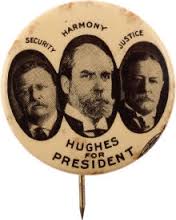
The Presidency of Charles Evans Hughes

Guest post by Andrew Schneider.
One of the more fascinating concepts of American political history is that of the “watershed election” - the notion that there are particular presidential contests that stand out as dramatically reshaping the political landscape, providing a convenient dividing marker between historical eras. Some of the more famous ones include 1860, 1932, and 1980.

The election of 1912 stands out for several reasons. That year, the Republican Party tore itself apart. President William Howard Taft secured his renomination at the G.O.P.’s national convention in Chicago through shrewd control of the party machinery, preventing the seating of delegates supporting his rival, former President Theodore Roosevelt. Roosevelt’s forces rebelled, bolting the convention and forming a new party to support their man’s bid to recapture the White House. The organization known variously as the Progressive or Bull Moose Party went on to win well over 4 million votes in the general election, translating to 88 electoral votes across six states. By comparison, Taft won fewer than 3.5 million votes – just eight electoral votes from two states. It was the best showing by a third-party candidate in the history of the modern U.S. party system. It also guaranteed the election of the Democratic candidate, Woodrow Wilson.

Wilson won a lopsided majority in the Electoral College, racking up 40 states with 435 electoral votes. He did not, however, win a majority of the popular vote. His total fell just short of 6.3 million. It’s tempting to look at those numbers and conclude that, had the Republican Party remained united, it would easily have held the presidency. That may have been the case if Roosevelt had somehow managed to win the Republican nomination. It seems less likely if TR had admitted defeat and sought to rally his followers behind Taft.

While Roosevelt ran as the candidate of the Progressive Party, both he and Wilson advocated the political philosophy known as progressivism – roughly defined as a movement favoring political reform and advocating economic and social justice. Read in this fashion, the 1912 election was an overwhelming victory for progressivism over the Old Guard conservatism of which Taft was champion. Had the contest been a two-man race between Wilson and Taft, many progressive Republicans may have voted for Wilson or stayed home. In any event, Wilson took the election as a mandate for progressive legislation on everything from banking regulation to the introduction of the eight-hour work day. The tide of progressive legislation ebbed with the U.S. entry into World War I, but it served as an inspiration to Wilson’s assistant secretary of the navy, Franklin Delano Roosevelt. FDR’s New Deal owed much of its existence to the groundwork laid by the 1912 platform Wilson called the New Freedom.

By contrast, the election of 1916 appears rather less consequential. It was a straight two-man contest between the Democratic incumbent Wilson and the Republican challenger, Charles Evans Hughes. There was very little to differentiate the two in terms of their domestic platforms. Hughes supported many, though not all, of Wilson’s economic and social reforms. He was slightly ahead of Wilson in endorsing women’s suffrage, and his views on civil rights were decidedly more forward-looking than those of the Virginia-born president.

But the issue that largely decided the election was that of America’s entry into the First World War. Both Wilson and Hughes argued for the U.S. to remain neutral. Hughes campaigned on a Republican platform argued that the U.S. needed a much stronger army and navy as a deterrent – in theory against any foreign power that might threaten the U.S., but with Imperial Germany utmost in mind. Wilson campaigned on a more straightforward message of peace and isolation, under the slogan. The contest was much closer than 1912. Wilson garnered a larger share of the popular vote. But the Electoral College broke for the incumbent by a much narrower margin of 277-254, with 30 states going Democratic and 18 Republican.

Before Wilson could take the oath of office for the second time, Germany resumed unrestricted submarine warfare and attempted to entice Mexico into declaring war on the United States, with the promise of restoring the territory it had lost to the U.S. in 1848. The U.S. learned of the latter when British intelligence intercepted, then leaked, a coded telegram from German Foreign Secretary Arthur Zimmerman to Germany’s ambassador to Mexico. Having won reelection by campaigning under the slogan, “He Kept Us Out of War,” Wilson began his second term by asking Congress to declare war on Germany.

Arguably, the election of 1916 was significant in at least two respects. First, Wilson became the first Democratic president since Andrew Jackson to win two consecutive terms in office. Second, Wilson’s belated (and forced) conversion to the Allied cause led him for the first time to apply his progressive ideology to foreign policy rather than domestic. It led him to adopt the position that the national interests of the U.S. and of world peace would best be served by spreading representative democratic government as widely as possible – ideally through diplomacy and free trade, but if necessary by force. This philosophy entered the lexicon as “Wilsonianism,” and it remains one of the leading schools of American diplomacy.

The U.S. would have entered the Great War soon after Inauguration Day 1917 regardless of who took the oath of office, given Germany’s actions in the months since the election. So how much difference would a Hughes presidency have made to the ultimate outcome? Answering this requires a closer look at Hughes, both in terms of what led him to the Republican nomination in 1916 and what he accomplished after his defeat that November.

Like Wilson, Hughes was the son of a clergyman and raised in a religious household. But where Wilson’s father moved to south from Ohio and became a slaveholder, Hughes father was a lifelong New Yorker and an abolitionist. Like Wilson, Hughes trained as a lawyer. But where Wilson grew bored with the actual practice of law, Hughes became obsessed by it, frequently working himself to exhaustion. His intelligence and dedication, particularly in his work as a special counsel for a commission investigating utility rates for New York City, drew him to the attention both of Roosevelt and Taft.

In 1906, Roosevelt drafted Hughes to run for governor of New York. Hughes beat heavily favored Democratic candidate William Randolph Hearst, in a campaign later immortalized in the film Citizen Kane. Hughes distinguished himself as a reform-minded executive, enacting social reforms, fighting political corruption, and attempting, unsuccessfully, to replace the state’s convention system for selecting political candidates with a direct primary. In 1910, while he was still governor, Taft named him to the Supreme Court as an associate justice. Hughes distinguished himself there as an advocate of regulating business and of civil rights.

Republican Party leaders had attempted to draft Hughes for the presidency as early as 1912, on the theory that he would make a good compromise candidate acceptable to both the Roosevelt and Taft factions. Hughes refused, saying it was improper for a sitting judge to involve himself in politics. Four years later, G.O.P. leaders tried again with the same argument but much more strenuously. This time, Hughes agreed. Taft endorsed him. Roosevelt, whose personal opinion of Hughes had cooled – he referred to him as a “bearded iceberg” – decided he would rather support Hughes than risk giving Wilson another victory. Hughes won the nomination on the third ballot. The convention nominated as his running mate Charles W. Fairbanks, Roosevelt’s former vice president.

The party Hughes led into the general election remained deeply divided. The Progressives had attempted to nominate Roosevelt as their candidate a second time. When he declined, and urged them to back Hughes, many took it as a betrayal. While Hughes had supported many progressive causes as New York’s governor, he was on record as opposing two of the most popular pieces of progressive legislation to date – the Sixteenth Amendment (allowing the creation of an income tax) and the Adamson Act (establishing the 40-hour work week). Despite Roosevelt’s active campaigning on Hughes’ behalf, many of these disappointed Progressives would cast their ballots for Wilson in the fall.

The one man who could conceivably have rallied these forces to Hughes was Hiram Johnson, the Progressive governor of California and Roosevelt’s 1912 running mate. In 1916, Johnson was running for the Senate as a Republican but remained in a bitter fight with the state’s Old Guard leaders. Hughes came to California to campaign in the midst of this fight and was briefly in the same hotel as Johnson. Due to a screw up by Hughes’ campaign manager, the two failed to meet, though Hughes did wind up meeting with several of Johnson’s conservative antagonists, including banker and state G.O.P. leader William H. Crocker. Hughes then compounded the slight by giving a speech at which he saluted Crocker as “California’s favorite son.” Johnson took this as a deliberate insult. He never forgave Hughes and thereafter refused to lift a finger on Hughes’ behalf.  Hughes lost California by a narrow margin and with it the presidency.

Hughes had a reputation as an extremely quick study. Had he met with Johnson, he would have realized very quickly how bitter the blood was between the governor and Crocker. He would not have made the blunder of publicly saluting Crocker as he did, certainly not without lavishing equal or greater praise on Johnson. With Johnson in his camp, Hughes would have carried California at the very least. That alone would have been enough for Hughes to edge out Wilson, although it would have been the tightest electoral contest in nearly thirty years -- 267 Hughes to 264 Wilson. It’s possible, though, that with Johnson in his corner, Hughes might also have carried Washington, which Roosevelt and Johnson carried in 1912. That would have tipped the balance to 274 Hughes to 257 Wilson, not much different from the margin by which Wilson actually won.

President Hughes would have taken the oath of office on March 4, 1917. He would have recognized at this point that U.S. entry into the Great War was all but unavoidable, but he would have wanted to do as much as he could to strengthen America’s position, both militarily and legally, before committing to the fight.

The new president would have had a deep bench of foreign policy and defense expertise on which to draw: Henry Cabot Lodge, U.S. senator from Massachusetts and ranking Republican on the Senate Foreign Relations Committee; Elihu Root, secretary of war under Presidents William McKinley and Theodore Roosevelt and secretary of state under Roosevelt; Henry Stimson, secretary of war under President Taft; and Major General Leonard Wood, U.S. Army chief of staff under Presidents Taft and Wilson. The men were all architects of the Preparedness Movement, pushing for universal military training and naval expansion. He would also, no doubt, have had to fend off helpful suggestions by Roosevelt himself.

Hughes immediate priorities would have been enacting the platform of military preparedness on which he had campaigned. The Democrats held majorities in both houses of Congress. But the renewed U-boat attacks on American shipping and the revelations of the Zimmerman Telegram would have undercut Democratic resistance to Hughes’ proposals. These would have included the enactment of conscription, which Congress had been considering as early as the previous December, and appropriations for a massive naval construction program.

Hughes would then have informed the German government – through neutral intermediaries, as Wilson had severed diplomatic relations with Germany in February – that any further attack on American shipping would be considered an act of war. To drive the point home, he could have ordered the seizure of German government assets in the U.S., pending Germany’s abandonment of unrestricted submarine warfare and payment of compensation to the families of those killed or injured in previous submarine attacks. Germany’s military leadership would almost certainly have ignored such an ultimatum – General Erich Ludendorff, who had insisted on resuming unrestricted submarine warfare, would scarcely have risked American entry into the war if he considered the U.S. a serious threat.

In our timeline, Wilson found one excuse after another to avoid calling for a declaration of war, with more than two months elapsing between the renewal of U-boat attacks and Wilson’s appeal to Congress. In this scenario, the declaration could have come within a matter of days after Hughes took office, roughly a month early compared to our history.

How much of a difference would this have made? The U.S. would still have had to build a mass army virtually from scratch. The peacetime U.S. Army had roughly 100,000 men. The American Expeditionary Force had about 2 million men in France by the time of the Armistice. American industry would also have faced the same limitations mobilizing its capacity to manufacture arms, ammunition, and other military supplies to meet U.S. needs, let alone those of the Allies.

Against this, we can weigh the likely appointment of Wood as the commander of A.E.F. instead of John J. Pershing. Wood was a more experienced combat leader, had greater experience leading large bodies of men, and had a record as an effective military reformer. Leading Republicans had argued strongly for Wood’s appointment to the post in our own timeline, but his political activities in the Preparedness Movement had made him anathema to Wilson, who chose Pershing as a non-partisan alternative. Wood, who built up a record as a military reformer and one of the fathers of American combined arms doctrine, would have been more likely than Pershing to absorb the bloody lessons the Western Allies had learned about the futility of mass assaults against fortified trenches. Pershing ignored those lessons and wound up repeating many of the same mistakes at the cost of tens of thousands of lives, particularly during the Meuse-Argonne Offensive.

At the height of the American effort on the Western Front, Britain and France requested the U.S. send 5,000 men to assist with a mission in Eastern Europe. Russia had erupted in civil war. The Allies wanted to intervene to keep German troops from seizing Allied stockpiles at the Russian port of Arkhangelsk, to rescue Czechoslovak troops who had become trapped behind the Bolshevik lines, and to reopen the Eastern Front against Germany. Underlying all this was the goal of overthrowing the nascent Bolshevik government.

In our timeline, the U.S. War Department rejected the request, but President Wilson overruled it. The result was what became known as American North Russian Expeditionary Force, colloquially known as the Polar Bear Expedition. It had no effect on outcome of Russian Civil War, but effectively poisoned U.S-Soviet relations from the start. Hughes was no more a fan of bolshevism than Wilson, but he would have recognized the mission as an unnecessary distraction from the Western Front. Odds are, he would have taken the War Department’s advice.

On the home front, progressive domestic legislation would have been as a low priority for a wartime Hughes Administration as it was for Wilson’s. But Hughes could have accomplished a significant civil rights goal during this period by executive authority. Wilson had effectively introduced southern “Jim Crow” laws at the federal level, banning African-Americans from higher level jobs in the federal civil service and reintroducing segregation in government office buildings. It would have been entirely within Hughes power, and character, to reverse these moves. In doing so, he would only have been restoring the status quo, as there was ample precedent under prior Republican administrations for keeping the civil service integrated.

Wilson, in asking Congress for a declaration of war on Germany, used the argument, “The world must be made safe for democracy.” This made for excellent propaganda, and it gave American involvement in the war the character of a crusade. It held out the promise of a postwar world where democratic governments would thrive the world over. Wilson raised hopes further with his January 8, 1918 speech to Congress, outlining America’s war objectives. What became known as the Fourteen Points included calls for national self-determination, freedom of the seas, free trade, an end to secret diplomacy, international disarmament, and the formation of a League of Nations. They also called for Germany to evacuate Belgium, give Alsace-Lorraine back to France, and to give up Polish territory that Prussia had held since the eighteenth century. But these seemed modest enough demands by October 1918, when German armies were collapsing in the field. Imperial Chancellor Max von Baden asked for an armistice on the expectation that the Fourteen Points would be, as advertised, the basis of a permanent peace settlement.

The Treaty of Versailles was, of course, far harsher than anything Wilson had proposed. Wilson sailed home from France in the middle of the conference to lobby for American membership in the League. By the time he returned, Wilson’s health was in decline. French Prime Minister George Clemenceau effectively dominated the proceedings.  The resulting peace terms for Germany included the assumption of guilt for starting the war, near total disarmament, and a bill for war damages that, adjusted for inflation, would amount to nearly half a trillion dollars in today’s currency. The nascent government of the German Republic never recovered from the humiliation of those peace terms.

Wilson came away from the proceedings with only one thing that he truly wanted, the creation of a League of Nations. He’d done nothing to assuage concerns of Republicans, who had by now taken control of both houses of Congress, that joining the League would infringe on American sovereignty. Senate Republican leaders, including Lodge, demanded revisions before they would ratify the Treaty of Versailles. Wilson refused, demanding they accept the treaty, and the League, as was. He then embarked on a nationwide speaking tour, hoping to build popular support for the League and force the Senate to cave. Instead, Wilson destroyed his health, suffering two major strokes that left him an invalid for the remainder of his presidency. The U.S. never joined the League of Nations. The American withdrawal from world affairs did almost as much as the Treaty of Versailles to prompt Germany to risk another devastating war with Britain and France just two decades later.

With Hughes as president, there would have been no call for a democratic crusade. No Fourteen Points. No reason for the German government to expect lenient terms if it sued for an armistice. The fighting might well have continued until the German Army was forced back onto German territory. That would have made it far more difficult to argue, as Ludendorff and many other German generals were to do, that the German Army was never defeated in the field and that only the betrayal by civilians on the home front, particularly Jews, had led to Germany’s defeat.

The American president and chief negotiator that arrived in France in 1919 would have been younger, healthier, and free of the messianic hopes that Wilson raised in our timeline. He would likely have been accompanied by Henry Cabot Lodge, Elihu Root, and a senior Democratic senator. Wilson’s decision not to include any Republicans in his negotiating team was a major reason Senate leaders distrusted the resulting treaty.

The resulting negotiations over the Treaty of Versailles between Hughes, Clemenceau, British Prime Minister David Lloyd George, and Italian Prime Minister Vittorio Orlando would have been every bit as complex as those of the treaty in our own history. The best gauge of President Hughes’ success would have been Hughes’ signature diplomatic accomplishment in our own timeline.

In 1921, President Warren G. Harding appointed Hughes as secretary of state. Hughes, with no prior experience in diplomacy, soon found himself overseeing a five-power conference to head off a naval arms race among the victorious powers in the Great War – Great Britain, the U.S., Japan, France, and Italy. Each power had a strategic interest in building the largest, strongest, most-technologically advanced navy possible. For all to follow this course, however, would have been to risk recreating the conditions that many blamed for touching off the Great War. Such an arms race would also have been economically ruinous for all powers involved, with the possible exception of the U.S.

Hughes oversaw the Washington Naval Conference with the assistance of Lodge, Root, and Senator Oscar Underwood, the Senate’s ranking Democrat. It was Hughes who ultimately persuaded the other great powers to accept naval construction limits, at a ratio of 5:5:3:1.7:1.7 – that is, for every 5 tons’ worth of U.S. battleship construction, Britain could build 5, Japan could build 3, and France and Italy 1.7 each. As an aside, the U.S. negotiators convinced Britain that the only way they could approve the deal would be if Britain allowed its alliance with Japan to lapse. Japan accepted the limits, in large part for economic reasons, but considered the treaty deeply unfair. This, and the American-enforced breakup of its alliance with Britain, went a long way toward convincing Japanese military and naval leaders that they would ultimately have to fight the United States to protect their interests in the Pacific.

A President Hughes at Versailles would have faced a set of foreign leaders every bit as protective of their own national interests. His task would have been to convince them that staking out the strongest possible gains at the expense of a defeated Germany would be counterproductive. Unless the Allied Powers were prepared to occupy Germany indefinitely, they could not keep it down forever. And the harsher the peace terms they imposed, the more determined Germany would become to seek revenge. In the meanwhile, the high level of reparations France and Britain were demanding would damage not only Germany’s economy but theirs as well. Here, he could use the leverage of the war debts France and Britain owed to America extract concessions on how much they would demand from Germany.

All this may appear more insightful that reasonable. If Wilson, Lloyd George, and Clemenceau could not see the consequences of a harsh peace with Germany, why would Hughes? There was one person at Versailles who foresaw exactly these consequences. Economist John Maynard Keynes attended the conference as an advisor to the British government. He wound up publishing his views later in 1919 as The Economic Consequences of the Peace. The book greatly undermined the legitimacy of the Treaty of Versailles both in the U.S. and Britain, providing a strong argument for those who later supported appeasement of Germany in the 1930s.

Hughes was no economist, but he had spent a good deal of his early public service dealing with economic issues, particularly in cases involving the federal regulation of interstate commerce. It’s likely that he would have drawn some of the same conclusions as Keynes and have done his utmost to convince his fellow world leaders of the potential consequences of their approach. As the Washington Naval Conference negotiations proved, Hughes at his best could be extremely persuasive.

With Hughes involved, the resulting Treaty of Versailles would have been far more likely to provide the framework for a lasting European peace. The U.S. Senate would have ratified the treaty with little trouble. The odds that the U.S. would have retreated into postwar isolationism would have greatly diminished. From a foreign policy and national security standpoint, Hughes first term as president would have been far more successful than Wilson’s second.

None of this would necessarily have guaranteed Hughes winning a second term. With demobilization, U.S. prices started to fall. The economy tipped into a deep recession starting in January 1920, which lasted until July 1921. One only need look at the U.S. election of 1992, in which Bill Clinton defeated George H.W. Bush, to see how a recession can prompt voters to reject a popular wartime leader. Still, this might have been where Hughes early support of women’s suffrage paid off. The Nineteenth Amendment took effect in August 1920, making that November’s election the first in which women’s votes could decide the outcome.

With so many changes from our history over the course of a first Hughes term, it would be nearly impossible to predict what a second term would look like. Two things, though, are certain. First, Hughes would have had a different vice president. Charles Fairbanks died in June 1918. Under the law then governing U.S. succession, the vice presidency would have remained vacant until the beginning of the next presidential term on March 4, 1921. Who Hughes would have picked to replace Fairbanks is anybody’s guess. It would not have been unreasonable, though, for him to turn to one of the men who had helped put him in office in 1916, Senator Hiram Johnson.

Second, Hughes would have had a dramatic opportunity to reshape the Supreme Court. Between March 4, 1921 and March 4, 1925, five justices left the bench. These included Chief Justice Edward Douglass White, who died in office. One could reasonably assume that Hughes would have proposed justices with judicial views similar to his own.

In our own history, President Herbert Hoover named Hughes chief justice of the Supreme Court in 1930. He served in that position for eleven years, a period of tremendous controversy in which the court acted as a conservative check on the New Deal. President Franklin Roosevelt’s attempt to break the court’s opposition to his programs by packing it with liberal justices resulted in one of the most serious political defeats of his career. It seems implausible that Hughes would have become chief justice in such an alternate timeline, but his ultimate impact on the Supreme Court and on U.S. law would arguably have been far greater.  

AUTHOR’S NOTE: I first wrote on what a Hughes presidency might look like seventeen years ago in Point of Divergence, No. 21. The occasion was an editor’s challenge to describe a history in which Leonard Wood won the both Republican nomination for president and then the presidency in 1920. I concluded the general would have made a poor candidate, focused as he was on the single issue of military preparedness. Instead, I wrote about what might have happened if Hughes had won the election in 1916, named Wood as his commanding general in World War I, and then appointed him secretary of war after winning a second term. The centennial of the Wilson-Hughes contest struck me as the perfect opportunity to revisit the issue, with a focus on Hughes instead of Wood. Thanks to Matt Mitrovich for the opportunity.

* * *

Andrew Schneider is the politics and government reporter for Houston Public Media (KUHF), NPR’s affiliate in Houston. His work has aired nationwide on Morning Edition, All Things Considered, and Here & Now. He holds degrees in history from the University of Chicago and Duke University. Andrew recently completed work on a memoir based on his experiences as a war correspondent in Afghanistan.