Showing posts with label Maps. Show all posts

Wednesday, September 14, 2016

The Alternate History Map That Ended Up In A History Textbook

Did you know an alternate history map got published in a history textbook? Watch this video to learn more.
Check out Andri/Kuusinen's Deviant Art profile: http://kuusinen.deviantart.com/

* * *

Matt Mitrovich is the founder and editor of Alternate History Weekly Update, a blogger for Amazing Stories, a volunteer interviewer for SFFWorld and a Sidewise Awards for Alternate History judge. When not exploring alternate timelines he enjoys life with his beautiful wife Alana and prepares for the day when travel between parallel universes becomes a reality. You can follow him on FacebookTwitterTumblr and YouTube. Learn how you can support his alternate history projects on Patreon.

Thursday, September 8, 2016

Fantastic Maps and Where to Find Them

Guest post by Lynn Davis.

As a decently experienced cartographer with work featured on this site and elsewhere, I like to give advice to potential cartographers—both of alternate history and not—who seek to create high-quality maps using programs like Inkscape or Photoshop (if you are using GIS, well, that’s a talk for another day).

One of the toughest parts of starting out using these programs to design maps is finding of the most essential tools in a burgeoning cartographer’s toolkit: basemaps. That is, unless you are able to freehand a perfect map of the world to make a derivative map, particularly for alternate history purposes, you are going to need maps that already exist which you can trace over and change into a piece of art of your own making.

To help with this, I will present to all you cartographers the top 5 best map resources around the internet. With these sites, your library of basemaps will quickly grow and, hopefully, so too will your body of work.

#1. Wikimedia
From old atlases to modern user-made data, the maps available on Wikimedia are perhaps the most diverse of any source. Like the rest of Wikipedia’s foundation, the point of the map database is to give people an open and free database to use, and any aspiring cartographer would be advised to take advantage of this fact.

The biggest disadvantage is that, like much of the Wikimedia site, the database can be difficult to navigate, particularly if you are looking for specific kinds of maps or maps from specific artists. If you’re willing to put up with the layout, however, it’s one of the best and most diverse of the examples given and well worth your time.

The database is available here to access. Make sure to click around categories and don’t be afraid to use the main Wikipedia site to poke around as well.

#2. University of Texas at Austin Perry-CastaƱeda Library Map Collection
Though just roughly 30% of the collection’s 250,000 maps are available online, the UT Austin map collection is an extremely valuable one. While Wikimedia and other sources tend to be a bit more random in what they choose to upload, due to problems of availability or varied sources, this map collection focuses more on specific atlases where each and every page is carefully cataloged and digitized for those who wish to view them.

The maps are available to directly download and in the public domain, which eases using them around the internet without having to worry too much about copyright. Most of the maps on here also tend to be clearer than those from the same atlas posted elsewhere. As a bonus, there are even some maps that I have simply not found elsewhere around the web, and for that alone it is extremely valuable.

Always continuing to grow as the collection receives money to digitize its records, this collection can be viewed here and is well worth checking out to find the basemap that is right for you.

#3. West Point Atlases
This source is one that is not only surprising, but also one that I have seen very few cartographers ever recommend, let alone use. Available as a courtesy of the United States Military Academy at West Point, the atlases available on their website to the public contain a wide array of subjects related to warfare, from ancient conflicts to the modern campaigns in Iraq and Afghanistan. Naturally, being a military academy, it is hard to find maps not related to warfare; alternate history being what it is, however, that doesn’t tend to be a down side.

The one caveat I could give is that some of the maps, notably the larger-scale pages in the atlases, seem to be rather inaccurate and give a very simple idea of worldwide or continental political geography. That said, this drawback is more than made up for by the highly-detailed country and local maps available through the atlases that look like they have been pulled from the pages of official military atlases. Suffice to say, accuracy at the local level is extremely important to the military so you can count on these to be among the best you can find. In this way, they are perfect for maps of specific historical or alternate historical military campaigns that you may want to show.

To check out these atlases, follow the link here for more information.

#4. Alternate History Wiki
That is, the wiki site created specifically for alternatehistory.com and not to be confused with the independent alternate history wiki (yes, it’s confusing). This is a site that is simply not used as often as it should be. While admittedly even harder to navigate than the others, the AH wiki is a fine resource for maps that have been made or found by users of alternatehistory.com as part of a community-wide project assembled by the good people at the wiki.

Maps can include anything from the wonderfully-detailed “world-a” style pixel maps to larger, more complete blank maps that anyone can use. Taken from well over a decade of gathering from all across alternatehistory.com, this archive is one that is well worth using for anyone who wants to make specifically alternate history maps, as this site tends to cater toward it. However, it also provides a good amount of material for those who lean toward real life history and who want to make maps of their own.

It's a really fantastic resource that I, personally, would enjoy seeing get a bit more love from the cartographical community. You can find the map portion through here, though some searching around the site may be required to find exactly what you’re looking for.

#5 David Rumsey Map Collection
In many ways the Holy Grail of basemaps, the David Rumsey Map Collection is a cornucopia of maps for every possible or thinkable part of the world that were created anywhere from centuries ago to just a few decades beforehand. The collection has been painstakingly digitized over the course of two decades and resulted in a database of more than 71,000 maps of all sizes, shapes, and containing a wide variety of subjects.

Not only are the maps available for download in high quality image sizes, but they are also organized by artist, date published, and geographical location covered in the map that allows anyone looking for a specific kind of basemap for a specific map in mind to quickly find something that will suit them. This can range from a large-scale political map of the Holy Roman Empire to a travel map from the 1930s of the United States to a landform map of eastern China before the Second World War.

I would caution that, unlike the other sites, the Creative Commons license is a little more complicated, so it’d be a good idea to look that up before you dive in. That said, for those of us who seek to make the best maps we possibly can in Inkscape, Photoshop, GIMP, or other programs, this site is far and away the best I’ve used and I cannot recommend it enough. You can find the collection’s homepage here and from there dive right in.

* * *

Lynn Davis is a cartographer and writer both of alternate history that can be found on her website, Toixstory.com, and has been featured around the internet. In addition she runs a tumblr, Facebook page, and is funded by generous donations to her Patreon.

Thursday, August 18, 2016

Alkebu-lan 1260 AH or: What If Africa Was Never Colonized?

Did you ever wonder what Africa would look like if it was never colonized by Europeans? Well Swedish artist Nikolaj Cyon took a shot at it and The Alternate Historian is going to review his map.

* * *

Matt Mitrovich is the founder and editor of Alternate History Weekly Update, a blogger for Amazing Stories, a volunteer interviewer for SFFWorld and a Sidewise Awards for Alternate History judge. When not exploring alternate timelines he enjoys life with his beautiful wife Alana and prepares for the day when travel between parallel universes becomes a reality. You can follow him on FacebookTwitterTumblr and YouTube. Learn how you can support his alternate history projects on Patreon.

Wednesday, July 13, 2016

What is Jesusland?

How well does the infamous Jesusland map hold up in 2016? Find out in today's video.

* * *

Matt Mitrovich is the founder and editor of Alternate History Weekly Update, a blogger for Amazing Stories, a volunteer interviewer for SFFWorld and a Sidewise Awards for Alternate History judge. When not exploring alternate timelines he enjoys life with his beautiful wife Alana and prepares for the day when travel between parallel universes becomes a reality. You can follow him on FacebookTwitterTumblr and YouTube. Learn how you can support his alternate history projects on Patreon.

Saturday, June 25, 2016

That is NOT the British Empire

I've seen another alternate history map shared around the Internet in response to Brexit...but for absolutely the wrong reasons. Learn what I am talking about below:

* * *

Matt Mitrovich is the founder and editor of Alternate History Weekly Update, a blogger for Amazing Stories, a volunteer interviewer for SFFWorld and a Sidewise Awards for Alternate History judge. When not exploring alternate timelines he enjoys life with his beautiful wife Alana and prepares for the day when travel between parallel universes becomes a reality. You can follow him on FacebookTwitterTumblr and YouTube. Learn how you can support his alternate history projects on Patreon.

Thursday, March 17, 2016

The Alternate History Map That Fooled The Internet

My old nemesis has returned, so I made this short video as a call to action to prevent it from happening again.

* * *

Matt Mitrovich is the founder and editor of Alternate History Weekly Update, a blogger on Amazing Stories and a Sidewise Awards for Alternate History judgeWhen not writing he works as an attorney, enjoys life with his beautiful wife Alana and prepares for the day when travel between parallel universes becomes a reality. You can follow him on FacebookTwitter and YouTube. Learn how you can support his alternate history projects on Patreon.

Thursday, July 9, 2015

Ɩgedei Khan Lives (Sort Of): My Scenario for SciFi Ideas' AltMap: Khaaan!

I felt inspired to write a scenario for SciFi Ideas' alternate history map challenge they ran last week, so here is the scenario I came up with:

Ɩgedei Khan doesn't drink himself to death in 1241, thus Batu Kahn continues to drive west into Europe. He eventually reaches the Pyrenees before news of Ć–gedei's death (caused by what historians would refer to as a "crazy bender of a weekend") causes him to turn around and return to Karakorum to elect a new khan. Now in the late 19th century (by the European reckoning) the Great Khanate of China, ruled by the Yaun Dynasty, may not be the world empire Genghis Khan had originally envisioned, but it has come pretty damn close. China is one of the world's largest states with its western border reaching the shores of the Caspian Sea and has vassals and colonies on Asia, Africa, Europe and even North America [1] (where people who really screw up go, but not bad enough to be executed). When it comes to the Great Khanate, the key word is "biggest". It has the biggest army, the biggest navy, the biggest population, etc. Of course, in this timeline, bigger doesn't always mean better.

Case in point: the Khanate of Rome. Once it was the Great Khanate's most western vassal, but in the last century and a half it has become its greatest rival. Rome's strength comes from trade with its colonies. The jewel in the Roman crown has to be Batustan where the Roman's alliance with the Lakota (who took to horses like ducks to water) helped carve out an expansive empire over the Great Plains. They have also rallied the Dutch and German khanates to their side, minor nations to be sure, but they can easily provide the extra soldiers and ships necessary to slay the Great Khanate dragon if when Rome decides the time is right to strike.

There are, of course, other powers to be concerned about. The Byzantine Empire gained an unexpected boon thanks to all of the European nobles, soldiers and artisans that fled to their lands following the Mongol invasion. This influx of people desperate for land were useful in driving back the Arabs, Turks, Egyptians, Persians and even the Mongols, giving the Byzantines control over much of the Middle East and northeast Africa. They have no love for the Romans (How dare they call themselves Romans! We are the real Romans!), but they see the Mongols as a greater threat and with their Serbian and Bulgarian vassals, could be willing to challenge the Great Khanate's hold over Asia.

Then we have the Great Northern Empire [2]. Also known as the "Nordic Realm", it was founded after an ambitious Norwegian king united the British Isles with Scandinavia. They are Rome's greatest imperial rival and there have been several colonial wars fought between them over the centuries. They rely on their strong navy rather than a large army, but they are known to be fierce fighters should a land battle be necessary. Their relations with two great powers is switched. Although they distrust the Great Khanate, they fought less wars with them than the Khanate of Rome. If push came to shove, they may find themselves fighting for the Great Khan if war ever broke out between the Khanates.

Other states include Spain and Portugal, which were some of the few European states to avoid being ravaged by Mongol invaders. They don't want any trouble and prefer to be left alone to trade and exploit their own colonies in peace. The same can't be said about Japan. Although they suffered through several failed Mongol invasions, they have proved a nuisance to the Europeans as well for constantly trying to snatch their colonies away from them. Incredibly militaristic and determined to create their own empire, no one likes the Japanese, not even Siam, the only other major state in East Asia not part of the Great Khanate. The Japanese instead must sit patiently and wait for their opportunity to snap up as much as they can before the rest of the powers can react.

Because the Mongol invasion delayed European imperialism and the Great Khanate was never that excited about oversea colonies (East Africa being one of the few exceptions [3]) many more native states in Africa and the Americas exist and are strong enough to avoid foreign occupation. The Incas are perhaps the most powerful in this category and are also one of the few willing allies of the Great Khanate. The Incas find the Chinese preferable to the Europeans since they don't seem to have much interest in raping their women and stealing their gold.

Technologically this world is a century behind ours, being more at the level Napoleon would recognize. Culturally things are all over the map. Islam is weak in the Middle East, but strong in Eastern Europe, with large pockets of Nestorian Christianity and Buddhism throughout the Great Khanate and their vassals. Their are two Popes, one in Rome and one in Canterbury, and a nation's allegiance to one usually depends on the politics of the day. Coptic Christians have a plurality in Egypt, but Muslim missionaries have had great success in Mexica. The Great Khanate's East African colonies have enjoyed the "benign indifference" of the Great Khan which has allowed them to pursue their own goals (which is usually making as much money as possible). Their cities are full of people speaking a dozen different tongues and even a couple new ones that merge the vocabulary and dialect of the different cultures. There has been talk in quiet corners of this realm about going their own way someday and creating a "United States of Africa" (or a "USA" if you will).

The outlook for peace is pretty dim in this timeline. The current Great Khan parties so hard he makes Ć–gedei Khan look like a teetotaler. The old nobility, disgusted by the Great Khan, want to quietly depose him and put someone more amenable to them on the throne. The new class of young nobles, supported by the growing middle class, just want a Great Khan, not necessarily the one currently on the throne mind you, who can finally fulfill Genghis Khan's dream of conquering the world. The Great Khan, however, is not without his supporters, mostly from the rich and powerful in the vassal states who prefer a do nothing Khan to the alternative. As the factions in the Great Khanate vie for supremacy, Rome senses weakness and prepares for war, while the neighbors of both empires ponder just what side to take (if any) in the conflict to come...

Notes

[1]: Neither continent is called North America or South America in this timeline, but because I am too lazy to think of a better name, I am going to stick with their names from our timeline as placeholders.

[2]: Some would argue the Great Northern Empire is neither "Great" nor an "Empire" since the different constituent parts fight amongst themselves or are rebelling against the High King so often that the Empire always seems to be on the verge of falling apart. Also since a good chunk is located in the Southern Hemisphere, you can't even really call it "Northern" anymore either, but hey, old habits die hard.

[3]: The surge of European refugees and Byzantine expansion led to an exodus of Muslims, Jews and Eastern Christians (who didn't listen to the Patriarch of Constantinople) to East Africa, where Middle Easterners had already been trading there for centuries. When the Europeans began encroaching on their territory and trade, they turned to the Great Khan for protection. This was a decision they would later regret after a flood of new immigrants came in from East Asia and other parts of the Great Khanate. It didn't help matters that the local Africans found all these new neighbors rather unpleasant as well. Things were dicey in the early years, but now there is a tenuous peace and much mixing of cultures and peoples. A booming economy doesn't hurt either.

* * *

Matt Mitrovich is the founder and editor of Alternate History Weekly Update and a blogger on Amazing Stories. Check out his short fiction. When not writing he works as an attorney, enjoys life with his beautiful wife Alana and prepares for the inevitable zombie apocalypse. You can follow him on Facebook or Twitter.

Friday, May 29, 2015

Interview: Rvbomally

For the next installment in my my interview series featuring my favorite alternate cartagraphers, I got a chance to talk with Rvbomally of AlternateHistory.com. He is the author of "Ad Astra Per Aspera", but I wanted to talk to him primarily for his map work. Check out what he had to say below:

Who is Rvbomally?

Just some random guy on the Internet.

What got you interested in alternate history?

I was first introduced to the concept by the Dawn of Victory mod. At that point, I was far more interested in conventional science fiction, so the WWII powers in space was a new concept that really got me interested in the genre. I then found out about Timeline-191, which I then picked up and fell in love with. And the rest, they say, is history.

What inspired you to write "Ad Astra Per Aspera"?

No one thing inspired me to write AAPA, although Fallout, 1984, and Warhammer 40K are clear influences. AAPA is, in a way, the final evolution of my science fiction musings dating back to at least 2006. The setting back then was far different, involving space Texans attacking robots on Mars, of all things. It gradually evolved into a more conventional space opera, where the primary civilization was the Holy Dominion of Christendom, a galaxy-spanning theocratic empire that enslaves any aliens it encounters, at war with a communist insurgency.

When I found out about Warhammer 40K, I decided to do something different, so I decided to make a space Cold War story, while retaining some elements of the original "Dominionverse" story. The Dominion became the Coalition of Western Republics, which was pitted against a Sino-Soviet Collective that later became the Conseil. The Technocracies were added later as a neutral kingmaker. You could see some of this evolution in early draft maps I have since posted to my deviantArt account, and I plan on revisiting the first two incarnations of AAPA in a remake.

When did you start creating alternate history maps?

A long time ago! I'd say about 2008, possibly even earlier. Those initial maps were utter garbage; nonsensical recolors of the Wikipedia basemap. Of course, I got better.

What do you think people like about alternate history maps?

For me, it shows a radically different world at a glance. When I see different borders, and different alliances on a key, I start thinking about how different that world's history, culture, and politics must be from our own. It's a very efficient and very effective form of telling a worldbuilding-heavy story.

What software do you use to create maps?

For my oneshots, a combination of Adobe Photoshop and Microsoft Paint. Photoshop isn't strictly necessary for the process, it just makes things like adding lots of text, choosing colors and outlining countries easier. All of my oneshots can be replicated on Paint alone. When I decide to get fancy, I use Adobe Photoshop and Adobe Illustrator.

What is your favorite map that you ever created?

That's a tough one. I tend to adopt a favorite and then drop it. For example, right now I'm a big fan of my cover of Transparent Blue's "Last Living Souls". But my all time favorite would have to be my Union of American Federal Republics map. I love how it turned out!

[Editor's Note: And it was featured on Map Monday.]

Where can people go if they wanted you to commission a map from you?

Nowhere, unfortunately. I'm typically a busy guy, with only enough time to make maps for myself. I'm trying to get through a large list of maps I'd like to make at the moment. I'm still making maps for ideas I had back in 2013. If you like what you see, however, feel to give me a tip on patreon.

Any other map makers you would like to recommend?

Yes! B_Munro/QuantumBranching, ToixStory, RoyalPsycho, vongreif, zalesky, 1Blomma, and Silas-Coldwine are some of my favorites. Check them out!

Any other projects that you are working on now?

Aside from my Oneshot Scenarios, I'm working on "Space Cadet", another science fiction setting which is my attempt to take just about every genre of science fiction at once and stick it in a blender.

What books are you reading?

These days, nothing but boring textbooks and legal codes, unfortunately.

Any advice for aspiring alternate cartographers?

The best way to learn is by trying to imitate maps you like. Most of my progress has been made trying to replicate an aesthetic I see on a map thread, or even on a map in real life. I find that I never replicate the aesthetic perfectly, but I learn a lot in the process, and it helps me develop my own style. Oh, and tutorials are helpful.

Thursday, April 23, 2015

Interview: Lynn Davis

Doing Map Mondays for more than a year now, I have to admire those alternate historians (who I usually refer to as "alternate cartographers") who have the patience and skill to create those wonderful and informative maps we find in timelines across the Internet. Wanting to learn more about this subset of our community, I decided to interview one of my favorite map makers: Lynn Davis. Check out our conversation below:

Who is Lynn Davis?

My name is Lynn Zelda Davis, a 21 year-old Texan college student currently working on their bachelor's degree in English Education. That's right, folks, history and cartography are just a side hobby for my real, crazy passion: teaching! Other than that, I love to write, to read, and just about everything involving Christmas. My favorite things in life are my partner Chris, my maps, and sleep. Most people around the web know me as ToixStory (formerly known as PlatoonSgt).

What got you interested in alternate history?

Sometime around 2010 I started to wonder about the usual history scenarios, about what would have happened if the Nazis had won, if Texas was still independent, etc., and found AlternateHistory.com that same year, which only fueled my passion. At the same time, I was becoming more and more interested in history itself, devouring every book I could find on any part of history, which only fueled my desire for alternate history. This past year has seen it really ramp up in terms of research and study, but the passion has been there for a while now.

When did you start creating alternate history maps?

Technically, I got started around 2011, using simple Wikipedia basemaps and the world-a basemaps you see on AlternateHistory.com Map Threads. However, I was never really satisfied with them, because they always seemed so...stale. Lifeless. After a while, I gave up on them. Then, last year, I picked up the hobby again, not with maps made in Microsoft Paint but in Inkscape, using more detailed techniques to create the beautiful maps I had seen posted on deviantart and AH.com before. I wanted to have maps that told a story, that showed a whole world instead of just a plate imitation of it.

In a world where geography is at the bottom of the list for someone's favorite subject, why do you think people make maps of alternate worlds?

I would say because, on some level, all people wonder how things would have gone had the circumstances been different. Alternate history is simply quantifying those thoughts and putting them into a study of how you think things could have gone, and maps are simply an extension of that. Not to mention, maps are something just about everyone has been exposed to at one time or another, from atlases to Google Maps, so I think anyone interested in alternate history has thought, at one time or another, of what the maps for different worlds would look like.

What programs do you use to create your maps?

I started out with, and still primarily use, Inkscape. It's a very sleek, free vector-based program that allows you to use all sorts of tools and tricks to get a map looking just right. It's easily manipulable and fairly easy to learn. Lately, I've experiment with using GIMP to make a base for the map before doing the details in Inkscape. There are definitely some advantages of GIMP, though I'm probably going to start going back to Inkscape more and more.

Where can people go if they wanted you to commission a map from you?

My deviantart is definitely the best place. I have a journal of all commission prices and info here or you can e-mail me at lzeldadavis at gmail dot com and we can talk prices and such.

Any other map makers you would like to recommend?

Oh, wow, there's almost too many to list. 1Blomma is definitely one of my favorites and is a master at the craft. There's also a ton more, off the top of my head: martin23230, Fenn-O-Manic, Kurarun, Undevicesimus, Pischinovski, ImDeadPanda, Kuusinen, Sapiento, ReagentAH, RvBOMally, nanwe01, and iselander. All of them are on deviantart, and definitely worth checking out.

Any other projects that you are working on now?

For alternate history? Well, something like 6 maps that are in some stage of completion, a tutorial, and a whole map series—world map, regional maps, flags, etc.--and that's just the tip of the iceberg. I may go a little overboard. As far as other things, I've got a couple novel ideas in the mix that I might sit down and write one day (alternate history, naturally), but mostly I just like my maps. Definitely my favorite and most soothing hobby.

What books are you reading?

Just like with my maps, I move between books very rapidly, so I'm never reading just one. At the moment, I'm reading In Spite of the Gods: The Rise of Modern India, An Empire of Wealth, Leviathan Wakes and A Canticle for Leibowitz. Like I said, my mind wanders a bit.

Any advice for aspiring alternate cartographers?

The biggest piece of advice I can give is: be patient. Cartography, whether it's digital or physical, takes time to get right. It can feel like a pain to meticulously trace coastlines, rivers, borders, and the like, but it definitely pays off in the end and makes your map look much nicer. More than half my maps took more than 50 work hours to make, with a couple taking over 100 hours of work time. It can be tedious, but find a rhythm and stick with it and you'll be a master of the craft before you know it.

Thursday, November 6, 2014

Twilight Histories Cover: Aztec Steel

With the permission of Sam McDonald and Jordan Harbour, the voice behind Twilight Histories, I present this new map and description made by Sam. It was inspired by the "Aztec Steel" episode of Twilight Histories. Enjoy!
After the sack of Tenochtitlan, Chinese hegemony was established and a new era of Sino-Aztec cooperation and rebuilding was born. The wealth brought by China's New World possessions, combined with a more outwardly thinking dynasty, meant that China was considered by many nations in the West to be the most powerful nation on earth.

China also made contact with the Incan Empire. The Inca fell into a civil war after the Old World diseases set in. The civil war was between those who wished to continue trade with China and those who wanted the foreigners out of their land. Eventually the Pro-Chinese faction won out. The Chinese began establishing colonies on Incan land to help make up for the depleted workforce.

China's colonies became autonomous regions within the Chinese sphere. This wasn't caused by any ill-will towards China, but rather because nominal self-governance was a more efficient form of managing distant lands. The former colonies still retained close relations and trade with China. Originally, the former colonies Xuya [1] and Mexica comprised a single province. The two, however, ultimately split over ethnic tensions due to Xuya being more pure Han Chinese, while Mexica was a mix of Aztec and Chinese culture. Tawantinsuyu, China's former Incan colony was a mix of Chinese and Incan culture.

Xuya modeled itself closely off of China's government where anyone was free to join if they passed the imperial exams. Mexica and Tawantinsuyu modeled themselves off of traditional Aztec and Incan government respectively, but certain Chinese elements such as imperial exams and increased bureaucracy persisted. Other progressive social developments were seen in the autonomous regions including the banning of human sacrifices and women being allowed to participate in the imperial exams.

Korea never established a colony in the New World. However, many Koreans made it to the New World through China's autonomous zones. Today, Koreans make up a noticeable minority in Xuya, Mexica and Tawantinsuyu.

The tiny nation of Tecas, made of an eclectic mix of Chinese, Korean, Aztec and English settlers. The Tecas were a threat to the larger autonomous zones because they practiced a form of direct democracy.

The Spanish established colonies in Cuba, Hispaniola and Puerto Rico. However, lacking direct access to Aztec and Incan gold and silver meant that Spain never became a great empire. Spain focused more on European affairs while at the same time putting more effort into the colonization of the Philippines. Spain also settled the Patagonia region of South America, to the consternation of the Chinese, and placed more emphasis on trade and commerce rather than conquest. This economic strategy proved more sustainable for Spain in the long run, and it remained a major power in Europe.

England established its first colony, Henrytown, in what would have been Louisiana. It was close to the Chinese-Aztec autonomous regions, which was good for trade, yet far enough away as to not pose a threat. England became the primary European trading partner for these regions. Despite the fact that half the colonist died in the first year due to malaria, the colony was a success. The English slowly expanded around the gulf coast with colonies called Chesapeake Bay and Plymouth. English settlers encroached on the edges of the French Ohio River Valley where tensions rose.

Scotland also established trade with the Chinese-Aztecs. The English remained the Aztecs’ primary trading partner for arms and armor, but the Scottish traded something equally valuable: whisky. The economics benefits of trading with the Chinese-Aztecs meant that Scotland didn't have to merge with England and remained an independent state. Scotland focused on colonizing Nova Scotia and what would have been New Brunswick and New England. Their colony's northern half was known as Nova Scotia, while the southern half was called Massachusetts.

France filled the power vacuum caused by Spain's lack of an empire. Eager to keep their spot on top, the French made colonizing the New World a priority. They colonized Canada and the Ohio River Valley, and the denser population of colonists allowed France to retain its lands. New France tended to be more laid back about religion than its mother nation.

The New Netherlands continued to survive and thrive despite occasional border clashes with the Scottish colonies. About half their population was Dutch, while the other half comprised of various foreigners. Meanwhile, Portugal colonized Brazil.


The royal families of Sweden and Brandenburg united and were known as the United Kingdom of Sweden and Brandenburg. Sweden-Brandenburg become a regional power in the Baltic. It has established a small colony in the northern part of South America.

Footnotes

[1]: Xuya, the name of one of China's former colonies, was originally a place holder I had until I could come up with something better, but as I worked on the map the name stuck with me so I kept it.  The name itself roughly translates as Dawn Shore, and I got it from Alliette De Bodard's series of alternate history short stories, collectively known as the Xuya Stories, which have a similar premise of China discovering the New World and the Aztec Empire surviving.

This article was written by Sam McDonald and edited by Jordan Harbour. It first appeared on the Twilight Histories Facebook page.

* * *

Sam McDonald is a college student from Shreveport, LA.  When not involved with his studies he can be found making and posting maps across the web and working on short stories that he hopes to have published in magazines such as Lightspeed, Strange Horizons, and the Escape Artists Podcasts.

Wednesday, October 15, 2014

Maps of Twilight Histories

With the permission of Sam McDonald and Jordan Harbour, the voice behind Twilight Histories, I present these three maps and descriptions made by Sam. They are inspired by episodes of Twilight Histories, which I will link to. Enjoy!

Persia conquered Greece, but this did not lead to the collapse of Greek civilization (although Athens was burned to the ground). As long as the Greeks pay tribute and acknowledge the emperor as their ruler the Persians leave them alone. The Greek colonies in Italy and elsewhere, however, managed to avoid the Persian conquest. These colonies, along with the Etruscan and Latin cultures, gave rise to Rome. Like in our world Rome went from Kingdom, to Republic to Empire. Rome, however, managed to subdue Germania and Scandinavia, while Persia expanded into Eastern Europe. 

Rome still mainly follows the traditional gods, though in a bit more of an organized religion akin to Hinduism. Due to the greater influence of the Etruscans on their culture, the Romans have a somewhat more gender equal society. Persia, on the other hand, mainly practices Zoroastrianism, but Buddhism is becoming increasingly popular both there and in Rome. Due to the differing cultural conditions, Christianity and Islam were never formed. Buddhism has filled the niche and due to its flexible nature and willingness to incorporate local gods and customs, Buddhists don't face persecution like Christians did.

In China, the An Lushan rebellion never happened due to An Lushan's plot being discovered by imperial officials and reforms being put in place to prevent similar rebellions. China has also managed to subdue northern barbarians such as the Mongols and the Jurchens due to a combination of more research being put into gunpowder and mechanical weapons sparking an industrial revolution.

This has spread to India, Persia and Rome (in that order). Persia and India lead the way in developing the scientific method. China was a bit stubborn at first, but eventually conceded that the scientific method was the way to go. Rome still hasn't quite come around, seeing it as Eastern rubbish. Most of their innovations tend to be copied from the other powers (not that they ever admit this) or discovered by accident.

The minor powers of Axum and Srivijaya haven't industrialized yet, but they are in the process. Srivijaya has discovered Australia, but there isn't much there to interest them yet. They have also made voyages to East Africa and Madagascar and sailed around the Cape of Good Hope.

Rome and China have both made voyages to the Americas and have begun the process of colonization. This has lead to disease breaking out among the native population, but because of the slower rate of colonization (compared to our world) the native population have a chance to recover and build up immunity.

The Mayans are still on good relations with the Romans, but they are keenly aware that it might only be a matter of time before they're conquered. They have united into a somewhat loose confederation of city-states akin to the Delian League. In fact the Delian League, which they learned of via the Romans, was their inspiration (though many have pointed out how things didn't quite workout for the Greeks in their resistance to the Persians).

An Aztec-ish culture is forming in the central valley of Mexico while the Incas are building their empire in the Andes, but European diseases have set back their progress a bit. Japan is still independent, but due to China being stronger, they're very much a vassal state to the Chinese. Things aren't exactly helped by the fact that they can't industrialize without raising China's suspicions.

The Byzantine Empire fell in the 8th century rather than the 15th century. Without a powerful Christian buffer state to oppose it, Islam quickly spread throughout Eastern Europe. Constantinople became both the capital of the Umayyads and a major pilgrimage site that rivaled even Mecca and Medina.

The Abbasids, feeling the Umayyads had grown too decadent and forgetful of the teachings of Islam (and angered over how much money Mecca and Medina were losing to Constantinople) would go on to overthrow the Umayyads as they did in our world.

The Frankish emperor Charlemagne converted to Islam, both due to having several Muslim tutors in his youth and seeing that Islam would most likely become the next major religion. Charlemagne went on to declare Jihad against the Umayyads and anyone he perceived to be an enemy of Islam. After helping establish Abbasid power in the Middle East he went on to conquer the Italian Peninsula.

The Abbasids, realizing they'd inadvertently created a monster, had Charlemagne poisoned. The noble families of Rome, lacking a clear leader, established something similar to the senate of their ancestors. This led to the establishment of an Islamic Roman Empire stretching from the Pillars of Hercules to the River Ganges. Several Romans unwilling to convert to Islam, including the Pope, and several Umayyads, fled to Ireland. The Umayyads converted to Christianity and became the new ruling class of the island nation.

The Mongol Empire managed to last considerably longer than in our world due to the greater emphasis on central government. Although Tengrism is still the dominate religion, Buddhism is winning more coverts by the day. Missionaries from Ireland have ensured that Christians are also a small but growing presence in the empire.

The Mongols were able to successfully conquer Japan. Several Japanese fled prior to the invasion in hopes of establish a new Japanese homeland free of Mongol rule. They arrived in Mexico and quickly conquered several native peoples and establish a new empire combining Japanese and native culture and traditions.

Northern Europe (the parts not under Roman rule) is still pagan. The no alcohol aspect of Islam is somewhat hard to sell. This has prompted many Imans within the empire to reinterpret the rule that "no Muslim shall drink alcohol" to be "no Muslim shall drink alcohol to excess" to encourage the conversion of those territories. This has created considerable controversy within the empire.

Russia was established by Viking princes as in our world, and has served as a (somewhat redundant) buffer state between the Romans and Mongols after many years of passing back and forth between the two empires.

Britain has been balkanized (the in-universe term is "anglicized") between Rome, Ireland, Scotland and the Danish. The Midlands is more of less neutral territory and is the site of much cultural blending. Scotland is a mixture of Christians and pagans due to the work of Irish missionaries.

Several nations have experienced Industrial Revolutions including Rome, the Mongols, Mali and India. Srivijaya and Ireland are currently in the process of industrializing. Mali has remained strong and continues to expand. Though Rome initially wanted to conquer Mali they are now more than happy to have a fellow Islamic empire as an ally.

Srivijaya has become a major power in the South Pacific and Indian Ocean. Their empire has expanded and their trading fleets are found in ports in all corners of the world. The fact that they are primarily Hindu and Buddhist has caused some issues when trading with Rome and has lead to their alliance with Hindu India. They are also the primary trading partner (besides Japan-in-exile) with the Inca Empire.

Several powers are beginning to colonize the New World. The Vikings are expanding there colonies along the northeast coast of what would be North America. The Irish established a colony just in case Rome ever conquers them and to spread Christianity to the natives. They originally intended to settle around Massachusetts, but after discovering the Vikings were already there moved to Virginia and the Chesapeake Bay. Rome has also established a colony at the mouth of the Mississippi with its capital at New Alexandria (roughly where New Orleans in OTL).

The Kaiser’s Assassin and Operation Wotan
Germany won World War I, or the Imperial War as it is known in this world. The war lasted from 1914-1915 just as many had hoped it would in our world. After the war Germany allowed the conquered nations to keep their own autonomous governments. In practice, however, these were mostly puppet governments with the real power residing with the Kaiser. Berlin and London are the financial and cultural hearts of the world. The many scientists, artists, musicians and architects who would have died in World War I have transformed German cities. Berlin has numerous Neo-Gothic and Romantic skyscrapers that are taller than those in New York.

All of Russia west of the Urals came under German occupation, but everything east remained nominally independent. The Czar still rules the puppet government of German occupied Russia. Free Russia, or the Republic of Siberia as some call it, briefly dabbled in communism, but a few failed crops later and the revolutionary government was replaced by a democracy.

The German Empire's runaway success took everyone by surprise, but especially the United States. Many Americans had hoped their nation would establish colonies to compete with the other Imperial powers. Germany's post-war success motivated the desire the spread a little bit of America throughout the world. Eventually, war was declared on Mexico, albeit on some very suspect reasons. The United States also invaded several nations in the Caribbean and Central America, but in those cases claimed they did so out of a desire to protect those nations from Britain and Germany.

The Austria-Hungary has successfully become more federated and is now known as the United States of Austria and Hungry. Austria-Hungry bought Italy's former colonies from Germany following the war. The colonies were supposed to be a stepping stone towards a greater overseas empire, but managing colonies turned out to be more difficult than Austria-Hungry had originally considered.

The Ottomans have also reformed themselves and have spent the last couple decades reversing their sick man status. The empire has embraced its multicultural nature thanks to the calls for reform and is far more diverse than in our world. As a result the empire protects the rights of all minorities within its borders.

China has once again become an empire under the Zhang Dynasty following a coup against the republican government by opportunistic politicians. The resorted Chinese Empire has also spent the last few decades reversing its decline and has quickly become something of a regional power.

Japan is also a rising power. Following the war Germany sold them Indochina and several islands of Indonesia. They have further expanded their empire by invading Thailand. Japan has recently been inching closer to war with the United States over disputed claims to Borneo and the Philippines. Foreign policy experts concur America could reasonably form an alliance with China, while Japan might be able to convince Germany or Britain to come to their aid. Either a cold war is forming or else this may become another flash point for a future war.

Although Britain stayed out of the Imperial War, several French resistance/terrorist groups were funded by members of the British government hoping to regain the economic benefits of an independent France. Ironically, when the Kaiser was killed at the Imperial Musical Gala it was by members of his own government eager for a war with Britain. The two nations went to war, but fortunately it didn't last any longer than the Imperial War had. There were still loses and those killed in the Anglo-Germanic War included JRR Tolkien, CS Lewis and Ernest Hemingway.

Culturally, the world is somewhat more conservative than our world. Without the horrors of the First World War the Romantic era never really ended in Europe. Jazz is very popular in America, but has only recently found an audience across the Atlantic. Jews are still viewed rather unfavorably and face discrimination, but nowhere near what they would have under the Nazis.

Speaking of which, Hitler is currently working at a coat hanger factory after having flunked out of art school. Meanwhile, Joseph Jugashvili is a priest of the Georgian Orthodox Church.

Editor's Note: Did you like what you saw? Would you like to see more Twilight Histories inspired maps? Let us know in the comments.


* * *

Sam McDonald is a college student from Shreveport, LA.  When not involved with his studies he can be found making and posting maps across the web and working on short stories that he hopes to have published in magazines such as Lightspeed, Strange Horizons, and the Escape Artists Podcasts. 

Thursday, August 28, 2014

Canada and Russia Spar Over Geography

What an amazing world we live in when trolling over social media is reported by major news outlets. With the ongoing conflict in Eastern Ukraine raising tensions between the great powers, Canada has this great response to Russia's claims that paratroopers captured in Ukraine weren't helping insurgents, they just got lost. To help Russian soldiers in the future, Canada posted this map on Twitter:
Seems pretty clear cut, don't you think? Not to be outdone, Russia responded with a map of their own:
This one colors in the Crimea as Russian territory and Abkhazia/South Ossetia as disputed territories, something not recognized on most Western maps. I have to admit Russia produces better quality maps than Canada.

All in all its weird to see countries snipe at each other (figuratively speaking) over social media. What if we had Twitter during the Cuban Missile Crisis? Would that have made matters better or worse?

God forbid if World War III finally happens because of an Internet troll.

* * *

Matt Mitrovich is the founder and editor of Alternate History Weekly Update and a blogger on Amazing Stories. Check out his short fiction. When not writing he works as an attorney, enjoys life with his beautiful wife Alana and prepares for the inevitable zombie apocalypse. You can follow him on Facebook or Twitter.

Thursday, August 7, 2014

Maps of The United Nations of America

Guest post by Alan Gratz.


When I was a kid, I loved books with maps in them. And I still do! So when I began developing the idea for my forthcoming alternate history middle grade steampunk adventure, The League of Seven, I started with a map.
My world is steampunk because there are giant, ancient monsters in it called the Mangleborn (think Lovecraftian creatures like Cthulhu) that feed on electricity. Every time human civilization discovers electricity and covers the world with generators and electric lines, the monsters rise up and destroy the world. Seven archetypal heroes rise each time to put the Mangleborn back in their prisons beneath the earth and the sea, but in time people forget, the Mangleborn become creatures of myth and legend, and we do it all over again. Mu, Lemuria, Atlantis, Rome, they've all conquered the world, discovered electricity, and been destroyed by the Mangleborn.

To break the cycle, a group called the Septemberist Society arose after the last cataclysm with a dual mission: keep an eye on the Mangleborn, and keep humanity from rediscovering and developing electricity again. They've been successful in the Americas, but in Europe they failed. Most alternate histories I've read have one pivotal point where history diverged from what we know, and although my world history is very different (Mu, Lemuria, and Atlantis were all real civilizations, originating in China, South America, and North America, respectively), my world of 1875 America has a lot of similarities to the real America of the 1870s. (Because that's more fun, right?)

In my world, the Mangleborn rose in Europe in 1770. The moon turned blood red, the seas became choppy an impassable, and all contact with the Old World was lost. Stranded, starving, and alone, the thirteen colonies turned to the Iroquois League and became their seventh “tribe”—the Yankee tribe. In time, more First Nations joined the league, and by 1875 the United Nations of America stretches from the Atlantis Ocean in the east to the Mississippi River in the west and the Gulf of Mexico in the south to Acadia in the north.

New Spain still exists in the south—they had a much stronger foothold there by 1770 than did the English in North America by that time. Louisiana is a monarchy, ruled by Queen Theodosia, daughter of King Aaron Burr, whose conspiracy to conquer New Orleans was never stopped by the fledgling United States of America in my world. Texas and California are their own countries (naturally), and the Japanese have a colonial foothold in the Pacific Northwest, pushed east by the rise of Mangleborn in China (Cathay). Between the United Nations and California are the remaining unaffiliated tribes of North America, all of whom are nations unto themselves. But these are not the American Indians of the Westerns—they are the remnants of a once-great Atlantean civilization, with rayguns and steam engines and advanced cities all their own.
When I sold the book to Tor/Starscape, they redesigned the map for the front of the book. I changed some of the tribe names as I did more research and clarified who would be where by 1875. I also added a few more Native American cities, like Cahokia, Sonnionto, and Broken Arrow, all of which really had been large settlements prior to the coming of Europeans. The Tor map doesn't have the benefit of color like my original map, unfortunately; it had to be black and white to be printed in the book. Still, I'm just excited to have a map in one of my books at last. After seven published novels for young readers, this will be my first with a map in it—and it's definitely one I would have pored over as a kid.

The League of Seven debuts on August 19, 2014. I'm partnering with my local indie bookstore, Malaprop's Bookstore in Asheville, North Carolina, to publish a special prequel short story called “Join, or Die,” that's about the formation of the United Nations of America. It also has Benjamin Franklin battling a sea serpent during a very different version of the Boston Tea Party. The prequel chapbook is available exclusively to folks who pre-order The League of Seven from Malaprop's Bookstore. For more information about the book and links to get it and the free chapbook, please visit www.septemberistsociety.com.

* * *

Alan Gratz is the author of a number of books for young readers, including Samurai Shortstop, The Brooklyn Nine, and PrisonerB-3087, none of which, alas, include maps.

Wednesday, August 7, 2013

What would Eurasia look like if it had been colonized and chopped up like North and South America?

Guest post by Daniel Bensen.

I can't say why. Maybe it was the Gondwanans or those pesky Martians, or some other invader entirely, but what we get is the polar opposite of the native-run North America you know and love.

Yellow is religion, Blue is language, red perceived ethnicity, Purple culture, Green trade. Looking at them all superimposed, it's easy to see the sad history of Eurasian colonization.

They came from the sea, expanding inland from coastal fortifications down rivers and sweeping across plains. Their early colonies in Southeast Asia were slow to expand, giving the natives some time to mount a resistance and force concessions. As their technology developed, however, the invaders moved faster, spreading across plains and forests, forming unstoppable cultural/economic superpowers. United as the earlier colonies were not, these states grew much larger, transforming vast tracts of land into a form that could support their burgeoning population.  The natives were killed by war, disease, starvation, and eventually simply outbred. Soon, aside from some mixed populations in Southeast Asia and some relics hiding in the desert, tundra, and mountains, all that remained of the original Eurasians were place-names, some words for animals and plants, and a few quaint local customs.

This project comes from Dan's to-be-published novel, The World's Other Side. Find out about his other projects on his website. Also find him on Twitter and Deviant art.

* * *

Daniel M. Bensen is an English teacher and writer in Sofia, Bulgaria. He is currently preparing for publication his time-travel adventure/romance Groom of the Tyrannosaur Queen.

Wednesday, July 17, 2013

What if the War of the Worlds had actually happened?

Guest post by Daniel Bensen.
Seen here are the national boundaries of the generally recognized countries of Mars drawn over a false-color elevation map. Population centers are marked in red. Gray denotes uninhabitable areas.

Martian civilization developed in the deep equatorial valleys Buro'fa'sa-uu and then spread westward. Areas of low elevation became desirable as farmland, and there were several waves of invasions from the mountains to the lowlands. The lowlanders however, could grow more food than the highlanders, and so eventually developed armies that kept the highlanders in the mountains. In modern times, highland clans have combined to form nation-states, but they are still very fragmented. Lowland states are larger, more politically organized, and more advanced technologically except in the northern latitudes, where civilization gives way to nomadic tribes. The big basin of La-uu'hi/veo'sa-uu was discovered relatively recently and settled by northern lowlanders. It, and the two lowland equatorial areas form the three big political powerhouses (or "continents") on Mars.
Surrounded by uninhabitable mountains, the lowlands of Mars form inverted "continents" in an ocean of peaks and plateaus.

The cradle of civilization in the equatorial valleys of the central continent of Buro'fa'sa-uu  still holds many ancient hill tribes. These inhospitable places form the ancestral homeland of most of the inhabitants of the more prosperous and advanced Buro'fa'sa-u/bo countries. Fewer tribes still persist in the uplands of the eastern continent of Filuu'cuu'sa-uu, although they are far more homogeneous. La-uu'hi/veo'sa-uu, settled in historical times by the Filuu'cuu'sa-u/bo'la-uu is more politically unified. The far northern steppes of Buro'fa'sa-uu and Filuu'cuu'sa-uu are not technically countries, but rather international territory claimed by various indigenous nomadic tribes.

Modern Martian politics could be described as the story of the old civilization of Buro'fa'sa-uu pitted against the more progressive Filuu'cuu'sa-uu and La-uu'hi/veo'sa-uu. The technical arms-race between the two in the 18th and 19th centuries by the human calender likely led to the developments that made the Earth Invasion possible, as well as the political climate that made the Invasion profitable.

For more, see Martian Law by Daniel M. Bensen.

* * *

Daniel M. Bensen is an English teacher and writer in Sofia, Bulgaria. He is currently preparing for publication his time-travel adventure/romance Groom of the Tyrannosaur Queen. Tune in to his podcast next week for more exciting developments in the world of Martian Law!

Thursday, June 27, 2013

American Nation-States

Guest post Daniel Bensen.
What would North America look like if, for whatever reason, it had developed indigenous nation-states rather than federal states of colonists?

This is a thought experiment a little different from what I (and everyone else) usually do with alternate history, which is to change an event in the past and extrapolate outcomes, then illustrate those outcomes with a map. What I did here is start with a map. Five maps. See those little colored maps at the top? Those are based off of real maps that trace the way people communicate, trade, and live with each other, based on a lot of interesting statistical analyses (and also US census data).

Yellow is religion, or what belief system the majority of the population belongs to (not necessarily the state religion), based on this census map of religion in the US.

Orange is perceived ethnicity, based on this census map of self-identified ancestry in the US.

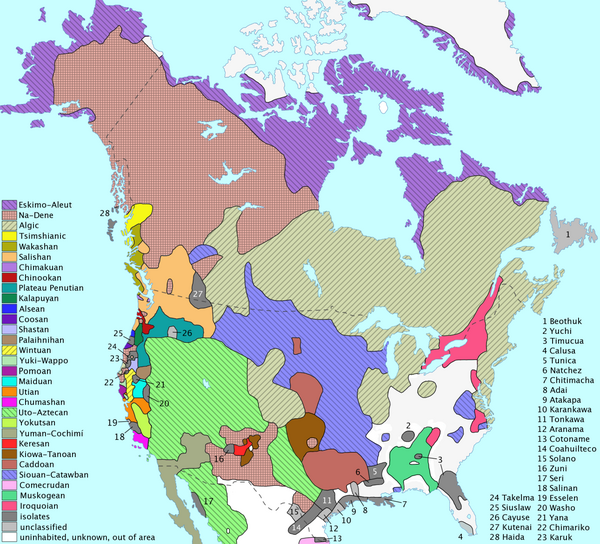
Blue is language family, based on this map of indigenous languages. Of course the brushstrokes here are very broad; and you may imagine many minority languages, extraterritorial enclaves, and dialect continua to complicate the rather simple picture.

Purple is culture, or how closely the ways of life of different people resemble each other, based on this map of how frequently people in different parts of the US communicate with each other.

Green is trade, or how much people in different places exchange goods and services, based on this map of dollar bill circulation in the US.

I traced boundaries around those geographical blocs, superimposed them, and found that some of those blocs correspond to each other. That is to say, cultural difference correlates with trade, communication, and language (I'm not convinced it correlates with religion or ethnicity, but feel free to disagree), with a lot of effect from the underlying geography (the Mississippi River, the Rockies, the Appalachians, and the North-South divide are visible in most maps). The blocks that most closely matched each other I traced around with black borders, trying to match those geographical boundaries as much as possible. The result is the big map you see above. The more different the colors, the more of a change you see going across a border.

You'll notice I haven't labelled the map. That's because this map might represent a lot of different timelines. Maybe no plagues killed off the Native American population, and we're left with a situation like post-colonial Africa ("the Democratic People's Republic of Comanche"?). Maybe this from a timeline where indigenous people domesticated horses ("The Union of Three Fires"?). Maybe European colonists came, but only with medieval technology (the Motherflippin' Gruinmarkt!). Maybe I accidentally deleted my version of photoshop, and sai doesn't do labels. Maybe I want to see what names and histories YOU think should be attached to those countries.

Come on! Let me hear 'em!

This project comes from Dan's to-be-published novel, The World's Other Side. Find out about his other projects on his website. Also find him on Twitter and Deviant art.

Friday, December 28, 2012

Best of 2012

Wow an entire year of blogging about alternate history. 2012 is kind of special since this is the first full year The Update has been active. Thanks to the apocalypse not happening on the 21st (wow the hippies were wrong again) I get a whole new year to keep sharing my love of alternate history with you all.

Since the year is coming to an end, it is time to talk about the Best of 2012. Like I said before there is no scientific selection process about these "awards". No one is voting on anything and several of the works below were not even created this year. This is really just my personal thoughts and feelings on the subjects covered by The Update this year. Perhaps next year we will make a real award since the Sidewise only covers books and short stories.

So without further ado...

Book
The Update is primarily a literary blog so of course we need to start with the best book of 2012. My choice has to be Land of Hope and Glory by Geoffrey Wilson, even though it was published in 2011. It was a surprisingly delightful novel to read and I highly recommend you check it out. As for the books read by our other contributors...ah hell I don't know what to do about those. There are just so damn many of them. Seriously, check out the Book Review page and I will leave that decision up to you.

Franchise/series
We haven't covered many current series this year, although I have been enjoying the reprints of the Anno Dracula series by Kim Newman, especially The Bloody Red Baron. If you want to check out some classic universes of alternate history reviewed this year may I recommend Worldwar (reviewed by Chris Nuttall) and Crimson Skies (reviewed by Sean Korsgaard).

Anthology
The best anthology of 2012 has to go to Substitution Cipher, edited by Kaye Chazan and featuring a short story by our own Tyler Bugg. I have been covering the creation of this anthology since October 2011 and although my own submission was not selected, I am still thankful to Candlemark & Gleam for opening this anthology to the public. It inspired me to write more fiction. Now I got three of my short stories published and a job blogging for Amazing Stories (don't forget, beta testing starts Jan 2nd).

Short story
I thought about giving this nod to "Vampire Romance" by Kim Newman, but since I already gave Anno Dracula the nod for best series, I decided to go with "The Beast of the Bosporus" by Matthew Quinn. It is a fun cautionary tale about why you should not call on the Great Old Ones to solve your problems. Of course, I am not the only one to review a short story this year. Check out the review of "43*" by Jeff Greenfield done by Andrew Schneider.

Non-Alternate History
It is rare, but every once in a while we do feature a publication that does not fit even under the liberal definition The Update uses for alternate history. This year the honor for the best non-AH has to go to the "No Bulls**t Guide to Self-Publishing" by Jennifer Ciotta, author of I, Putin. This quick read is a must for anyone thinking about self-publishing.

Comics
For me personally, I have to go with The Five Fists of Science by Matt Fraction and Steven Sanders. In it Twain and Tesla team up to defeat tentacled evil in this steampunk adventure comic. Of course I would be remiss not to mention Chris Nuttall's review of Star Trek: The Next Generation/Doctor Who: Assimilation 2. I realize I have been promoting this review for three whole days now, but come on, it is doing well in page views. At least I'll promise not to show the cover art again.

Showcase
Speaking of page views, showcases of web original AH are the lifeblood of The Update. They have, until very recently, been our most popular posts. I can't stress enough how much I need showcases to publish on this blog. The people love them and I like to give the people what they want. That being said, how exactly do you pick the best of what is already the best? I decided to share one showcase from each of the authors who submitted one this year (and if they submitted more than one I selected the one I liked the best).

Although biased, I did enjoy the showcase I did for A Crack at Draka, a timeline featuring a revamped history of the Draka. Brian W. Daugherty feature on the extremely detailed Protect and Survive universe also brought light to an amazing piece of nuclear war fiction. Out of all the showcases written by Sean Korsgaard, however, I would have to pick A Giant Sucking Sound. You just don't see that many dystopias from the 1990s. Finally, let us move away from the good folks at AH.com to highlight the work of the editors over at the AH Wiki with Napoleon's World, covered by Tyler Bugg. It is a reminder to us that despite AH.com's vast size, there are other communities out there striving to produce excellent work of AH.

Please send me your thoughts on your favorite web originals. I would love to share them with our readers.

Film
Not a great year for film. As far as I know there were no pure alternate history films released this year (although some people think Django Unchained is one), but you did have a couple that were in the same spirit. I enjoyed Abraham Lincoln, Vampire Hunter and Sean liked Iron Sky as well. Check out both of those movies and cross your fingers that we will see another alternate history film in our future (we have been experiencing a drought since 2011). Hopefully it will be War of the Worlds: Goliath.

Television
Not a great year for television either. The only thing we really had was NBC's Revolution, which if you read Seb's review of the first episode, didn't excite most AH fans. It seemed even the people who liked it spent more time apologizing for the show's flaws and suggesting ways to improve it. People seem to like Elementary, the modern Sherlock Holmes in America crime drama on CBS, but I have not watched it so I can't really comment. Perhaps 2013 will be better when the World War II, alien invasion drama Horizon is produced.

Podcast
Wow this is a tough one. On one hand I really like Twilight Histories by Jordan Harbour. This podcast has some imaginative scenarios and their presentation as a radio play makes this one of the most intriguing sources of alternate history. On the other hand, Series 6 of Dissecting Worlds has showcased a lot of good discussion on alternate history across various medias and I can't forget how nice they guys were when they invited me to be a guest on their American Civil War episode.

I don't know, I just can't decide. I guess you will just have to listen to both of them and decide for yourself.

Essay
Although Chris Nuttall's How to Write and Publish a Novel in Eight Easy Steps is probably one of the best essays I posted on this blog this year, it has little to do with alternate history. If you really want some counterfactual goodness, check out The Economics of a Roman Suez Canal by Christopher Brielman. I love it when writers step away from the great man theory and alternate battle outcomes when crafting their alternate history. Brielman's work needs to be read not just for the quality scenario he crafted, but also because it is an example as to why alternate historians must, must, MUST do their research. If you do, you get something as great as this essay.

Map
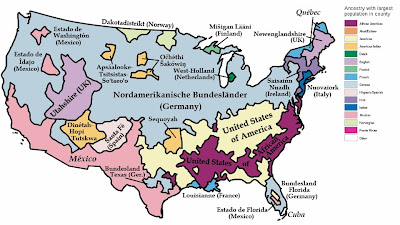
The map of the year has to go to Ben Carnehl:
More thought experiment than plausible alternate history, this map shows what the continental United States would look like if it balkanized along ethnic lines. I really need to do more with maps in 2013. Perhaps a "Map of the Week" post or something similar. Hmm...

Interview
Finally we are on the people awards. This was a difficult category to narrow down. How exactly do you judge the best interview you conducted with someone?

Among the books I personally read, I would have to say my favorite interview was with Roger L. Ransom, author of The Confederate States of America: What Might Have Been?. He crafted one of the most plausible CSA wins scenarios I ever read and it was also refreshing to talk to someone who enjoyed history as much as I do.

Among the books I did not read, I have to pick Rhys Davies, author of Timewreck Titanic. Not only did he have the best bio pic ever sent to me, but you can tell from his answers to my questions that he really put a lot of thought into them. They were a joy to read and I hoped you liked them as well.

Honorable mentions also need to go out to Doctor Quincy E. Quartermain (the biggest fan of alternate history/steampunk I ever met, who also gave me some good pointers about attending SF conventions) and Joe Pearson (the first film maker I ever interviewed).

Contributor
This is another difficult one, but not for the same reasons as stated in the above categories. Everyone who has contributed to The Update is dear to my heart. You guys (and gals) have brought me joy by just believing enough in the mission of this blog that you wanted to help in any way you could. Thank you.

However, if I had to pick, then the honor for best contributor would have to go to Chris Nuttall. He is one of our most prolific reviewers and essay writers. Plus his most recent submissions have been extremely popular, especially with the Reddit community. I can't imagine the number of followers to The Update have been enticed by the works of Chris. Thank you Chris and I hope I get the honor of posting more of your work on this site in 2013.

Conclusion
You know what I just realized? We did not review any video or computer games this year. Huh...really need to get better about that. So many things I wish I could have done. So many topics left uncovered. Not exactly regrets, mind you. Just...lost opportunities. I got a lot of interesting ideas for 2013.

Well guys I hope you enjoyed 2012. You have two more posts before the year is up (an alternate history and steampunk themed Weekly Update) before The Update starts 2013. I hope you are looking forward to the future. I sure am.

* * *

Matt Mitrovich is the founder and editor of Alternate History Weekly Update and a volunteer editor for Alt Hist magazine. His fiction can be found at Echelon PressJake's Monthly and The Were-Traveler. When not writing he works as an attorney, enjoys life with his beautiful wife Alana and prepares for the inevitable zombie apocalypse. You can follow him on Facebook or Twitter.