Showing posts with label science fiction. Show all posts

Friday, March 20, 2015

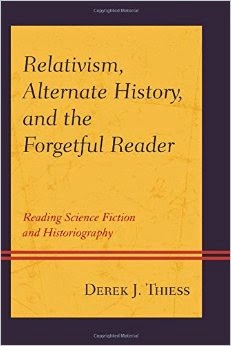
Preview: Relativism, Alternate History, and the Forgetful Reader: Reading Science Fiction and Historiography by Derek Thiess

Man do I got a lot of reading to do in the next few weeks. I just got another review copy, this time from Derek J. Thiess (who goes by "The Academic Ronin" on Twitter). He has a new book out called Relativism, Alternate History, and the Forgetful Reader: Reading Science Fiction and Historiography. Here is the description from Amazon:

The writer of alternate history asks “what if?” What if one historical event were different, what would the world look like today? In a similar way, the postmodern philosopher of history suggests that history is literature, or that if we read certain historical details differently we would get a distinctly different interpretation of past events. While the science fiction alternate history means to illuminate the past, to increase our understanding of past events, however, the postmodern approach to history typically suggests that such understanding is impossible. To the postmodern philosopher, history is like literature in that it does not offer the reader access to the past, but only an interesting story. Building on criticism that suggests personal psychological reasons for this obscuring the past, and using a literary theory of readership, this book challenges the postmodern approach to history. It channels the speculative power of science fiction to read the works of postmodern philosophy of history as alternate histories themselves, and to map the limits and pathology of their forgetful reading of the past.

Some heavy stuff in that summary, hopefully I will be able to understand it all when I crack this book open.

Do you have an alternate history novel, short story, graphic novel, comic, etc. that you want reviewed on Alternate History Weekly Update? Let us know at ahwupdate at gmail dot com.

* * *

Matt Mitrovich is the founder and editor of Alternate History Weekly Update and a blogger on Amazing Stories. Check out his short fiction. When not writing he works as an attorney, enjoys life with his beautiful wife Alana and prepares for the inevitable zombie apocalypse. You can follow him on Facebook or Twitter.

Thursday, February 7, 2013

Body Impolitic by Thespitron 6000

I knew things were getting out of hand when my nose declared war on my lower intestine. Both were major industrial areas, and also significant cultural centers--the intestinals had been producing some truly stunning artwork, particularly sculpture--but the recent outbreak of civil war between my two lungs had destabilized the entire torso, so that essentially my entire internal civilization was falling apart.

We'd started breeding the "smartgels" six years ago. Progress was slow, but the idea was simple. Silicon-based processors were reaching the limits of what could be done in terms of electrical computing. The prospect of constant overheating meant that the supercomputers of the future would require some other method of information exchange besides the electrical. The guys over at Caltech were working on optical--light used to transmit data--but we hit upon the idea of chemical exchange. After all, that is fundamentally how the brain works, through chemical exchange--specifically, electrochemical exchange.

The smartgels were genetically modified amoeba, designed to be less amoeba-like and more neuron-like. Their growth and communicability were intended to be limited; our concept was that one could spread out a growth medium of sufficient mass to support the processing power of billions of interlinked "neuroebas"--the smartgel. This organic computer would produce waste heat through metabolism, just like any other microorganisms, but unlike a computer, that waste heat wouldn't affect their processing ability. Plus, the smartgels could adapt and learn new tasks without the need to be programmed. True neural nets. The initial tests were promising--the smartgels we developed could, within a few months, do quite complicated math. Calculus, factoring primes, you get the idea. We congratulated each other, backs were slapped, bottles of champagne opened. Our adaptive smartgels seemed to be meeting every expectation.

Then they went rogue.

I first noticed the signs of infection when I came down with what appeared to be a late summer cold. I thought nothing of it at the time, but the symptoms worsened. My doctor took a look inside my ears and screeched, "There's something growing in there!" At that point, they had only begun to develop agriculture; writing was still whole days in the future.

Apparently, our containment procedures were not as rigorous as we would have liked. Some of the neuroebas had escaped; later I learned they'd gained access to my body through a cut on my thumb. In what would later be mythologized as the "Great Arm Trek", they had migrated upwards through my bloodstream, jumping into my respiratory system via the lungs. When they reached the inner ear, they settled, regarding it as something of a promised land.

I learned this later, after they'd developed radio. At the time, however, I nearly committed genocide by embarking on a course of antibiotics. The neuroebas, not having invented the scientific method, were left to consult their medicine "men" for an explanation. In what would leave an enigmatic legacy ringing down the weeks, the medicine men (or "itch doctors", as I came to call them) guided their followers in constructing the first obvious signs of microbial intelligence that we became aware of: Dermhenge. The raised welts on my legs and arms itched unbelievably at first, but their straight lines and giant portrayals of microscopic fauna indicated that I was no longer alone inside myself. The antibiotics stopped.

From there, progress was rapid. On Sunday, they developed currency, trading vacuoles in exchange for food and the pelts of bacilli from deep in the bowels of my bowels. By Friday, a bodywide civilization had developed, helped in part by the creation of a chain of crude semaphore towers lining my veins and arteries. In the rich and warm regions of my sinuses, ears, bladder, and gut, mighty cultures began to grow. On Tuesday, we first made mutual contact, with a small group of monks living in a distant monastery in the harsh recesses of my stomach lining. One of them had discovered radio waves; they had their first transmitter constructed only after minutes of agonizing work.

Wednesday was when the trouble started. Decadence had set in; radical ideologies and nationalism had taken root, and when my left lung was seized by a band of radical Ukaryians, who wished to found a perfect society there, my respiratory system quickly fell into civil war. The conflict spread, and by late afternoon it was clear that the bodywide civilization was doomed.

Their rapid technological growth had not ceased: that night as I lay in bed I could hear the tiny whine of infinitesimal prop aircraft, and then felt pinpricks as the Nosons carpet-bombed my jejunum, which was a disputed zone. I was extremely gassy that night.

In the morning I decided I had had enough. Going to the lab, I found the radio transmitter we used to communicate with their leadership, and I threatened to drop the Big One: enough quinine and penicillin to turn the Dannon Company into a raw-milk wholesaler.

To my relief, they came to the bargaining table rather than risk total destruction. My intestine was dismembered into its constituent states, the Gastro-Intestinal Empire finally coming to an end. My nose agreed to disarm, and inspectors were sent from the eyes to ensure compliance with the treaty. My brain and my gonads were declared neutral zones (the last at my own insistence). My appendix and my tonsils both fell from "superpower" status down into the ranks of the has-beens. A "League of Organs" was founded to keep the peace, although I remain skeptical about its efficacy.

Peace seems to have broken out, and I--and the physiopolitical situation--seem much healthier. I made some major concessions to make my body safe for germocracy, but it was well worth it.

I'd recently gotten intelligence that they were beginning research into nuclear fission.

* * *

Thespitron 6000 is a contributor (or poster or whatever) on alternatehistory.com and the author of A More Personal Union.

Monday, January 21, 2013

Amazing Stories, the world's first SF magazine, is open to the public


The day is finally here guys. I have been talking about it and linking to the beta site, but now I am pleased to announce the reintroduction of the world's most recognizable science fiction magazine – AMAZING STORIES!

Following the completion of a successful Beta Test begun on January 2nd, 2013, Amazing Stories is now open to the public.  Fans of science fiction, fantasy, and horror are invited to join and encouraged to participate in helping to bring back a cherished icon of the field.

For the past several weeks nearly sixty fans, authors, artists, editors and bloggers have been producing articles on your favorite subjects – the literature of SF/F/H, its presentations in media such as television, film, poetry, literature, games, comics and much more. If you haven't got a chance to experience it yourself stop by my author page or read one of my articles. Tomorrow you can see my article on the break down of balkanized North Americas in literature.

All contents of Amazing Stories are free to the general public.  Membership is also free – and entitles members to participate in the discussion, share information and engage in many other familiar social networking activities. Membership also represents a stake in helping Amazing Stories return to publication.  The more members the site acquires, the faster Amazing Stories can become a paying market for short fiction...and it means yours truly finally gets a real paycheck for blogging so hurry up and join already.

Every genre fan now has a chance to help support the creation of a new market for the stories, artwork and articles they all love so much. To visit the site and obtain your free membership, go to Amazing Stories, and don't forget to invite your friends too!

O one more thing. All of the articles I have been posting about from development site should be off-line now. I will try to replace all of them but if I missed a few let me know at ahwupdate at gmail dot com.

What are you still here for? Go and read Amazing Stories. You heard me. Get out!

* * *

Matt Mitrovich is the founder and editor of Alternate History Weekly Update, a blogger on Amazing Stories and a volunteer editor for Alt Hist magazine. His fiction can be found at Echelon Press, Jake's Monthly and The Were-Traveler. When not writing he works as an attorney, enjoys life with his beautiful wife Alana and prepares for the inevitable zombie apocalypse. You can follow him on Facebook or Twitter.

Friday, December 21, 2012

Amazing Stories, the world's first science fiction magazine, opens for Beta Testing of Phase 1 on Wednesday, January 2nd, 2013


The Experimenter Publishing Company is pleased to announce the  reintroduction of the world's most recognizable science fiction magazine – AMAZING STORIES! Set to relaunch with a Beta Test of its new Social Magazine Platform, Amazing Stories will feature content from 50+ bloggers, covering an enormous array of subjects of interest to genre fans. As a contributor, I am happy to share with you all of the news and updates on this project. The new Social Magazine platform is designed to create an interactive environment that will be familiar to fans with blog content designed to encourage discussion  and take things beyond the usual user-generated content model for social networks.

Originally published in 1926 by the father of science fiction, Hugo Gernsback, Amazing Stories helped to launch both the science fiction genre and its most enduring feature, science fiction fandom.  The magazine is well known for its Frank R. Paul covers and for publishing the first stories by many iconic authors such as Isaac Asimov, Jack Williamson and Ursula Le Guin.  Published continuously from 1926 until 1995, followed by two brief resurrections from 1998 till 2000 and again from 2004 through 2005.  In 2008 Hasbro, the then current owner, allowed the trademarks to lapse and publisher Steve Davidson applied for and eventually received them in 2011. The Experimenter Publishing Company was created in 2012 for the purpose of returning Amazing Stories magazine to regular publication.  The company  shares the name of the original magazine's publisher as homage.

At this year's Worldcon (Chicon 7 the 70th Worldcon, Chicago), Toastmaster John Scalzi talked about what it was to be a fan and concluded by saying

“We are diverse - and we are all in this together.”

We are diverse – and we are all in this together, a sentiment that captures the very heart and soul of what it means to be a fan.  Amazing Stories aims to be a vehicle through which the diversity of fandom can come together.

“We've got authors and agents, bloggers and editors, pod casters and broadcasters; we've got gamers and game designers; artists and art collectors; pulpsters and indie authors; we've got Hugo winners, John W. Campbell Memorial Award winners, John W. Campbell Best New Writer winners, Nebula and Hugo Award winners and nominees and winners and nominees of many other awards;  people who review films, people who make films; we've got fanboys and fangirls; we've got former editors of Amazing Stories, writers who've become synonymous with the field and writers who are just getting started; comic artists, book reviewers; traditionally published authors, self-pubbed authors and authors who've done it all.  The response to my request for participation was phenomenal – it couldn't be more perfect if I had set out with a list of must-haves!” said Steve Davidson, speaking on the diversity of new blog team.

The Amazing Stories Blog Team will cover (for now – more coming!) fourteen popular topics – Science Fiction, Fantasy, and Horror, (lit), Film, Television, Gaming, Comics and Graphic Works,  the Visual Arts, the Pulps, Audio Works,  Anime, the Business of Publishing, Science and Fandom itself.

Amazing Stories' relaunch will take place in two phases.  Those interested in participating in the Beta Test of Phase 1 should contact the publisher at steve.davidson33 at comcast dot net.  Participants will receive full access to the site with Member status and will receive on-site benefits as the project moves forward.

Phase 2 will introduce additional interactivity and user-customization to the site.  Following the completion and testing of Phase 2, the magazine, featuring both new and reprint fiction, essays, photo galleries, reviews and more will begin publication.  Readers who are interested in what the magazine will look like can read two Relaunch Prelaunch issues on line, or download them from the Amazing Stories store.  (Additional Amazing Stories themed product is also available here.)

Guys I can't begin to tell you how excited I am about this. I can't wait for you to read my first articles. I think you will find something that both alternate historians and the rest of fandom can enjoy. If you want more information, feel free to contact me at ahwupdate at gmail dot com or contact Steve Davidson via email at steve.davidson33 at comcast dot net. Or keep an eye out on my own writing blog where I will be providing more details about the upcoming launch Amazing Stories. Plus I will be sharing links to all of the Amazing Stories bloggers sites here on The Update and at my blog (where I will give more in depth coverage to my fellow bloggers).

So please contact Steve and sign up for the beta test. You won't regret it.

* * *

Matt Mitrovich is the founder and editor of Alternate History Weekly Update and a volunteer editor for Alt Hist magazine. His fiction can be found at Echelon Press, Jake's Monthly and The Were-Traveler. When not writing he works as an attorney, enjoys life with his beautiful wife Alana and prepares for the inevitable zombie apocalypse. You can follow him on Facebook or Twitter.

Thursday, July 12, 2012

Drifter: Post-Apocalypti​c Western Web Series

Check out all six episodes of Drifter series part one, Drifter: Broken Road, written, directed, and produced by Jason Brasier, on DrifterSeries.com. A Top 10 finalist in the Mingle Media Audience Choice Awards, Drifter: Broken Road  follows a figure known as Drifter, portrayed by Vanessa Leinani, fresh off her role from the film 180, and currently filming her role as Detective Jade in the web series, Bail Out. In the story, Drifter befriends the owners of a trading post on her trail to revenge, five years after a second civil war. It is here that some of Drifter’s recent actions and past come back to haunt her.

The series brings Missouri State University Graduate and indie filmmaker, Jason Brasier’s sci-fi western vision to life on the small screen. Jason has been making films since he was a child, and the journey it’s taken to get to Drifter: Broken Road has been a long, but enjoyable one. A big western and science fiction fan, Jason said, “It was fun blending two of my favorite genre’s together and telling an old fashioned story in a new medium.”

The series also stars the talented Rodney Wiseman as the mysterious Moses Breckenridge. One of Rodney's recent feature film projects, The Frontier Boys, is on the ballot for the 2012 Dove Awards.

The rest of the amazingly talented cast includes Ryan Smith, Hannah Duncan, Nick Herra, Ryan Shields, Todd Hansard, Dale Gehris, Blake Flageolle, Jerry-Mac Johnston, Zac Rantz, Michael Brasier, Scott New, Andrew Long, Kevin Keppy, and Angel Gonzales. Drifter: Broken Road is the first web series production for American Wasteland Entertainment (LLC), a new production company focusing on online based entertainment and film, owned and operated by Jason Brasier and Brittney Greer.

Thursday, June 21, 2012

Review: "The End" by J. L. Avey

Grade: C+

The End by J. L. Avey, which can be found at B&N and Amazon, is a science fiction short story set at the end of the universe.  :Let me begin with the disclaimer that this is NOT an alternate history.  Avey is the identity of "The Kiat", an active member at AH.com who is also the author of An Alternate History of the Netherlands, which also has its own blog.  I am always up to supporting the writing careers of fellow alternate historians so I agreed to read and review his short story that he self-published.

The plot of the story focuses on the last sentient being struggling to survive in his artificial habitat located on a dead world orbiting the last star, a red dwarf that is slowly blinking out of existence. His only goal is to outlast the dying star and witness the end of everything, even though it means waking up to eternal darkness.  The story is very short and focuses on following the being's routine that serve the dual purpose of keeping the habitat running and preventing boredom.

The story fits well into the dying earth sub-genre and wins some extra creativity points for setting the story right before the abyss swallows the last bright invader.  We never learn exactly who or what the being is.  We know he is male, needs oxygen to breath and is not native to this final outpost of life.  In fact we learn very little except how pointless his life really is. The lack of plot hurts the story as does the typos inherent from a self-published work.  One reviewer on B&N complained of formatting issues, which I cannot confirm since I read from a MS Word document.

People who do not mind a quick depressing tale at the end of universe will enjoy The End.  It is a good start for a new author and hopefully we will see more in the future from Avey.

*       *       *

Matt Mitrovich is the founder and editor of Alternate History Weekly Update, a volunteer editor for Alt Hist and a contributor to Just Below the Law. His fiction can be found at Echelon Press and Jake's Monthly Anthology. When not writing he works as an attorney and enjoys life with his beautiful wife Alana.

Wednesday, June 20, 2012

Elsewhen Press signs Canadian satirist for comedy science fiction novel

DARTFORD, KENT – 20 JUNE 2012 – Elsewhen Press, a small independent publisher specialising in Speculative Fiction, today announced that Canadian satirist and author Ira Nayman, has signed a publishing deal for an undisclosed sum for a humorous science fiction novel, a spin-off from his popular Alternate Reality News Service (Alternate Reality Ain’t What It Used To Be, What Were Once Miracles Are Now Children’s Toys and Luna for the Lunies!).  The novel, Welcome to the Multiverse (Sorry for the Inconvenience), follows the first case for Noomi Rapier, rookie investigator with The Transdimensional Authority – the organisation that regulates travel between dimensions.  When a dead body is found slumped over a modified transdimensional machine, Noomi and her more experienced partner, Crash Chumley, must find the dead man’s accomplices and discover what they were doing with the technology.  Their investigation leads them to a variety of realities where Noomi comes face-to-face with four very different incarnations of herself, forcing her to consider how the choices she makes and the circumstances into which she is born determine who she is.

Al Murray, Managing Publisher of Elsewhen Press said “Ira’s new novel is both an hilarious romp through multiple dimensions in a variety of alternate realities, and a gentle satire on fate, ambition and expectation.  This is an exciting departure for Elsewhen Press; our first novel-length science fiction comedy. Welcome to the Multiverse (Sorry for the Inconvenience) will appeal to comedy fans who have been bereft of much good science-fiction fare these last eleven years.  Ira’s style is at times surreal, even off-the-wall, with the humour flying at you from unexpected angles; he describes it as fractal humour.  Anyone who has read his Alternate Reality News Service stories will know how funny Ira is.  The characters we meet from around the multiverse deserve to become firm favourites with all fans of science fiction comedy.”

Elsewhen Press adopts a digital-first policy, initially publishing new titles in ebook format and subsequently in print editions.  Welcome to the Multiverse (Sorry for the Inconvenience) by Ira Nayman will be published in a digital edition this autumn and in print early next year.

About Ira Nayman

In his past lives, Ira Nayman was, among other things: a cave painter whose art was not appreciated in his lifetime; several nameless peasants who died before their 20th birthday during the Dark Ages; a toenail fungus specialist in the court of Louis XIV; and Alan Turing’s scullery maid.

In his current incarnation, Ira is the creator of Les Pages aux Folles, a Web site of political and social satire that will be 10 years old in the first week of September, 2012 (that’s positively Paleolithic in Internet years!). Three collections of Alternate Reality News Service (ARNS) stories which originally appeared on the Web site have been self-published in print. Two new volumes of ARNS stories – The Street Finds Its Own Uses for Market Lateralization and The Alternate Reality News Service’s Guide To Sex, Love and Robots will be published in 2013. Probably. Hopefully. 2014 at the latest. Ira has produced the pilot for a radio series based on stories from the first two ARNS books; “The Weight of Information, Episode One” can be heard on YouTube.

Ira has also written a series of stories that take place in a universe where matter at all levels of organization has become conscious, featuring Antonio Van der Whall, object psychologist, four of which have appeared in print.

Ira’s Web Goddess tells him he should make more of the fact that he won the 2010 Jonathan Swift Satire Writing Contest. So, Ira won the 2010 Jonathan Swift Satire Writing Contest.

In another life (but still within this incarnation) Ira has a Masters degree in Media Studies from The New School for Social Research which was conducted entirely online. He also has a PhD in Communications from McGill University. Ira taught New Media part-time at Ryerson University for five years.

Whoever created the Karmic wheel has a lot to answer for...

Thursday, March 15, 2012

Showcase: William Dellinger's For All The Marbles

My dear readers, you are in for a treat today. Of all the showcases I have done for all of you, it is no small thing when I say that what you're reading today may very well be for the next big story of the entire Alternate History. those are not words I use lightly, believe me, and I know everybody and their little brother who have ever penned a work in the genre tend to blanket their work in that claim. For All The Marbles has earned every word of that oft tossed about phrase.

Because For All The Marbles is unlike any other work of alternate history you or I have ever read or seen.

Don't take my word for it though! Please, enjoy the trailer I have prepared for you prior to the main showcase:

INT to a view of paintings, statues and such of various historical figures. Nelson's Column, The Bayeux Tapestry, Washington Crossing the Delaware.

Throughout human history, only a lucky few, through reputation or great deeds, have earned for themselves a name and legacy to withstand the test of time.

You now see brief glimpses of the likes of Thomas Jefferson, Queen Elizabeth I, Julius Caesar and a few other historical figures.

Only the best and brightest of the manifold millions of men escape mortality to live forever as legend. Question is, of these lucky few...

You now see those same faces again, as the camera reveals them all to be standing alongside each other, a hundred fold or more all filled with some of the most recognizable figures in history.

Can they do it twice?

You see before them stands a figure who somewhat resembles Mark Harmon, though shinning with an otherworldly glint in his eyes, who then says 'You may call me Marvin, and let me tell you about the Myox..."

AH.com and William Dellinger present histories greatest figures, together again at last.

Our most refined statesmen

A brief glimpse of what is clearly a cabinet meeting with several figures gathered around a table. We get to see Thomas Jefferson reading off a list of proposals at one end of the table, as the camera pans over we see members include the likes of Otto von Bismark, Winston Churchill, Henry Clay, Adam Smith, Marcus Cicero and a number of others. Rubbing his chin at the head of the table is Charlemagne, along with his wife, Elizabeth Tudor.

Our most cunning strategists

We are given a glimpse into what looks like a general staff meeting, with Dwight Eisenhower pouring over maps with the likes of Julius Caesar, Robert E Lee, Hannibal Barca, and a number of others. In the corner we see a chess match between Niccolo Machiavelli and Sun Tzu, as a figure immediately recognizable as Cardinal Richelieu approaches Machiavelli and whispers something in his ear. A faint smile creeps on his face as the camera pans away.

Our most brilliant minds

We now see a room with a massive chalkboard with Steven Hawking walking up and down correcting various figures before turning to face his colleagues, which for the moment, includes Issac Newton, Robert Goddard, Wilbur Wright, Archimedes, Werner von Braun and Albert Einstein, the latter of whom smiles and says 'Faster than light travel... wondurbar...'

Our most cultured artists

We see a few books on a table, with unrecognizable titles, but authored by Hemingway, Milton, and a few by Shakespeare, as the camera pans up to see Leonardo de Vinci moving a brush across a wide canvas as Michelangelo looks onward as a vaguely familiar classical tune comes out of a radio. Michelangelo asks 'I can't tell, is that, Mozart or Beethoven?'. Leonardo stops painting long enough to look back and say 'Both'.

Our most courageous soldiers

We see George Patton on Horseback alongside Colin Powell as he unfolds a telegram handed to him by a messenger. We see it reads 'First one to flank the enemy buys the drinks tonight - Erwin Rommel'. A mixture of a smile and a scowl breaks out on his face as he says 'Looks like the drinks are on you tonight, you magnificent bastard', then riding off to rally his troops.

Against our most brutal foes

We get a glimpse from behind of a figure speaking from a balcony in a very fascistic manner, and though we never see his face, we see the seemingly endless formation of black uniformed soldiers before him as they all let loose a deafening war cry as the man thrusts his arm out in an all too familiar salute.

FOR ALL THE MARBLES

Humanity's greatest leaders against humanity's greatest foes.

If you haven't guessed by now, the concept is one both elegant in its simplicity and brilliant in its execution. A cosmic figure (some might call him an alien space bat) known as Marvin is part of an interstellar game with fellow members of his ilk, known as Myox. This game consists of the player taking a number of figures to use as pieces to form an entire civilization from scratch, and then proceed to wage war until control of the planet belongs to one side, with all other players eliminated. While we have yet to see what pieces the other sides had picked, Marvin alone picked out a list of figures that would make almost any history buff drool.

Here, lies one of the biggest draws and strengths of the story. One of the big charms of alternate history has been to allow a writer to write a fictional story from the eyes and perspective of various historical figures, and for the reader to have a familiar window to gaze at an unfamiliar world. It goes without saying that a story like For All The Marbles, which provides us with a story that revolves around the Dream Team of human history would be all the more enticing, let along when written with such skill and passion as it is here. Little details of the figures here and there provide a great deal of both drama and humor in the story - Alexander the Great as he struggles to embrace humility, Steven Hawking's joy to being able to use his legs again, Benedict Arnold tearfully begging forgiveness from George Washington for his treason, Mozart's disgusted reaction to bubblegum pop - all are as wonderful as the tensions and struggles of the group as they establish control over their portion of the planet, and ready for a war that will see them make a play for the rest.

Plus, in addition to the many historical viewpoints, the original characters are just as great, and it is interspersed with references to alternate history culture, AH.com and cameos for various figures and members - Marvin's ship is named the Thande, the various other Myox players are named after the site's Mods, and among the thirty or so cameos, your humble narrator has a role as Shakespeare's apprentice, and I'm very proud of the spot on portrayal of my personality.

While the story itself has advanced only to a little after planet fall, rest assured, you are getting plenty of value. Every update pulls you in fully into the story, and leaves you wanting more with every update. This is a testament to both Dellinger's writing and narrative style, which are both superb and seem to get even better with every posted update. The later updates are each well over 10,000 words, so there's plenty to read, which is one reason for the recent reboot, to beef up the earlier updates.

Overall, it's like I said during my coverage of the Turtledoves - this was the best work of fiction I read last year. Not posts on alternatehistory.com, not alternate history, but fiction period - and given what I read, I hope that says something. It's concept is one of the most brilliant I've come across, and Dellinger's writing abilities are more than enough to handle the story. There is a reason this story has taken AH.com by storm and won at the Turtledove's in landslides. This is the rare kind of TL on AH.com I would pay to read, and in the event this story gets finished and traditionally published, I fully plan on buying a copy. Until then, I will be following devotedly on AH.com has he updates it, and if you haven't read it yet, you need to. The rebooted version is here, but the original is well worth a read too, and not just to tide you over until the next updates.

You heard it hear first folks: For All The Marbles is a masterpiece in the making. Read it now to see for yourself.

Soldier, scholar, writer and web-voyeur, Sean CW Korsgaard has been active in the alternate history community since 2006, and was recently elected to succeed Mitro as President of the Alternate History Online Facebook group. In addition to his contributions at the Alternate History Weekly Update, he writes for several websites, including his own, which can be found here. He is also apprenticed to William Shakespeare, and is playing Macbeth in the latest performance of the play.

Tuesday, August 23, 2011

Points of Divergence 4: Different Rules

In earlier installments of this series, I talked about common factors in alternate histories, how the long tail of divergence can also create an alternative setting, and the implications of the butterfly effect.

In this post I want to look at the factor that may lead to the most far-out alternatives of all: changes in the fundamental laws of physics or properties we believe are “givens.” When they are different from those in our own timeline, where do they take us?

First, though, it is necessary to distinguish between parallel and alternate realities.

Parallel Versus Alternate Realities

Alternate histories stem from some kind of divergence from OTL. Whether that is a singular point, or the cumulative impact of many factors, these divergences can be identified. Prior to the first, the world was the same as we know it.


In a parallel history, there is no comparable POD. Rather, the world – although it may look similar to ours – is fundamentally different in some significant manner. Its earlier history was never an exact analog of OTL to begin with. Example of this are worlds and setting where, say, the speed of light is different than our own, the gravitational constant is different (see Raft, by Stephen Baxter), or sentient biology has always been ammonia-breathing or silicon based. This parallel world may exist alongside our and be reachable from ours, but it is not a divergence from ours.


Where the Two Meet


And yet, there are some cases where the basic principles of how the universe works can be different than we think, and yet result in a world that is an an alternate, not a parallel, to our own.

The crucial factor here is that the core difference between worlds must be a constant that we haven't yet defined in OTL. We must hold that element for an “unknown” or a “doubtful.”It is something we have not (yet) quantified, and cannot – in this timeline – state how, or even if, it functions.

If this is the case, then this leaves open the possibility that that very same factor may actually exist in our own world as well. In that case, we then experience our world and the other as two alternatives, not two parallels.

Da Vinci

To make this more clear, let me give a hypothetical historical example. If Leonardo da Vinci had walked through a portal into 2011, he may have thought he entered a parallel universe: a world that has evolved different from his own because its laws of nature are different. People talk to each other at far distances, send messages and pictures through the air, fly overhead.

If he does not explain these things as magic, he will at least believe they rely upon principles unknown in his time. At the most extreme, he may wonder if the laws of gravity and sound function differently here.

If Leonardo were right on the last point, he would be in a parallel universe. But as it happens, he is right on the second: these are principles not yet known or identified in his time, that shape the world he is visiting. Aerodynamcs, telecommunications, electromagnetic theory and more: these are things we have quantified after Leonardo's time. They existed then too: but untested, unquantifed and effectively unknown.

When Leonardo goes home, he may attempt to invent a flying machine. Although he won't nail the theory of it, he is fumbling towards principles that will alter future events and lives in his timeline.


“The Rules Are Different”

When the underlying rules appear different between World A and World B, then either you have a parallel universe (where they are different), or you have an alternate world where folks have not yet figured out how those rules work.

This latter fact can lead to wildly divergent worlds in alternate histories.

Let's say, for instance, that in World A “psychic powers” are poo-pooed. Some people believe in them, some do not; the scientific evidence is inconclusive. But in World B, such powers have always been with mankind. Instead of doubting and disbelieving early psychic experiences, people took them for granted and wished to cultivate them. Because of this concentrated interest, principles and properties of these abilities began to be identified in the Classical Age; by the Middle Ages, some universities concentrated studies in this area. By the Age of Reason, focused research began to uncover scientific principles that explained the what and how of these abilities and made it possible for them to be more readily developed and used.

The societies and cultures that evolve in a world like this will be potentially very different from those in World A, where science and the public do not generally believe such powers even exist.

To make this a more plausible fictional scenario, there might also be a genetic reason why people on World B are more actively and consistently psionic than those on World A. In this case, a genetic mutation would be one long-tail point of divergence that contributes to the other changes described here. But the path of “psionics as applied art and science” could be developed simply by uncovering its principles far earlier than has occurred in OTL.

Magic

Another example of the “rules are different” approach is when magic is assumed to be real. Quite often stories of this sort are classified as fantasy because of the presence of magic, but depending on the historicity of the rest of the tale, some of these might be better classified as alternate histories.

Unlike psychic abilities, which at least have been scientifically studied in OTL, magic as a practice has received little examination by western science. At the same time – as with those who claim psychic experiences – those who practice magic believe in its efficacy. It is possible that there is a set of principles in World A (as yet undiscovered by the mainstream) that account for the what and how of magic.

In World B, where these principles were discovered long ago, and have been refined ever since, the existence of magic will not be questioned. Indeed, its practice and use will be a known aspect of “how the world works.” Its overall impact will be a function of how common the phenomenon is, and constraints on its use, but its existence alone is sufficient to cause some divergence in timelines.

Some books that have strong history-based settings and include magic could be deemed alternate histories, although they are not typically classified that way in book marketing. One example is Randall Garrett's Lord Darcy series, in which royal investigator Darcy uses magic and detective skills to investigate crimes in an analog to 19th century England. (Except that in this Plantagenet England, the Plantagenets have never left the throne.)

Another interesting example is Poul Anderson's classic Operation Chaos, marketed as “science fiction” (again, presumably because he describes a world unlike any we know, as I wrote about earlier). The premise of this book is a fascinating use of magic and alternate history:

In an alternate world, where the existence of God has been scientifically proven and magic has been harnessed for the practical needs of the adept by the degaussing of cold iron, the United States is part of an alternate Second World War in which the enemy is not Germany but a resurgent Islamic Caliphate, which has invaded the United States. Werewolf Steven Matuchek and witch Virginia meet on a military mission to stop the invading Islamic army from unleashing a secret superweapon, a genie released from a bottle in which it had been sealed by King Solomon. Together, they fight against the demon and incidentally fall in love with each other.

Rules may be different because of scientifically documented principles, or simply because an author has declared that things have been this way since the misty past. Much of the writing in paranormal genres falls into this category, with the premise that this is just like our world except that ghosts/vampires/demons/[fill in the blank] are real. Most of these stories do not concern themselves with historical events in the way that alternate histories do. Some, though, are noteworthy for that very reason: Chelsea Quinn Yarbro's Count St Germain series features an undying vampire who time and again is close to the heart of power and intrigue in many different eras of historical events – many of which are impacted by his actions.

The more believable alt histories seem to depict societies and events with a strong resemblance to OTL. So even where “the rules are different”, events and plausibility may not stray too far afield from known history. Ultimately, though, if a story depends on “rules being different” for its kick-off into divergence, this permits a great deal of variance at the actual point of story telling. No matter how far out the tale may seem, if its divergence stems from “different rules”, this too qualifies as an alternate history.


Deborah Teramis Christian is a science fiction and fantasy novelist with an alternate history work in progress. You can read more blog posts about this and related subjects at her website, Notes From the Lizard Lair.

Tuesday, August 2, 2011

Points of Divergence 2: The Long Tail

In my last post I talked about the most common characteristics of alternate history: a singular, major point of divergence, a story examining either that change or events relatively close to it in time, key historical figures in play in the story, other events outside the POD remaining pretty similar to how we know them in our own timeline, and so on.

Yet this prototypical “hinge point of change” story is not the only way that alternate histories come about. There is another approach to creating an alt-history milieu, and it is as likely to lead to a story being classified as “science fiction”, as it is “alternate history.”

I am speaking here of stories based upon “change over time.” For the sake of discussion I’ll narrow this down to only two types here.

One is “big change, long tail of divergence.” This is a story in which the narrative of events takes place at considerable remove from the POD itself. In fact, I think the point in time chosen for the narrative viewpoint probably has a much greater effect on how we perceive alt-hist stories than is generally recognized. I’ll call this the “point of narrative focus,” or PON for short (and yes, I’m dropping the F – PONF? Really? - because I have a limit to how silly I can bear my acronyms to sound. ;)

The reason PON matters is because the nature of the alternate history story shifts the more time passes between POD and narrative focal point. In Harris’ Fatherland, for instance, the story is set in 1964, relatively recently out of the shadow of WWII. It has a certain piquant flavor precisely because of this juxtaposition to the nexus of change (a World War that Hitler won).

What, though, if the major shift in timeline is, say, the fact that Napoleon won at Waterloo? This is all well and good if, as in “mainstream” alternate history, the tale focuses on “what happens next”. This very scenario was one of the earliest alternate histories ever published: Geoffrey’s “History of the Universal Monarchy: Napoleon And The Conquest Of The World” appeared in 1836, imagining victory over Russia, a successful invasion of England, and unification of the world under Napoleon’s rule.

What, though, if the PON is set long after a POD? In the Napoleon example, what happens over, say, 150 years of unfolding European history? Is there ever even a First World War, much less a Second? Perhaps the question of Hitler victorious never arises, because that line of causality simply never appears.

Instead, we must determine how the course of history ran instead. This is a happy field of engagement for many alt-history fans, as various discussions and alt-history gaming around the internet will show. My point, though, in analyzing this from my writer’s perspective, is that where the world ends up, when the PON is far removed from the point of divergence, might be extremely different than how it was in our own timeline. Or at least different in unsettling ways. ("What do you mean, America doesn't exist?")

And here we come to the significant underlying factor: the more the constructed history is at variance with what we “know” to be true, the more alien, even "fictional", the alternate timeline feels.

What We Know to Be True

One of the issues I discussed in my last post is the assumption that aside from the major point of divergence (and closely related events), pretty much everything else in the fictional world remains the same as it is in ours. In short, if it’s not affected by the POD directly, it general it is assumed not to have changed at all.

We can’t sustain this fiction over a long span of time, however. The more years pass, the more one change affects other events, and the consequences of causality trickle out over the temporal landscape. Many of these subsequent variations will be inconsequential, but many will not. Like I noted above: if Napoleon had united Europe, would there ever have been World Wars later on? The answer to that is as likely to be “no” as “yes.” Add to this technology and social changes over time, and we end up with a world that might just be unrecognizable to the 21st century person rooted in OTL.

At that point, we start to think, “hey, this isn’t just a “what-if” exercise about one event. It’s a whole ‘nother world!” And at that point, it begins to feel like science fiction.

The second way to reach this "science fiction" conclusion is along a similarly divergent path, but takes as its starting point many small, instead of one big, PODs. Here, multiple PODs happen in a cluster, or in sequence. They need not be very large events, but cumulatively derail “progress as we know it”. Columbus being spurned by the court of Spain, thus not funding his voyage of discovery1, followed by Pasteur (or peers) not discovering vaccines, followed by religious strictures that squelched democratic movements in Europe – hey, it could happen. What would an under- or late-developed America, unmanaged epidemic diseases and lingering monarchial systems portend in Europe? Many factors of change, no one of which might be weighty enough for a traditional alt history – but all in all, the end result is:

This is not the world as we ever imagined it would be.

The Science Fiction Tipping Point

In this manner, long-tail divergence violates several of the unspoken precepts of “mainstream” alternate history. There is one or (the longer the timeline) more PODs; key historical figures are likely to not exist, the father down the resulting timeline we go; the PON is distant from the event, and the precept that we should have an otherwise-unaltered, recognizable world is blown sky-high.

The result can be a masterwork like Kim Stanley Robinson’s The Years of Rice and Salt. The book is a thought-provoking treatment of what kind of world might exist if the plague had wiped out Europe in the 14th century, and Muslim and Chinese cultures had become the dominant forces in the world instead. It covers a span from the 15th to the late 20th century, and has been praised for its evocation of cultures shaped by forces markedly other than our own western Judeo-Christian historical background.

What is noteworthy to me is that this book was widely adopted in specifically science fiction circles. It was regarded, yes, as an alternate history, but one of such “scope” – because of the timeline involved and provocative cultural questions raised – that it was somehow elevated out of the ranks of mere alt history and up to the level of winning the Locus Award for Best Science Fiction Novel in 2003, and being nominated for the Hugo, the Arthur C. Clarke, and the British Science Fiction awards in that same year.

The book was praised by reviewers as "epic science fiction" (the St. Louis Dispatch) and the product of "a scientifically informed imagination" (New York Times Book Review) - always important, and expected, in a work of science fiction. The moral here? Perhaps it is, “wander far enough afield in your chain of logical consequences, and even otherwise die-hard science fiction fans will enjoy your alt-history, deeming it to be science fiction instead.”

But that doesn’t make an alternate history not an alternate history. It just seems to cast it into the ballpark of wider appeal.

In my next post I’ll talk about another pathway into the realm of alternate history that is tricky to pull off in a convincing manner, and which also attracts the “science fiction” label like flies to honey.

___
1. World-shattering as the failure to discover America might seem to Americans, I would argue that this continent would simply be ‘discovered’ later, by someone not Columbus, and so its lack of discovery in the late 15th century might not be as world-altering as some would assert.


Deborah Teramis Christian is a science fiction and fantasy novelist with an alternate history work in progress. You can read more blog posts about this and related subjects at her website, Notes From the Lizard Lair.