Showing posts with label What If Wednesday. Show all posts

Wednesday, September 23, 2015

What If Wednesday: Atlantropa

Last week, Ricarda Vidal published an article on Real Clear World about German architect Herman Sörgel's early 20th century plan to build dam across the Strait of Gibraltar containing a massive hydroelectric power plant. Sörgel argued that this dam would provide free energy to the nations of Europe and open up new land due to the retreating Mediterranean Sea, which would be partially drained. There was also a plan to dam the Congo River, which would refill Mega-Chad basin around Lake Chad, thus allowing the Sahara to be irrigated and open Africa to further colonization by Europeans. This new mega-continent would be called "Atlantropa".

The hope was that the massive amounts of time and resources needed to accomplish this goal would discourage nations from war and further solve the energy and unemployment problems plaguing Europe in the 1920s and 30s. Sörgel's grand idea of peace and prosperity, however, never came to fruition. In his article, Vidal used the Atlantropa plan to criticize Europe for failing again to cooperate to solve their communal problems in light of the ongoing refugee crisis.

The problem with Atlantropa is that despite its utopian ideals, it sounds more like a plan Lex Luthor would come up with to make a fortune through real estate. There are also other reasons for why Atlantropa never worked out in spite of European cooperation. For one thing the partial draining of the Mediterranean would have ruined the economies of coastal cities in the region. The Suez Canal would also need to be extended and while Sörgel planned for that in his vision, worldwide shipping would be disrupted as people waited for the extension to be completed. On top of that, any new land created from the draining sea would just be salt flats that would not be able to support agriculture.

All of that aside, doing my own preliminary research on Atlantropa made the whole idea seem less utopian and more racist. Sörgel had a very Eurocentric view of Africa, seeing it as a land that was only there to be exploited by Europeans. What would have happened to the peoples and cultures of Africa after they were displaced by climate change and European colonization didn't seem to concern Sörgel or his supporters. There also was a level of paranoia in the plan, which argued Europeans needed to resources of both the Middle East and Africa to protect themselves not only from America, but also the nations of Asia. In fact, if Wikipedia is to be believed, Hitler himself said the idea was in line with Nazi ideology.

Yikes. Now to be fair to Vidal, knocking an idea down from the 1920s and 30s just because the Nazis thought it was a good idea perhaps isn't a valid argument. For example, the world certainly benefited from Germany's research into rockets and were bizarrely pro-animal rights. That being said, when you begin to imagine the sheer number of people who could have died or have their lives ruined in one way or another if the Europeans went ahead with Atlantropa, reminding them of it is not a good idea if you are trying to get them too cooperate.

So what does Atlantropa have to do with alternate history? Well several books have referenced a plan to dam the Mediterranean, even if the project wasn't the focus of the story. The Man in the High Castle by Philip K. Dick and the Domination series by SM Stirling are two good examples. Perhaps its not ironic that the two groups who went through with it were the aforementioned Nazis and the Draka, a culture where readers often root for the Nazis to beat them. Harry Turtledove also tackled Atlantopa in his novella "Down in the Bottomlands", although in this story the Atlantic Ocean did not reflood the Mediterranean Sea, creating one of the harshest deserts on Earth, instead of it being a man made phenomenon.

Certain utopian ideals continue to have subscribers because on their face they make a certain amount of sense. Atlantropa, however, is not one of those utopian ideas. Its pointless, racist and, since the rise of nuclear energy, obsolete. Using it as a means to remind Europe of what happened last time when they didn't cooperate, undercuts the entire argument. I personally find the Franco-British Union of WWII or the original goals of the League of Nations to be a much better argument. Let Atlantropa, on the other hand, remain a footnote in an alternate history.

* * *

Matt Mitrovich is the founder and editor of Alternate History Weekly Update, a blogger on Amazing Stories and a Sidewise Awards for Alternate History judgeWhen not writing he works as an attorney, enjoys life with his beautiful wife Alana and prepares for the day when travel between parallel universes becomes a reality. You can follow him on FacebookTwitter and YouTube. Learn how you can support his alternate history projects on Patreon.

Thursday, September 3, 2015

Top 5 Posts from August 2015

Do you see that map right there? The map you see before you has introduced more people to alternate history and Amazing Stories than I can ever hope to reach in a lifetime. No wonder it's Map Monday post was the most viewed post from last month. (Spoiler alert, I guess.)

With that said, let's look at our top five posts from August 2015:

1) Map Monday: A map where Europe never discovered America by liminalsoup by Matt Mitrovich.

2) Weekly Update #200: Special Announcement Incoming by Matt Mitrovich.

3) 7 What Ifs About An Earlier WWI by Matt Mitrovich.

4) Map Monday: The Baltic Region by False Dmitri/Ben Carnehl by Matt Mitrovich.

5) What If Wednesday: The Last English King of England by Matt Mitrovich.

If you would like to see more high quality alternate history reviews, news and commentary from me, please consider becoming one of my patrons.

* * *

Matt Mitrovich is the founder and editor of Alternate History Weekly Update, a blogger on Amazing Stories and a Sidewise Awards for Alternate History judgeWhen not writing he works as an attorney, enjoys life with his beautiful wife Alana and prepares for the day when travel between parallel universes becomes a reality. You can follow him on FacebookTwitter and YouTube. Learn how you can support his alternate history projects on Patreon.

Wednesday, August 26, 2015

7 What Ifs About An Earlier WWI

Last week, George Dvorsky shared seven possible points of divergence for an earlier WWI. After reading an article I couldn't help but imagine what would happen if war actually did break out because of one of the many incidents shared by George. So I wrote them down and I am now sharing them with you.

Quick disclaimer: these aren't meant to be the absolute most plausible scenario that could have happened. These are just possible scenarios created over a weekend by someone with a lot of imagination and very little research. If you have your own ideas, please share them in the comments.

Lets begin...

#1: The War-in-Sight Crisis (1875)

Cooler heads do not prevail during the War-in-Sight Crisis and Britain, France and Russia decide they can't have peace with a united Germany. They are joined by Austria-Hungary, who want to get back at Germany for their defeat in the Austro-Prussian War. The Germans hold their own for several years, but eventually surrender against the combined forces of Europe. Germany is dismembered, although Prussia still maintains large parts of northern Germany. Prussia will try a couple more times in the future to unite Germany, but will always fail and always lose more territory in the process.

Today German nationalism is only really popular in the rump Prussia, with the other German states preferring their local identity over Pan-Germanism. This is important to their survival since the monarchist-clerical alliance led by the Kingdom France and the Imperial Federation of Austria don't want any trouble from that corner of the globe. They have enough trouble opposing the Anglo-American-Russian republican coalition, especially after their last attempt to reinstall the House of Saxe-Coburg and Gotha to throne of Britain failed miserably.

#2: The Fashoda Incident (1898)

An argument between the British and French commanders at Fashoda leads to the British commander being taken prisoner and shots being fired after British forces came to his rescue. Coupled with the heated rhetoric from both sides, war erupts between the two traditional rivals. Russia comes to the side of France, who signed a secret alliance with them earlier, as does Italy, who found this a good of chance as any to grab as much colonial territory as they could from Britain. Surprisingly, Germany and Austria-Hungary join on the side of Britain, who see France and Russia as greater threats to their sovereignty. Japan also joins the Anglo-German side, but just so they can swallow up as much French and Russian territory as they can. After years of war, the Anglo-Germans and their allies defeat the Franco-Russians and their allies. France and Italy lose much of their colonial empires, while Russia is forced to cede territory to its neighbors as well.

Decades later, right-wing governments come to power in France, Russia and Italy and try again for revenge in a Second World War. They actually managed to overrun Germany and Austria-Hungary, before a combined force of Britain, Japan and the United States breaks their hold over Europe, but not without copious amounts of nuclear weapons. Today Europe is still recovering from the nuclear onslaught it faced while the Anglo-American alliance fights for influence with the Empire of Japan. Thankfully, both sides in the struggle have seen the dangers of nuclear warfare and have agreed to limit their atomic arsenals...but not get rid of them entirely.

#3: The Russo-Japanese War (1904-05)

More British fisherman die during the Dogger Bank incident and it incites the British public to war. After the Royal Navy drives the Russian fleet back to the Baltic. France sides with Russia, but Germany and Austria-Hungary join on the side of Britain (Japan, meanwhile, couldn't be happier that Russia now has a war back east to deal with). The Anglo-Germans are eventually victorious, but leftist revolutions in Russia and France lead to the creation of Marxist governments in both countries. As soon as they secured their rule, both government began working together to undermine the power of imperialists who defeated them.

Eventually the Anglo-German alliance become fed up with all of the social unrest in their nations and colonies caused by the Franco-Russians and decide another war is in order to end their threat. Neither is prepared, however, for the amount of preparation France and Russia made for this moment and that, coupled with rebellions and general strikes behind Anglo-German lines, leads to a victory for the Reds. Marxism spreads across Eurasia and Africa, only contained by the American-Japanese alliance. That alliance is starting to fray at the edges, especially as the Reds use Japan's harsh treatment of its subject peoples as propaganda. Some American politicians and generals are beginning to think that it would be in their nation's best interest to incite a war between Japan and the Reds, but one where they sit out and rebuild the world afterwards.

#4: The First Moroccan Crisis (1905-1906)

In a surprising turn of events at the Algerciras Conference, German diplomats actually manage to come to an understanding with France and Russia, keeping Morocco independent, but open to all nations, while forming a new military alliance: the Quadruple Entente (Austria-Hungary was allowed in as well). Britain, finding itself suddenly isolated, rejects the decision at the Conference and, after a period of increased tensions, finds itself at war with all of Europe. With the Royal Navy bottled up at the Home Islands by Entente forces, the British watch in horror as their Empire is overrun. At the end of the war, all of British territory is divided among the Entente powers and their allies, except for Ireland, Canada, South Africa, Australia and New Zealand  The United States also invoked the Monroe Doctrine and occupied British territory in the New World to keep it from falling into Entente hands.

The defeat in the Great War led to a total collapse of British society. A long civil war ended in the rise of a totalitarian government that sought to isolate Britain even further from the world and control every aspect of its citizens lives. A cult of personality formed around the position of Grand Minister that was passed from father to son, while the British poured vast amounts of money into weapons programs, even if it meant their people starved. At first the rest of the world tried to ignore what was happening on Britain, but after evidence was uncovered that the British were selling weapons of mass destruction to other rogue nations, the world decided they couldn't ignore them any longer. In 1984, the Entente, along with America and Japan, invaded Britain and overthrew the government. The leaders were tried for humans rights abuses and international aid poured in to alleviate the suffering of the British people, but the indoctrination program of the government was so prevalent that many British citizens still backed their former rulers, leading to a long occupation by the international force that is still ongoing.

#5: The Casablanca Incident (1908)

Three German deserters from the French Foreign Legion are arrested by the French, but in the process one of them dies. The event leads to war between Germany and France, with Austrian-Hungary and Russia, joining their respective allies. Britain, however, decides to sit this one out and the war drags to a status-quo peace. Both Russia and Austria-Hungary collapse and shaky democracies arise in their successor states. Germany also becomes a constitutional monarchy, while France came under the control of a socialist government that seeks to disentangle themselves from world affairs. Deciding they couldn't handle the strain of maintaining their colonial empires, the exhausted powers give their colonies independence. The British aren't happy with decolonization, but nevertheless decide they don't want to fight long-drawn out colonial wars and free their colonies as well. Europe turns into a sleepy backwater where not much happens and, to be honest, the people like it that way.

The same can't be said about the rest of the world, Other powers tried to fill the power vacuum left by the Europeans and the increasingly isolationist Americans. Japan and India, which was never partitioned, fought several bloody wars over China, dividing that region between several tiny states. Africa also had several regional conflicts as the Brazilians and the united Arab state battled for influence. There is a growing fear that an Indian/Arabic alliance and a Japanese/Brazilian alliance could lead to another global war if something is not done soon.

#6: The Bosnian Crisis (1909)

Russia refuses to back down over the Bosnian annexation leading to war breaking out between the Entente and the Central Powers (Germany, Austria-Hungary and Italy). In a surprising turn of events, the Ottomans find themselves on the Entente side, although they don't profit much in the short-term from the victory over the Central Powers, but it begins a new era of peace and understanding between Russia and the Ottoman Empire. Meanwhile, both nations reform themselves from the inside. Russia becomes a constitutional monarchy and works to unify the Slavic people into a union that becomes Pan-Slavia. The Ottomans do the same, except they seek peace and unity among all sects of Islam. After making a deal with the secular Arabs, the Ottoman Empire is transformed into the Islamic Federation.

Although there was a few close war scares, the Russo-Islamic bloc has managed to stay at peace with the Western powers, even after decolonization set in and many Muslim majority nations joined the Islamic Federation. Even without major ideological differences, things aren't always peachy between the great powers, but they are more friendly rivals than outright enemies. A new age of imperialism, however, is beginning now that the crescent moon has been raised over the actual Moon.

#7: The Agadir Crisis (1911)

When the German warship Panther mysteriously blows up off the coast of Morocco, the French are blamed and war begins between the Triple Entente and Triple Alliance. The war in the west breaks down into bloody trench warfare, but on Christmas, a truce happens on one stretch of the front that soon spreads from the English Channel to Switzerland. The high commands are puzzled and then horrified as the truce continues to last in the days to come. Attempts to get the troops fighting again, ranging from officers shouting at subordinates to firing on their own men, incites all the soldiers to turn on their generals and politicians. A unified, international army spreads across the continent. Forces on the Eastern Front join in and even Britain falls when the Royal Navy mutinies in support of the rebels. A new democratic European Federation is established to ensure universal liberty, rights, and equality, and to share knowledge and resources in peaceful cooperation.

Although not all of the Federation's Utopian ideas stood the test of time, it still managed to prove their detractors wrong by surviving and thriving in the years to come. The question of what to do with their colonial empire led to the next evolution of the Federation. At first the colonies were administered as whole to benefit all Europeans, but when that seemed to go against the guiding principals of the Federation, the colonies were given the option to become full members in the Federation, transforming it into the United Federation of Earth. Although some former colonies did choose independence, many other joined and even some nations that were independent at the time requested membership.

Today the UFE is the world's largest, most populous and richest nation on the planet. They have led the world in space exploration as well, establishing bases as far out as the Asteroid Belt and nuclear powered ships are already venturing into the Outer System. There are few states that remain outside of the Federation, the largest being the paranoid and xenophobic United States, which has been the UFE's largest rival. Although increasingly isolated, they refuse to surrender to foreign scum and tell their people to trust the leadership and to ignore rumors that there 105 year old President actually died ten years ago. That is only just another lie from the evil one world government.

* * *

Matt Mitrovich is the founder and editor of Alternate History Weekly Update, a blogger on Amazing Stories and a Sidewise Awards for Alternate History judgeWhen not writing he works as an attorney, enjoys life with his beautiful wife Alana and prepares for the day when travel between parallel universes becomes a reality. You can follow him on FacebookTwitter and YouTube. Learn how you can support his alternate history projects on Patreon.

Thursday, August 6, 2015

Top 5 Posts from July 2015

I would've got every spot on the top 5 list, if it wasn't for that meddling Sam McDonald!

1) Was the American Revolution a Mistake? by Matt Mitrovich.

2) Queer Timelines: A Brief Overview of Homosexuality and Alternate History by Matt Mitrovich.

3) What If Wednesday: The British Republic, No Iraq War and the Hong Kong Diaspora by Matt Mitrovich.

4) The Audio File: StarShipSofa by Sam McDonald.

5) New Releases 7/21/15 by Matt Mitrovich.

* * *

Matt Mitrovich is the founder and editor of Alternate History Weekly Update, a blogger on Amazing Stories and a Sidewise Awards for Alternate History judgeWhen not writing he works as an attorney, enjoys life with his beautiful wife Alana and prepares for the day when travel between parallel universes becomes a reality. You can follow him on FacebookTwitter and YouTube.

Wednesday, August 5, 2015

What If Wednesday: The Last English King of England

Social media is amazing. Without it I never would've had a Twitter conversation with a representative of The Richard III Society of Canada, which inspired me to do some digging on Richard III, who some call the "last English king of England". Wikipedia tells us that he was King of England from 1483 until his death in 1485, at the age of 32, in the Battle of Bosworth Field. Hah! I'm only 30 years old and I have a successful alternate history blog. Take that you York bastard!

Richard was a lot of "lasts" as well. He was the last king of the House of York and the last of the Plantagenet dynasty. His defeat at Bosworth Field, the last decisive battle of the Wars of the Roses, marked the end of the Middle Ages in England. Although perhaps having a play named after you written by none other than William Shakespeare can make up for his inglorious end...except for the fact that his body was found just a few years ago under a parking lot.

Richard legacy hasn't really stood the test of time. He is often portrayed as grotesque hunchback and many still believed he murdered his nephews to secure his place on the throne. Of course, not everyone agrees with this portrayal. Besides the aforementioned Society, Scottish mystery writer Josephine Tey's The Daughter of Time features one of her famous characters digging through historical evidence to come to the conclusion that much of what we know of Richard is nothing but Tudor propaganda. On top of that, looking at his list of accomplishments, he did pass some laws that could be considered "modern", such as the creation of a court for those who could not afford representation, improved bail terms, the banning of restrictions on the printing and sale of books and the translations of laws from the traditional French to English.

So now that you have a taste of the historical Richard III, lets see what he is like in other corners of the multiverse. My first encounter with Richard was actually in Kim Newman's "Vampire Romance", which is set in his Anno Dracula universe. In that story Richard actually survived his death at Bosworth Field by becoming a vampire. Later, during the interwar period, Richard plots to take the throne again by first becoming the new King of the Vampires since Dracula has been exiled. Now that story falls completely under the alien space bat category, but you would be hard pressed to find a Richard story that isn't intentionally implausible, such as John Ford's The Dragon Waiting. While you have Richard winning the Battle of Bosworth Field and a religiously tolerant Byzantine Empire, you also have magic and, yes, even more vampires.

Neither of the stories above are that surprising really. For some reason fantasy dominates alternate histories set during or characters from the Middle Ages and the Renaissance. For a Richard III story with a little science, even if its on the weird side, you can check out Andre Norton's time travel novel: Quest Crosstime (a.k.a. Crosstime Agent), which features a world where Richard III was victorious at the Battle of Bosworth Field, eventually leading to a North America divided between England and the Aztecs. So still not that plausible, but at least there is no magic.

The closest we come to a plausible Richard III alternate history without any magic or sci-fi, is oddly enough not from a book, but from television. I am speaking about The Black Addera BBC show from the 1980s that features Richard winning the Battle of Bosworth Field (of course) only to be unintentionally assassinated by his nephew Edmund and succeeded by Richard IV, one of the Princes in the Tower. There are issues with this history, since Richard IV would have been two at the time and the show portrays him as much older and he is eventually overthrown by Henry Tudor, who rewrites history so that everyone will remember Richard III as a monster, while completely omitting Richard IV from the history books altogether. This make The Black Adder more of a secret history than an alternate history, but considering this show was mostly a comedy, we can forgive it for its lack of plausibility.

If there is one thing these alternate histories have in common its that Richard III's big turning point was the Battle of Bosworth Field. Most of the time he will be victorious or at the very least survive and try again to take the throne (even if it takes a few centuries). Except for one exception, most of the stories above appear to adopt the modern view on Richard: that he wasn't as bad as history and fiction remember him, at least compared to a lot of monarchs and nobles of the time and many of his alleged crimes may just be a case of the victor writing the history. If that's the case, perhaps a longer reign for Richard III may not have been a bad thing for England, but I frankly do not know enough about the era to give that argument any justice.

What do you guys think about a longer reign for Richard III? Also, was there any books, stories, shows, etc. that I missed? Let us know in the comments.

* * *

Matt Mitrovich is the founder and editor of Alternate History Weekly Update, a blogger on Amazing Stories and a Sidewise Awards for Alternate History judgeWhen not writing he works as an attorney, enjoys life with his beautiful wife Alana and prepares for the day when travel between parallel universes becomes a reality. You can follow him on FacebookTwitter and YouTube.

Wednesday, July 8, 2015

What If Wednesday: The British Republic, No Iraq War and the Hong Kong Diaspora

For this What If Wednesday, I have THREE short scenarios for all of you based on news articles I shared with you last week. Lets begin with...

#1: What if Napoleon turned Britain into a republic?

Last month Martin Kettle complained on The Guardian of liberalism and democracy's defeat after Napoleon lost the Battle of Waterloo. While criticizing the anti-liberty forces that came to power after Napoleon's final defeat, he also shared this tidbit from Napoleon himself regarding what would he have done if he had successfully invaded England:

I would have hastened over my flotilla with two hundred thousand men, landed as near Chatham as possible and proceeded direct to London, where I calculated to arrive in four days from the time of my landing. I would have proclaimed a republic and the abolition of the nobility and the House of Peers, the distribution of the property of such of the latter as opposed me amongst my partisans, liberty, equality and the sovereignty of the people.

As great as this sound to British republicans, I am not convinced Napoleon would have done this. He had tendency to put his family into positions of power rather than establish republics. Even if he really meant to create a republic in Britain, to do so after a victorious Waterloo was extremely unlikely, but I have already said as much elsewhere. If Napoleon had successfully invaded and conquered England, he would have likely put some family member or willing stooge up as king, but this king would only survive on his throne as long as Napoleon was alive. After Napoleon died I expect his empire would have collapsed around him. Now perhaps the rebellious British may welcome back the Hanoverians, but then again they could easily form a republic instead, much like the French did after Napoleon III was overthrown. Then again there are probably more plausible points of divergence for a British republic than any involving Napoleon.

Once again thanks to Bill Weber for recommending this article to me. Don't forget to check out his contributions to The Update.

#2: What if the United States does not invade Iraq in 2003?

Maybe this what if is a little too soon to speculate on, but God knows we hear people do it on the Internet all the time. A recent example is from Robert Farley who speculated on The National Interest about what would happen if the United States had not invaded Iraq in 2003. Among other things, Farley argued that without the Iraq War the Middle East may have been more stable with Hussein's Iraq acting as a buffer to the influence of Iran, the United States would have been free to focus fully on Afghanistan (maybe even destroying the Taliban in the process) and the US could have had access to more advanced military technology than it does today.

That all being said, Farley's article is more thought experiment than counterfactual as he doesn't have a specific point of divergence, instead relying on "saved game" analogy from the computer game Civilization. Thus Frank P. Harvey's argument in his book Explaining the Iraq War that presidents tend to follow the foreign policy of their predecessor regardless of what they said on the campaign trail, means that simply starting over won't cut it. The United States will invade Iraq if all the circumstances that led to it still happen, thus the choices Bush, Gore or whoever else is in the White House could make would be severely limited. In fact, Frank said in an interview I conducted with him that perhaps the only way to avoid the Iraq War was to somehow avoid 9/11 as well.

That is pretty much all I am going to say about that scenario, since the issues stemming from the Iraq War and the 9/11 terrorist attacks are still touchy subjects. So lets move on to our last, and most bizarre, what if...

#3: What if the UK settled 5.5 million Hong Kong Chinese in Northern Ireland?

Owen Bowcott of The Guardian reported that in 1983, at the midst of The Troubles, someone in the British government suggested settling the then 5.5 million inhabitants of Hong Kong in Northern Ireland before it reverted back to Chinese control in 1997. If this sounds like a joke...it was, or at least that was how it was treated through the official channels. It was simply an attempt at some levity by people trying to resolve an extremely difficult situation. Then again, what if someone did take the plan seriously?

To be honest, it is completely unlikely the plan as is would have been carried out. Moving a population of 5.5 million people to an area that today only supports 1.8 million people sounds like utter madness. My guess is the plan would be paired down simply to generous aide packages to any Commonwealth country that would take in any Hong Kong Chinese who wanted to leave. Would all 5.5 million choose to go? Probably not, but enough might go that China might not bother with the "one country, two systems" and today Hong Kong would be far less capitalist and democratic. That being said, Hong Kong is an important part of China's economy and if some or most of its population immigrates to the Commonwealth nations, China's present day economy in this alternate timeline could be weaker.

And what about the Chinese populations that settled in the Commonwealth? How would they effect their new homes and how would the original inhabitants take to their new neighbors? I have no idea, so I will leave that speculation to someone more knowledgeable than myself. If you have any ideas or comments for any of the above what ifs, please let us know in the comments.

* * *

Matt Mitrovich is the founder and editor of Alternate History Weekly Update and a blogger on Amazing Stories. Check out his short fiction. When not writing he works as an attorney, enjoys life with his beautiful wife Alana and prepares for the inevitable zombie apocalypse. You can follow him on Facebook or Twitter.

Wednesday, June 17, 2015

What if Wednesday: Napoleon is Victorious at Waterloo

With tomorrow marking the 200th year anniversary of the Battle of Waterloo, expect to see a lot of content this week regarding Napoleon from many sources, including counterfactuals about what would happen if he was victorious. In fact the speculation has already begun. For example, Phillipp Saure posted an article on Yahoo! where historian Helmut Stubbe da Luz suggested that if Napoleon won the Battle of Waterloo, he would have reconquered Europe and extended his empire to China. This massive French Empire would be an enlightened dictatorship that would prevent the worlds wars or the rise of Nazism.

Now I freely admit there are many people out there who are brighter and know a lot more about Napoleonic history than me, but Helmut's scenario sounds amazingly optimistic. I find it hard to believe that the rest of Europe would after being defeated in a single battle just shrug their shoulders and say: "Well I guess we all have to speak French now". Remember this battle was fought not when Napoleon was at his height, but when he had just returned from his exile and was trying to regain what he had lost. Even if he had been victorious at Waterloo, there would still be a long campaign through Germany and the rest of Europe, giving his enemies time to recover from their defeat and try again. Plus the Royal Navy wouldn't disappear if Wellington was defeated and I am sure they will have something to say if Napoleon tried to conquer China.

At best a victory at Waterloo would hurt the resolve of the Seventh Coalition to continue the war. A negotiated peace recognizes Napoleon as the ruler of France and gives him some influence over neighboring countries. It is foreseeable he would build up his forces to try and conquer Europe again, but with his OTL death just a few years away, it is unlikely that would ever happen. Napoleon II would thus succeed his father and while it is difficult to speculate on what he would be like as a ruler, it is possible he wouldn't immediately set off to bring all of Europe under the French heel, especially when there are easier and more valuable targets in Africa, Asia and the Americas.

As time goes by it would become increasingly difficult to imagine how European history would change. What would future Bonaparte rulers be like? Would France evolve into a constitutional monarchy like Britain or would the Bonapartes be overthrown in a violent revolution like what happened in Russia? At this point it is pretty much open to your imagination. Let me know what you think in the comments below.

The great thing about Napoleon is that there are a lot of potential PODs out there besides a victory at Waterloo. For example, maybe he adopted steam technology for his navy and created a steampunk alternate history where everyone spoke French instead of English. Here at The Update, we have featured a lot of alternate Napoleon histories including Napoleon conquering England with zombies, veterans of the Grand Army carving out an independent state in Louisiana, Napoleon fleeing from his exile on St. Helena and settling in America and Napoleon using the knowledge gained from his adventure while time travelling to finally conquer Europe once and for all. Go check them out and tell us what you think.

* * *

Matt Mitrovich is the founder and editor of Alternate History Weekly Update and a blogger on Amazing Stories. Check out his short fiction. When not writing he works as an attorney, enjoys life with his beautiful wife Alana and prepares for the inevitable zombie apocalypse. You can follow him on Facebook or Twitter.

Wednesday, September 24, 2014

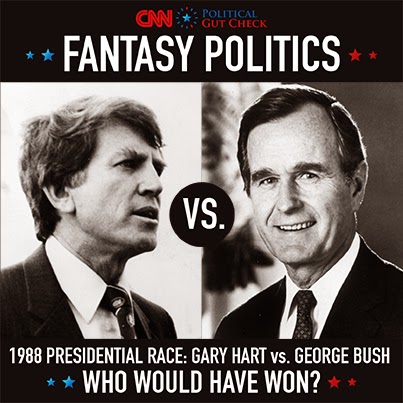
What If Wednesday: President Gary Hart

From The CNN Brief.
I think its safe to say that younger generations (and I include myself in this group) have no idea who Gary Hart is. Quick primer: he was an American politician, an almost liberal alternative to the Reagan era, who twice sought the Democratic nomination for President (1984 and 1988) but was brought down by a sex scandal during the 1988 campaign. Matt Bai in The New York Times discussed the whole scandal and lamented the changes to journalism it caused, but the last part of the article, where Hart speculates about what would happen if he was president, is what really perked my attention:

“Well, at the very least, George W. Bush wouldn't have been president,” Hart said ruefully. This sounded a little narcissistic, but it was, in fact, a hard premise to refute. Had Hart bested George H. W. Bush in 1988, as he was well on his way to doing, it’s difficult to imagine that Bush’s aimless eldest son would have somehow ascended from nowhere to become governor of Texas and then president within 12 years’ time.

“And we wouldn't have invaded Iraq,” Hart went on. “And a lot of people would be alive who are dead.” A brief silence surrounded us. Hart sighed loudly, as if literally deflating. “You have to live with that, you know?”

Now Gary Hart presidential alternate histories aren't very popular in the genre. The most famous one has to be "Palace of Fine Arts, San Francisco, California - October 6, 1976, 7:00 p.m." from Jeff Greenfield's Then Everything Changed (review), which has him winning the presidency in 1980. Still considering how controversial President Reagan was for some Americans, one wonders what would have happened if Hart was elected President sometime between 1980 and 1988...

Well first off, Hart may have needed more than a sex scandal staying buried to be elected president. As many have pointed out, Hart had too many rumors about his infidelity swirling around and his high poll numbers came too early in the 1988 campaign to be very meaningful for a plausible counterfactual. Perhaps his best shot was to get the nomination in 1980 or 1984, although honestly I don't know enough about the era to speculate confidently. I can say that a known womanizer who already had multiple affairs could easily have a sex scandal happen while he was president, causing a Clinton-esque crisis to happen years earlier. Could he have been impeached? Its possible, considering even Clinton's impeachment got to the Senate.

What I really wanted to discuss, however, is the two counterfactual statements made by Gary at the end of the article: that Hart as president would mean no George W. Bush or Iraq War. This belief doesn't seem backed up by any real facts. Even if George H.W. Bush is not elected president (or vice president in a scenario where Hart defeats Reagan) there is no guarantee that George W. or someone with his politics would not be able to reach the White House on their own merit in a post-Hart presidency (in fact if Hart does have a sex scandal while president, it is not unforeseeable that Americans would elect a Republican in the next elections).

It also presumes that somehow Hart would have prevented the circumstances that led to the Iraq War, which as Frank Harvey described in Explaining the Iraq War (review), had little to do with who was in office and more to do with factors that were set in motion decades before. Maybe Hart could have avoided the Iraq War, or even 9/11 since he is given a lot of credit for predicting it would happen, but it is just as likely that something worse could have happened and there is no guarantee President Hart would be as farsighted as Citizen Hart was. As we get far enough away from the initial point of divergence, it becomes harder to assume we will know exactly what will happen without falling into the trap of creating a parallel history.

Perhaps it was a narcissistic thing for Hart to say about himself or, as Gavriel D. Rosenfeld said in his commentary on Bai's article, he is just using a counterfactual in order to give meaning to his life. Hart wants to believe that in the end he is a good person and would have been a great president. Whether he would have is a matter for us alternate historians to decide. What do you think of President Gary Hart? Let us know in the comments.

* * *

Matt Mitrovich is the founder and editor of Alternate History Weekly Update and a blogger on Amazing Stories. Check out his short fiction. When not writing he works as an attorney, enjoys life with his beautiful wife Alana and prepares for the inevitable zombie apocalypse. You can follow him on Facebook or Twitter.

Wednesday, September 17, 2014

What If Wednesday: NATO Did Not Expand Into Eastern Europe

Last week I found a counterfactual by Cheryl of Nuclear Diner that posited a world where NATO never expands into Eastern Europe. It was based on the opinions of what she called "foreign policy realists" that blamed NATO for the events in Ukraine because it provoked Russia by expanding into their sphere of influence. Now I have heard this opinion voiced before and I have not been sold on the logic. It sounds too much like victim blaming. Some of the blame is shifted from the aggressor because of something the victim did, i.e. "if you didn't want to be raped you shouldn't have worn such slutty clothes" or "the Germans invaded the Soviet Union to defend Europe from invasion". Arguments like that ignore the motivations and desires of the aggressor and in the end encourage similar behaviors from the aggressor. Essentially it is appeasement all over again.

Now I am sure some of the examples above might set some off on tangents that would derail the conversation, so lets get back to the question at hand: what if NATO (and presumably the European Union as well) did not expand into Eastern Europe? Would the Ukrainian Conflict be happening right now? Certainly it is fair to admit relations may be better between Russia and the West. There does appear to be evidence that promises were made that western military forces would not be stationed in the East, but if they were made they were never formalized. Still it is understandable that Russia could have felt betrayed by the West and thus this could explain some of the current problems the world is experiencing in Europe.

Yet that is just one of many factors influencing the current situation. Russia's conflict with the West is as much a cultural battle as it is anything else. Putin has made one of his goals to make Russia the world leader of anti-western culture. The differences between Russia's conservative values and the West's more tolerant society is not something that can be solved at the negotiating table. Either the Western world would require a major cultural shift following the end of the Cold War or Russia would need to completely isolate itself from the global economy to prevent some sort of conflict. And what about ethnic Russians who approve of Putin's presidency, but reside in parts of the former Soviet Union? Should we just assume that their desire to once again be a part of Russia would disappear in a world where the West stays out of East?

Assuming NATO leaders stands by their promises, and the leaders of the European Union follow their lead, Russia is unlikely to stay out of Eastern Europe. With the West ignoring them and Russia exerting political/economic pressure, one by one the Eastern Europe states would take their cues from Moscow. The Warsaw Pact might have fallen, but a new version would arise to take its place. Areas where there is a high percentage of Russian minorities could be ceded back to Russia. More former Soviet Republics could also be members of the Union State. Having regained its old influence, Russia would still position itself as the leader of the anti-western world, as its conservative culture clashes with Western Civilization. Conflict is likely inevitable somewhere, with the Yugoslav states or the Middle East being likely candidates for new proxy wars as a new Cold War begins.

Then again, perhaps Eastern Europe would resist. I am reminded of the Eastern Europe nation from Harry Turtledove's "Les Mortes d'Arthur" that came together after the Soviet Union collapsed in the near future. Perhaps abandoned by the West and terrified of a more powerful Russia, the Eastern European nations band together into their own political and economic alliance, something along the lines of the proposed Intermarium perhaps? A community of nations to keep Russia at bay and to compete with Western Europe for economic dominance on the continent. Perhaps they may even gain support from the United States not just as a convenient buffer against an old rival, but also as an alternative ally in case there is any dissatisfaction in Western Europe with American policy. Then again this doesn't prevent any conflict or from Russia inciting minorities to revolt as they are doing now.

Perhaps the one thing to take away from this counterfactual is that some sort of post-Cold War conflict between Russia and the rest of the world was inevitable. So what do you guys think of my scenario? I understand that because this is a current event and the terminology I was required to use, passions are likely to run high. Please keep all comments civil.

* * *

Matt Mitrovich is the founder and editor of Alternate History Weekly Update and a blogger on Amazing Stories. Check out his short fiction. When not writing he works as an attorney, enjoys life with his beautiful wife Alana and prepares for the inevitable zombie apocalypse. You can follow him on Facebook or Twitter.

Wednesday, September 10, 2014

What if Wednesday: The German-American War of 1902

The title is a tad misleading, but I want to talk about the secret German plans to invade America almost two decades before World War I, as reported last week by George Dvorsky at io9 (whose work I have linked to on numerous occasions). A brief background, essentially Kaiser Wilhelm II had dreams of gobbling up Latin America, but to do that he needed to get the United States out of the way. He ordered the German military to come up with a plan to invade the United States and several proposals were drafted between 1898 and 1903. As history tell us, however, no such plan was put into action...but what if it had?

I am not going into too many details about why the war would happen, how it would be fought and who would won. Coverage of these plans and the expected result can be found not only in Dvorsky's article but also in Edmund Morris' Theodore Rex (and I am not talking about the Whoopi Goldberg movie) and Robert Conroy's 1901. I think we can skip pass this issue by saying Germany would have ultimately lost. Its fleet would be defeated and its soldiers would be forced to surrender after being left trapped a half a world away surrounded by hostile forces. What I really want to talk about is what happens next.

The United States would come out the war feeling elated having defeated not just one, but two, European empires. This victory also wouldn't have the moral ambiguity of the Spanish-American War. The United States was attacked and they defended themselves. Whoever was president at the time, McKinley or Roosevelt, would be able to ride the popularity surge to get whatever policy they wanted adopted with almost unanimous approval. Presumably certain measures would have to take precedence. Fear of another invasion would mean money spent on more troops, more ships and more fortifications along the East Coast.

We may even see a more interventionist version of the Roosevelt Corollary to defend the western hemisphere from future invasions. There may be increased interventions into Latin America affairs and we may even see America taking a larger role in governing struggling countries. Outright annexation is probably unlikely, but formal protectorates and commonwealths like Puerto Rico aren't out of the question.

Meanwhile, across the Atlantic, Germany would be humiliated. The Kaiser and the military would lose a lot of prestige and perhaps the Reichstag would take advantage of the situation to gain more power. The Social Democratic Party would see a growing support among the populace and could potentially turn Germany into a constitutional monarchy and end the rising militarism. Of course the military, not wanting to lose their influence, could just stage a coup, but then again after such a humiliating defeat against America, they may lack the popular support to pull it off.

Depending on how domestic issues play out, Germany's foreign policy could change. They navy smashed and their army defeated, Germany may be less likely to make risky ventures that could lead to another costly war. So if, shall we say, a crisis arose in the Balkans, Germany may just stay out of it or at the very least use some of the Realpolitik from Bismark's era and try to mediate a peace. A Germany unwilling to risk a large scale war could potentially create a world not dissimilar to Richard Ned Lebow's Archduke Franz Ferdinand Lives! Then again if there is a coup in Germany, peace in the long run would be impossible. That being said, a general European war may see the early involvement of a more militarized United States, ready and willing to take down the country who launched an unprovoked attack against them recently.

What do you guys think? What would the future hold for the United States and Germany in a world where they went to war before World War I? And do you want to see more What If Wednesdays? Let us know in the comments.

* * *

Matt Mitrovich is the founder and editor of Alternate History Weekly Update and a blogger on Amazing Stories. Check out his short fiction. When not writing he works as an attorney, enjoys life with his beautiful wife Alana and prepares for the inevitable zombie apocalypse. You can follow him on Facebook or Twitter.

Wednesday, June 18, 2014

What If Wednesday: Leopold and Loeb Get Away with Murder

I recently read For the Thrill of It: Leopold, Loeb, and the Murder That Shocked Jazz Age Chicago by Simon Baatz. As the title suggests, it recounted the tale of Nathan Leopold and Richard Loeb, two affluent and well-educated young men who decided to commit the perfect murder. They kidnapped young Bobby Franks (who was actually a second cousin of Loeb) and murdered him, dumping the body culvert north of Wolf Lake, which is not far from my old neighborhood. They were arrested after Leopold's glasses were found near the body and the two eventually confessed to the murder.

The crime shocked the country and many news agencies covered the trial. Leopold and Loeb's families hired famed defense attorney Clarence Darrow, who successfully managed to save them from the death penalty by having them plead guilty but requesting a lesser sentence from the judge. Loeb eventually died in prison, while Leopold was released in 1958 and died in 1971. Neither had managed to commit the "perfect" crime.

But what if they had gotten away with murder?

With so many alternate histories created by big events like battles with death tolls in the thousands, I wanted to try my hand at how the death of just one person being slightly different could have changed the timeline. In this case Leopold is a bit more careful and doesn't lose his glasses while disposing of Franks. The murder makes headlines for quite some time, but with police getting nowhere, the public's attention begins to wane. An attempt to blame one of Franks' teachers goes nowhere and prosecution accepts the fact that this will be an unsolved mystery.

Leopold and Loeb celebrate their "victory" in the only way people with a warped view of Nietzsche can. I don't believe, however, that they would commit more murders...at first. Leopold was planning on transferring to Harvard Law School after taking a trip to Europe, while Loeb would remain at the University of Chicago. If there plans aren't changed, then what would Leopold do in Europe? What would he see and experience? I have no idea if he planned to go to Italy or Germany, but I wonder how much he knew about fascism and whether he would run into anyone promoting the ideology in Europe. Certainly Nazism would probably not appeal to him because of Jewish roots (he was not practicing, but as we know that mattered little during the Holocaust), but maybe their example might stir some dark thoughts.

As I started thinking about that, I started writing down my ideas. Leopold and Loeb come up with a different type of crime. One that is even more dangerous, but the rewards of not getting caught are even greater: politics. The short story I have been picking away it is a 1930s American dystopia, essentially the Jazz Age gone bad. The more intelligent Leopold is now the face of a growing political movement sweeping the country. Loeb is still in Chicago, but he is a powerful party boss and we learn about him and his alternate relationship with Leopold from a low-level enforcer who rises through the ranks of the party.

I am having fun writing it, despite knowing I am straining plausibility to its limit. I am even enjoying all of nifty references I am including. What do you think about my scenario? What did I get right and what did I get wrong? Let us know your thoughts in the comments below and if want to submit your own scenario email me at ahwupdate at gmail dot com for a chance to be featured on the next What If Wednesday.

* * *

Matt Mitrovich is the founder and editor of Alternate History Weekly Update and a blogger on Amazing Stories. Check out his short fiction. When not writing he works as an attorney, enjoys life with his beautiful wife Alana and prepares for the inevitable zombie apocalypse. You can follow him on Facebook or Twitter.

Wednesday, June 11, 2014

What If Wednesday: D-Day Fails

This year marks the 70th anniversary of the Normandy landings of World War II, commonly known as D-Day. On June 6, 1944, Allied forces launched the largest seaborne invasion in history that opened a second front in Europe and led to the liberation of France and contributed to victory in Europe. Numerous websites and blog posts have commemorated the anniversary and I've decided to wade in (only a week late) by asking the question: what if D-Day failed?

It is not that hard to imagine. The Normandy landings were a complicated operation that required cooperation not just between different branches of the military, but also between the varied nations of the Allied powers. Poor weather, German fortifications and alternate history's all-time favorite German soldier, Erwin Rommel, added to the Allied woes. Even Supreme Commander of Allied Forces, General and Future President Dwight Eisenhower prepared for the worst by drafting a speech he would give in case D-Day failed.

It is quite popular in alternate history to assume that the Nazis could have won the war if they had driven the Allies into the sea. The scenario goes something like this: the Allies, horrified by the incredible loss of life, make peace with the Germans. No longer threatened by invasion in the West, the Nazis are able to free up soldiers to fight on the Eastern Front. They roll back the Soviet advance and are either in Moscow by next year or else Stalin is killed in a coup and the new Soviet overlords make peace as well. The West and Germany then settle in to a nice, long Cold War. Examples of this point of divergence appear in the televised version of Fatherland, Spike's Alternate History and Tsouras's Disaster at D-Day: The Germans Defeat the Allies.

Popularity, however, does not equal plausibility. I find that assuming D-Day would make or break the overall Allied victory to be a common misconception in alternate history. Writers who make that assumption tend to forgot about how well the Soviet Union was doing on the Eastern Front. See the map to your right to see just how far the Russians were advancing before, during and after the invasion. Also they forget about Allied forces advancing up the Italian peninsula. These two forces aren't going to be wiped out along with the forces at Normandy unless the Nazis had nuclear weapons (which is an entirely different point of divergence). In fact the German military was not the same military of 1939. Many of their soldiers, even their elite, were poorly trained and may not even have been able to stem the tide of Soviet/Allied advance if freed from defending Western Europe.

As Tim Jones pointed out in "Bloody Normandy: The German Controversy" (originally published in The Hitler Options: Alternate Decisions of World War II) even if the Germans had done better at Normandy, they still probably would have been driven back by overwhelming Allied numbers and firepower. Assuming they are somehow victorious, it is unlikely the Allies would make peace barring drastic changes to their government. They may not try another invasion of Normandy, but this wouldn't stop the Soviet advance. The war may take longer, but the Soviets could potentially reach the English Channel. The United States could use one of their nuclear bombs to force an early German surrender before the Soviets reach the Atlantic. This of course would have a profound effect on the War in the Pacific if there is one less bomb to use, although after the disaster at Normandy they are unlikely to launch a seaborne invasion of Japan.

Politics in America could also be very different. Eisenhower may either resign or get fired after a failed D-Day. His future political career would also suffer as well and he would unlikely run for president, possibly giving the Republican nomination and election victory to non-interventionism Robert A. Taft, unless liberal intellectual Adlai Stevenson beats him for the White House. One of them would have to handle the Cold War, the Red Scare and the Civil Rights movement.

Or maybe I am wrong. Maybe the Germans could have driven the Allies back from Normandy and fight the Soviets to a stand-still. What do you think about my scenario? What did I get right and what did I get wrong? Let us know your thoughts in the comments below and if want to submit your own scenario email me at ahwupdate at gmail dot com for a chance to be featured on the next What If Wednesday.

* * *

Matt Mitrovich is the founder and editor of Alternate History Weekly Update and a blogger on Amazing Stories. Check out his short fiction. When not writing he works as an attorney, enjoys life with his beautiful wife Alana and prepares for the inevitable zombie apocalypse. You can follow him on Facebook or Twitter.

Wednesday, May 28, 2014

What If Wednesday: No Louisiana Purchase

In 1803, the United States purchased the Louisiana Territory from France, nearly doubling the size of the United States. The territory was originally settled by the French but had been a part of Spain since the end of the French and Indian War (Seven Years War). Under Napoleon, France regained the territory in 1800 with the dream of rebuilding their North American empire. Those dreams were dashed by a slave revolt in Haiti and an upcoming war with Britain. So when the Americans came with overtures about purchasing New Orleans, Napoleon threw in the entire territory as part of the deal. The rest, as they say, is history.

But what if Louisiana was never sold? There are several points of divergence to consider. Maybe the slave revolt in Haiti was easily defeated or never happened. Perhaps opposition to the purchase in America was too great for Thomas Jefferson to overcome. Or we could make it so that a United States still under the Articles of the Confederation and is too politically weak to make the purchase in the first place. Either way, Louisiana remains French territory. What happens next?

Perhaps the most plausible scenario is that nothing really changes all that much. The Native Americans, Mexico or British claims to Oregon did not stop American settlers in our history and a French Louisiana would unlikely stop them in this timeline. Louisiana might end up with a history similar to Florida with settlers carving out their own states and the French powerless to stop them. Although its possible some of these states might make a go for it on their own, most likely they would be annexed by the United States. Eventually France realizes they can't prevent the inevitable without a major war, so they sell whats left of Louisiana to the encroaching Americans while there is still something left to be sold.

The above scenario is not much different from our timeline. American westward expansion just takes a different path, but still happens more or less the same. On its face this might not seem very interesting, but you never know how minor changes can have drastic outcomes as history continues its divergence. Still, I rather spend more time on how Louisiana could stay French indefinitely.

I see two possible ways to make this happen and both center on how well the French defend New Orleans from the British. My assumption is that if Napoleon manages to hang onto Louisiana after 1803, the British would likely try to capture it once war begins again. Depending on whether the French defenders succeed or fail could establish the road Louisiana takes.

If New Orleans is captured by the British it would likely be occupied until Napoleon is defeated. The British may annex Louisiana, but since I want the territory to stay French, the British in this timeline will return it to France. Perhaps they wouldn't want to hassle of administering another French territory or else they would prefer it to act as a buffer to American westward expansion (still a possibility for a War of 1812-esque war in this timeline) without causing a renewed war with an America that feels encircled by the British. Britain guarantees Louisiana as French territory while the United States is mollified by at least having naviagation rights to the Mississippi and New Orleans.

If New Orleans is successfully defended, however, the territory would still likely revert back to Bourbon France once Napoleon is defeated. Whether it stays a part of France is another story. Enough soldiers loyal to Napoleon, who remember their valiant defense of New Orleans, might not want to be ruled again by the Bourbons and would revolt. Even if they don't revolt immediately, Louisiana could become a hotbed of dissent spurred on by ex-Grande Armée soldiers who immigrated from the continent. Depending on how French history plays out in this world, they could revolt later on. Britain (wanting to weaken their old rival) and America (wanting to have one less European power on their border) might even lend a hand.

Of course keeping it the the massive territory "French" over the ensuing centuries is nigh impossible, regardless of who is directly in charge. The French never had much success convincing large number of their citizens to leave Europe for the Americas. The French could look for settlers from elsewhere, maybe even from other Franco-Americans who could be directed to Louisiana instead of the places they went to in our timeline. Catholic Europeans might be lured in Louisiana in exchange for land and stories about the discrimination they would face from Protestant America.

Speaking of Protestant Americans, it is still unlikely in this scenario that Americans will just stop at the Mississippi and go not further. The French government could patrol the river and deport any illegal immigrants, but they probably couldn't stop everyone. Certain Native American tribes, however, could be courted and provided with materials and weapons in exchange for allegiance to Louisiana. Tribes pushed across the Mississippi by the Americans may also find potentials allies from the government in New Orleans. The French could thus make life very difficult for any Americans wishing to settle on the Great Plains.

What about Mexico? France intervened in Mexico in our timeline and they would have a power base in this timeline to do so again. If the French/Louisianans are ambitious enough they may try to rebuild their old empire in North America by conquering Latin America. Whether the British or the Americans would allow that is unlikely. Perhaps at the very least French/Louisianan machinations in Mexico would weaken and fracture the country. Some of these new state could be annexed into Louisiana (especially those with Pacific ports) while other might be propped up as buffers to Mexican revanchism. In fact places like Texas may even be used by the French to encourage Americans to settle elsewhere, thus relieving pressure on their eastern border.

What is America doing in this timeline? With the west blocked, the number of slave and free states in the Union will become unbalanced. Politics in Antebellum America involved keeping the peace between the North and the South and one way to do that was to make sure the Senate was equally split between free and slave states (see Compromise of 1820). Without western states like Louisiana, Arkansas, Missouri and Texas, things will become unbalanced very quickly even without making Maine its own state. An earlier civil war could be a distinct possibility.

As a solution, Americans might turn their eyes southward and create states out of Cuba, Central America or even Latin America. At the very least they would want a Pacific port and land to maybe one day build a trans-ocean canal. Other compromises might be adopted like a federally recognized free slave colony. The Civil War may even be avoided altogether with slavery being phased out in the late 19th century after economic pressure forces slave holders to give up their slaves. This alternate America may be more interested in not only Latin American affairs, but colonial African affairs as well. America also would have to deal with large Catholic Hispanic populations a lot earlier than it did in our timeline.

There is still so much to talk about. I didn't even touch on what would happen if Napoleon had been victorious and still had Louisiana. What do you think about my scenario? What did I get right and what did I get wrong? Let us know your thoughts in the comments below and if want to submit your own scenario email me at ahwupdate at gmail dot com for a chance to be featured on the next What If Wednesday.

* * *

Matt Mitrovich is the founder and editor of Alternate History Weekly Update and a blogger on Amazing Stories. Check out his short fiction. When not writing he works as an attorney, enjoys life with his beautiful wife Alana and prepares for the inevitable zombie apocalypse. You can follow him on Facebook or Twitter.