Showing posts with label Alternate Presidents. Show all posts

Wednesday, September 7, 2016

President Washington's Third Term

Guest post by Theo Taylor.

By 1798, George Washington boasted undoubtedly the most impressive resume of any man in the United States, a country so new the ink had barely dried on its new constitution. He had led the Continental armies to victory against a fierce and determined enemy--the British Royal Army, aided in the manifestation of the American Republic and served two terms as its first Commander in Chief. So important was he, that the second President, John Adams, demanded Washington's return in Summer, 1798 to the United States Army to plan for a potential conflict with France.

Less than twelve months later he was implored by his contemporaries to seek a third term as President of the United States. Most Americans are aware that he denied such a request, putting in place a time honored tradition not broken until Franklin Delano Roosevelt's monumental third term in 1940. What if, however, George Washington, the Cincinnatus of the West, as his colleagues referred to him, decided not to shirk the responsibility of his fledgling Republic, what then would the modern political conflict look like?

An argument against implausibility is a contemptible one. Washington would have won any third term election, against any challenger. The evolution of the position of the President of the United States would have likely become more monarchic. Without a term limit set in place--whether by law or tradition--it exists only as an inevitability that a future president would simply continue as president until death or he lost an election. Considering George Washington's life, he may very well have died during his third term and no precedent on it may ever be established.

A minor inconvenience in this alternate world would be a handful of one term presidents would never come about, those presidents such as George H.W. Bush who would have been replaced by a three term Ronald Reagan. Presidencies such as FDR's, which ended only by death, would be more commonplace. The speculation thus, is what more good--or evil--could a President do, knowing he is not bound by term limits? An answer best left to speculation.

* * *

Theo Taylor is a science fiction writer and essayist. His works have appeared in Asimov's, Every Day Fiction, Aphelion Stories and Thought Catalog. When not penning science fiction stories, he's almost always researching some obscure historical fact or in the gym. Check out his book Rogue Cosmos.

Wednesday, June 15, 2016

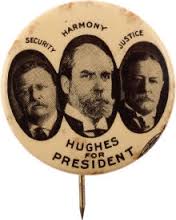
The Presidency of Charles Evans Hughes

Guest post by Andrew Schneider.
One of the more fascinating concepts of American political history is that of the “watershed election” - the notion that there are particular presidential contests that stand out as dramatically reshaping the political landscape, providing a convenient dividing marker between historical eras. Some of the more famous ones include 1860, 1932, and 1980.

The election of 1912 stands out for several reasons. That year, the Republican Party tore itself apart. President William Howard Taft secured his renomination at the G.O.P.’s national convention in Chicago through shrewd control of the party machinery, preventing the seating of delegates supporting his rival, former President Theodore Roosevelt. Roosevelt’s forces rebelled, bolting the convention and forming a new party to support their man’s bid to recapture the White House. The organization known variously as the Progressive or Bull Moose Party went on to win well over 4 million votes in the general election, translating to 88 electoral votes across six states. By comparison, Taft won fewer than 3.5 million votes – just eight electoral votes from two states. It was the best showing by a third-party candidate in the history of the modern U.S. party system. It also guaranteed the election of the Democratic candidate, Woodrow Wilson.

Wilson won a lopsided majority in the Electoral College, racking up 40 states with 435 electoral votes. He did not, however, win a majority of the popular vote. His total fell just short of 6.3 million. It’s tempting to look at those numbers and conclude that, had the Republican Party remained united, it would easily have held the presidency. That may have been the case if Roosevelt had somehow managed to win the Republican nomination. It seems less likely if TR had admitted defeat and sought to rally his followers behind Taft.

While Roosevelt ran as the candidate of the Progressive Party, both he and Wilson advocated the political philosophy known as progressivism – roughly defined as a movement favoring political reform and advocating economic and social justice. Read in this fashion, the 1912 election was an overwhelming victory for progressivism over the Old Guard conservatism of which Taft was champion. Had the contest been a two-man race between Wilson and Taft, many progressive Republicans may have voted for Wilson or stayed home. In any event, Wilson took the election as a mandate for progressive legislation on everything from banking regulation to the introduction of the eight-hour work day. The tide of progressive legislation ebbed with the U.S. entry into World War I, but it served as an inspiration to Wilson’s assistant secretary of the navy, Franklin Delano Roosevelt. FDR’s New Deal owed much of its existence to the groundwork laid by the 1912 platform Wilson called the New Freedom.

By contrast, the election of 1916 appears rather less consequential. It was a straight two-man contest between the Democratic incumbent Wilson and the Republican challenger, Charles Evans Hughes. There was very little to differentiate the two in terms of their domestic platforms. Hughes supported many, though not all, of Wilson’s economic and social reforms. He was slightly ahead of Wilson in endorsing women’s suffrage, and his views on civil rights were decidedly more forward-looking than those of the Virginia-born president.

But the issue that largely decided the election was that of America’s entry into the First World War. Both Wilson and Hughes argued for the U.S. to remain neutral. Hughes campaigned on a Republican platform argued that the U.S. needed a much stronger army and navy as a deterrent – in theory against any foreign power that might threaten the U.S., but with Imperial Germany utmost in mind. Wilson campaigned on a more straightforward message of peace and isolation, under the slogan. The contest was much closer than 1912. Wilson garnered a larger share of the popular vote. But the Electoral College broke for the incumbent by a much narrower margin of 277-254, with 30 states going Democratic and 18 Republican.

Before Wilson could take the oath of office for the second time, Germany resumed unrestricted submarine warfare and attempted to entice Mexico into declaring war on the United States, with the promise of restoring the territory it had lost to the U.S. in 1848. The U.S. learned of the latter when British intelligence intercepted, then leaked, a coded telegram from German Foreign Secretary Arthur Zimmerman to Germany’s ambassador to Mexico. Having won reelection by campaigning under the slogan, “He Kept Us Out of War,” Wilson began his second term by asking Congress to declare war on Germany.

Arguably, the election of 1916 was significant in at least two respects. First, Wilson became the first Democratic president since Andrew Jackson to win two consecutive terms in office. Second, Wilson’s belated (and forced) conversion to the Allied cause led him for the first time to apply his progressive ideology to foreign policy rather than domestic. It led him to adopt the position that the national interests of the U.S. and of world peace would best be served by spreading representative democratic government as widely as possible – ideally through diplomacy and free trade, but if necessary by force. This philosophy entered the lexicon as “Wilsonianism,” and it remains one of the leading schools of American diplomacy.

The U.S. would have entered the Great War soon after Inauguration Day 1917 regardless of who took the oath of office, given Germany’s actions in the months since the election. So how much difference would a Hughes presidency have made to the ultimate outcome? Answering this requires a closer look at Hughes, both in terms of what led him to the Republican nomination in 1916 and what he accomplished after his defeat that November.

Like Wilson, Hughes was the son of a clergyman and raised in a religious household. But where Wilson’s father moved to south from Ohio and became a slaveholder, Hughes father was a lifelong New Yorker and an abolitionist. Like Wilson, Hughes trained as a lawyer. But where Wilson grew bored with the actual practice of law, Hughes became obsessed by it, frequently working himself to exhaustion. His intelligence and dedication, particularly in his work as a special counsel for a commission investigating utility rates for New York City, drew him to the attention both of Roosevelt and Taft.

In 1906, Roosevelt drafted Hughes to run for governor of New York. Hughes beat heavily favored Democratic candidate William Randolph Hearst, in a campaign later immortalized in the film Citizen Kane. Hughes distinguished himself as a reform-minded executive, enacting social reforms, fighting political corruption, and attempting, unsuccessfully, to replace the state’s convention system for selecting political candidates with a direct primary. In 1910, while he was still governor, Taft named him to the Supreme Court as an associate justice. Hughes distinguished himself there as an advocate of regulating business and of civil rights.

Republican Party leaders had attempted to draft Hughes for the presidency as early as 1912, on the theory that he would make a good compromise candidate acceptable to both the Roosevelt and Taft factions. Hughes refused, saying it was improper for a sitting judge to involve himself in politics. Four years later, G.O.P. leaders tried again with the same argument but much more strenuously. This time, Hughes agreed. Taft endorsed him. Roosevelt, whose personal opinion of Hughes had cooled – he referred to him as a “bearded iceberg” – decided he would rather support Hughes than risk giving Wilson another victory. Hughes won the nomination on the third ballot. The convention nominated as his running mate Charles W. Fairbanks, Roosevelt’s former vice president.

The party Hughes led into the general election remained deeply divided. The Progressives had attempted to nominate Roosevelt as their candidate a second time. When he declined, and urged them to back Hughes, many took it as a betrayal. While Hughes had supported many progressive causes as New York’s governor, he was on record as opposing two of the most popular pieces of progressive legislation to date – the Sixteenth Amendment (allowing the creation of an income tax) and the Adamson Act (establishing the 40-hour work week). Despite Roosevelt’s active campaigning on Hughes’ behalf, many of these disappointed Progressives would cast their ballots for Wilson in the fall.

The one man who could conceivably have rallied these forces to Hughes was Hiram Johnson, the Progressive governor of California and Roosevelt’s 1912 running mate. In 1916, Johnson was running for the Senate as a Republican but remained in a bitter fight with the state’s Old Guard leaders. Hughes came to California to campaign in the midst of this fight and was briefly in the same hotel as Johnson. Due to a screw up by Hughes’ campaign manager, the two failed to meet, though Hughes did wind up meeting with several of Johnson’s conservative antagonists, including banker and state G.O.P. leader William H. Crocker. Hughes then compounded the slight by giving a speech at which he saluted Crocker as “California’s favorite son.” Johnson took this as a deliberate insult. He never forgave Hughes and thereafter refused to lift a finger on Hughes’ behalf.  Hughes lost California by a narrow margin and with it the presidency.

Hughes had a reputation as an extremely quick study. Had he met with Johnson, he would have realized very quickly how bitter the blood was between the governor and Crocker. He would not have made the blunder of publicly saluting Crocker as he did, certainly not without lavishing equal or greater praise on Johnson. With Johnson in his camp, Hughes would have carried California at the very least. That alone would have been enough for Hughes to edge out Wilson, although it would have been the tightest electoral contest in nearly thirty years -- 267 Hughes to 264 Wilson. It’s possible, though, that with Johnson in his corner, Hughes might also have carried Washington, which Roosevelt and Johnson carried in 1912. That would have tipped the balance to 274 Hughes to 257 Wilson, not much different from the margin by which Wilson actually won.

President Hughes would have taken the oath of office on March 4, 1917. He would have recognized at this point that U.S. entry into the Great War was all but unavoidable, but he would have wanted to do as much as he could to strengthen America’s position, both militarily and legally, before committing to the fight.

The new president would have had a deep bench of foreign policy and defense expertise on which to draw: Henry Cabot Lodge, U.S. senator from Massachusetts and ranking Republican on the Senate Foreign Relations Committee; Elihu Root, secretary of war under Presidents William McKinley and Theodore Roosevelt and secretary of state under Roosevelt; Henry Stimson, secretary of war under President Taft; and Major General Leonard Wood, U.S. Army chief of staff under Presidents Taft and Wilson. The men were all architects of the Preparedness Movement, pushing for universal military training and naval expansion. He would also, no doubt, have had to fend off helpful suggestions by Roosevelt himself.

Hughes immediate priorities would have been enacting the platform of military preparedness on which he had campaigned. The Democrats held majorities in both houses of Congress. But the renewed U-boat attacks on American shipping and the revelations of the Zimmerman Telegram would have undercut Democratic resistance to Hughes’ proposals. These would have included the enactment of conscription, which Congress had been considering as early as the previous December, and appropriations for a massive naval construction program.

Hughes would then have informed the German government – through neutral intermediaries, as Wilson had severed diplomatic relations with Germany in February – that any further attack on American shipping would be considered an act of war. To drive the point home, he could have ordered the seizure of German government assets in the U.S., pending Germany’s abandonment of unrestricted submarine warfare and payment of compensation to the families of those killed or injured in previous submarine attacks. Germany’s military leadership would almost certainly have ignored such an ultimatum – General Erich Ludendorff, who had insisted on resuming unrestricted submarine warfare, would scarcely have risked American entry into the war if he considered the U.S. a serious threat.

In our timeline, Wilson found one excuse after another to avoid calling for a declaration of war, with more than two months elapsing between the renewal of U-boat attacks and Wilson’s appeal to Congress. In this scenario, the declaration could have come within a matter of days after Hughes took office, roughly a month early compared to our history.

How much of a difference would this have made? The U.S. would still have had to build a mass army virtually from scratch. The peacetime U.S. Army had roughly 100,000 men. The American Expeditionary Force had about 2 million men in France by the time of the Armistice. American industry would also have faced the same limitations mobilizing its capacity to manufacture arms, ammunition, and other military supplies to meet U.S. needs, let alone those of the Allies.

Against this, we can weigh the likely appointment of Wood as the commander of A.E.F. instead of John J. Pershing. Wood was a more experienced combat leader, had greater experience leading large bodies of men, and had a record as an effective military reformer. Leading Republicans had argued strongly for Wood’s appointment to the post in our own timeline, but his political activities in the Preparedness Movement had made him anathema to Wilson, who chose Pershing as a non-partisan alternative. Wood, who built up a record as a military reformer and one of the fathers of American combined arms doctrine, would have been more likely than Pershing to absorb the bloody lessons the Western Allies had learned about the futility of mass assaults against fortified trenches. Pershing ignored those lessons and wound up repeating many of the same mistakes at the cost of tens of thousands of lives, particularly during the Meuse-Argonne Offensive.

At the height of the American effort on the Western Front, Britain and France requested the U.S. send 5,000 men to assist with a mission in Eastern Europe. Russia had erupted in civil war. The Allies wanted to intervene to keep German troops from seizing Allied stockpiles at the Russian port of Arkhangelsk, to rescue Czechoslovak troops who had become trapped behind the Bolshevik lines, and to reopen the Eastern Front against Germany. Underlying all this was the goal of overthrowing the nascent Bolshevik government.

In our timeline, the U.S. War Department rejected the request, but President Wilson overruled it. The result was what became known as American North Russian Expeditionary Force, colloquially known as the Polar Bear Expedition. It had no effect on outcome of Russian Civil War, but effectively poisoned U.S-Soviet relations from the start. Hughes was no more a fan of bolshevism than Wilson, but he would have recognized the mission as an unnecessary distraction from the Western Front. Odds are, he would have taken the War Department’s advice.

On the home front, progressive domestic legislation would have been as a low priority for a wartime Hughes Administration as it was for Wilson’s. But Hughes could have accomplished a significant civil rights goal during this period by executive authority. Wilson had effectively introduced southern “Jim Crow” laws at the federal level, banning African-Americans from higher level jobs in the federal civil service and reintroducing segregation in government office buildings. It would have been entirely within Hughes power, and character, to reverse these moves. In doing so, he would only have been restoring the status quo, as there was ample precedent under prior Republican administrations for keeping the civil service integrated.

Wilson, in asking Congress for a declaration of war on Germany, used the argument, “The world must be made safe for democracy.” This made for excellent propaganda, and it gave American involvement in the war the character of a crusade. It held out the promise of a postwar world where democratic governments would thrive the world over. Wilson raised hopes further with his January 8, 1918 speech to Congress, outlining America’s war objectives. What became known as the Fourteen Points included calls for national self-determination, freedom of the seas, free trade, an end to secret diplomacy, international disarmament, and the formation of a League of Nations. They also called for Germany to evacuate Belgium, give Alsace-Lorraine back to France, and to give up Polish territory that Prussia had held since the eighteenth century. But these seemed modest enough demands by October 1918, when German armies were collapsing in the field. Imperial Chancellor Max von Baden asked for an armistice on the expectation that the Fourteen Points would be, as advertised, the basis of a permanent peace settlement.

The Treaty of Versailles was, of course, far harsher than anything Wilson had proposed. Wilson sailed home from France in the middle of the conference to lobby for American membership in the League. By the time he returned, Wilson’s health was in decline. French Prime Minister George Clemenceau effectively dominated the proceedings.  The resulting peace terms for Germany included the assumption of guilt for starting the war, near total disarmament, and a bill for war damages that, adjusted for inflation, would amount to nearly half a trillion dollars in today’s currency. The nascent government of the German Republic never recovered from the humiliation of those peace terms.

Wilson came away from the proceedings with only one thing that he truly wanted, the creation of a League of Nations. He’d done nothing to assuage concerns of Republicans, who had by now taken control of both houses of Congress, that joining the League would infringe on American sovereignty. Senate Republican leaders, including Lodge, demanded revisions before they would ratify the Treaty of Versailles. Wilson refused, demanding they accept the treaty, and the League, as was. He then embarked on a nationwide speaking tour, hoping to build popular support for the League and force the Senate to cave. Instead, Wilson destroyed his health, suffering two major strokes that left him an invalid for the remainder of his presidency. The U.S. never joined the League of Nations. The American withdrawal from world affairs did almost as much as the Treaty of Versailles to prompt Germany to risk another devastating war with Britain and France just two decades later.

With Hughes as president, there would have been no call for a democratic crusade. No Fourteen Points. No reason for the German government to expect lenient terms if it sued for an armistice. The fighting might well have continued until the German Army was forced back onto German territory. That would have made it far more difficult to argue, as Ludendorff and many other German generals were to do, that the German Army was never defeated in the field and that only the betrayal by civilians on the home front, particularly Jews, had led to Germany’s defeat.

The American president and chief negotiator that arrived in France in 1919 would have been younger, healthier, and free of the messianic hopes that Wilson raised in our timeline. He would likely have been accompanied by Henry Cabot Lodge, Elihu Root, and a senior Democratic senator. Wilson’s decision not to include any Republicans in his negotiating team was a major reason Senate leaders distrusted the resulting treaty.

The resulting negotiations over the Treaty of Versailles between Hughes, Clemenceau, British Prime Minister David Lloyd George, and Italian Prime Minister Vittorio Orlando would have been every bit as complex as those of the treaty in our own history. The best gauge of President Hughes’ success would have been Hughes’ signature diplomatic accomplishment in our own timeline.

In 1921, President Warren G. Harding appointed Hughes as secretary of state. Hughes, with no prior experience in diplomacy, soon found himself overseeing a five-power conference to head off a naval arms race among the victorious powers in the Great War – Great Britain, the U.S., Japan, France, and Italy. Each power had a strategic interest in building the largest, strongest, most-technologically advanced navy possible. For all to follow this course, however, would have been to risk recreating the conditions that many blamed for touching off the Great War. Such an arms race would also have been economically ruinous for all powers involved, with the possible exception of the U.S.

Hughes oversaw the Washington Naval Conference with the assistance of Lodge, Root, and Senator Oscar Underwood, the Senate’s ranking Democrat. It was Hughes who ultimately persuaded the other great powers to accept naval construction limits, at a ratio of 5:5:3:1.7:1.7 – that is, for every 5 tons’ worth of U.S. battleship construction, Britain could build 5, Japan could build 3, and France and Italy 1.7 each. As an aside, the U.S. negotiators convinced Britain that the only way they could approve the deal would be if Britain allowed its alliance with Japan to lapse. Japan accepted the limits, in large part for economic reasons, but considered the treaty deeply unfair. This, and the American-enforced breakup of its alliance with Britain, went a long way toward convincing Japanese military and naval leaders that they would ultimately have to fight the United States to protect their interests in the Pacific.

A President Hughes at Versailles would have faced a set of foreign leaders every bit as protective of their own national interests. His task would have been to convince them that staking out the strongest possible gains at the expense of a defeated Germany would be counterproductive. Unless the Allied Powers were prepared to occupy Germany indefinitely, they could not keep it down forever. And the harsher the peace terms they imposed, the more determined Germany would become to seek revenge. In the meanwhile, the high level of reparations France and Britain were demanding would damage not only Germany’s economy but theirs as well. Here, he could use the leverage of the war debts France and Britain owed to America extract concessions on how much they would demand from Germany.

All this may appear more insightful that reasonable. If Wilson, Lloyd George, and Clemenceau could not see the consequences of a harsh peace with Germany, why would Hughes? There was one person at Versailles who foresaw exactly these consequences. Economist John Maynard Keynes attended the conference as an advisor to the British government. He wound up publishing his views later in 1919 as The Economic Consequences of the Peace. The book greatly undermined the legitimacy of the Treaty of Versailles both in the U.S. and Britain, providing a strong argument for those who later supported appeasement of Germany in the 1930s.

Hughes was no economist, but he had spent a good deal of his early public service dealing with economic issues, particularly in cases involving the federal regulation of interstate commerce. It’s likely that he would have drawn some of the same conclusions as Keynes and have done his utmost to convince his fellow world leaders of the potential consequences of their approach. As the Washington Naval Conference negotiations proved, Hughes at his best could be extremely persuasive.

With Hughes involved, the resulting Treaty of Versailles would have been far more likely to provide the framework for a lasting European peace. The U.S. Senate would have ratified the treaty with little trouble. The odds that the U.S. would have retreated into postwar isolationism would have greatly diminished. From a foreign policy and national security standpoint, Hughes first term as president would have been far more successful than Wilson’s second.

None of this would necessarily have guaranteed Hughes winning a second term. With demobilization, U.S. prices started to fall. The economy tipped into a deep recession starting in January 1920, which lasted until July 1921. One only need look at the U.S. election of 1992, in which Bill Clinton defeated George H.W. Bush, to see how a recession can prompt voters to reject a popular wartime leader. Still, this might have been where Hughes early support of women’s suffrage paid off. The Nineteenth Amendment took effect in August 1920, making that November’s election the first in which women’s votes could decide the outcome.

With so many changes from our history over the course of a first Hughes term, it would be nearly impossible to predict what a second term would look like. Two things, though, are certain. First, Hughes would have had a different vice president. Charles Fairbanks died in June 1918. Under the law then governing U.S. succession, the vice presidency would have remained vacant until the beginning of the next presidential term on March 4, 1921. Who Hughes would have picked to replace Fairbanks is anybody’s guess. It would not have been unreasonable, though, for him to turn to one of the men who had helped put him in office in 1916, Senator Hiram Johnson.

Second, Hughes would have had a dramatic opportunity to reshape the Supreme Court. Between March 4, 1921 and March 4, 1925, five justices left the bench. These included Chief Justice Edward Douglass White, who died in office. One could reasonably assume that Hughes would have proposed justices with judicial views similar to his own.

In our own history, President Herbert Hoover named Hughes chief justice of the Supreme Court in 1930. He served in that position for eleven years, a period of tremendous controversy in which the court acted as a conservative check on the New Deal. President Franklin Roosevelt’s attempt to break the court’s opposition to his programs by packing it with liberal justices resulted in one of the most serious political defeats of his career. It seems implausible that Hughes would have become chief justice in such an alternate timeline, but his ultimate impact on the Supreme Court and on U.S. law would arguably have been far greater.  

AUTHOR’S NOTE: I first wrote on what a Hughes presidency might look like seventeen years ago in Point of Divergence, No. 21. The occasion was an editor’s challenge to describe a history in which Leonard Wood won the both Republican nomination for president and then the presidency in 1920. I concluded the general would have made a poor candidate, focused as he was on the single issue of military preparedness. Instead, I wrote about what might have happened if Hughes had won the election in 1916, named Wood as his commanding general in World War I, and then appointed him secretary of war after winning a second term. The centennial of the Wilson-Hughes contest struck me as the perfect opportunity to revisit the issue, with a focus on Hughes instead of Wood. Thanks to Matt Mitrovich for the opportunity.

* * *

Andrew Schneider is the politics and government reporter for Houston Public Media (KUHF), NPR’s affiliate in Houston. His work has aired nationwide on Morning Edition, All Things Considered, and Here & Now. He holds degrees in history from the University of Chicago and Duke University. Andrew recently completed work on a memoir based on his experiences as a war correspondent in Afghanistan.

Monday, October 6, 2014

Weekly Update #163

Editor's Note

So I was blocked from the AltHistory Wiki!

Well, not really. My old user name still works (after I remembered the password), but my IP address is blocked. So when I am not logged in, I can't edit anything. A little digging by myself discovered it happened after I corrected some bad grammar while I was not logged in...on an article I worked on extensively when I was still a member of the wiki. Now I am sure the admin did not know it was me, but it does seem a little ridiculous to undo a harmless edit and ban the person. Of course the wiki has had these issues in the past. I'm not trying to cause a stink, just suggesting a light touch next time when dealing with anon edits.

Maybe I will write a more thorough article on my thoughts on the Wiki, but I don't know.

Some more bad news. I downloaded and installed Crusader Kings II this weekend and discovered it doesn't work on my computer. It runs, but I don't have the minimal graphics capabilities on my Toshiba laptop. I may be in the market for a new computer with a better video card, preferably something with NVIDIA GeForce 8800, an ATI Radeon® X1900 or better. Any suggestions?

Some good news now. I broke my monthly page view record again. The final count for the month of September was 22,711 views. Thanks everyone!

Some more good news, my research paper on the alternate history fandom is progressing well. I read a lot of articles and took a lot of notes that helped flesh out the paper more. I even had a eureka moment where I remembered Stirling once commenting on people dissecting his Draka books online. Wish me luck that I can keep the momentum going (we all know what happened to my podcast).

Even more good news: part 2 of my conversation with Daniel Bensen of The Kingdoms of Evil podcast is up. So please check it out.

And now the news...

Videos for Alternate Historians

What? No major news? Or was I just being lazy? O well lets look at some videos. We begin with "4 U.S. Presidents Whose Lives Put Action Movies to Shame" from Cracked's Badassing Your Way Through History:
Next we have the trailer for Epic Rap Battles of History's new season:
G-g-g-g-ghost Hitler!!!! Anywho, lets go back in time and learn how hard it was to be a jouster on Culture Shock:
Man, A Knight's Tale made it look so easy. Oops, the time machine just sent us into the future...well to our old future. Let's check out Syfy's new trailer for Ascension:
And since I have been talking so much Paradox these days, lets finish with the trailer of Crusader Kings II: Charlemagne:

Links to the Multiverse

Books


8 Alternate History Books by Jonathan Melville at Scottish Book Trust.
COVER REVEAL- The Diamond Conspiracy by Philippa Ballantine at The Ministry of Peculiar Occurrences.
Cover & Synopsis: CHRONICA by Paul Levinson at SF Signal.
David Brin, Bruce Sterling & Daniel Suarez – Manual for Civilization Lists by Mikl Em at The Long Now Foundation.
Gail's Steampunk Book Recs from Convolution by Gail Carriger.
Is It Science Fiction? Harry Turtledove and the Ways that the South Won the Civil War at Thatjeffcarter Was Here.
Jonathan Strange & Mr Norrell Reread: Introduction by Kate Nepveu at Tor.com
Recommended Reading by Professionals…with David Barnett at SF Signal.
Review: California Bones by Greg Van Eekout at The Skiffy and Fanty Show.
Review: Hive Monkey by Gareth L Powell at Sibilant Fricative.
Review: Wars to End all Wars edited by GL Lathian at Midlist Writer.
Stop the (parallel) Worlds – I Want To Get Off! by Alastair Savage at Amazing Stories.
Time Travellers at Hodderscape.

Comics

Review: World War Kaiju by Josh Finney and Patrick McEvoy at Nerd Binge.

Counterfactuals, History and News

An Adams family dynasty in the US? by Dale Cozort.
Alternate History: What If Anne of Cleves Refused the Terms of the Annulment by AlexandriaIngham at Wizzley.
(Arab-Jewish Reconciliation) Counterfactual Counter-history (Feisel-Weizmann Agreement) by Zachary Braiterman at Jewish Philosophy Place.
Bill Gates Wants To Change How We Teach History In High Schools by Peter Jacobs at Business Insider.
Colorado school board vote doesn't appease critics by Colleen Slevin at Yahoo.
Fox News Poll: Voters reveal which state they want kicked out of the union by Dana Blanton at Fox News.
If you haven’t noticed, counterfactual histories are *so* hot right now by Mian at History Mine.
JIMMY CARTER: 'I Could Have Wiped Iran Off The Map' by Hunter Walker at Yahoo.
Newly-Declassified CIA Document Says Ben Franklin Was A Security Risk by Mark Strauss at io9.
The Real-Life Letter Of Apology Written By The Salem Witch Trial Jury by Charlie Jane Anders at io9.
Why It's A Mistake To Call ISIL "Medieval" by Mark Strauss at io9.

Film and Television

It’s About Time: Bad Robot Gets a Series Order from Hulu for Stephen King’s ‘11/22/63’ by Nicholas Graff at ScienceFiction.com.
The Man in the High Castle: Lights, camera, action in Chinatown by Assunta Ng at Asian Weekly.
'Outlander' Recap: Starz Series Makes Strong Start, Plays the Niche TV Game at The Christian Post.
Review: Space Station 76 at Amazing Stories.
VIDEO: Archival footage of The Great Martian War of 1913-1917 at SF Signal.
Why Do I Love Historical-Fiction Sex So Much? by Allison P Davis at The Cut.

Games

The alternate history of Goku in Smash Bross by JC Fletcher at Tiny Cartridge.

Interviews

Gail Carriger at Tea and Jeopardy.
Leslie S. Klinger at The HP Lovecraft Literary Podcast (More Lovecraft than alternate history, although they do talk about some topics I think you would like.)
E. Catherine Tobler at Eating Authors.

* * *

Matt Mitrovich is the founder and editor of Alternate History Weekly Update and a blogger on Amazing Stories. Check out his short fiction. When not writing he works as an attorney, enjoys life with his beautiful wife Alana and prepares for the inevitable zombie apocalypse. You can follow him on Facebook or Twitter.

Wednesday, September 24, 2014

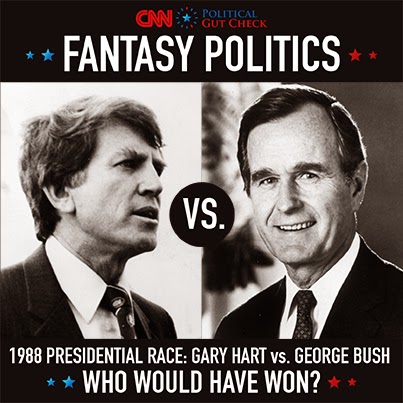
What If Wednesday: President Gary Hart

From The CNN Brief.
I think its safe to say that younger generations (and I include myself in this group) have no idea who Gary Hart is. Quick primer: he was an American politician, an almost liberal alternative to the Reagan era, who twice sought the Democratic nomination for President (1984 and 1988) but was brought down by a sex scandal during the 1988 campaign. Matt Bai in The New York Times discussed the whole scandal and lamented the changes to journalism it caused, but the last part of the article, where Hart speculates about what would happen if he was president, is what really perked my attention:

“Well, at the very least, George W. Bush wouldn't have been president,” Hart said ruefully. This sounded a little narcissistic, but it was, in fact, a hard premise to refute. Had Hart bested George H. W. Bush in 1988, as he was well on his way to doing, it’s difficult to imagine that Bush’s aimless eldest son would have somehow ascended from nowhere to become governor of Texas and then president within 12 years’ time.

“And we wouldn't have invaded Iraq,” Hart went on. “And a lot of people would be alive who are dead.” A brief silence surrounded us. Hart sighed loudly, as if literally deflating. “You have to live with that, you know?”

Now Gary Hart presidential alternate histories aren't very popular in the genre. The most famous one has to be "Palace of Fine Arts, San Francisco, California - October 6, 1976, 7:00 p.m." from Jeff Greenfield's Then Everything Changed (review), which has him winning the presidency in 1980. Still considering how controversial President Reagan was for some Americans, one wonders what would have happened if Hart was elected President sometime between 1980 and 1988...

Well first off, Hart may have needed more than a sex scandal staying buried to be elected president. As many have pointed out, Hart had too many rumors about his infidelity swirling around and his high poll numbers came too early in the 1988 campaign to be very meaningful for a plausible counterfactual. Perhaps his best shot was to get the nomination in 1980 or 1984, although honestly I don't know enough about the era to speculate confidently. I can say that a known womanizer who already had multiple affairs could easily have a sex scandal happen while he was president, causing a Clinton-esque crisis to happen years earlier. Could he have been impeached? Its possible, considering even Clinton's impeachment got to the Senate.

What I really wanted to discuss, however, is the two counterfactual statements made by Gary at the end of the article: that Hart as president would mean no George W. Bush or Iraq War. This belief doesn't seem backed up by any real facts. Even if George H.W. Bush is not elected president (or vice president in a scenario where Hart defeats Reagan) there is no guarantee that George W. or someone with his politics would not be able to reach the White House on their own merit in a post-Hart presidency (in fact if Hart does have a sex scandal while president, it is not unforeseeable that Americans would elect a Republican in the next elections).

It also presumes that somehow Hart would have prevented the circumstances that led to the Iraq War, which as Frank Harvey described in Explaining the Iraq War (review), had little to do with who was in office and more to do with factors that were set in motion decades before. Maybe Hart could have avoided the Iraq War, or even 9/11 since he is given a lot of credit for predicting it would happen, but it is just as likely that something worse could have happened and there is no guarantee President Hart would be as farsighted as Citizen Hart was. As we get far enough away from the initial point of divergence, it becomes harder to assume we will know exactly what will happen without falling into the trap of creating a parallel history.

Perhaps it was a narcissistic thing for Hart to say about himself or, as Gavriel D. Rosenfeld said in his commentary on Bai's article, he is just using a counterfactual in order to give meaning to his life. Hart wants to believe that in the end he is a good person and would have been a great president. Whether he would have is a matter for us alternate historians to decide. What do you think of President Gary Hart? Let us know in the comments.

* * *

Matt Mitrovich is the founder and editor of Alternate History Weekly Update and a blogger on Amazing Stories. Check out his short fiction. When not writing he works as an attorney, enjoys life with his beautiful wife Alana and prepares for the inevitable zombie apocalypse. You can follow him on Facebook or Twitter.

Wednesday, May 7, 2014

What If Wednesday: James K. Polk is Not Elected President

In my humble opinion, James K. Polk is the most underrated American president in history. The Tennessee Democrat was a one-term president, but in that term he accomplished all the goals he set out to achieve when he announced his candidacy. He lowered the tariff, established a treasury system that lasted until 1913, ended the Oregon boundary dispute with Britain and led the country to victory in the Mexican-American War that gave the United States its Southwest. He kept one more promise as well, to only serve one term if he achieved his goals. Thus in his one term, Polk accomplished more than most presidents do in two terms.

But what if Polk was never elected president? How would American history change without Polk? I don't think we need to do anything drastic to the timeline like having him die early, because Polk already was a "dark horse" candidate of the Democratic party. The deeply divided factions of the Democrats only chose him as a compromise because they could not come to agreement over any of the other candidates, like former president Martin Van Buren who garnered a simple majority on the first ballot of the convention but unable to gain the necessary 2/3rd majority to win the nomination. If Van Buren's supporters had campaigned harder or the 2/3rd majority rule had not been adopted, Polk may not have been needed at all.

Even if Polk had been nominated, he still could have lost the 1844 election. Many historians believe that third party candidate James G. Birney of the Liberty Party stole victory from the Whigs by getting votes that would have otherwise have gone to their candidate (more on him later). Third parties in American politics tend to have that effect in the two parties system to encourage the party they are ideologically aligned with to adopt some or all of their platform. If Birney had not run, Polk could have lost some key states and thus would lose the election.

Who would be president then? Both scenarios I feel would have ended with a Whig victory, because I think anyone the Democrats choose besides Polk would have split the Democrats after the losing faction puts up their own candidate. Thus Henry Clay, the Whig candidate for president in 1844, would have been elected president. In our timeline, Clay ran three times unsuccessfully for president, but in this timeline he would have been victorious. Although a slave-owning Southerner, Clay backed a lot of policies popular in the North. He wanted a high tariff to foster industry, federal funding put toward improving infrastructure and a strong national bank. He also was a staunch anti-expansionist and opposed annexing Texas. I didn't find much on his opinions on Oregon, but he would probably not have taken an aggressive negotiating policy as Polk did, which could lead to the United States getting a smaller share of the territory than it did in our timeline.

So President Clay would not annex Texas, thus avoiding the Mexican-American War, but his policies would have been unpopular in the South and could have potentially led to an earlier Civil War if not handled correctly. Clay may have been able to reach a compromise (like he did in 1850 of our timeline) by opening up more of the Great Plains to slavery or putting federal backing to colonization of freed slaves (something Clay's running mate, Theodore Frelinghuysen, was a proponent of), but it may not be enough. Without Texas, the balance of slave vs free may tip to early to the North and thus start an early Civil War. There is a general school of thought among alternate historians that the earlier the war, the more likely the South would win. Thus a Clay presidency could have to a rump United States with only a small strip of territory on the Pacific coast, instead of the American Southwest.

What about Texas? What would they do with a prolonged period of independence? I always found alternate historians to be overly optimistic about its future as an independent Republic. Although it did gain recognition of its independence from foreign nations like the United States and France, Texas' independence was based on a treaty signed at gun point that was never ratified by Mexico. Despite the size of the territory Texas claimed, the government only ever controlled a portion of it and were often unable to prevent Mexican incursions into the territory or stop Native American raids. On top of this there was a lot of conflict in Texan politics that sometimes led to armed conflict between factions. This all bodes poorly for Texas and will likely lead to a demise similar to its contemporary, the Republic of Yucatan. If fighting between the Texan factions becomes too intense, one group may request aide from Mexico on the condition that they rejoin Mexico.

Or could Texas side with the South if the American Civil War happens earlier? Would this bring Mexico into the war in an effort to once and for all bring the wayward province back into the fold? Or could someone else besides Clay and Polk be president? What would they do?

Regardless, I hope you guys got an idea of how American history would have been different without James K. Polk. If you would like more information about this little-known president, check out Polk by Walter R, Borneman. In the meantime, let us know your thoughts in the comments below and if want to submit your own scenario email me at ahwupdate at gmail dot com for a chance to be featured on the next What If Wednesday.

* * *

Matt Mitrovich is the founder and editor of Alternate History Weekly Update and a blogger on Amazing Stories. Check out his short fiction. When not writing he works as an attorney, enjoys life with his beautiful wife Alana and prepares for the inevitable zombie apocalypse. You can follow him on Facebook or Twitter.

Friday, October 25, 2013

Alternate Nixons Part 2

Guest post by Andrew Schneider. Read Part 1 here.

There are any number of minor changes that could have led to a Nixon victory in 1960. The popular vote was the closest in living memory, with just a fraction of a percent separating the winner from the loser. In Barry N. Malzberg’s “Heavy Metal” -- published in Mike Resnick’s short story collection Alternate Presidents -- a last minute fight between Kennedy and Chicago’s Mayor Daley prompts the latter to tilt his city’s returns, and thus Illinois as a whole, into Nixon’s column.

Undoubtedly, the first presidential debate between Nixon and Kennedy played a role in JFK’s eventual victory.  Polls conducted after the debate suggested that a majority of those who watched the debate on television believed Kennedy won. But the majority of those who listened to the debate on the radio believed Nixon was the victor. If Nixon had accepted advice from his handlers on how to prepare for the debate – let the makeup people do their work, or you’re going to look unhealthy under the lights – then appearance would have played less of a role in popular perceptions of who won. The fact was that Nixon wasn't in the best of health.  He was still recuperating from an infection he’d sustained by slamming his knee into a car door. Subtract the injury, and Nixon would not only have looked healthier but might have turned in a sharper performance.

A more intriguing turning point to me hinges on the way each of the candidates reacted to the arrest and imprisonment of Martin Luther King Jr. in Georgia on trumped up charges.  Kennedy called King’s wife Coretta to offer his sympathy. Nixon failed to do so, though he apparently did try, without success, to get the Eisenhower Justice Department to intervene to get King released.

Nixon’s 1968 victory came in significant part because of his domestic platform of “law and order,” framed as a coded appeal to whites who resented the civil rights policies of the Kennedy and Johnson administrations. The strategy laid the ground work for a massive shift in the states of the South, transforming it over the course of a few decades from a solidly Democratic bastion to an overwhelmingly Republican one. So it’s easy to overlook the fact that Vice President Nixon was a staunch supporter of the civil rights movement.
Jeffrey Frank explores this subject at some length in his recent study of Nixon’s relationship with Eisenhower, Ike and Dick: Portrait of a Strange Political Marriage. Frank characterizes Nixon as “the one major [Eisenhower] administration official who went out of his way to meet regularly with black leaders” (p. 214). Nixon had been on good terms with King since they met in 1957, and he had the active support of the Reverend Martin Luther King, Sr., a highly influential figure in his own right. As a private citizen, he supported passage of the 1964 Civil Rights Act -- unlike Ronald Reagan and George H.W. Bush.

Frank characterizes Nixon’s decision not to intervene more forcefully as “cautious, even cowardly,” motivated by fear that he would alienate Southern whites who’d voted for Eisenhower without making any significant inroads among black voters. But JFK took an even greater risk. Nixon could have won without the South. Kennedy could not.  In our timeline, the risk paid off. Kennedy picked up tens of thousands more black votes than he otherwise expected, including in the critical states of Illinois and Texas. Had Nixon shown the courage of his convictions, those votes could have been his.

It’s worth examining what this would have meant for an earlier Nixon presidency. There were any number of Republican presidents prior to 1960 who had campaigned for, and been elected with the help of, African-American votes, but who failed to do anything significant in the way of mitigating the horrors in which African-Americans lived. Nixon may well have been different, if for no other reason than because of the time at which he took office. Nixon saw civil rights as an issue intertwined with the Cold War. America claimed the mantle of leader of the free world, casting the Soviet Union as the enemy of freedom. However obvious that might be in retrospect, it was difficult to make that case to other when the United States visibly denied civil rights (and frequently life itself) to non-white citizens across much of its territory. It was even more difficult in the new nations of Africa, freshly emerging from decades or even centuries of colonial rule.

My guess is that a Nixon elected president in 1960 would have made this argument forcefully to Congress.  With Democrats still in charge of both houses, and segregationist Southerners in charge of many of the key committees, getting any civil or voting rights bills through would have been just as difficult for Nixon as for Kennedy.  It’s possible, though, that Nixon may have been able to pull enough support among Northern Democrats, together with the Republican caucus, to have pushed such measures through. He would likely have shown fewer compunctions than did Eisenhower about using federal authority to integrate southern schools.

From that standpoint, there might have been little difference in the pace of civil rights legislation under an earlier President Nixon than under Presidents Kennedy and Johnson. The long-term implications for U.S. politics, though, would have been significant. It would have made a G.O.P. embrace of the Southern Strategy highly implausible. The end result would likely have been a party that was less sectional and more moderate. That raises the question, though, of where conservative southern whites would have taken their votes. In 1968, both Nixon and George Wallace were competing for that bloc. If President Nixon emerged as a champion of civil rights, would that bloc have stuck with the Democrats? Or would have led to a durable third party, aiming both at southern conservatives and disaffected northern whites?

The Nixon of 1960 was a complex man, prone to self-doubt, temper tantrums, and bullying behavior. He had an extremely suspicious nature. He’d demonstrated a willingness to play dirty, both in his first congressional campaign (1946) and in his senatorial campaign (1950). He was not an easy man to like. But he was a long way from the bitter, obsessive, vengeful figure he’d become by 1968. Whether a Nixon elected in 1960 would have been any more effective as president, he would have been far less likely to have broken the law.

Could Nixon have had an even earlier start to his presidency? This is a question Frank comes back to repeatedly. Eisenhower was close to death at least three times during time in office. He suffered his first heart attack in September 1955, a severe gastrointestinal illness in June 1956, and a stroke in November 1957.

The stroke offered the greatest possibility for an early, and successful, Nixon presidency. It brought about widespread, public speculation that Eisenhower was no longer physically capable of carrying about the duties of his office. It was particularly worrisome to Secretary of State John Foster Dulles.  Dulles’ uncle, Robert Lansing, had been secretary of state when President Woodrow Wilson suffered his own debilitating stroke, leaving the government largely under the influence of Wilson’s wife Edith for months. The stroke itself came just weeks before Eisenhower was scheduled to travel to a NATO meeting in Paris. According to Frank, had Eisenhower not recovered sufficiently to make the NATO meeting, he had planned to resign.

There were relatively few crises between 1957 and 1960 that give us much ground for speculation on how Nixon would have behaved differently from Eisenhower. It’s unlikely, for example, that Nixon at this stage in his career would have been inclined to risk war with Mainland China when, in August 1958, it resumed shelling of the islands of Quemoy and Matsu, occupied by Chiang Kai-shek’s forces.  Nor is it likely that Nixon would have intervened to prevent the January 1959 overthrow of Cuba’s Fulgencio Batista. At this point, it was still unclear that Fidel Castro was a Communist. By contrast, the corrupt Batista was generally regarded as an embarrassment to the United States. The odds are that Nixon would have performed competently.

Would he have then won a term on his own merits in 1960? John F. Kennedy would have had a much tougher time beating Nixon as a sitting president than as a departing vice president. Lyndon Johnson – then the Senate majority leader and the most powerful Democrat in Washington – would have made a more formidable opponent had he been able to rouse himself to pursue the nomination more energetically than he did in our timeline. But Johnson would have faced a serious problem in terms of his geographical origins.  In 1960, no one from South of the Mason-Dixon Line had been elected president in more than 100 years. His support for the 1964 Voting Rights Act and the 1965 Civil Rights Act were far in the future. In fact, LBJ was one of the Southern Democratic leaders who participated in the epic filibuster of the weaker 1957 Civil Rights Act. That might have helped him in the South, but it would have killed him in the North. It’s difficult to envision either of the other major Democratic candidates of 1960 -- Adlai Stevenson and Hubert Humphrey -- doing much better against an incumbent Nixon.

What might have happened if Eisenhower had died in 1955 or 1956 is another matter. At this point, Nixon was younger and less seasoned a foreign policy hand. He would have faced the twin crises of the Suez War and the Hungarian Revolution in 1956, presumably in the midst of a campaign for a full term as president.
Eisenhower ended the Suez Crisis by forcing Britain and France to withdraw their forces from Egypt, on pain of forfeiting badly needed financial assistance. Israel, then isolated, was pushed to withdraw from the Sinai in exchange for United Nations guarantees of its security and freedom of navigation (both of which ultimately proved worthless, leading directly to the Six Day War of 1967). This was one of the few moments since the start of the Cold War when the U.S. and the Soviet Union found themselves taking a common position against the European colonial powers. Nixon let it be known, years later, that he disagreed with Eisenhower’s handling of the Suez Crisis.

Nixon didn’t hold back from expressing his position on the Hungarian Revolution at the time, though. Shortly before Election Day 1956, Nixon gave a speech at Occidental College calling for open support of the rebels as part of a campaign to liberate Eastern Europe from Soviet rule.  Calling for the liberation of Eastern Europe was hardly new for Nixon. Nor was it unique to the vice president. It was a position he shared with his foreign policy mentor, Secretary of State Dulles.

As mentioned above, Eisenhower refused to intervene in the Hungarian Revolution. Would the young Nixon have shown similar restraint? The pairing of Suez and Hungary would have presented him with an international crisis to match what Kennedy faced in October 1962. Like the Cuban Missile Crisis, this could all too easily have escalated into a nuclear confrontation.

Frank presents earlier points of divergence for Nixon. There were concerted efforts to dump Nixon from the Republican ticket, both in 1952 and again in 1956. Eisenhower appeared to support these efforts at times, particularly during the financial scandal that Nixon sought to stem with his famous “Checkers” speech.  Eisenhower never liked to fire people. He much preferred to have other people deliver the bad news, or to encourage the offenders to resign. Various lieutenants in the 1952 Eisenhower campaign – including New York Governor Tom Dewey, twice the former GOP standard bearer – passed the word to Nixon that Eisenhower wanted him to resign from the ticket. Ike himself said nothing directly, and Nixon declined to fall on his own sword.

Eisenhower could have demanded Nixon’s resignation, though, which would have left the vice presidential nominee with little choice. Most likely, Nixon’s replacement on the ticket would have been William Knowland, the senior senator from California and Nixon’s bitter rival. Knowland was an experienced foreign policy hand, a staunch conservative, and an ally of Eisenhower’s main opponent for the Republican nomination, Ohio Senator Robert Taft. An Eisenhower-Knowland ticket would likely have triumphed in November 1952, although the upheaval might have made it a closer race than Eisenhower actually enjoyed against Stevenson. Whatever the outcome for Eisenhower, though, it’s unlikely Nixon would ever have had another shot at national office.

There is one still earlier divergence for Nixon that is particularly intriguing. In 1937, fresh out of Duke University School of Law, Nixon applied to become an agent of the Federal Bureau of Investigation.  Nixon’s full application has since been declassified and is available for viewing on the FBI’s website. It appears that Nixon’s application was in fact approved. What happened next is unclear.  According to one telling, Nixon’s decision to postpone his accepting the post until after he’d taken the bar exam led to the offer being withdrawn.

Nixon himself later claimed Hoover told him the only thing that kept Nixon from being made an agent was that Congress hadn't appropriated the necessary funds in 1937 -- entirely possible, given that 1937 was a year of budget cutbacks, but this doesn't appear as part of the original FBI record. Either way, had Nixon joined the Bureau, it’s unlikely he would have served in the Navy in World War II, and less likely still that he would have entered politics. Instead, he may well have spent the balance of his career hunting Communists and other alleged subversives with a badge and gun. And the shape of post-war American politics would have been unimaginably different.

* * *

Andrew Schneider is the business news reporter for KUHF Houston Public Radio. His work has appeared in print in The Kiplinger Letter and The Writer, as well as online at KUHF.org. He is currently writing a memoir of his time in Afghanistan as a war correspondent. You can follow him on Facebook or on Twitter.

Wednesday, January 30, 2013

Review: 43* by Jeff Greenfield

Guest post by Kieran Colfer.
It was a familiar refrain from the political left all the way though the Bush years and ever since: "Everything would be different if only Gore had won the election". There would be no budget deficit, no Iraq War, everyone would still love the USA and we'd be well on our way to solving global warming. There have been many fantasies about this, including even a Saturday Night Live skit by Al Gore himself, but here it finally gets the full book treatment.

Normally the "President Gore" fantasies begin with the election night count itself, but here the author does something a bit cleverer, he moves the butterfly back a year to a little boy being washed up on a Florida beach. As a result, the Florida election turnout is slightly different enough to not need a recount, and so Al Gore returns to the White House as The Man rather then The-Man-In-Waiting. This isn't the only butterfly in the book, however, the second one blows the whole "9/11 was as bad as things can get" idea right out of the water. This particular twist sends subsequent events off on a direction totally different from our timeline - or does it?

The book itself takes a little bit of time to get used to - most alternative history books you read are about events and characters long since consigned to the pages of history, but here you are reading about events that you have lived though (or "would live through" maybe?), so it was slightly strange seeing characters and saying "ah yeah, I remember him".  One nice touch here is in the battle between the recently defeated Republican power players and the newly elected Gore -  a lot of the quotes here will look very familiar, as they are quotes used by the Republicans after Obama won in the 2008 election. For those who look back on the Post-Bush days through rose-tinted glasses and imagine a Gore presidency as a halcyon time of bi-partisan co-operation, this book may come as a rude awakening, but politics was never a gentleman's game, and we see this here in spades.

My one big issue with this book is the ending - in the context of the book itself, it's a good place to end, but it's a bit abrupt, you're left hanging wondering what will happen next. Will a second order counterfactual kick in for Iraq, or wont it? This is a book that begs for a sequel, although it is a clever move by the author to leave the public wanting more.

* * *

Kieran Colfer is a member of the AH Weekly Update Review Team.

Wednesday, November 7, 2012

Alternative Elections: 1844

Guest post by Jake Schenberg.

The importance of the presidential election of 1844 is overlooked as often as the man who won it. James K. Polk, an important yet largely forgotten president [Editor's Note: Hell yeah!], oversaw the fulfillment of Manifest Destiny, expanding the United States from ‘sea to shining sea.’  But what if he had been defeated by Henry Clay, a man famous for his many compromises? Would the United States still have gone to war with Mexico, the very conflict which historically resulted in Mexico’s cession of California and the New Mexico Territory?

President John Tyler had been pushing for Texas Annexation since he took office after the death of William Henry Harrison. Clay’s Whigs, who opposed the expansion of slavery and hostilities with Mexico that Texas annexation implied, defeated a treaty of annexation which Tyler had previously negotiated with the Texas government in June of 1844. Determined for Texas to be the feather in his cap, Tyler announced the formation of a third party, the Democratic-Republicans, as a vehicle for his reelection. In actuality his goal was to force the Democratic Party to nominate a pro-annexation candidate rather than the favorite, Martin Van Buren.  The ploy worked and the hitherto unknown James K. Polk was nominated instead.

Polk went on to win the election by a very narrow margin. Had Clay managed to win over five thousand more voters in the state of New York, perhaps from the abolitionist Liberty Party which was closely aligned with northern Whigs, he would have won the Electoral College and become the nation’s 11th President at a turning point in American history. Under President Clay, no joint resolution for the annexation of Texas would have been considered by Congress, which means no Mexican War (at least not this early) and subsequently a halt to westward expansion. The consequences of such a scenario are too numerous to explore completely, but a number of interesting possibilities present themselves when imagining President Henry Clay’s administration.
Map of North America when President Clay assumes office in March 1845.
Clay ran on a platform which included his constant support of the American System, a threefold plan which pushed for a strong central bank, high tariffs, and internal improvements funded by the sale of federal lands in order to promote commerce. In 1841, Clay championed an effort to charter a Third Bank of the United States, to be called the Fiscal Bank of the United States. President Jackson destroyed the second in 1836, prompting the Panic of 1837 which led to widespread bank failures and massive unemployment; the United States did not emerge from the depression until 1843. President Tyler vetoed the 1841 bill, but a Clay administration backed by a Whig congress and with the memory of the recent depression still fresh on everyone’s mind should be able to push through the Fiscal Bank of the United States in 1845.

The existence of a regulatory agency would have prevented the subsequent Panics in the 19th and early 20th century, assuming of course it were allowed to remain in place for its chartered twenty years and renewed consistently afterwards. In reality the issue of a central bank would again be a central campaign issue in the decades to come. The Jacksonian Democrats would not abide the existence of the thing their progenitor had destroyed, an entity they viewed as unconstitutional and felt threatened by. Thus, the narrative of the 1848 campaign may have shifted away from Manifest Destiny and towards domestic policy.

Interestingly, the term “Manifest Destiny” may not have been coined in this timeline. Newspaper editor John L. Sullivan first used the phrase in an 1845 essay urging President Polk to annex the entirety of the Oregon Territory. That argument must be seen in the rhetoric of the time; expansionists proclaimed “54’ 40 or Fight!” as Polk played hardball with Britain over the Oregon boundary dispute. By contrast, President Clay by nature would have been much more ready to compromise. He likely would have used President Tyler’s original proposal, which placed the border at the 49th parallel and ceded Britain the island of Vancouver and navigation rights along the Columbia River.  Such an easy settlement would have allowed Clay to focus on implementing the other two points of his American System.

In 1842, the Whigs pressured Tyler into signing what became known as the Black Tariff, which raised tariffs on imported goods to nearly 40%.  However, Clay was not able to push his program of federal land sales to fund internal improvements through congress.  Assuming as president he succeeded in doing so, the northern states would have industrialized even quicker due to more and better canals and roads linking the western Great Lake states to Atlantic ports.  Such a trend towards a more industrialized North at an earlier time would only accelerate the divergence between northern and southern interests while increasing the North’s political clout at a faster pace.

A growing North would vocally have supported Clay in opposition to the historical Walker Tariff of 1846, which entailed immense reductions in the tariff rates. This policy of continued high tariffs, coupled with a central bank unpopular among farmers who profited on speculation and a system of internal improvements which favored the industrialized North would seem to lead to early sectionalism in American politics. Clay certainly would have fared poorly in the south in 1848 and would need to carry most of the North to win a second term.

The issue of slavery in the territories would have reared its head earlier without expansion below the 36’ 30 (Missouri’s southern boundary). In our timeline, free Iowa and Wisconsin were admitted during what was Polk’s presidency after the slave state of Texas joined the Union.  Without Texas, any attempt by territories in what was the Louisiana Purchase to become states would be blocked by Southern legislators, unless a new compromise could be made. Henry Clay, the Great Compromiser, may have allowed slavery to spread farther into the northern territories, but abolitionists were growing in strength politically during this period and would certainly raise hell over such a compromise, if they could not stop it themselves.

What is clear is that the two halves of the ostensibly United States are moving farther apart in this timeline much sooner than they actually did. A civil war in the 1850s could take on an entirely new character. Whether it would be more or less successful is difficult to ascertain; this point of divergence gives wings to so many butterflies that a determined author could produced any outcome he or she wants.  Those butterflies run amok not just within the shrunken United States, but across North American.  I hope to cover some of these possibilities in future installments.

* * *

Jake Schenberg is a student and aspiring writer. When he isn't staring at blank pages in Word, you can usually find him out running miles or inside curled up with a good book.

Tuesday, November 6, 2012

Showcase: A Giant Sucking Sound


Guest post by Sean Korsgaard.

Happy Election Day my dear readers! I hope the Americans reading this have taken the time to go out and vote, I don’t care for whom, just do so! In any event, I have a very special showcase for you today, the Turtledove Award winning A Giant Sucking Sound, by MaskedPickle!

As an American, it’s only natural to look at our two party system and think ‘what would it be like if we had a third?’ At least from an AH standpoint, it’s perhaps as much of a challenge to write a plausible third party TL as it is to get one elected in real life, mainly because in the last hundred years, you really only have two choices. The first is Teddy Roosevelt’s run as a Progressive in 1912. The second, is in 1992, and a particularly peculiar Texan billionaire named Ross Perot. Though shockingly little more than a footnote, his role as a third party candidate should not be underestimated – his run is likely why President Clinton was elected as opposed to President George HW Bush winning a second term, and his platform of balanced budgets, libertarian social values, decreased economic regulation and investing in technology, energy and infrastructure would prove decades ahead of its time, with both parties adopting bits of it since then. That said, he lost due to his own habit of gaffes and erratic behavior, and likely did the country a service in doing so.

Of course, we’re in the business of asking what if – just what would a Ross Perot Presidency look like?

After getting elected by first, not withdrawing in August, and nominating populist Governor Jerry Brown as his running mate, Ross Perot is largely opposed by both parties out of a mutual desire to see the first Independent president since George Washington play ball by their rules. Needless to say, Perot chooses to destroy the two party system instead, forming his own political party, the Freedom Party, or Freedomites. Largely centrist, but attracts all types not represented by either wing or ignored by their own, it’s ranks include the likes of John McCain, Paul Tsongas, Ron Paul, Al Sharpton, Joseph Patrick Kennedy II, as well as the likes of Jon Stewart, Jello Biafra and Donald Trump. With the two party stranglehold broken, President Perot and the Freedomites begin implementing their agenda, whether or not they can reach a tripartisan agreement.

The Perot Presidency sees some great things done. Perot spearheads an international coalition of forces to intervene in Rwanda to prevent the 1994 genocide, as well as a more competent attack on Somalia which ends with a puppet regime installed in Mogadishu. In addition, he almost immediately starts pushing for national internet infrastructure akin to phone lines or highways, with the committee implementing such an approach headed by Steve Jobs. As promised, he pushed a balanced budget amendment through Congress and it passes once turned over to the states, though a similar one pushing for term limits to Congressmen failed. In addition, he enacts a version of gun registration not seen for years later in the aftermath of Waco. To top it all off, Perot prevents the implementation of NAFTA and stands up to China over Taiwan.

There are also some downsides of course. At home, in reaction to the harsher put down of Waco and Ruby Ridge, and inspired by other international terrorist movements, the brief 1990s militia movement has blossomed into a homegrown terrorist movement called Stormfront, led by the likes of David Duke, Richard Girnt Butler, Tom Metzger, David Leach and Matthew F. Hale, as the OTL lone wolf attacks are traded for attacks like the Oklahoma City Bombings and assassinations ranging from Paul Wellstone to Steven Spielberg. This was inspired in part because of the rise of doomsday cults in Asia and Islamic terror in Europe, both of which are far more successful at committing deeds far worse than OTL – one of the most stunning moments of the TL is when Aum Shinrikyo detonates a stolen nuclear bomb in Nagoya. Russia seems to have come under the grip of a would be fascist movement that is starting to make Vladimir Putin look positively warm and fuzzy, and Europe is locked in a war in Algeria combating Islamists.

Ultimately, the turmoil abroad and at home was enough that, when combined with an Perot finally snapping under the pressure, leads to Democrat Ann Richards winning in 1996. Richards, though she comes down hard on Stormfront, does so by enacting legislation that makes the OTL Patriot Act look tame, and between that and pushing for unpopular health care reform, she is in a vunerable position for reelection. Heading into the 2000 national election, one with chaotic details on all sides, including a brutally drawn out Freedomite convention, we are about to see Republican Jeb Bush, Freedomite Angus King, and even two fourth party runs from both Pat Buchannan and Jerry Brown challenge the vulnerable President Richards for the Presidency. It will be interesting to see who wins in upcoming updates.

The effects of Ross Perot’s Presidency on the United States are both good and bad. Perhaps most obviously, the end of the two party system has shaken American politics and American culture to the bone, mostly for the better. His push for improved infrastructure, especially the national internet network, in addition to proving a boon to the economy and the nation, is the sort of project we’d likely never see in the OTL two party system. That said, the rise of domestic terror due to backlash has had a telling effect on America in TTL, and the future of this America could go either way.

The international scene is just as radically different. Terrorism has become a global threat even more than OTL – ranging from the Islamic variety, which for a number of reasons, is focused largely on Europe and Russia, Aum Shinrikyo in Japan, to Stormfront in the USA. Lady Diana, who is still alive in this TL, has been vilified for marrying Dodi El Fayed and converting to Islam, which with the ongoing European War on Terror, has made her the most hated woman in Britain since Wallis Simpson. Japan’s economy has been further crippled by the terrorist nuclear attack on Nagoya. An increasingly fascist Russia led by Prime Minister Alexandr Lebed is taking steps toward reclaiming some of the neighbors. Somalia fragmented years ahead of schedule, one where Mogadishu is ruled by Hussein Mohammed Farrah Aidid. Though Perot intervenes against the genocide against the Tutsis in Rwanda, ones in Congo and the Solomon Islands take its place. The map of the world has been radically altered, with independent nations like Mindanao, Somaliland, Kurdistan, and even Quebec, and hints of a federalized Europe in the future.
Yet another hallmark of the TL is the vivid alternate pop culture, which helps characterize the world even further. One of the most powerful moments of the TL is when famed Director Steven Spielberg is killed by Stormfront, with Saving Private Ryan dedicated to his memory and a number of other projects of his circulating around Hollywood in various forms. Brandon Lee has lived to become one of Hollywood’s biggest action stars, having stared in TTL Matrix movie (of which, there is only one) and another movie based on Metal Gear Solid. Kurt Cobain’s gunshot wound left him braindead, something which has affected rock music in ways even more than his OTL death. Television has seen a version of the West Wing with Sidney Poitier playing the President, and 24 with Charlie Sheen playing Jack Bauer. Other butterflies have seen Harrison Ford play Oskar Schrindler in Schrindler’s List, Russel Crowe land the role of Aragorn in Peter Jackson’s Lord of the Rings trilogy, Titanic going down as a box office bomb, and a grief stricken George Lucas handing the directing job for the Star Wars prequels to Sam Raimi.

Overall, the timeline does two things masterfully that next to no other AH works have achieved in terms of detail and plausibility – they made a successful modern third party, and a dystopian 1990s, and in the process showed just how close we could have had either. This timeline is rich, developed, often veers off in unpredictable directions, yet often funny or quirky, yet always worth a look and brilliant in ways – and after all, should a TL about Ross Perot be anything else? Give this masterwork a read if you haven’t already, and have a Happy Election Day!

* * *

Soldier, scholar, writer and web-voyeur, Sean CW Korsgaard has been active in the alternate history community since 2006, and was recently elected to succeed Mitro as President of the Alternate History Online Facebook group. In addition to his contributions at the Alternate History Weekly Update, he writes for several websites, including his own, which can be found here.