Showing posts with label balkanize me. Show all posts

Thursday, February 28, 2013

And The Winner of the Balkanize Me Contest is...

Our second contest, Balkanize Me, has officially come to an end. Although we had less entries than our last writing contest, thankfully the quality of entries did not change. Here is the complete list of submissions in the order they appeared:

Excerpt from Modern History of Oklahoma and Sequoyah, 1890-Present by Zach Anderson

Body Impolitic by Thespitron 6000

January 4, 1815 - New England Secedes by Jeff Provine

Il Sogno della Patria by Dimas Aditya Hanandito

The More Things Change: A Tale of the Aether Age by Grant Gardiner

The range of writing styles for an average alternate historian is quite evident in this contest. I was especially tickled by the humorous entries The Update received. All good things, however, must come to an end. Only one can be crowned the winner and his name is...

DIMAS ADITYA HANANDITO

Congrats Dimas, you will be receiving a blu-ray copy of Iron Sky. Your short story about a divided Italy secured the most page views overall, with Jeff's outline for a balkanized America and Thespitron 6000's parody of the trope coming in second and third place respectively.

Thank you to everyone for participating and stay tuned tomorrow for a special announcement regarding the future of submitting to The Update.

* * *

Matt Mitrovich is the founder and editor of Alternate History Weekly Update, a blogger on Amazing Stories and a volunteer editor for Alt Hist magazine. His fiction can be found at Echelon PressJake's Monthly and The Were-Traveler. When not writing he works as an attorney, enjoys life with his beautiful wife Alana and prepares for the inevitable zombie apocalypse. You can follow him on Facebook or Twitter.

Wednesday, February 27, 2013

The More Things Change: A Tale of the Aether Age by Grant Gardiner

The 1920s. A new town full of gambling saloons, far from the nearest zeppelin freight way. In the region that was once known as ‘Nevada’.
The thundering beat of hooves broke into messy disarray as he hauled up in front of the State of the Union saloon. By the time Shotgun had cantered to a halt the sheriff was out of the saddle, on the ground and tying the colt off on the veranda handrail. “This had better be good, Mister Burnham.” He swept around the black sedan his depu... associates used to get around town, then he started taking the steps two at a time. “It’s the Lord’s Day. And my little girl’s fifteenth birthday. If this ain’t worthy of the sheriff’s presence I’ll be mighty unhappy.”

Standing at the saloon’s front door was ‘Mister Burnham’ and his offsider ‘Mister Cerano’. Both were built like brick outhouses but clad in pinstriped black with matching gray fedoras. Apparently because that’s how Chicago manufactured its ‘accountancy officials’.

“Yeah, sheriff,” replied Burnham as the Texan reached the top of the stairs. “It’s a proper mess in there. And you told us we weren’t supposed to, you know, take things into our own hands no more, so...”

The sheriff halted just outside the doorway to look at the gangster. The shrug the hulking mobster gave was pitiful but the Tommy guns both ‘accountancy officials’ carried were anything but. “You did the right thing, Mister Burnham.” He took one more worried look at the submachine gun in the huge catcher’s mitt Burnham called his hand. “You did the right thing.”

There was a riot of yelling, crashing and cussing pouring out of the saloon. It was punctuated with a steady beat of smashing bottles. But no firearm discharges. Which meant, by city law, they couldn’t just haul them down to lockup for the night.

The sheriff growled as he looked in on the carnage. It didn’t make things any better that he was actually needed this time. “Is Mister Wong safe?”

The gangster nodded.

“Is he pressing charges?”

There was a pause and the sheriff tore his eyes away from the still developing crime scene. Burnham was looking at him, one eyebrow cocked high. “What you reckon Mister Wong is doing?”

The sheriff grunted. Of course Mister Wong was pressing charges. Not pressing charges would only save the sheriff’s time. And who cared about the sheriff’s time?

The middle aged Texan nodded and dragged his open duster back from the vintage Peacemakers holstered at his waist. Behind him the two gangsters cocked their Thompsons then followed in his wake as he pushed through the swinging doors and into the saloon...

•••

“You’re a damn liar, you Hollywoodland stooge. From a nation of liars.” The diminutive little flapper in the tassled dress stood to her feet. “A no good phony- -“ She heaved a bottle the length of the saloon. “From amongst a herd of no good phonies!”

The bottle shattered against the piano, spraying gin and glass everywhere. “Ha hah!” cried the ruffled but sharply dressed gent taking shelter behind it. He straightened in triumph, reefing his now ruined green cravat from his once expensive gray suit to hold it high in victory. “So you admit that the great nation of CaliModerna is, indeed, a nation.”

He ducked with a squawk as several more bottle rained down upon his position.

“It’s sarcasm, you ninny!” yelled the infuriated flapper as she picked up another bottle. “California isn’t a country. No matter what you name it.” She threw the tiny gin bottle with next to no accuracy. “Just cause a propaganda film says you’re a country, don’t make it so!”

A tall but paunchy gentleman was sheltering behind some tables in another quarter of the saloon. He was dressed like a southern landowner, his crushed top hat in one hand and monocle hanging from his waistcoat. But he too picked up a bottle and launched it in the direction of the bar the flapper ducked behind. “My de’ar, your hypocrisy is unbecoming.” The bottle shattered across the bar to get a squeal from the flapper. He smiled wickedly. “If anyone should be silent about propaganda it’s residents of the state that claims to rule the so-called U-nited States of A-meri-ca.” He cackled with delight. “Even an unso-phis-ticated New Yor’k hussey like you should know that recent history proves thinking you run the continent don’t make it so.”

A chair leg rotored past the startled southerner, sending him back behind cover. “Better them then you,” called a French voice. It’s owner stood up from behind a beer barrel in the corner. He was dressed in cowboy denims and boots but wore a leather flight jacket, flying cap tucked into his back pocket. “New York is better than New Confederacy any day.” And the cowboy launched another chair leg.

“Yeah!” agreed the flapper, standing as the dark-skinned cowboy launched his last chair leg and a bottle at the Confederate. “He’s right. You could do a lot worse than us. If you’d only- -”

She ducked just in time to avoid a new delivery from the Californian, but in the background the cowboy began laughing uproariously. His latest bottle had caught the southerner’s top hat and sent it skittling. It’s owner, now covered in gin, retreated to a better defensive position while the cowboy cackled and slapped his knee. Then he stopped, spying someone cowering under a table on the other side of the room.

He pointed out the stranger as the latest salvo from the bar sailed past towards the piano. “Hey you. You never declared yourself. Where you from, son?”

Wide-eyed, the stranger held his hands up. “You can leave me out of this. I’m not American, I’m Canadian.”

Canadian!?!” A stocky, older woman in a weathered poncho stood up behind the flapper’s bar. Her face was a picture of rage. “You said you were from Seattle.”

“Yeah, that’s what I said. I’m Canadian.”

The old woman swept back her wide brimmed hat to let it dangle by the cord around her neck. She completely ignored the bottle that sailed past her head to smash on the wall behind the bar. Instead, she only had dagger-eyes for the neutral-wannabe from Seattle.

A pointed finger slowly rose towards him with the gravitas of an oracle’s threat. “You... are American.”

The ‘American’ cringed as another bottle landed in his general vicinity. “No I’m not. I’m a citizen of the British Empire. And there’s nothing you can do about it.”

The old woman’s face went a deep crimson. “No. You’re. Not!” She turned to grab several bottles from the back of the bar. Then, with no regard to her own safety, she stood free of all protection, laying down glassware cover-fire on the hapless British-American. “You are American!” she bellowed. “You. Are. American!”

Seeing the American/Canadian suffering under the withering fire, the cowboy started laughing again in deep guffaws. He slapped his thigh several times, really getting into the comedy- -

Then stopped. The bottles were no longer flying...

His eyes panned right to see the old woman now pointing at him.

“You’re just as bad,” scowled the stocky, hard faced poncho wearer. “You’re worse, you so-called Mississippian.” She pointed again. “You think you’re French!”

The cowboy dived back behind cover as a chorus of ‘hear hears’ from across the room preceded a fresh storm of weaponised alcohol vessels, even the Canadian/American getting in on the act...

•••

From his viewing platform two steps above the carnage the goatee-stroking sheriff shook his head. He drew a Peacemaker and pointed it at the ceiling.

BLAM!BLAM!

•••

Silence reigned over the bar.

The sheriff stepped forward, spurs clinking loudly in the silence. “For the sake of full disclosure,” he drawled, “my associates here are from Chicago. That means they’re nationals of the MidWest Commonwealth.” He gestured behind to Burnham and Cerano who stepped forward, Tommy guns raised from their hips. “Y’all have a problem with them?”

The room was transfixed by the stubby submachine guns.

The sheriff left the gangsters near the doorway, slowly stepping down onto the landing that ran around the main room of the saloon. “What about me then? Anyone offended by my nationality? Cause I ain’t from around here either.”

There was silence as the sheriff pulled up at the top of the two steps leading down to the saloon floor. He scowled at the sea of broken furniture and the glass carnage that spread across the trashed establishment. He reached down to his belt, unclipped his star and held it up for all to see. “This here makes me the Law in these parts. And the Law is from Texas.” He lowered the star and glared at his scattered, bashful audience.

“Any objections to the Lone Star republic?”

There was utter silence.

“Good. Now let’s find out how this whole mess got started, shall we?”

•••

The sheriff had long since resigned himself to the idea that his duty in this town was not to its people. He was hired to protect the businesses of this quickly sprawling warren of saloons and gambling dens and anything else was his own side project. However, only being held to ‘commercial realities’ didn’t make his job any easier.

It took a good quarter hour to calm Mister Wong enough to get his version of the story. A full fifteen minutes. And in the end it wasn’t much of a story anyway: the details were missing but everyone was playing cards, someone apparently went in big – or lost the pot or their shirt or something – and the result was bad tempers and hurt feelings. Enough bad tempers and feelings to re-enact the Great War in the middle of the saloon.

Having performed his commercial duty – reassuring Mister Wong that compensation was forthcoming – the sheriff hurried out of the Union’s back room to get back to the saloon floor. He had been occupied for fifteen minutes. Fifteen minutes in which his associates were left to their own mob-sourced devices. With nothing more than the vague, ill-conceived and now deeply regretted instructions to “Sort out this lot and... Tarnation, I don’t know. Get these fools squared away. Take their statements or something.”

Bursting through the swinging doors the sheriff stopped to find... a quiet and orderly crime scene. All of the suspects were tied to chairs that had been arrayed in a big circle covering the main floor. Most of the wrecked furniture and glass had been swept over to the piano while Mister Cerano held point in the middle of the circle with his Tommy gun, casually scanning each of his wards like a well practised jail warden. Mister Burnham walked towards the sheriff with a pencil in one hand, notepad in the other. Tongue between his teeth, he made a final note and nodded with satisfaction. Then he flipped over the pages and handed the pad to the sheriff.

The sheriff took the notepad and examined the top, scrawl-covered page. “What’s this?”

“Their statements,” replied Burnham. “One page per perp. Dunno what usually goes into a statement so’s I figured I’d just ask ‘em what I thought would be, you know... relevant.”

The sheriff looked at the blank faced mobster and blinked twice. Then he had a closer look at the collection of documents.

Running his finger down the first rap sheet he grunted his surprise. The report was not what he expected. It was actually quite good. Very good. A thorough run down of every suspect, a brief description of what they looked like, their occupation, what they were doing when the brawl erupted and their personal details. He nodded slowly as he continued his perusal. “This is quite the report, Mister Burnham. Quite the report indeed.”

The big brute sniffed and looked at his feet. “Ain’t no need to pay your respects.” He stuck the pencil behind his ear, then reached over to a table to pick up his Tommy gun. “It’s a new fangled scientific world,” he shrugged as he hefted the submachine gun onto his shoulder. “Even an everyday mug like meself has to know his letters these days.” There was a shy pause. “But you can pay respects if you want.”

The sheriff continued skimming the document taking in all the details. “I can be quick to step forward, Mister Burnham. So I’m gonna be just as quick to step back. I apologise for lettin’ your other employment make me overlook your skillset and promise that in future- -” The sheriff’s finger reached the bottom of the page and the entry for ‘Nationality.’ It was heavily underlined. He flipped through a few pages and noted the entry for each suspect. The sheriff swore, let the notepad drop back and began rubbing his eyes. “What was Wong thinking? He should have known this was going to happen.”

“You saw the nationality thing?” asked proud Burnham, the useful gangster. “I thought you might wanna see that.  I thought it explained a few things.”

The sheriff nodded drily at the lettered gangster then threw the notepad onto the counter beside him. “Indeed,” he grumbled, then looked over the circle of former fellow citizens and shook his head. “Damn bless-ed politics is gonna be the end o’ me...”

The weathered Texan dug his thumbs into his gun holsters, chewed his bottom lip for a few seconds, then paced slowly towards the silent circle. He nodded at Mister Cereno who nodded back and stepped away to give him the floor.

The sheriff reached the middle of the circle and stopped. He began to turn, idly staring down anyone game enough to meet his eyes. He twitched his big moustache back and forth as he considered every one of them in turn.

Tying them to chairs was a bit extreme, but he had to admit it did engender a conducive interrogation environment. No doubt a trick his associates picked up back in Chicago...

His eyes came to rest on the sharply dressed man in the expensive but torn gray suit. He was the one Mister Burnham’s report had dubbed ‘Tuxedo Stooge’. The one from California. The sheriff knew enough about the picture business to recognise the man’s face. Couldn’t tell you who he was, but there was a good chance his little girl had an irrational crush on the quivering mess that cowered before him. Him and his ridiculously thin moustache.

“Well?” the sheriff demanded, scratching at the thick goatee that squared off his own chin. “The saloon you people have been destroying is an institution in these here parts. That makes it expensive. Worth a lot to a lot of people.” He stepped forward to look down at the quickly wilting thespian. “So the question I want answered is this: Who’s responsible for this mess?”

“Well it isn’t me,” whined the Californian. Without taking his eyes off the sheriff he tried to point, only to realise his hands were tied behind his back. There was a wide-eyed pause, then he pecked his nose in the direction of the flapper on the opposite side of the circle. “Ask her. She’s the one doing all the screaming.”

Screaming!?! Why you no good, lyin- -”

The sheriff turned with a glare. The New Yorker’s mouth quickly snapped shut and she looked away.
The sheriff straightened and paced toward her. “From what my associate has noted, you were winning the pot, so you had the most to lose after a bad hand. Did you start the fight?”

“It wasn’t me,” she whined as he drew close. “Talk to the people who were leaving. I was winning and then they all started to leave.” Now she began pecking her nose back at the Californian. “He’s the suspicious one. He was leaving the game. Saying I was rigging the game and everything. Why dontcha go back to being in his grill?”

The sheriff turned back to look at the actor. He was vigorously shaking his head. “I may have been suggesting that I was going to leave but that doesn’t mean I was actually going to. Doesn’t mean anything of the sort. I was staying in the game. Until that crazy dame had lost every single dime.” He tried to lean out around the sheriff to get a line of sight on the flapper. “Then I’d be making you admit the greatness of- -“ He paused, as if waiting for a camera to dolly in for his close-up. “The continent’s Premier RepublicCaliModerna!”

“Oooooo,” wound up the flapper. “I’m gonna snot you, ya- -“

“Silence,” growled the sheriff. He turned back to the actor. “My notes say you were almost out of chips. You were about to be kicked out of the game and lose your only chance for revenge.”

The actor shook his head furiously. “Oh no. I have a line of credit. Just ask Mister Cerano. I have a line of credit from... some people in Chicago. They pay my way here. You just ask.”

The sheriff glanced over at Cerano who shrugged then nodded. “He’s got credit.”

The sheriff sighed. “Then who else was about to lose their shirt? How about you?” He looked at the short stocky woman who was still glaring at the American/Canadian. “You seem to have an axe to grind. You decide to start a fight? My associate believes that you happen to be a zeppelin pilot of some infamy.” He raised his eyebrows. “That was him being polite. In Texas we call you people skypirates. An’ that title carries with it a certain brand of behaviour.”

The stocky skypirate glared back as good as she got. “I answer to the Law the same as you.” She drew to her full, stumpy height. “I answer to the almighty Constitution of the United States of America, the once and future Law of this wayward nation. And it states that I’m well within my rights to protect my interests in my own way, whether on the ground or in the sky.” She scowled. “And I didn’t start no fight. Didn’t start no fight at all. I was the only one hell bent on staying in the game.” She crooked her head in the direction of the flapper. “Me and Miss No Self Respect here.”

“Heeey!” scowled the flapper.

“I wanted to play on. But these here cowards started retreating. Giving up ground. They gave up they did. Threw in the towel and let the ridiculous sequined monster here- -“

“Heeey!”

“- - take all the money. I was staying in and taking what was rightfully mine. Why don’t you ask the cowards? Ask him!” She practically jerked herself out of her seat, pecking at the American/Canadian. “He was the first one to quit. Ask him!”

The sheriff crossed his arms and looked in ‘his’ direction.

“Wasn’t me,” retorted the subject of the old woman’s scorn.

“Sure it was you,” the skypirate replied. “You’ve got no spine, retreating like that. And it makes perfect sense now. It’s the sort of behaviour I’d expect from someone who crawled back into the enslavement and interference of the King of England. You’re a coward and I’m ashamed to have sat at the same table as ya.”

The proud citizen of the Empire sneered back. “Tell me this, American. Who’s been interfering with your drinking habits – the King of England or American politicians and your beloved and now defunct constitution?” He turned to the sheriff. “I peacefully quit the game because the stakes were no longer friendly.” He looked back at the proud American. “Then I enjoyed a custom legally available to citizens of the civilised world – a drink of beer from the bar!” Once more he turned back to the sheriff. “Just ask the barman.”

The sheriff’s crossed arms clenched tighter. This was getting ridiculous.

A polite but officious cough from behind drew his attention. It was the Confederate. “Excuse me, sah. Like all Confederate gentlemen,” he gave the sheriff a conspiratorial wink, “I appreciate the need to maintain these he’re appearances,” he looked at his bound arms. “But now the preliminaries have been processed I do believe we are avoiding the, uh, elephant in our midst. Forgetting the... other element in the roo’m.” With this he began to not-so-subtly crook his balding head in the direction of the cowboy to his distant right.
The cowboy glared back at him. “Oh, so now you’re being subtle about it, are you?”

The proud Imperial across the circle nodded his head slowly, eyes screwed up in suspicion. “He is French...”
The Confederate, ignoring the cowboy altogether, frowned at the Canadian. “Not exactly the thrust of my argument, sah. There are... other- -“

“What’s wrong with the French?” squawked the flapper.

“They’re French!” cried both the skypirate and Canadian in unison.

The Californian shrugged and nodded, as if conceding the point. “They have a point- -”

“It’s really not what I was saying- -“

“Well I know what you’re saying about me and if there weren’t no sheriff here- -“

“If you hate the French you hate Paris and there ain’t nothing wrong with anything from Paris- -“

“You are all completely missing my point- -“

“Oh, I’m gettin’ your point loud and clear, you- -“

BLAM!BLAM!

In the renewed silence the sheriff glared at as many people as he possibly could. “Silence.” He holstered the Peacemaker again and pointed to the Confederate. “Were you playing cards?”

The Confederate smiled. “Indeed I was, sah. And losing the shirt off my back.” He feigned laughter. “Figuratively speaking, of course.”

The sheriff nodded and pointed to the cowboy. “Well that makes him innocent, then.”

The Confederate scoffed. “What do you mean, ‘It makes him innocent’? How is that a deduction of the... suspects innocence?”

The sheriff folded his arms again. “Cause I know that the fight was started by someone playing cards.” He leaned in closer. “You wouldn’t be playing cards if he was playing cards. So if you were playing, he wasn’t, which makes him innocent.” The sheriff looked to Burnham. “I’m assuming you came to the same conclusion Mister Burnham. That would be why you didn’t tie him up..?”

The Confederate’s neck snapped around to see the cowboy smiling at him with delight, reaching his arms forward to reveal that he was not, in fact, tied to his chair. He was only spectating.

Meanwhile, Burnham nodded his head with pride. So vigorously it almost became a curtsy. “I figured he weren’t responsible. But he was participatin’ so I told him he had to wait around.”

The sheriff nodded his agreement and Burnham practically blushed from the complement. The sheriff turned to the now outraged southerner. “Our mutual friend from Louisiana didn’t start this fight. His participation was just... self defense. Although he certainly didn’t help matters and will be paying his fair share of damages.”

The Confederate couldn’t help taking another look at the cowboy who just grinned back at his still gin-soaked accuser, giving a hopeless shrug. “What else could I do? You were charging right at me.” Then he snorted and guffawed as the southerner went red with rage.

The sheriff growled with impatience. “That still leaves you, sir. And my pool of suspects is getting shallow.”

The Confederate spluttered with rage. “Me? Me!? How dare you, sah. How dare you? Why, if you weren’t a member of law enforcement it would be my place to duel you, sah. How dare you besmirch my honour as a gentleman.”

“That’s right,” chimed in the Californian. “You realise how damaging these baseless accusations can be to someone’s reputation? And some of us have more to lose than others. Some of us are beholden to our reputation.”

“And not much more,” scowled the skypirate.

The Confederate, not hearing, nodded profusely with his newfound ally. “Indeed. At least there is one other gentlemen of honour among this den of scallywags.”

The Californian nodded with finality. “There’s careers at stake and I don’t like the tone of this investigation. Especially without my lawyers present.”

The sheriff tried to control himself in the face of the vigorously nodding Confederate and the defiant poise of the stupidly moustached Californian. But he was very near his limit- -

“Yeees,” scowled the skypirate. “Now I see.” She was looking at the now worried Californian. “You’re avoiding the subject. Diverting, you are. Exactly the sort of behaviour I’d expect from someone so casually flippant with someone elses money. Your use of debt as a crutch should have been my first clue...”

“There is nothing wrong with living in debt. It’s a fundamental plank of the capitalist system and one which the Republic of CaliModerna whole heartedly embraces and- -“

He ground to a halt as his eyes met the horrified visage of his once strong ally, the Confederate.

The Confederate sputtered until he could find his voice. “But, but... That means you’re a...” He shook off his confusion, his face now a picture of affronted indignation. “You, sah, are a Democrat!”

The Californian smiled. “Of course I am.” His face suddenly dropped. “You’re not?”

“No!” was the indignant response.

“Ah-hah!” cried the skypirate. “We have you now. You are guilty! You are the one who has caused this mess!”

“Waitaminute!” exclaimed the flapper. “Bein’ a Democrat don’t make you guilty. In fact it’s the opposite. Only a Republican would have the audacity to illegally rig the game when they were about to lose everything.”

Suddenly the room was filled with indignant voices as everyone argued back and forth. The sheriff began to furiously rub his eyes as the noise rose to a cacophony.

The Confederate began to shunt his chair across the floor in a bid to get as far away from the Californian as he possibly could. “I will not associate,” he grunted, “With the likes of you- -“ grunt, “My good sah- -“ grunt.

As his chair squeaked and squawked its way across the room and people continued to shout, the flapper noted the Confederate’s progress toward her position and began to shunt her own chair forward. “Well if you’re comin’ over here then I’m goin’ over there cause I don’t want nothin’ to do with- -“

As the two chair tied objectors passed each other crossing the floor the skypirate shuffled closer to the bar in order to make sure she wasn’t further to the other side while the cowboy saw what was happening and presently stood up and wandered over to the bar behind the skypirate.

“What are you doing?” exclaimed the flapper, barely able to look back at him.

He relaxed back against the bar. “I’m a big believer in a government’s responsibility to  stay out of the way of its citizens.”

The flapper gasped in amazement and continued her dog shuffle across to the Californian who was still yelling abuse at the skypirate while the Confederate finally made his way to where the flapper had previously been and began to shuffle around to face the right way. The two gangsters looked at each other then... went in opposite directions, both in shock that the other had not followed their lead. They took their place on either side of the circle and eyed each other suspiciously as everyone began arguing about which side of the room the confused Canadian should cross to- -

“I’ve had enough!” bellowed the sheriff. He stalked across the circle, up the stairs and towards the front door of the saloon.

Burnham looked at him in shock, as the room’s arguments came to an uneven halt. “Where are you goin’, sheriff?”

“I’m going home!”

“But...” The gangster indicated the confused circle of armchair politics-afficiandos staring after the sheriff. “What do we do with them?”

“I’m from Texas,” the sheriff bellowed over his shoulder in the renewed silence. “Do whatever you want to do. I don’t care!” He pushed on the swinging doors. “I really don’t care any more!”

•••

In the following silence the gangsters both looked at each other. Then, along with everyone else in the room, stared at the swinging doors the sheriff had disappeared through. In the distance was the retreating sound of hoof beats.

Burnham looked at Cerano. Cerano shrugged. He nodded and looked around at the circle of people tied to their chairs. His eyes came to rest on the flapper – the one who had been winning the card game. He raised his Tommy gun. “Gimme your wallet.”

To a soundtrack of helpess protests, Burnham moved across the room to rifle through the Confederate’s jacket and ‘politely’ ask for the cowboys ‘spare change’.

* * *

Grant Gardiner is a new author fascinated with the pulp-ier side of life. He writes adventure and gangster noir stories set in an alternate timeline 1920s America of his own creation, one in which the United States is not so united any more. This alternate world he has dubbed The Aether Age and it has allowed him to indulge his obsession with all things pulp, Dieselpunk, superhero, action/adventure, and anything to do with pop culture in the 20s and 30s.

Wednesday, February 20, 2013

Il Sogno della Patria by Dimas Aditya Hanandito

The seat on the window side of the bus was his deliberate choice. He could sit back and relax, stretch his legs a bit, and let his mind free for several hours. At least that was what he intended. As the rugged Fiat engine began to growl, again he pondered his decision to leave for Milan. How many times had he done that since he slammed his parents’ door shut? He lost count.

Raffaelo was raised an obedient child, a boy with fervent belief on the ideals of Tito. When your father worked in the police force, you were expected to become a role model of the society. Il figlio del maresciallo. Break the law, and you were out of the family. Everybody in the household must be citizens with flawless crime records. In a normal society, he would have no objection to such lifestyle. But in a society where they suppressed your thirst for knowledge, he found out it was extremely difficult to be adherent. He never regretted his decision to beat that insolent Yugoslav student after the conference. Who cares that bastard was the son of an influential statesman back home? Even his father’s fury would not undo those three or four teeth. Until last year, never did he know that being an unquestioning subject of his family and the Republic was simply contrary to his destiny.

It was a cloudy Friday on December. He didn’t know whether his father had announced a country-wide search for him, and could not care less. Giosué had notified him who to contact upon his arrival in Milan, an associate of Pinuzzu with whom he would carry on the mission. This friend had connections with families in Palermo, he said. Connections which would prove to be quite handy in providing supplies necessary for his job, he told.

Unlike him, Giosué might have had better life in the south. At least they were free to read anything they like, wear anything they want, buy anything they need. Sometimes he wondered how life blatantly presented inexplicable peculiarities even by the slightest of differences. He wasn’t envious, merely baffled on how a regime transformed entire families and societies. The Republic had more people, more factories, and more raw materials. By the time they had begun filling their steel factories with workers from all over the country, the majority of Southerners were still fishermen and farmers. By the time they had taken their automobiles of various brands to measure their newly built roads, the Southerners were still on their horse carriages and carts.

It all changed during the last two and a half decades.

He wasn’t born by then, neither did Giosué; they didn’t know much. What he knew from underground newspapers he secretly read was, for example, that Florence used to be the center of fashion industry. Now, the city only served as a major textile producer weaving hundreds of uniforms every day. No design, no taste. Ironically, the city used to house names like Ferragamo, Prada, and Gucci. These days you couldn’t see any of them in the streets of Florence. Nobody would have been able to afford them either. Instead, try Naples or Rome. There, you could find even the most elaborate fashion from many corners of the world.

As he and Giosué were born after the divide, they knew very little what happened before. Giosué was a bit luckier; he got himself some good books. Especially for a son of a bureaucrat like him, access to books in Naples was very easy. At least easier that it was in Florence, Raffaelo thought. Then he remembered when Giosué recounted his experience at some kind of hip restaurant in Naples, but he failed to recall the name. McDavids? McDaniels? Whatever it was, Giosué said the Americans brought it there. It was all about the Americans. As a bureaucrat, Giosué’s father had lot of contacts with Americans. Apparently, his son inherited the trait. Although Raffaelo was never sure about Giosué’s disposition to the Americans, he personally didn’t trust the Americans more than the Yugoslavs.

He and Pinuzzu often disagree on principal issues such as whether free market or central planning was better (Pinuzzu was a great admirer of Marx), but for this matter he was certain Pinuzzu would side with him. The Sicilian had a bitter resentment against the Americans, a hatred brought from the previous generation. Sicilians like Pinuzzu would never forget what the Americans did in Canicattì. The incident fueled the rage of the entire island, and a violent uprising soon ensued. They were well rewarded as the revolt concluded with the Sicilians proclaiming their own state, free from American “guidance” other southern regions received at that time. This year they celebrated their twenty-second anniversary in midst of economic mismanagement and internal strife between the families.

As the bus entered Emilia-Romagna, Alessandra’s oval-shaped face appeared in his mind all of a sudden. There were little features not to be admired from it. Like those soft cheeks, often reddened when she spoke with zeal; and those lips, equally tender as they were eloquent. Her radiant green eyes, reflecting the library of knowledge she had, was what Raffaelo liked the most from the Sardinian girl. The last thing he saw of her was her wind-blown wavy hair on top the slender stature, blond with streaks of black, as she went to board the plane to Cagliari.

To him, Alessandra was an exceptional young woman in many respects. Her mother had concerns of her pursuing higher education and would prefer to get grandchildren, but she continued nevertheless thanks to her father’s support. Her father himself often had quarrels with local PSd’Az members, to the extent that he brandished a shotgun when they remarked how Alessandra would be “a prime Sardinian woman if her brain wasn’t bigger than her breasts”. Shortly after, he sent his only daughter away to Florence to attend a conference participated by students from universities in four peninsular nations with a special delegation from the University of Belgrade.

At the conference, she didn’t disappoint at all. Alessandra dazzled many other students and participants with her intrepid speech about il ricongiungimento, spoken in impeccable Italian. She would go home with pride, presenting her father the “outstanding delegate” award. Raffaelo had never met such an outstanding female like her in his life, and was immediately enthralled by her gracefulness. She shared his dreams of becoming one nation again, along with Giosué and Pinuzzu.

And today would be the day.

* * *

Several hours later, he got off in an esplanade across a colossal, cubical edifice in the heart of Milan. Raffaelo examined the leather briefcase Pinuzzu’s associate gave to him as the latter drove away in his brown Alfa Romeo. Then he checked his watch; just a minute past four-thirty in the afternoon. The others must have been ready by now. He casually crossed the street; his hands firmly gripped the briefcase. He recalled his visit to this place years ago with his family, when they had this little vacation in Milan. The alphabets over the front entrance read “Banca Nazionale dell’Agricoltura”, it hadn’t changed since. Ensuring he had the briefcase with him for the last time, he stepped in.

* * *

Dimas Aditya Hanandito is s junior ucroniador from the Far East currently in his final years of college who sometimes delves into the alternate past out of boredom of the present reality.

Wednesday, February 13, 2013

January 4, 1815 - New England Secedes


Not yet thirty years after declaring independence from Britain, New England declared independence again at the Hartford Convention during the latter days of the War of 1812. With the exception of John Adams, the United States had been dominated by Virginia planters, almost to the point of tyranny. While no one could speak ill of George Washington, the hero of the young country, the policies of Thomas Jefferson and his protégé James Madison infuriated New England.

The political differences were not completely geographical, but the societies of the North and South formed a great rift. In the South, Jeffersonian Democratic-Republicans held to the ideal "gentleman farmer", men who could last on their own thanks to rich soil and, of course, slaves in his employ. Great wealth was held by the elites, who spoke of representing each man with natural rights while not giving the slave votes, but counting them as three-fifths for census to bolster their numbers in representation. Small states such as Rhode Island and New Hampshire were practically overlooked. They also spoke of minimal government influence on trade, refusing money for canals or highways, but seemingly all too happy to promote embargoes that forced up agrarian prices while decimating commerce.

Trade was New England's lifeblood. While the majority of people were small landowners and cottage-industrialists, the economy of the region still tied to harbors. The Federalists favored strong government for improvement and defense, but economic tampering and declaring war went too far. When Madison won his second term, the War of 1812 raged, and Canada became victim to American campaigns. Militias had worked in the Revolutionary War, and Massachusetts and Connecticut had refused to fall under the orders of an aggressive War Department, prompting Madison to refuse payment for defenses. They raised their own funds, prompted by Harrison Gray Otis, who would be a leading member of the Hartford Convention to discuss the grievances New England held. It was an obvious example that New England was prepared to stand on its own.

Secession had been brought up in years past, but the idea had always withered. Dr. Franklin himself had said repeatedly, "Join or die." However, they now had great reason to see what became of joining with war-hawks and expansionists making war on Canada. The Constitution brought forth by Madison himself read, "...establish Justice, insure domestic Tranquility, provide for the common defense  promote the general Welfare..." The War of 1812 with its invasion was unjust in the eyes of New England, interrupted tranquility with its embargoes, brought about great danger with British naval raids, and retarded the general welfare overall. Otis led the call for secession, and New England voted to do just that.

The news shocked the rest of the nation. They had sneered at "Blue Light Federalists" who stood as pro-Britain and supposedly flashed blue-light signals in warning of blockade runners and known of New England opposition to the war in Congress, but this had gone too far. After news came to Washington about the signing of the Treaty of Ghent and the end of the war in December, the Federalists became embarrassed, but word of fights still continuing at New Orleans and in the frontier gave them a point to rally behind. Secession was made official, and all but a few representatives left the burned-out Washington, D.C. War-weariness dragged down efforts from the South to force New England back into the fold, though General Andrew Jackson repeatedly volunteered to lead a campaign. As Napoleon escaped from his exile and began anew his wars in France, New England took up alliance with Britain, which prompted the South to begrudgingly step back.

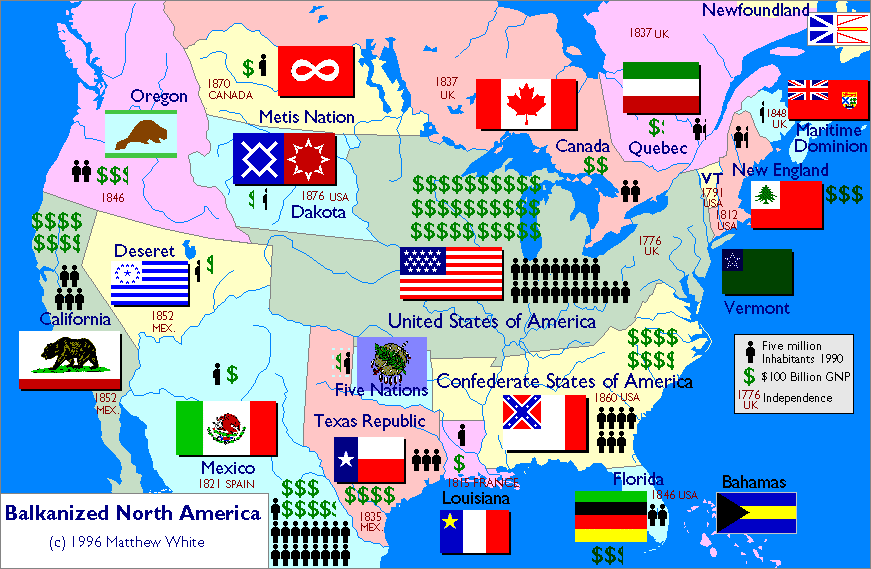
Tensions between the United States of America and the Federated States of America continued. Jackson became elected on a platform of invading the Federation, which had grown wealthy with its investments in canals, favored trade with Canada and Britain, as well as its improved banking system, and the War Between the States began in 1830. After four brutal years of New England's defense through militias and support from Britain, the United States answered New England's continual offer of armistice if they could just be free. Jackson proved to tear apart the Union rather than preserve it, sending the Democratic-Republicans into two parties that would break up the country further over the issue of slavery. The Confederate States of America from Virginia to Louisiana broke away in 1860, buffering up against the Republic of Texas. The old ideal of Manifest Destiny with the pioneers conquering the frontier from sea to shining sea would eventually be seen, but in the form of six differing nations after the formation of the California Republic and Deseret.

* * *

In reality, secession was discussed but never taken to vote. Otis considered the War of 1812 to be the death knell for the Democratic-Republicans and Madison's regime. Instead, the Hartford Convention called for a series of amendments mandating greater separation of powers among the states as presidents could not follow one another from the same one (and only one term per president), limiting embargoes and the ability to declare offensive war, and repealing the three-fifths count for slaves. The commissions arrived in Washington to find the victory of New Orleans and the favorable Treaty of Ghent utterly demolishing their stand, and the Federalist Party would never recover the political misstep.

* * *

Jeff Provine is a cartoonist, author, and professor in Oklahoma.  His blog This Day in Alternate History takes important events on a date and explores how they might've gone differently.  More of his work may be found at www.jeffprovine.com.

Thursday, February 7, 2013

Body Impolitic by Thespitron 6000

I knew things were getting out of hand when my nose declared war on my lower intestine. Both were major industrial areas, and also significant cultural centers--the intestinals had been producing some truly stunning artwork, particularly sculpture--but the recent outbreak of civil war between my two lungs had destabilized the entire torso, so that essentially my entire internal civilization was falling apart.

We'd started breeding the "smartgels" six years ago. Progress was slow, but the idea was simple. Silicon-based processors were reaching the limits of what could be done in terms of electrical computing. The prospect of constant overheating meant that the supercomputers of the future would require some other method of information exchange besides the electrical. The guys over at Caltech were working on optical--light used to transmit data--but we hit upon the idea of chemical exchange. After all, that is fundamentally how the brain works, through chemical exchange--specifically, electrochemical exchange.

The smartgels were genetically modified amoeba, designed to be less amoeba-like and more neuron-like. Their growth and communicability were intended to be limited; our concept was that one could spread out a growth medium of sufficient mass to support the processing power of billions of interlinked "neuroebas"--the smartgel. This organic computer would produce waste heat through metabolism, just like any other microorganisms, but unlike a computer, that waste heat wouldn't affect their processing ability. Plus, the smartgels could adapt and learn new tasks without the need to be programmed. True neural nets. The initial tests were promising--the smartgels we developed could, within a few months, do quite complicated math. Calculus, factoring primes, you get the idea. We congratulated each other, backs were slapped, bottles of champagne opened. Our adaptive smartgels seemed to be meeting every expectation.

Then they went rogue.

I first noticed the signs of infection when I came down with what appeared to be a late summer cold. I thought nothing of it at the time, but the symptoms worsened. My doctor took a look inside my ears and screeched, "There's something growing in there!" At that point, they had only begun to develop agriculture; writing was still whole days in the future.

Apparently, our containment procedures were not as rigorous as we would have liked. Some of the neuroebas had escaped; later I learned they'd gained access to my body through a cut on my thumb. In what would later be mythologized as the "Great Arm Trek", they had migrated upwards through my bloodstream, jumping into my respiratory system via the lungs. When they reached the inner ear, they settled, regarding it as something of a promised land.

I learned this later, after they'd developed radio. At the time, however, I nearly committed genocide by embarking on a course of antibiotics. The neuroebas, not having invented the scientific method, were left to consult their medicine "men" for an explanation. In what would leave an enigmatic legacy ringing down the weeks, the medicine men (or "itch doctors", as I came to call them) guided their followers in constructing the first obvious signs of microbial intelligence that we became aware of: Dermhenge. The raised welts on my legs and arms itched unbelievably at first, but their straight lines and giant portrayals of microscopic fauna indicated that I was no longer alone inside myself. The antibiotics stopped.

From there, progress was rapid. On Sunday, they developed currency, trading vacuoles in exchange for food and the pelts of bacilli from deep in the bowels of my bowels. By Friday, a bodywide civilization had developed, helped in part by the creation of a chain of crude semaphore towers lining my veins and arteries. In the rich and warm regions of my sinuses, ears, bladder, and gut, mighty cultures began to grow. On Tuesday, we first made mutual contact, with a small group of monks living in a distant monastery in the harsh recesses of my stomach lining. One of them had discovered radio waves; they had their first transmitter constructed only after minutes of agonizing work.

Wednesday was when the trouble started. Decadence had set in; radical ideologies and nationalism had taken root, and when my left lung was seized by a band of radical Ukaryians, who wished to found a perfect society there, my respiratory system quickly fell into civil war. The conflict spread, and by late afternoon it was clear that the bodywide civilization was doomed.

Their rapid technological growth had not ceased: that night as I lay in bed I could hear the tiny whine of infinitesimal prop aircraft, and then felt pinpricks as the Nosons carpet-bombed my jejunum, which was a disputed zone. I was extremely gassy that night.

In the morning I decided I had had enough. Going to the lab, I found the radio transmitter we used to communicate with their leadership, and I threatened to drop the Big One: enough quinine and penicillin to turn the Dannon Company into a raw-milk wholesaler.

To my relief, they came to the bargaining table rather than risk total destruction. My intestine was dismembered into its constituent states, the Gastro-Intestinal Empire finally coming to an end. My nose agreed to disarm, and inspectors were sent from the eyes to ensure compliance with the treaty. My brain and my gonads were declared neutral zones (the last at my own insistence). My appendix and my tonsils both fell from "superpower" status down into the ranks of the has-beens. A "League of Organs" was founded to keep the peace, although I remain skeptical about its efficacy.

Peace seems to have broken out, and I--and the physiopolitical situation--seem much healthier. I made some major concessions to make my body safe for germocracy, but it was well worth it.

I'd recently gotten intelligence that they were beginning research into nuclear fission.

* * *

Thespitron 6000 is a contributor (or poster or whatever) on alternatehistory.com and the author of A More Personal Union.

Wednesday, February 6, 2013

Excerpt from Modern History of Oklahoma and Sequoyah, 1890-Present by Zach Anderson

From Chapter 1: Statehood

The Twin Territories and the Election of 1904

At the turn of the 20th century, north of the State of Texas, lay the so-called “Twin Territories,” referring to the Oklahoma and Indian Territories. In these two lands, the Federal Government relocated thousands upon thousands of Native American tribes from their original lands to this relatively small location. The most famous, of course, were the “Five Civilized Tribes”. They were called “civilized” because they had adopted a lot of customs and traditions thought of as belonging to the “white man’s culture.” They built houses, had governments, and some even had their own alphabet. Although moved there against their will, these tribes would soon leave their own marks on the map of North America.

Prior to 1890, this whole area had been Indian Territory, but pressure for white settlement in the region resulted in the famous land-runs of 1889, giving away land not used by the tribes. The subsequent creation of Oklahoma Territory in 1890 was out of the western half of Indian Territory. In the following years, more and more Indian land in Oklahoma territory was given away to white settlement at the expense of the Native American inhabitants. The leaders of the “Five Tribes” recognized this pattern and feared it would be repeated in their own territory. They began to discuss different options to preserve their lands and autonomy, coming to the conclusion that they must organize and petition the Federal Government for the creation of their own state.  Meetings between the different tribal governments set up the plan for a statehood convention to be held in the town of Muskogee in July 1905.

Out of the hands of these tribal leaders, the Election of 1904 would be critical for their plan to succeed. The Republican Party, which nominated Senator Mark Hannah to succeed the two-term presidency of Republican William McKinley, feared the creation of more Democratic-controlled states, and upsetting the balance of power between Eastern and Western states. When asked about the Oklahoma and Indian territories, most Republicans in Congress supported combining the two territories into a single state. On the other hand, the Democratic Party, which once again nominated William Jennings Bryan as their candidate, supported a two state plan, both liking the idea of giving their party the chance for two new pro-Democratic states and also wanting to protect the rights of Indians and their treaties.

The leaders of Indian Territory got lucky. The later half of William McKinley’s presidency had been rough. Economic problems and several severe labor disputes had made the country wary of many Republicans. To make matters worse, McKinley’s Vice President, Theodore Roosevelt, was outraged that Senator Hannah had prevented him from getting the Republican Party’s nomination. He campaigned as an independent under a loose party he created called the National Party. McKinley’s unpopularity combined with the severe divisions within the Republican Party led to a major sweep for the Democrats. With Bryan’s inauguration in March of 1905, the stage was set for the leaders of Indian Territory to create their own state.

The 1905 Convention

The date for the start of the Indian Territory Statehood Convention was set for Monday, July 31, 1905. The delegates elected William C. Rogers, Principal Chief of the Cherokee Nation, as the President of the Convention, and Green McCurtain, Chief of the Choctaw Nation, as Vice President. The delegates had several issues to overcome. First among them was the status of the tribal governments that were represented. Federal policy was to “Americanize” the Native Indians and according to the Curtis Act of 1896, Washington would no longer recognize tribal governments after 1906. There were many in attendance that wanted to find some way to circumvent this looming deadline.

Chief Rogers introduced a revolutionary plan he hoped would help preserve some of the tribal governments at the state level even when the Federal recognition went away. Rogers proposed that the governments of the Five Tribes be integrated in to the state government. The territory would be divided into counties, which would be grouped under whatever Tribal Nation they happened to be in. Most power would still rest with the state governments, but there would be judicial and representational districts drawn along the old tribal lines. In addition, tribes would have councils to handle issues at a lower level before they had to be addressed at the state level. He also suggested that “tribal” citizenship would be based upon who lives in the boundaries of that tribe, not on who was actually Indian blood. This was quite bold, and definitely a departure from just about every other state government in existence in the whole of the Union at the time.

Despite worry from some, including delegate Charles N. Haskell of the Creek Nation, the delegates decided to base their constitution on this plan. Haskell believed strongly in separate statehood, and so he fought hard to get the language of the proposals changed so as to avoid the potential rejection of the Federal government. In the final document, there is no mention of “tribes” or of the five nations. Instead, these political divisions were called “districts” and were named after cities: Tahlequah for the Cherokee; Okmulgee for the Creek; Wewoka for the Seminole; Tuskahoma for the Choctaw; and Tishomingo for the Chickasaws. These were to serve as an intermediary between the State and county governments, and would primarily serve as judicial districts. Some delegates criticized Haskell, saying that he was weakening the tribes too much. He countered that the Federal government would never approve a constitution with strong Indian governments. He believed that after statehood was achieved, the tribal governments could be reconstituted on some level without interference from Washington. His arguments won over most, and on September 8, the convention adopted the Constitution of the proposed State of Sequoyah. After approval by territorial voters in November, Haskell, Rogers, and several others took their proposal to the national capital to seek Federal approval.

Statehood for Indian Territory

The reaction to the proposed “State of Sequoyah” in Washington was mixed. The Republican minority in the House was mostly against the idea, as expected, and there was some confusion about the “district” structure that was included in the constitution. Some congressmen correctly made the connection to the tribal boundaries and spoke out about this as a way to slip around the Curtis Act. President Bryan met with Haskell about the proposal on January 3, 1906, and seemed amiable to the proposal, promising he would do his best to see it passed. Congress would vote later that month, ultimately approving, by some of the narrowest of margins, the Sequoyah Enabling Act.

The bill recognized the constitution adopted by the Convention held the previous summer, stated that all tribal governments within the new state would be dissolved upon statehood, and recommended that Sequoyah be recognized as a state on March 1, 1906. President Bryan signed the bill on Tuesday, January 30, 1906, after which things began to move very fast. Elections for the governorship and legislature were scheduled for February 20th, and the politicians went to work trying to secure votes. Haskell announced his candidacy as soon as he got back, as did Chief Rogers. Voter turnout was high, and Haskell was elected as first governor. As predicted, the Democratic Party controlled the new state legislature. Everything was now set for statehood.

On March 1, 1906, thousands of Sequoyahns gathered at the local courthouse in the new state capital of Muskogee, where at the stroke of noon Charles N. Haskell would be sworn in as the first governor of the new state of Sequoyah. The people were ecstatic, many waving around the new state flag (consisting of three equal stripes, blue, white, and red, with a yellow 5-pointed star in the center that was upside down just like in the new state seal), ready for their state to join the Union.

-------------

From Chapter 8: Final Devolution in the tumult of the 1950s

Native Rights Movement and Devolution

The 1950s were a tumultuous time throughout the United States. In the South, African Americas were clamoring for real equality. In the West, the Asian communities wanted equality before the law and also compensation for their poor treatment during the Second World War. Throughout the West and Midwest, Native Americans wanted true equality and restoration of their old tribal organizations. In this, the States of Sequoyah and Oklahoma led the fight.

Thanks to the planning of Sequoyah’s first governor Charles N. Haskell, the governments of the Five Civilized Tribes were gradually reconstituted over the intervening four decades. By 1950, the so-called “judicial districts” had been renamed as the original Indian nation that they represented (1919).  Those nations had elected legislatures called Councils (1930), and the state legislature had gradually granted more and more authority to those councils. In 1939, the nations elected “Executive Chiefs” who would sit on the Governor’s cabinet to represent the interests of the 5 Tribes. When the Great Equal Rights campaign erupted, the State of Sequoyah, led by its governor, Samuel Rogers, soon found itself at the forefront.

In the State of Oklahoma, things had taken a little longer to get off the ground after statehood in 1908. Many Native American’s who had means to do so moved to Sequoyah. Those who stayed did not have much in the way of representation until the 1930s, when a significant number of native representatives were elected to the state legislature in Guthrie for the first time. They began to advocate for the same kind of recognition for their tribes as what existed in Sequoyah. The first tribe to receive this was the Comanche Nation, followed by the Cheyenne and Arapaho Nation in 1948. These administrative districts were much weaker versions of what existed in Sequoyah, but were considered a “good start” by the locals.

Sequoyah’s example to other tribes across the nation caused quite a stir, with native people’s demanding legal recognition from the Dakotas to New Mexico and even back east in New England. This would become even louder in 1952. That year, as the country decided whether pro-segregationist Democrat Michael Thompson would remain in the White House or if pro-equality Nationalist-Republican Richard Morris would take office, the citizens of Sequoyah were presented with nearly a dozen changes to their constitution. They called for a level of devolution to the Five Nations that had been unprecedented at statehood forty-six years prior. State taxes would be determined by each nation, police would be handled primarily at the tribal level, as would the courts, with the Supreme Court of Sequoyah becoming the only non-tribal court. The only things remaining under the State’s control would be the National Guard, education, intra-state trade, and the state highway network. On every other issue, power would be vested in the administrative zones of the Five Nations. In addition, the constitutional changes referred to the tribal organizations not as tribes, but as “First Nations,” a term that gained wide popularity in the Equal Rights Movement. An equal rights amendment was also on the ballot, ending racial segregation.

When citizens of the state went to the polls on November 4th, 1952, the amendments were overwhelmingly approved, making Sequoyah the most devolved state in the Union. Over the next decade, other tribes would pressure their states to give similar concessions, with varying degrees of success. It is widely accepted that the actions of Sequoyahns helped frame the section of the All are Created Equal Act of 1963 dealing with native peoples, which officially adopted the term “First Nations,” and saw the creation of dozens of tribal administrative districts throughout the country by the end of the 1970s.

* * *

Zach Anderson is studying to become a history teacher  in Oklahoma. When he's not working on his studies, he likes to think about what might have been in years past, and when he gets a particularly good idea going, it will end up on his blog, the Weekly Chrononaut. You can find his biggest work, The Airship President and Legacy, a world where the airship survives, Hitler never comes to power, and where the Soviet Union crumbles in the 1970s, on that blog in addition to several other stories. He also posts on alternatehistory.com under the username Eckener.

Wednesday, January 2, 2013

February 2013: Balkanizing Up is Hard to Do

The people have spoken and we at The Update have listened. The writing contest for the month of February will be "balkanize me", the famous trope where alternate historians take a united nation and break it into pieces.

The name for the trope derives from the geopolitical term "balkanization" used to describe the process of fragmentation or division of a region or state into smaller regions or states that are often hostile or non-cooperative with each other, and it is considered pejorative.  Although the term originally referred to the break-up of Ottoman Europe, it came into widespread use after the break-up of Austria-Hungary and Russia following World War I.  Alternate historians generally use the term balkanization when they are breaking up an OTL state into smaller components.

Although balkanized Americas are the most popular, any country can be balkanized, including China:
France:
The "United" Kingdom:
Heck, even Belgium:
Here are the rules:
  • Submissions should be between 500 to 2000 words. We are open to accepting submissions over 2000 depending on their quality, but they may be split into separate parts if possible.
  • We are accepting reviews, essays and original fiction based on the trope.
  • Submissions period begins today and posting will begin Feb 1st. The submissions period ends on Feb 27th.
  • All submissions must be sent by email with something either in the subject or body of email stating this is for February 2013's theme.
  • All submissions must meet the theme for the contest but we will not stop accepting articles for the month of February 2013 that do not meet the theme. We reserve the right, however, to postpone publication if we receive articles for the theme.
  • All other rules regarding contributing to AH Weekly Update remain in effect.
To encourage you all to submit articles for this contest, the person who generates the most page views will receive a blu-ray copy of Iron Sky...because who more wants to fracture the world than Moon Nazis?

WARNING: Any suspected cheating will immediately disqualify the contributor and there will be no appeals.  You are encouraged to promote your work through social media, but if I see that someone has clicked a link to an article 100 times in a minute I am going to suspect foul play.

If you any questions email me at ahwupdate at gmail dot com. Don't forget our January contest is still open for submissions and I will be posting the first entry tomorrow.

* * *

Matt Mitrovich is the founder and editor of Alternate History Weekly Update, a blogger on Amazing Stories and a volunteer editor for Alt Hist magazine. His fiction can be found at Echelon PressJake's Monthly and The Were-Traveler. When not writing he works as an attorney, enjoys life with his beautiful wife Alana and prepares for the inevitable zombie apocalypse. You can follow him on Facebook or Twitter.