Showing posts with label Balkanized North America. Show all posts

Friday, January 22, 2016

Flag Friday: Workers' Republic of Nebraska by Vizio

When I was a lad, I read Back in the USSA by Kim Newman and Eugene Byrne. It was an alternate history/fictional mashup in the style of Kim's Anno Dracula series, but this time set in a world where the United States experienced a communist revolution, not Russia. I became obsessed afterwards with creating a "realistic" version of the story, one without all of the fictional characters and pop culture references. I never shared what I created (I'm assuming its somewhere on my hard drive), but the experience left me with a soft spot for early 20th century American socialist/communist states.

That's probably why I liked this flag of the Workers' Republic of Nebraska by Vizio:
There really isn't much of story that goes with this flag, other then the alternate Nebraska being governed by "First Citizen Eric Hass". I was surprised to learn that Eric Hass is actually a real person and is best known for being the four-time Socialist Labor candidate for President of the United States. Although born in Nebraska, it looks like he spent a lot of time in New York and elsewhere in his adult life, so whatever point of divergence created this state couldn't have happened any later than the 1920s. My guess is we would be looking at a balkanized North America with a similar story to Crimson Skies the game. I would be curious to know what the rest of the country looks like, but such speculation isn't the purpose of Flag Friday.

Although you don't see many "workers' republic" flags that are not majority red, I still think the flag looks good with just a red star set in a sun (which I assume is rising). The yellow probably would stand for the bountiful harvest of the states and the blue would be the sky because I doubt this Nebraska would have access to the sea. Admittedly the dimensions seem a bit off, but I really do like this flag for the greater alternate history it seems to represent.

Honorable mention goes to "Reichskriegsflagge for the Australian Capital Territory" by LorisUmbrella. If you want more fun with flags (yes I just made a The Big Bang Theory reference) then I would check out this article where Western Sydney University examines Australians relationship with their flag.

* * *

Matt Mitrovich is the founder and editor of Alternate History Weekly Update, a blogger on Amazing Stories and a Sidewise Awards for Alternate History judge. When not writing he works as an attorney, enjoys life with his beautiful wife Alana and prepares for the day when travel between parallel universes becomes a reality. You can follow him on Facebook, Twitter and YouTube. Learn how you can support his alternate history projects on Patreon.

Thursday, October 29, 2015

Book Review: Russian Amerika by Stoney Compton

I have been having some bad luck with alternate histories published by Baen lately. First, there was the major disappointment that was Germanica by Robert Conroy and now there is Russian Amerika by Stoney Compton. While this is probably not the worst alternate history I have ever read, it is near the top...or the bottom in this case if you want to be precise.

The story primarily follows Grigoriy "Grisha" Grigorievich, a half-Russian, half-Native American charter boat captain in Russian controlled Alaska, in a world where Russia is a world power still ruled by the Czar. He was a major in the Troika Guard (Russia's French Foreign Legion), but he was kicked out after "disobeying an insane direct order". Since I only finished half of the book before I set it aside (and I didn't feel too bad about that since I paid for this book with my own money), I can't exactly say what that order was, but since it wasn't important enough to mention in the fist half of the book, I guess it couldn't be that insane.

Things just keep getting worse for old Grisha. He believes his marriage is ending ever since his wife got the hots for the handsome Russian officer who was quartered with them. Worse yet, what he thought would be nothing but a simple smuggling cruise for a boorish Cossack and his companion, Valari, becomes deadly when the Cossack tries to rape Valari and he dies after Grisha intervenes. Valari seduces Grisha and convinces him to run away with her to the southern republics of North America, only for Valari (who turns out is a Russian spy) to betray him to the authorities once they pull back into Grisha's home port to pick up some cash before they were to leave forever. Grisha is sentenced to hard labor building a hotel for tourists, which is a likely death sentence until he is rescued by the "Dena'".

I believe Stoney is referring to the Athabaskan people known as the "Dena'ina" or "Dene" in Canada, although in the paperback copy I read its just "Den" with a dot coming right after the "n". My guess is that when the publishers printed this book the "a'" got replaced by the dot, because the e-book version of Russian Amerika doesn't have this problem. This means there is a major typo on what has to be dozens (if not hundreds) of pages. In fact my copy had a lot issues, including ink splotches on several pages that made it hard to read the text. Also there was a character who was called "Ambrose Ambrose". At first I thought it was another typo, but after the name came up again I wasn't so sure. No one commented on him having the same exact first and last name, so either that is an oversight on the author's part or that typo was repeated more than once.

Okay, if I keep stopping to complain I am never going to get through the rest of the plot summary. To make a long story short, Grisha decides to fight with the Dena' to kick the Russians out of Alaska. He trains with them, helps them infiltrate a major Russian base and even manages to find a new lover. Meanwhile, Valari works with the Russian military to undermine the Dena' separatists from the inside. I would love to tell you how Russian Amerika ended, but like I said, I stopped reading it at page 276. The plot summary from Wikipedia and the description for the sequel, Alaska Republic, suggests that the Russians were kicked out of Alaska so its likely that the good guys won and the bad guys lost. Yay...I guess.

To be fair, Russian Amerika is not all bad. I actually thought Stoney presented the alternate history of his universe fairly well. Its a standard balkanized North America timeline with several popular tropes include the Confederate States of America, the Republic of Texas and Deseret. Admittedly the First People's Nations seems like it is just space filler for fly-over country and the fact that Mexico and Central America are part of "New Spain" raises more questions then answers, but those are minor quibbles.

What is strong about this timeline is that Stoney never really explains how this balkanized North America came about. In any other genre that last sentence would be a criticism, but with alternate history, it works. It avoids the "As You Know, Bob" moments where the characters have to spend a page or two discussing the specific historical event that diverged this timeline from ours. Instead, Stoney just has the characters live in the world as is and don't take unnatural breaks to discuss history. It is refreshing actually and with the references to a "World War", a Russian military action in Algeria, the North American Treaty Organization (get it?) and the fact that technology doesn't seem to be more advanced than the 1940s (despite being set in the 80s) it leaves room for the fun speculation that alternate historians enjoy the most.

That all being said, lets see how either Stoney or Baen decided to visualize this alternate North America:
O my God. That has to be one of the ugliest maps I have ever seen in a printed book. Its nothing but arbitrarily straight line and curved borders. Why are our timeline borders so much clearer than the alternate borders? Why does the First People's Nations just randomly jut out into Canada like that? What is up with Arizona? Its color looks somewhat like the First People's Nations, but it has "Deseret" written across it. Why put the name there when it is obvious that Utah and eastern Nevada is Deseret? You want to know what is even worse about this map? Compare it to the map of Alaska that was also included with the book:
This is actually a fairly well done map. I like the perspective of putting Russian Amerika on its side and how the shading reflects how the influence of the Dena' or "Dene", as they are called on the map, (Consistency? What's that?) extends into Canada. So if they can do Alaska right, why phone it in for all of North America? The first map just looks cheap, which makes me angry when I think of all of the amazing alternate cartographers out there who I feature every week on Map Monday who could probably make a better map in their sleep. Advice to Publishers: spend some time on AlternateHistory.com or DeviantArt the next time you need to find someone to make a map, instead of handing it off to your stoned, unemployed cousin.

Typos and bad maps, however, are not enough to get me to stop reading a book only halfway through. Bad writing and a poor story, however, will. The dialogue was stilted and unnatural, plus there was rarely any time given to character development. People became friends and lovers without any real explanation. Additionally, the book is full of pointless philosophical debates that don't go anywhere and really just sound like two strawmen arguing. There is also several pages showing the step by step process on how the Dena' created a provisional government, just so the military leaders could say there is nothing for them to do until the war is over. One could perhaps argue that the military wing of the separatists just wanted a civilian government to exist to give them legitimacy, but this could have been removed from the book without hurting the story in the slightest.

I also never really understood the plan of the Dena'. I get the feeling they just wanted to win enough battles so that the southern American republics would recognize them and come to their assistance, but why would they do that? Russia is presented as a major force in this timeline. It is able to project power on other continents and, from one throw away comment I read, had a successful military intervention in Afghanistan (Something the Soviets were unable to do and the Americans are still struggling to do in this timeline. China, you're up next.). On top of that, in the early chapters of the book we learn that the North American nations had just signed a new treaty with Russia that eased tensions and opened Alaska to more trade. Why would they risk all of that just to start a world war to come to the help of some Indians? It just doesn't make sense.

I also hated the bad guys in this book. Yeah, I know they are the villains and I am not supposed to like them, but there is a difference between realistic antagonists and cartoon super villains. The Russians in Russian Amerika came off as just broad caricatures who, when not being illiterate, drinking vodka or saying Da, seem obsessed with raping, torturing and killing (not necessarily in that order). Now I may not agree with everything Russia is doing in the present day of this timeline, but even I feel this depiction of them is incredibly offensive.

Then there is the aforementioned Valari, who is a captain in the Russian military. She is perhaps the worst female character I ever read in fiction. She is an incompetent slut who is evil for the sake of being evil (like Lara from Outlaw of Gor for any MST3K fans out there). For example, after Grisha escapes imprisonment to fight for the Dena', it turns out Valari actually has a mole inside their army who is feeding her information thanks to a secret radio. What does she do with this incredibly important source of intelligence? Does she use it to keep track on the plans and movements of the Dena' so they could trap them and end their rebellion once and for all?

Nope, she just has the mole tell her when he and Grisha are going out on patrol so she can surprise him and offer Grisha a chance to rejoin the Russians and work for them. Yes, because the person who has been screwed over by his racist government (twice) would betray the people who rescued him and gave him a new purpose in life just because he was asked nicely by the woman who most recently fucked him over (both literally and figuratively) and represented the same racist government who had imprisoned and nearly killed Grisha in the first place. This ends not only with Grisha getting out of the trap without much effort, but also with the mole deciding he rather fight for the Dena' instead of Russia. Smart move, really.

What does Valari do for an encore after this? Well the radio the mole had does suddenly start broadcasting, potentially revealing the location of the Dena' forces. Since we know that her former spy is no longer trustworthy, this could obviously just be a trap and the Russians should either ignore it or perhaps send a small force of promyshlenniks (the elite Russian woodsman who enforce the Czar's rule in the Alaskan interior) to recon the location the radio last broadcasted from. Instead Valari, in her infinite wisdom, recommends that they send their few airplanes they have in the theater to strafe the position and they are, of course, chewed to bits after the Dena' light them up with their new anti-aircraft weapons. So after failing more than once at her job in a country where women are treated as second class citizens, Valari should kiss her career goodbye. Firing her would be the right thing to do, but no. Instead, her bosses promote her from captain to major. Wow...just wow. Was there still a Stalin in this timeline to purge all the smart people out of the Russian military?

You know talking about Valari reminds me that I need to mention the other female characters in Russian Amerika. In reading this book I discovered there are two types of female characters: those who are the victims of sexual assault or those who are obsessed with sex. Its actually quite uncomfortable to read at times. I can't think of a single female character who didn't either have some rape in her backstory or had strong sexual overtones surrounding her. It was weird, but considering Germanica had the same problems, this might just be par for the course with Baen's recent alternate histories.

Maybe things got better in the last half of the book, but I will never find out. Russian Amerika is bad and you should avoid it and its sequel. Admittedly the overall alternate history is handled well and at least the map of Russian Alaska is nice to look at, but the story is just barely readable. Some may argue that my review isn't complete or fair since I didn't read the whole book, but just as video game reviewers don't have to beat the game to review it, I also don't feel its always necessary to read the entire book before reviewing it. If it can't keep my attention the whole way through, then that is something that deserves to be mentioned in any criticism of the book.

Additionally, ignore the blurb on the front from Eric Flint (one of the most influential alternate historians of the modern era who authored of 1632, which started one of the longest running collaborative fictional worlds, not just in alternate history, but in speculative fiction) which called it "[a]n exciting story of war and revolution." He must have been doing someone a favor when he wrote that, because I certainly did not read anything like that in Russian Amerika.

* * *

Matt Mitrovich is the founder and editor of Alternate History Weekly Update, a blogger on Amazing Stories and a Sidewise Awards for Alternate History judge. When not writing he works as an attorney, enjoys life with his beautiful wife Alana and prepares for the day when travel between parallel universes becomes a reality. You can follow him on Facebook, Twitter and YouTube. Learn how you can support his alternate history projects on Patreon.

Monday, September 14, 2015

Map Monday: Kingdom of Maryland by Martin23230

For this Map Monday I wanted to talk about Martin23230 of AlternateHistory.com's Kingdom of Maryland, which a squeal to an earlier map he did featuring a surviving British Commonwealth. Here it is below:
This map features some of my favorite tropes in alternate history including a Stuart kingdom in North America and an East Coast that isn't dominated entirely by English-speakers. The story is that Charles I flees across the Atlantic with the help of the Dutch and establishes control of the Catholic majority colony of Maryland. This is actually an odd choice by Martin since Virginia was actually called "The Old Dominion" by Charles II because the colony remained loyal to the Stuarts during the Civil War and considering it was the larger and more developed colony, it is perhaps more plausible for Charles I to go there instead of Maryland. I'm also pretty sure at this time Maryland was majority Protestant so perhaps it wasn't a great idea for Charles I to come ashore.

Plausibility issues regarding the point of divergence aside, eventually the new kingdom conquers the rest of British North America, but they never expand to the Pacific like the United States did in our timeline. They are relatively small, but prosperous, nation of this alternate North America that includes two French states, a New Netherlands and uber-Florida. The map itself is in a style of an encyclopedia article and it is very well done, despite a couple of typos in the text. I enjoy the black stripes of the flag as well. This means that while the underlying scenario has much to be desired, it is still a good map with strong supporting images.

Honorable mentions this week goes out the Federal Republic of New Afrika by Kyriakos-Cyp and the Chicago International Map Fair (Oct 23-25). If you would like to submit a map for the next Map Monday, email me at ahwupdate at gmail dot com with your map attached and a brief description in the body of the email.

* * *

Matt Mitrovich is the founder and editor of Alternate History Weekly Update, a blogger on Amazing Stories and a Sidewise Awards for Alternate History judge. When not writing he works as an attorney, enjoys life with his beautiful wife Alana and prepares for the day when travel between parallel universes becomes a reality. You can follow him on Facebook, Twitter and YouTube. Learn how you can support his alternate history projects on Patreon.

Monday, July 14, 2014

Map Monday: American Quilt by Jordan Penny

Although this is an old map, it got a lot of press last week on io9 and thus I decided to talk about it on Map Monday. Check out "American Quilt" by Jordan Penny:
As you can probably guess, this is a balkanized North America timeline, but what makes this project unique is that it is not just a map, but an entire series of graphics set in this alternate universe. Check out this bank note from Louisiana:
Telling an alternate history entirely through images excites me and I will be following this project with interest. You can see more images from Jordan here. I am a little iffy on the POD. If you read the io9 article, Jordan described the American rebels as "insurgents", which doesn't really fit with the Revolutionary War. When 21st century Americans hear "insurgent" they think terrorist or guerrilla fighter. The Revolutionary War, however, was often fought through set piece battles between organized armies and while both sides used partisan warfare, in truth most partisans were Loyalists trying to combat the rebels where they were most numerous. It is a misconception of history that Americans fought like the Viet Cong, waging a war of attrition against the British Empire, while ignoring completely the contributions of France and other foreign powers.

Of course I could just be nitpicking by focusing on one word instead of looking at the project as a whole. All in all I like the world Jordan is building and I hope to see more in the future. Honorable mentions this week go to "Osman 2014" by Bruce Munro (based on this scenario) and "The Plum Blossom Blooms" by rvbomally. If you want to submit a map for consideration for the next Map Monday, email me at ahwupdate at gmail dot com with your map attached and a brief description in the body of the email.

* * *

Matt Mitrovich is the founder and editor of Alternate History Weekly Update and a blogger on Amazing Stories. Check out his short fiction. When not writing he works as an attorney, enjoys life with his beautiful wife Alana and prepares for the inevitable zombie apocalypse. You can follow him on Facebook or Twitter.

Monday, July 7, 2014

Map Monday: Mumby's Broken America by Bruce Munro

So I may need to find a different map maker to idolize. I certainly post way too much about Bruce Munro, but what can I say? He makes a lot of interesting maps. This one, although created by Bruce, the underlying scenario was written by another AlternateHistory.com member. It is titled "Mumby's Boken America":
The scenario was originally written by Mumby, which was in turn inspired by another member's challenge to write a rationalized version of a game of Risk. This balkanized North America features a world where the Thirteen Colonies went their own way after their war of independence and eventually stabilized into four different states, each with its own unique government. Flash forward to 1920, a major war has just ended and the Carolina jugernaut has been broken. Western and southern North America is a mess and their are plenty of flash points waiting to spark another major war.

I especially like this map for the African colonies. Without a large federal government, the states probably would have pursued such an avenue of expansion, especially the ones cut off from the West. I applied the same logic when I contributed to "Out of One, Many" on the AltHistory Wiki.

Honorable mentions go to Newcastle's Independence Eve marketing campaign and this bogus map of ISIS's territory goals. If you want to submit a map for consideration for the next Map Monday, email me at ahwupdate at gmail dot com with your map attached and a brief description in the body of the email.

* * *

Matt Mitrovich is the founder and editor of Alternate History Weekly Update and a blogger on Amazing Stories. Check out his short fiction. When not writing he works as an attorney, enjoys life with his beautiful wife Alana and prepares for the inevitable zombie apocalypse. You can follow him on Facebook or Twitter.

Thursday, April 10, 2014

Timeline Thursday: Out of One, Many by Erwin Wodarczak

I know balkanized North Americas are old hat with many alternate historians, but at one point we all had to experience it for the first time. For me it was "Out of One, Many" by Erwin Wodarczak. To give you an idea of what we are working with, here is a map:
North America in 1878.
The timeline is, according the author, inspired by "What If Elbridge Gerry Had Been More Rational and Less Patriotic? (1787)" by William Riker, original published in What If? Explorations in Social-Science Fiction edited by Nelson Polsby. The point of divergence is in 1787 when the delegates to the Constitutional Convention fail to come to an agreement on congressional representation. A conflict over Vermont between New England and New York breaks the United States further apart and the Union eventually dissolves.

"Out of One, Many" features a lot of elements that caught my attention as a young alternate historian. It has an enlarged Virginia controlling the Midwest (except for the Western Reserve), a French Louisiana that would create an empire across the Great Plains, a British West Coast and smaller states like New Jersey and Delaware making a go as independent nations instead of being shoehorned into a larger nation. This timeline formed the foundation for how I approached all balkanized North America timelines and it still holds a special place in my heart.

Perhaps I am being overly sentimental, but I do believe the early 21st century was a golden age for online alternate history. There was a bevy of personal author sites where you could find timelines and even tie-in fiction. Today most of these sites have disappeared, but you can still find them using the Wayback Machine. That is when I rediscovered Wodarczak's "Out of One, Many" in 2009. I created a new project that I dubbed "Save Our Alternate History", where I would copy these old timelines (with the author's permission, of course) and post them on the AltHistory Wiki.

"Out of One, Many" was the first, and only, timeline that I transfered to the wiki. Although Wodarczak gave me his blessing, the second timeline I tried to transfer failed after the author refused to give me permission. Stymied, I lost interest in the project and moved on to other things. The original timeline is still intact on the Wiki, so I highly recommend you go and read it.

I am starting to think I should rename this series "Throwback Thursday". I am not sure how many retro timelines I will cover, but I am enjoying this and I hope you are too. If there are any other timelines you would like me to check out or you would like to recommend to our readers, contact me at ahwupdate at gmail dot com.

* * *

Matt Mitrovich is the founder and editor of Alternate History Weekly Update and a blogger on Amazing Stories. Check out his short fiction. When not writing he works as an attorney, enjoys life with his beautiful wife Alana and prepares for the inevitable zombie apocalypse. You can follow him on Facebook or Twitter.

Friday, March 21, 2014

Five Hundred Other Years: Freedom, Monarchy and Mitteleuropa in The Extra Girl

Guest post by Jerry A. Dowless, Jr.

I've just published I cannot speak your England, the first novel in my alternate history cycle, The Extra Girl. One reader described it as “Wolf Hall meets the Hunger Games”, and I’m honored enough to be placed in the company of those authors I’m not about to protest that description. Essentially in its guts the novel is traditional historical fiction complete with the requisite intrigue and pillow talk, just referring to events that did not actually happen in real life. The extra girl in question is the Princess Elizabeth Tudor (no, not that one), the daughter of Henry VII and Elizabeth of York. In real history she died at the age of three from a mysterious wasting disease.

I posit what would happen if instead, dear Elizabeth survives childhood and becomes the awkward and under-loved Peter Parker of Tudor princesses. Turning sixteen, she is the subject of marriage negotiations and thus becomes the pivotal figure in a conspiracy that may work to subvert the throne of the Holy Roman Empire. Lots of dying ensues. To find out precisely what happens, you have to read the book.

Because I cannot speak your England focuses on the first sixteen years of this different course of history, outside a brief framing sequence (featuring a character who should be somewhat familiar to many fans of science fiction), there’s not the chance to really delve into the differences between this world and our own. So instead of summarizing the timeline for you, what I would like to do in this space instead is discuss some of the questions that preoccupy and shape the ensuing alternate history. If from this you happen to guess some of the directions in which our story is headed, that’s hardly a tragedy.

What difference does it make which state the united Germany coalesces around, and what difference does it make when this happens?

If you had explained to a subject of the Holy Roman Empire in 1508 that his country was going to vanish and be replaced by a combination of the German princely states under Prussia, not only would he be skeptical, he would be confused as to what precisely that was. Prussia, as such, was only a product of the Reformation, and even Hohenzollern Brandenburg was in the shade of its richer neighbors during this time. That eventually Germany would dispense with its cumbersome internal political divisions was perhaps inevitable: certainly the idea was already rolling around in the early sixteenth century in the minds of Ulrich von Hutten and his hero the Emperor Maximilian. But it was not inevitable that a state not yet even recognizable in 1508 would do the work, or that it would take the shape it did.

German unification as we are familiar with it is the product of repeated tragedies. In the Thirty Year War the German states and the foreign powers acting on the German stage alike participated in the indiscriminate slaughter of the German people, and embraced a general unprincipled lawlessness in order to advance their particular interests. The effect of this wasn't just death, poverty and misery on a huge scale, it was the destruction of the rule-bound order that had safeguarded the interests of states, cities and citizens in late-medieval Germany. The Thirty Years War was followed hard by the devastation of the wars of Louis XIV. Increasingly, Germany became the battlefield of choice for non-German actors. And increasingly, these actors found themselves not bound by any principle of legitimacy or legality at all. Frederick the Great’s seizure of Silesia only perpetuated this decline, and the emergence of Brandenburg-Prussia as a new power only contributed to this militarization of the relationships of the states of the Holy Roman Empire with each other. Of course this cycle of lawlessness and militarism reached its end-point in the wars of the French Revolution and Napoleon.

The father of his country?
If the Prussia that united Germany in 1870 was a devotee of expansionist warfare, it was so because its institutional leadership had learned well in the brutal school of the previous 250 years of European history. If Germany had been united without these intervening centuries of humiliation and destruction, the nature of the end-product state would be decidedly different. And if the state uniting it had not won the honor by virtue of its standing army and aggressive war-making, the result perhaps would be even more different.

That any united Germany is a great European land power is the simple consequence of having a single language spoken by the people between the Alps and the North Sea and the Rhine and the Oder. That Germany’s unification would have the consequence it had in the late nineteenth and early twentieth century is the product of a much more proximate and specific history. Unite Germany early, and unite it around a different core, and the Europe of later centuries may be a much happier, safer place.

What difference would a alternate slave trade make to the history of racism?

While darker skin colors held negative connotations for Europeans long before the Atlantic slave trade, many of these originated in the unfamiliarity of black persons and the association of these people with a rival faith, Islam. The permissibility of slavery when the enslaved are of another religion is what led Christian slavers to seek African slaves from the time of the first exploratory voyages to Africa. However the possibility that these slaves would be converted to Christianity led slave-holding colonies to seek some more permanent and immutable distinction than religious difference to justify the enslavement of Africans. They found their answer in the idea that skin color coincided with differences in intelligence, work ethic and cultural accomplishment. Starting with Edward Long’s History of Jamaica in 1774, this mythology of racial inferiority entered into the discourse of the infant sciences of biology and ethnography and became almost generally accepted as true through the nineteenth century. These false ideas shaped laws and policies in Europe itself, in the European settler colonies of the New World and the independent countries that succeeded them, and in those parts of Africa and Asia that were divided up and governed by the European powers until the mid-twentieth century.

Thus the economic necessities that arose from the wide-spread enslavement of non-white peoples shaped the concept of race in European society. But what would happen if more European people were caught in the net of slavery, so that imagined differences coinciding with skin color would not be sufficient to protect slaveholders’ property interest in other human beings?  Would the settler colonies of the New Would have been so relatively secure in their control of their enslaved populations? Would the evil of slavery have lasted as long? And could Europe’s imperial project have proceeded in the outside world in the same way, or been as durable as it was?

Imagine there’s no Cromwell (it’s easy if you try).

Friction between the English monarchy and Parliament dates from the thirteenth century. Now, of course throughout the medieval and late-medieval period, the practical boundaries of the English monarchy were determined less by Parliament and more by the needs, circumstances and personalities of individual monarchs. This changed decisively with the epic cycle of turmoil that accompanied the Stuarts: the English Civil War, the Restoration, the Glorious Revolution, and the Hanoverian Succession. The Stuart dynasty ended in England with the dawn of the notion that the throne was more or less a gift in the giving of Parliament, an idea that would have been absurd at the dawn of the Tudor Era.

Yet for those of us living in the present day, the evolution of parliamentary democracy in the British Isles is a cherished chapter of our tradition, and whether we are British or not the rights we bear as the result of that process we tend to think of as extensions of our persons. However, if the cycle of confrontations between king and parliament that transformed English political life in the seventeenth century did not occur, then would parliamentary democracy as we know it today still have happened, and would it have become the model of a democratic form of government almost universally imitated by the end of the twentieth century?

One can argue democracy is an inevitable consequence of increased literacy, the wider diffusion of knowledge and higher standards of living arising from industrialization, and that it would have triumphed in the British Isles regardless of the precise political circumstances in which it did in the history we know. But these circumstances would in turn shape the form of the democracy that emerges, and that form in turn shapes the ensuing governments of the country.

What difference does the settlement pattern of colonial North America make to the history of the world?

Given that so much attention is paid in alternate history to various possible outcomes to the American Civil War, the Revolutionary War before it, and to the various contingencies that ultimately shaped the destiny of British North America in the eighteenth century, perhaps it would be interesting to not take for granted the emergence of said British North America. Of course the United Kingdom’s gradual dispatching of its rivals was far from accidental. British naval power, the emergence of the United Kingdom’s innovative model of state finance under the Bank of England, problems of scale and expense that inhibited the smaller competitors from enhancing and maintaining the early footholds of the various New Swedens and their ilk, and of course the consequences to the colonies of upheaval in continental Europe, all helped propel North America towards an English-speaking future.

But if the ability of Britain to project its power decisively onto the Atlantic coast of North America in the critical early decades of colonization were somehow compromised, there would be no reason to suppose England would inevitably win the struggle for supremacy on the continent. Nor is it necessarily the case an English failure would in itself yield a French or Spanish alternative. Instead, it is entirely possible to imagine an America north of the Rio Grande as divided as Europe, with contestant countries that are the heirs of various colonial enterprises jostling for supremacy against their rivals, some of which emerged because of the migration within North America of persecuted religious minorities, some of which are evolved from the refuges of escaped slaves established in the manner of the quilombos of Latin America, some of which are the nation-states developed by the indigenous American peoples, and perhaps some of which are even colonies formed from the eventual exploitation of parts of North America by non-European powers.

One effect of the U.S. constitutional system is the inconsequentiality of the state lines many Americans cross as part of their daily commutes. That inconsequentiality is soldered to our imaginations, and so we perpetually imagine “America” as wide-open in respect to its own internal boundaries. So if we imagine a different America, we frequently imagine a different single country, or pieces of a previously united America that has been shattered or split. The idea of an alternate present-day North America that is and has always been a vast multiplicity of countries with a multiplicity of origins is radical to our current assumptions, but really only too plausible given the vagaries of European history that determined the fortunes of the early colonizing powers of North America.

Of course, it goes without saying that the history of the world in the twentieth and twenty-first centuries become unrecognizable without a certain super-power residing comfortable and protected in the temperate latitudes of North America, taking up the full space between the Atlantic and Pacific Oceans.

I could continue.  But not only do I not want to reveal quite everything, I don’t want to foreclose the possibilities of what remains still a mostly open canvas. One thing I am determined to do in the alternate history I have begun is to imagine new nations and new cultures. One of the most invigorating challenges of an alternate history diverging more than five-hundred years back is the awareness of just how much in our world has been created in the time since then, and hence how much which is different from that must be created in a world with a truly divergent history. I have no illusions how daunting all this is, and I expect it will become only more so as I dig deeper into the project I've set for myself. But my hope above all else is that the result is thought-provoking and entertaining. Thank you, and I hope you take this journey with me.

Welcome to the world of The Extra Girl.

* * *

Jerry A. Dowless, Jr. grew up on a family farm in Bladen County, North Carolina. Though he is retired from the practice of law in New York, he remains licensed to practice in North Carolina. Currently he is preoccupied with writing fiction and running his family's peach orchard.

Thursday, June 27, 2013

American Nation-States

Guest post Daniel Bensen.
What would North America look like if, for whatever reason, it had developed indigenous nation-states rather than federal states of colonists?

This is a thought experiment a little different from what I (and everyone else) usually do with alternate history, which is to change an event in the past and extrapolate outcomes, then illustrate those outcomes with a map. What I did here is start with a map. Five maps. See those little colored maps at the top? Those are based off of real maps that trace the way people communicate, trade, and live with each other, based on a lot of interesting statistical analyses (and also US census data).

Yellow is religion, or what belief system the majority of the population belongs to (not necessarily the state religion), based on this census map of religion in the US.

Orange is perceived ethnicity, based on this census map of self-identified ancestry in the US.

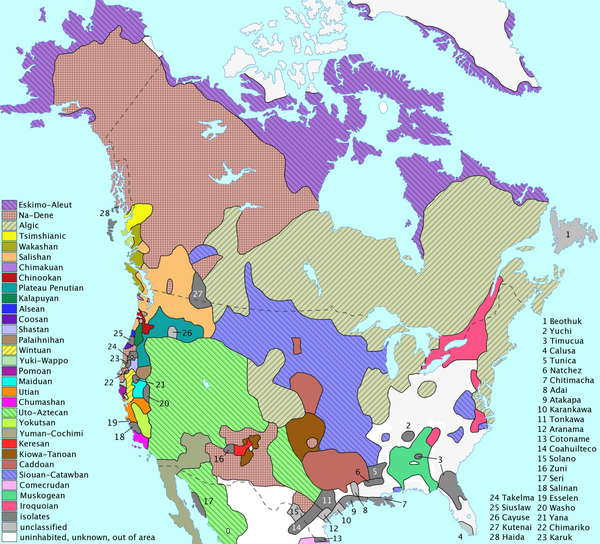
Blue is language family, based on this map of indigenous languages. Of course the brushstrokes here are very broad; and you may imagine many minority languages, extraterritorial enclaves, and dialect continua to complicate the rather simple picture.

Purple is culture, or how closely the ways of life of different people resemble each other, based on this map of how frequently people in different parts of the US communicate with each other.

Green is trade, or how much people in different places exchange goods and services, based on this map of dollar bill circulation in the US.

I traced boundaries around those geographical blocs, superimposed them, and found that some of those blocs correspond to each other. That is to say, cultural difference correlates with trade, communication, and language (I'm not convinced it correlates with religion or ethnicity, but feel free to disagree), with a lot of effect from the underlying geography (the Mississippi River, the Rockies, the Appalachians, and the North-South divide are visible in most maps). The blocks that most closely matched each other I traced around with black borders, trying to match those geographical boundaries as much as possible. The result is the big map you see above. The more different the colors, the more of a change you see going across a border.

You'll notice I haven't labelled the map. That's because this map might represent a lot of different timelines. Maybe no plagues killed off the Native American population, and we're left with a situation like post-colonial Africa ("the Democratic People's Republic of Comanche"?). Maybe this from a timeline where indigenous people domesticated horses ("The Union of Three Fires"?). Maybe European colonists came, but only with medieval technology (the Motherflippin' Gruinmarkt!). Maybe I accidentally deleted my version of photoshop, and sai doesn't do labels. Maybe I want to see what names and histories YOU think should be attached to those countries.

Come on! Let me hear 'em!

This project comes from Dan's to-be-published novel, The World's Other Side. Find out about his other projects on his website. Also find him on Twitter and Deviant art.

Thursday, June 13, 2013

Midterm Exam, History 412: Modern North America, 1847-Present Part 2 by Kyle Owenby

Entry for the DBWI Writing Contest. Go to Part 1.

Date: Friday, March 1st
Subject: MIDTERM EXAM
Class: HISTORY 412: MODERN NORTH AMERICA, 1847-PRESENT
Instructor: Thomas Jackson IV, American and Military History
Department: History and Moral Philosophy, VMI
Departmental Secretary’s Signature: Velma May Ford

Dear Instructor Jackson,

My apologies for turning in the assignment at the last possible moment, my history of monarchism in America class toured the palace and government grounds in Quebec City the week of the midterm, limiting the time I had to work on your assignment.

With Regards,

Alexander Stephens Maddox

SECTION ONE: TERMINOLOGY IDENTIFICATION (20 points)
Select five of the following ten terms to define, making note of their significance for North American history.

1. Comancheria

Comancheria was the largest and most powerful of the "Indian republics" that dominated the interior of North America from the Rio Grande to the Arctic Circle. Not an actual republic, their government resembled the militarized Indian socialism of other Indian states that emphasized the public good, strict control over mankind's impact on nature and the licensed exploitation of natural resources. Comancheria exported cattle, silver and mercenaries to the rest of North America, operated a small but strong industry from the Rockies and vigorously defended their borders against outsiders, maintaining their independence into the twentieth century.

2. Port of Havana
3. Agrarian Federalism

Modeled on the Jeffersonian ideal of the yeoman-farmer, agrarian federalism advocated that the integral component of commerce and society were family held farmsteads and businesses, as opposed to plantations, banks or the large, capital financed corporations. To this end, they believed laws and public institutions should be structured to support the small farmers and businesses through tax and public works incentives. The ideology is and was prominent in the Midwest of the USA, California and the Unorganized Territory, but manifests itself differently in the various republics. In the USA it is an actual political party, whereas in the Republic of the South followers of agrarian federalism are held together by a loose network of sympathetic politicians from coastal and urban interests opposed to the dominance of the planter aristocracy.

4. Haitian Insurrection
5. Mexican Dissolution

Los Estados Unidos de Mexicanos was the rising power of the early nineteenth century, successful in its war against the revolutionaries in Tejas-Coahuila, the largest empire by territory in the Americas and resistant to the Bolivarian ideology being spread from further south. However, the Mexican state spread its resources to far, and collapsed after warring with its neighbors, the USA, California and the Republic of Central America. These wars resulted in the loss of political unity and territory, culminating in the period of the North American Wars (1844-1850). After numerous military defeats and the Second Texan Uprising, the other constituent states of Mexico began breaking away, starting with the Yucatan, to form their own republics. The last military act of los Estados Unidos de Mexicanos was the catastrophic intervention into the American War for Succession in the late 1840s to take territory along the Gulf. This resulted in the complete obliteration of the last Mexican Grand Army, ironically against one of its former commanders and presidents, Antonio Lopez de Santa Anna.

6. Deseret
7. Technocratic Efficiency

The technocratic efficiency movement emerged in the late 1800s out of the industrial centers of the USA. Business leaders, managers and labor organizers recognized the inherent inefficiency of relying on people to make decisions without sufficient information. Critical industries were brought under the guidance of state-industry planners who used tabulated information, extremely early computational engines that factored in all available recorded sources: train schedules, the prices of goods, power rates and the usage of resources. This was done to determine how much of a good to produce and when, ostensibly allowing every industry and worker to maximize production.

8. Popular Socialism
9. Hanoverian Exiles

After a peasants revolution instigated by French anti-monarchists in 1808 from the French Republic, the House of Hanover fled their holdings in the British Isles to become exiles in their North American territories in Oregon Country. Their homelands thereafter referred to as the Directory Republic of England and Wales, the Restored Stuart Kingdom in Scotland and Eire. The Kingdom of British Columbia expanded quickly into the North American interior before negotiating an alliance with the tribes of the Unorganized Territory. They exchanged wheat and cattle for autonomy and trade privileges. The Kingdom is bordered by Yukonia to the north and Oregon to the south which buffers the Hanoverians against their more bitter rivals, Romanov Alaska and the California Republic.

10. Presidency of Antonio Lopez de Santa Anna

SECTION TWO: MULTIPLE CHOICE (30 points)
Select the best answer(s) for the following ten questions.

1. The Treaty of Havana (1887) ended which war?

A. The Mexican-American War
B. The War of Texas Secession
C. The Comancheria War
D. The War of Southern Independence

2. The goal(s) of the Technocratic Efficiency movement were?

A. State planning of the production for critical industries
B. Organizing the population to prevent wasted life and energy
C. Establishing standards for citizenship and reproduction
D. Fulfilling the mathematical precepts for human life

3. The first railroad that successfully connected a landlocked interior republic with the Pacific coast was?

A. The Canadian Transcontinental
B. The Yucatan to Los Angeles
C. The Deseret Exclusive 
D. The New Orleans to San Francisco

4. The last state to abolish slavery in North America was?

A. The Republic of Sonora
B. The Republic of the South
C. The Deseret Republic
D. The Empire of Haiti

5. The Caracas Dispute (1925) repudiated which international agreement?

A. The Geneva Conventions
B. The Treaty of Paris (1820)
C. The Monroe Doctrine
D. The Hanoverian Resolutions

6. Which states first successfully completed an Atlantic to Pacific canal?

A. The Republic of the South and France in Nicaragua
B. Los Estados Unidos de Mexicanos and Austria through central Mexico
C. The United States of America and Great Britain in Nicaragua
D. The Republic of the South and Los Estados Unidos de Mexicanos through central Mexico

7. Antonio Lopez de Santa Anna served as President of which two nations?

A. Los Estados Unidos de Mexicanos and the United States of America
B. The United States of America and the Republic of the South
C. Los Estados Unidos de Mexicanos and the Republic of California
D. The Republic of the South and los Estados Unidos de Mexicanos

8. The largest naval battle in the Caribbean was between which two forces?

A. The US Navy and the British Navy
B. The Confederate Navy and the Brazilian Navy
C. The Californian Navy and the French Navy
D. The Gran Columbian Navy and the Confederate Navy

9. As of 1925 which North American state(s) practiced Popular Socialism?

A. Oregon and Guatemala
B. The Republic of the South and Cuba
C. Oregon
D. Cuba and Los Estados Unidos de Mexicanos

10. Which quote can be attributed to the Napoleon of the West, Antonio Lopez de Santa Anna?

A. "The failure of democracy was my success."
B. "The Founding Fathers' vision for their ideals was short sighted."
C. "Bolivar is welcome to the South, so long as he leaves Mexico and the North for me."
D. "Without fail, one nation cannot rule this continent alone, its people are too stubborn, its spirit too independent, its landscape too harsh to allow that."

SECTION THREE: ESSAY (50 points)
Choose one of the following two topics and write a five paragraph essay.

1. Arguably on its way to becoming the most powerful state in North America due to its size and natural resources, and a contentious rival with the USA after putting down the Texas Revolt, why does Mexico's Dissolution into the numerous "little republics" represent the turning point for modern North America? Use three distinct examples when writing your five paragraph essay.

The Mexican Dissolution, the breakup of the larger Mexican Republic into the "little republics" became the model for other states in North America to rescind their political boundaries and focus on tightly organized, regional polities that took on more limited aims and responsibilities. Other North American states with significant internal political divisions faced separatist movements and revolutions that broke up their political union. This convinced European liberals that republicanism could not govern a large, multiethnic empire, only enlightened, constitutional monarchies could do that. In response the nations of North America, those that remained undivided (too few) and the new nations, adopted strong nationalist and propagandist ideologies that helped unify their constituent members.

After the Mexican Dissolution, separatist ideologies spread across the whole of North America, leaving no region or polity unaffected. Some of the separatist states to emerge out of these revolutions include the Republic of the South, Deseret, and Quebec. The Republic of the South alleged federal complicity in the American loss to Mexico, and an industrial, northern ploy to subjugate the slaveholding South. The Americans fought a short civil war from 1848-1851 over the issue, before the northern war effort fell apart in a series of regional rebellions, such as Deseret, and workers strikes in the major cities like New York and Boston. When the other great power of the continent fell apart due to political infighting, it symbolized the collapse of the large, continent spanning empires.

Despite the collapse of the continent spanning governments this did not discredit the institution of the republic, at least not in North America. If anything, the spread of republicanism was hastened by these collapses as local and regional governments asserted themselves. In addition to the Republic of the South, other regional associations, such as the Republic of Sonora and the Republic of the Yucatan threw off the shackles of a federal government and organized their own political and military institutions. Unwilling to let their populations simply dissolve the political unions, numerous wars were fought to keep the "little republics" as a part of the Mexican Republic, the Dominion of Canada and the United States. Across North America these conflicts are referred to as The War for Secession, and lasted from roughly 1850-1857. They were almost wholly unsuccessful at keeping any nation in a union they were committed to leave.

Despite the popularity of republicanism and regional decision making, the widespread expansion of democracy and the democratic franchise was considered untenable for several centuries after the Mexican Dissolution. In each of the newly established "little republics" it was a small minority of local elites who organized the secession efforts and constitutional conventions (each new state, almost to a fault, felt the need to establish their own Constitutions). What this meant was an institutionalized lack of civic involvement for women and blacks as white males controlled the political process. In the Republic of the South this process was led by the middle class coastal merchants and urban industrialists in association with wealthy rural planters. In Deseret the process was directed by LDS elders, again white males, who disenfranchised non-Mormons, women, slave and free blacks, and Indians. The exception to the lack of Indian involvement was the establishment of the so called "Indian republics" across the American Midwest.

In conclusion, the Mexican Dissolution established the political paradigm that North America has followed for the last two centuries of its modern existence, even spreading the ideology to parts of Europe and Asia. North America is understood by both its inhabitants and outsiders as a fractured continent, drought with political and military intrigue. Without any successful examples of the widespread (continental) application of democratic and republican ideas to ethnically and religiously diverse polities, it can be argued that the enlightened absolutist philosophies of the European monarchies, most notably the French and the Austrians, have been irreconcilably strengthened against republicanism.

2. The Caracas Dispute (1925) brought the major nations of North America together with and against the leading powers of Europe, the French and Austrian Empires, in both a military and a political sense. How did the politics and national identities of the North American republics change in the aftermath of that meeting? Use three distinct examples when writing your five paragraph essay.

* * *

Kyle Owenby is a former history educator and soon to be law student residing in Atlanta, Georgia with his wife, a fellow history enthusiast. In his free time he reads and writes speculative fiction, especially alternate history and space opera.

Midterm Exam, History 412: Modern North America, 1847-Present Part 1 by Kyle Owenby

Entry for the DBWI Writing Contest. Go to Part 2.

MIDTERM EXAM, HISTORY 412: MODERN NORTH AMERICA, 1847-PRESENT Thomas J. Jackson IV, JD, PH.D; Instructor of American and Military History
Department of History and Moral Philosophy, VMI

Dear class,

We've covered modern North American history from the conclusion of the North American Wars (1844-1850) until the Caracas Dispute (1925). Now at the midpoint of our semester we pause to evaluate your grasp and comprehension of the facts and dates, as well as the implications of war, economics and politics for the people who lived in the times, and of course, the overall significance of these events. The big picture: Why did history turn out the way it did? Who, or what, is responsible for that?

This exam will test all of that knowledge. It is of course open book and open note, though the answers will not be easily found in your scribbles. I expect that you will analyze and interpret, not just parrot back facts to me. You will find in this packet your exam in three sections; do them in any order that pleases you, as long as they are completed and returned to the departmental secretary by 5:00 pm on Friday, March 1st.

SECTION ONE: TERMINOLOGY IDENTIFICATION (20 points)
Select five of the following ten terms to define, making note of the significance for North American history.

1. Comancheria
2. Port of Havana
3. Agrarian Federalism
4. Hanoverian Exiles
5. Mexican Dissolution
6. Deseret
7. Technocratic Efficiency
8. Popular Socialism
9. Haitian Insurrection
10. Presidency of Antonio Lopez de Santa Anna

SECTION TWO: MULTIPLE CHOICE (30 points)
Select the best answer(s) for the following ten questions.

1. The Treaty of Havana (1887) ended which war?

A. The Mexican-American War
B. The War of Texas Secession
C. The Comancheria War
D. The War of Southern Independence

2. The goal(s) of the Technocratic Efficiency movement were?

A. State planning of the production for critical industries
B. Organizing the population to prevent wasted life and energy
C. Establishing standards for citizenship and reproduction
D. Fulfilling the mathematical precepts for human life

3. The first economically successful cross country railroad was?

A. The Canadian Transcontinental
B. The Yucatan to Los Angeles
C. The Deseret Exclusive
D. The New Orleans to San Francisco

4. The last state to abolish slavery in North America was?

A. The Republic of Sonora
B. The Republic of the South
C. The Deseret Republic
D. The Empire of Haiti

5. The Caracas Dispute (1925) repudiated which international agreement?

A. The Geneva Conventions
B. The Treaty of Paris (1820)
C. The Monroe Doctrine
D. The Hanoverian Resolutions

6. Which states first successfully completed an Atlantic-Pacific canal?

A. The Republic of the South and France in Nicaragua
B. Los Estados Unidos de Mexicanos and Austria through central Mexico
C. The United States of America and Great Britain in Nicaragua
D. The Republic of the South and Los Estados Unidos de Mexicanos through central Mexico

7. Antonio Lopez de Santa Anna served as President of which two nations?

A. Los Estados Unidos de Mexicanos and the United States of America
B. The United States of America and the Republic of the South
C. Los Estados Unidos de Mexicanos and the Republic of California
D. The Republic of the South and los Estados Unidos de Mexicanos

8. The largest naval battle in the Caribbean was between which two forces?

A. The British Navy and the US Navy
B. The Confederate Navy and the Brazilian Navy
C. The Californian Navy and the French Navy
D. The Gran Columbian Navy and the US Navy

9. As of 1925 which North American state(s) practiced Popular Socialism?

A. Oregon and Guatemala
B. The Republic of the South and Cuba
C. Oregon
D. Cuba and Los Estados Unidos de Mexicanos

10. Which quote can be attributed to the Napoleon of the West, Antonio Lopez de Santa Anna?

A. "The failure of democracy was my success."
B. "The Founding Fathers' vision for democracy was short sighted."
C. "Bolivar is welcome to the South, so long as he leaves Mexico and the North for me."
D. "Without fail, one nation cannot rule this land alone, its people to stubborn, its spirit to independent, its landscape too harsh to facility one continental government."

SECTION THREE: ESSAY (50 points)
Choose one of the following two topics and write a five paragraph essay.

1. Mexico was arguably on its way to becoming the most powerful state in North America due to its size and natural resources, as well as being a contentious neighbor with the USA after putting down the Texas Revolt. Why does Mexico's Dissolution into the numerous "little republics" represent the turning point for modern North America? Use three distinct examples when writing your five paragraph essay.

2. The Caracas Dispute (1925) brought the major nations of North America together with and against the leading powers of Europe, the French and Austrian Empires, in both a military and a political sense. How did the politics and national identities of the North American republics change in the aftermath of that meeting? Use three distinct examples when writing your five paragraph essay.

* * *

Kyle Owenby is a former history educator and soon to be law student residing in Atlanta, Georgia with his wife, a fellow history enthusiast. In his free time he reads and writes speculative fiction, especially alternate history and space opera.

Thursday, May 30, 2013

Interview: Katina French

Now on to the next author featured in Once Upon a Clockwork Tale: Katina French. Let's see what she has to say:

Can you tell us a bit about yourself? 

I call myself a Bluegrass Hoosier, because Kentucky is my birthplace, my workplace and where my family is from, but I grew up and currently live in southern Indiana. I sort of claim dual citizenship. I've been married for over 20 years to my high school sweetheart, so I've literally never been a single adult. We've got two kids, a teenage boy and a 9 year old girl. We also have a pug named after Rocky Balboa. I'm a member of a church known for its thriving arts ministry, including visual arts and music. Aside from reading and writing, I love music, theater, yarn, coffee, tea, bourbon, kayaking and camping. My "day job" is working in digital marketing for CafePress.

What got you interested in steampunk?

I think the combination of Victorian-style adventure tales with the steampunk aesthetic. I love the classic, sort of serial-pulp novels from Robert Louis Stephenson, Charles Dickens, Arthur Conan Doyle, and Edgar Rice Burroughs. My dad is a retired metalworker, and he specialized in brass and copper work when I was a kid. They're actually incredibly hard materials to work with, so I respect anyone who can work in that medium, even if it's making brass goggles. My parents built street rods (customized antique cars) together. So I kind of grew up in that DIY, "maker of cool things" culture, and that kind of ingenuity is very much an element of steampunk fiction. Plus, I like wearing corsets!

What is "Bitter Cold" about?

It's a retelling of Hans Christian Anderson's "The Snow Queen." It's about two kids who grow up together as best friends. Fantastic events conspire to test their dedication to each other. At the core, it's still that story--about how the boy is lost, and the girl risks everything to save him. The setting is an alternate version of North America where the American states never united after the Revolutionary War. So in this world, the states are independent republics. There was never a Civil War, although there have been lots of little civil wars between competing republics. It's a lot more like Europe right before World War I, with the addition of magic in the form of alchemy. Of course, since it's steampunk, there are also dirigibles, mechanical reindeer, and a band of Tennessee hillbilly gypsies.

Balkanized North America are a popular trope in steampunk and alternate history. What is it about the setting that draws authors to it?

From a world-building standpoint, fracturing North America gives you room to push regional differences into truly foreign cultures, which can be fun. From a plotting perspective, the thing that makes fragmented, parochial governments and political instability a bad thing in the real world--a higher likelihood of conflict--is what makes it a great thing for a fiction writer. Anything that can bring conflict, raise the stakes for your characters, and create danger and obstacles is a good thing to have handy.

Plus, there's a lot of intriguing what ifs there. If there were never these massive, unified continental governments and armies, how would that have altered things for native Americans? Would slavery have been even more entrenched, or would uprisings and abolitionist movements had more success against smaller governments? Would competition with each other have slowed or accelerated technological advancements? There are a lot of big questions you can address just by saying "What if we'd never united after the Revolution?" Some very influential people were opposed to a single strong, federal government. It's not like it was never a possibility, and I think that makes it something fascinating to consider. Because it very well could have worked out that way.

What inspired you to write the story?

I love fairy tales, especially the ones that haven't been bowdlerized or Disney-fied to death. I think "The Snow Queen" is a story about the lengths love will go to in order to save someone who's lost, and you don't see a lot of those stories in steampunk. Plus, I married my childhood best friend. I have some life experience to apply to that kind of tale.

What sources were particularly helpful when researching for the novel?

Well, the original fairy tale was obviously pretty helpful, although it's fairly long. A lot of the action takes place as a sort of aerial chase, so I had to research airships. I needed to know how fast they could actually travel. Since it was my first steampunk story, I also read Writing Steampunk by Beth Daniels. It was a quick read, and it helped me find out where to start doing some of the heavier research specific to the genre.

Do you have any other projects you are working on?

This year I made a crazy goal of trying to produce and publish an eBook every month. Some of them are long short stories or novelettes, and the first two are set in the same alternate version of North America as "Bitter Cold". In fact, the first one is a steampunk version of "Red Riding Hood," featuring some of the characters from "Bitter Cold". The next one will be a contemporary fantasy that's more of a southern gothic take on The Creature from the Black Lagoon, with a monster pulled from Orkney Island folklore.

How did you hear about Echelon Press?

I belong to a writers' group called Quills & Quibbles with Marian Allen, who is another Echelon author. I enjoyed her Echelon novel, Force of Habit. She knew I was interested in both steampunk and fairy tale retellings. When Echelon announced they were open for submissions for Once Upon a Clockwork Tale, I decided it was too perfect an idea not to take a shot and submit a query.

What are you reading now?

I just finished Goblin Moon by Teresa Edgerton which is a neat fantasy of manners novel with some steampunk/clockpunk touches. Right before that I read John Scalzi's Old Man's War, which is the first novel from the universe where he's set his new Kindle Serial stories,The Human Division. It was wonderful, funny and touching, especially for a military sci-fi book. I'm also slowly working my way through The Complete Sherlock Holmes. I finished A Study in Scarlet earlier this month.

Do you have advice for would-be authors?

With the publishing industry in such a tumult, it's easy to get sucked into all the stuff around writing. Things like marketing, or choosing a publishing model, or building an author platform. But you can't get anywhere until you start actually producing finished prose. And by "finished" I mean "it has a beginning, middle and end," not "it's professionally edited." First focus on applying butt to chair and getting to "The End." Keep reading, so you keep feeding your writer brain. Once you have a few promising drafts, then you can start worrying about what to do with those drafts. Don't get our cart before your horse.

Thursday, February 28, 2013

And The Winner of the Balkanize Me Contest is...

Our second contest, Balkanize Me, has officially come to an end. Although we had less entries than our last writing contest, thankfully the quality of entries did not change. Here is the complete list of submissions in the order they appeared:

Excerpt from Modern History of Oklahoma and Sequoyah, 1890-Present by Zach Anderson

Body Impolitic by Thespitron 6000

January 4, 1815 - New England Secedes by Jeff Provine

Il Sogno della Patria by Dimas Aditya Hanandito

The More Things Change: A Tale of the Aether Age by Grant Gardiner

The range of writing styles for an average alternate historian is quite evident in this contest. I was especially tickled by the humorous entries The Update received. All good things, however, must come to an end. Only one can be crowned the winner and his name is...

DIMAS ADITYA HANANDITO

Congrats Dimas, you will be receiving a blu-ray copy of Iron Sky. Your short story about a divided Italy secured the most page views overall, with Jeff's outline for a balkanized America and Thespitron 6000's parody of the trope coming in second and third place respectively.

Thank you to everyone for participating and stay tuned tomorrow for a special announcement regarding the future of submitting to The Update.

* * *

Matt Mitrovich is the founder and editor of Alternate History Weekly Update, a blogger on Amazing Stories and a volunteer editor for Alt Hist magazine. His fiction can be found at Echelon Press, Jake's Monthly and The Were-Traveler. When not writing he works as an attorney, enjoys life with his beautiful wife Alana and prepares for the inevitable zombie apocalypse. You can follow him on Facebook or Twitter.