Showing posts with label World War One. Show all posts

Monday, July 11, 2016

Map Monday: Greater Lebanon by Simon Regan

Since I missed Map Monday last week, I'm going to feature two maps this Monday. Luckily they are both from the same universe so it makes it easier to talk about them. Let's begin, shall we:
This is "Greater Lebanon" by Simon Regan. In this timeline the Ottoman Empire is carved up differently in a way that favors the Arabs. A "Federation of the Levant", however, was created as a counterweight and a home for the minorities living along the Mediterranean coast. We can also see a Jewish state in southern Palestine, an independent Kurdistan (or "Curdistan") and a Kingdom of Iraq in the Shia majority areas.

First up, I love maps focusing on a different division to the Middle East. Second, this map is well done. Soft colors, realistic borders and lots of details; pretty much everything I look for in a map. Regan gets a lot of praise in the community as an alternate cartographer and this map confirms his position as one of the best. Hold on, there is still another map to look at:
This is an ethnicity map of the Federation of the Levant, also done by Regan. As you can see the Levant is a multicultural place, hence why they probably need to be a federation. Trying to get all of these ethnic and religious groups to work together must be like trying to herd jet pack wearing cats, but somehow they make it work. Anywho, this is another nice map for all of the same reasons mentioned above. I really do need to feature more of Regan's work.

Honorable mentions this week goes out to "A Totally Random Map" by Martin23230, "Dixie-2" by Rvbomally, "Rome Eternal 1.0" by Bruce Munro, "If Hokkaido was an independent country" by Pavelzuk, "Iksander-1" by Rebecca Stirling, "Alexander's World​" by Zek Sora and "Balkanized North America Tribute" by 22iron thunder.

* * *

Matt Mitrovich is the founder and editor of Alternate History Weekly Update, a blogger for Amazing Stories, a volunteer interviewer for SFFWorld and a Sidewise Awards for Alternate History judge. When not exploring alternate timelines he enjoys life with his beautiful wife Alana and prepares for the day when travel between parallel universes becomes a reality. You can follow him on Facebook, Twitter, Tumblr and YouTube. Learn how you can support his alternate history projects on Patreon.

Wednesday, June 15, 2016

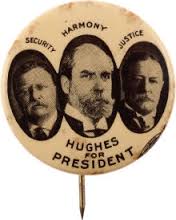
The Presidency of Charles Evans Hughes

Guest post by Andrew Schneider.
One of the more fascinating concepts of American political history is that of the “watershed election” - the notion that there are particular presidential contests that stand out as dramatically reshaping the political landscape, providing a convenient dividing marker between historical eras. Some of the more famous ones include 1860, 1932, and 1980.

The election of 1912 stands out for several reasons. That year, the Republican Party tore itself apart. President William Howard Taft secured his renomination at the G.O.P.’s national convention in Chicago through shrewd control of the party machinery, preventing the seating of delegates supporting his rival, former President Theodore Roosevelt. Roosevelt’s forces rebelled, bolting the convention and forming a new party to support their man’s bid to recapture the White House. The organization known variously as the Progressive or Bull Moose Party went on to win well over 4 million votes in the general election, translating to 88 electoral votes across six states. By comparison, Taft won fewer than 3.5 million votes – just eight electoral votes from two states. It was the best showing by a third-party candidate in the history of the modern U.S. party system. It also guaranteed the election of the Democratic candidate, Woodrow Wilson.

Wilson won a lopsided majority in the Electoral College, racking up 40 states with 435 electoral votes. He did not, however, win a majority of the popular vote. His total fell just short of 6.3 million. It’s tempting to look at those numbers and conclude that, had the Republican Party remained united, it would easily have held the presidency. That may have been the case if Roosevelt had somehow managed to win the Republican nomination. It seems less likely if TR had admitted defeat and sought to rally his followers behind Taft.

While Roosevelt ran as the candidate of the Progressive Party, both he and Wilson advocated the political philosophy known as progressivism – roughly defined as a movement favoring political reform and advocating economic and social justice. Read in this fashion, the 1912 election was an overwhelming victory for progressivism over the Old Guard conservatism of which Taft was champion. Had the contest been a two-man race between Wilson and Taft, many progressive Republicans may have voted for Wilson or stayed home. In any event, Wilson took the election as a mandate for progressive legislation on everything from banking regulation to the introduction of the eight-hour work day. The tide of progressive legislation ebbed with the U.S. entry into World War I, but it served as an inspiration to Wilson’s assistant secretary of the navy, Franklin Delano Roosevelt. FDR’s New Deal owed much of its existence to the groundwork laid by the 1912 platform Wilson called the New Freedom.

By contrast, the election of 1916 appears rather less consequential. It was a straight two-man contest between the Democratic incumbent Wilson and the Republican challenger, Charles Evans Hughes. There was very little to differentiate the two in terms of their domestic platforms. Hughes supported many, though not all, of Wilson’s economic and social reforms. He was slightly ahead of Wilson in endorsing women’s suffrage, and his views on civil rights were decidedly more forward-looking than those of the Virginia-born president.

But the issue that largely decided the election was that of America’s entry into the First World War. Both Wilson and Hughes argued for the U.S. to remain neutral. Hughes campaigned on a Republican platform argued that the U.S. needed a much stronger army and navy as a deterrent – in theory against any foreign power that might threaten the U.S., but with Imperial Germany utmost in mind. Wilson campaigned on a more straightforward message of peace and isolation, under the slogan. The contest was much closer than 1912. Wilson garnered a larger share of the popular vote. But the Electoral College broke for the incumbent by a much narrower margin of 277-254, with 30 states going Democratic and 18 Republican.

Before Wilson could take the oath of office for the second time, Germany resumed unrestricted submarine warfare and attempted to entice Mexico into declaring war on the United States, with the promise of restoring the territory it had lost to the U.S. in 1848. The U.S. learned of the latter when British intelligence intercepted, then leaked, a coded telegram from German Foreign Secretary Arthur Zimmerman to Germany’s ambassador to Mexico. Having won reelection by campaigning under the slogan, “He Kept Us Out of War,” Wilson began his second term by asking Congress to declare war on Germany.

Arguably, the election of 1916 was significant in at least two respects. First, Wilson became the first Democratic president since Andrew Jackson to win two consecutive terms in office. Second, Wilson’s belated (and forced) conversion to the Allied cause led him for the first time to apply his progressive ideology to foreign policy rather than domestic. It led him to adopt the position that the national interests of the U.S. and of world peace would best be served by spreading representative democratic government as widely as possible – ideally through diplomacy and free trade, but if necessary by force. This philosophy entered the lexicon as “Wilsonianism,” and it remains one of the leading schools of American diplomacy.

The U.S. would have entered the Great War soon after Inauguration Day 1917 regardless of who took the oath of office, given Germany’s actions in the months since the election. So how much difference would a Hughes presidency have made to the ultimate outcome? Answering this requires a closer look at Hughes, both in terms of what led him to the Republican nomination in 1916 and what he accomplished after his defeat that November.

Like Wilson, Hughes was the son of a clergyman and raised in a religious household. But where Wilson’s father moved to south from Ohio and became a slaveholder, Hughes father was a lifelong New Yorker and an abolitionist. Like Wilson, Hughes trained as a lawyer. But where Wilson grew bored with the actual practice of law, Hughes became obsessed by it, frequently working himself to exhaustion. His intelligence and dedication, particularly in his work as a special counsel for a commission investigating utility rates for New York City, drew him to the attention both of Roosevelt and Taft.

In 1906, Roosevelt drafted Hughes to run for governor of New York. Hughes beat heavily favored Democratic candidate William Randolph Hearst, in a campaign later immortalized in the film Citizen Kane. Hughes distinguished himself as a reform-minded executive, enacting social reforms, fighting political corruption, and attempting, unsuccessfully, to replace the state’s convention system for selecting political candidates with a direct primary. In 1910, while he was still governor, Taft named him to the Supreme Court as an associate justice. Hughes distinguished himself there as an advocate of regulating business and of civil rights.

Republican Party leaders had attempted to draft Hughes for the presidency as early as 1912, on the theory that he would make a good compromise candidate acceptable to both the Roosevelt and Taft factions. Hughes refused, saying it was improper for a sitting judge to involve himself in politics. Four years later, G.O.P. leaders tried again with the same argument but much more strenuously. This time, Hughes agreed. Taft endorsed him. Roosevelt, whose personal opinion of Hughes had cooled – he referred to him as a “bearded iceberg” – decided he would rather support Hughes than risk giving Wilson another victory. Hughes won the nomination on the third ballot. The convention nominated as his running mate Charles W. Fairbanks, Roosevelt’s former vice president.

The party Hughes led into the general election remained deeply divided. The Progressives had attempted to nominate Roosevelt as their candidate a second time. When he declined, and urged them to back Hughes, many took it as a betrayal. While Hughes had supported many progressive causes as New York’s governor, he was on record as opposing two of the most popular pieces of progressive legislation to date – the Sixteenth Amendment (allowing the creation of an income tax) and the Adamson Act (establishing the 40-hour work week). Despite Roosevelt’s active campaigning on Hughes’ behalf, many of these disappointed Progressives would cast their ballots for Wilson in the fall.

The one man who could conceivably have rallied these forces to Hughes was Hiram Johnson, the Progressive governor of California and Roosevelt’s 1912 running mate. In 1916, Johnson was running for the Senate as a Republican but remained in a bitter fight with the state’s Old Guard leaders. Hughes came to California to campaign in the midst of this fight and was briefly in the same hotel as Johnson. Due to a screw up by Hughes’ campaign manager, the two failed to meet, though Hughes did wind up meeting with several of Johnson’s conservative antagonists, including banker and state G.O.P. leader William H. Crocker. Hughes then compounded the slight by giving a speech at which he saluted Crocker as “California’s favorite son.” Johnson took this as a deliberate insult. He never forgave Hughes and thereafter refused to lift a finger on Hughes’ behalf.  Hughes lost California by a narrow margin and with it the presidency.

Hughes had a reputation as an extremely quick study. Had he met with Johnson, he would have realized very quickly how bitter the blood was between the governor and Crocker. He would not have made the blunder of publicly saluting Crocker as he did, certainly not without lavishing equal or greater praise on Johnson. With Johnson in his camp, Hughes would have carried California at the very least. That alone would have been enough for Hughes to edge out Wilson, although it would have been the tightest electoral contest in nearly thirty years -- 267 Hughes to 264 Wilson. It’s possible, though, that with Johnson in his corner, Hughes might also have carried Washington, which Roosevelt and Johnson carried in 1912. That would have tipped the balance to 274 Hughes to 257 Wilson, not much different from the margin by which Wilson actually won.

President Hughes would have taken the oath of office on March 4, 1917. He would have recognized at this point that U.S. entry into the Great War was all but unavoidable, but he would have wanted to do as much as he could to strengthen America’s position, both militarily and legally, before committing to the fight.

The new president would have had a deep bench of foreign policy and defense expertise on which to draw: Henry Cabot Lodge, U.S. senator from Massachusetts and ranking Republican on the Senate Foreign Relations Committee; Elihu Root, secretary of war under Presidents William McKinley and Theodore Roosevelt and secretary of state under Roosevelt; Henry Stimson, secretary of war under President Taft; and Major General Leonard Wood, U.S. Army chief of staff under Presidents Taft and Wilson. The men were all architects of the Preparedness Movement, pushing for universal military training and naval expansion. He would also, no doubt, have had to fend off helpful suggestions by Roosevelt himself.

Hughes immediate priorities would have been enacting the platform of military preparedness on which he had campaigned. The Democrats held majorities in both houses of Congress. But the renewed U-boat attacks on American shipping and the revelations of the Zimmerman Telegram would have undercut Democratic resistance to Hughes’ proposals. These would have included the enactment of conscription, which Congress had been considering as early as the previous December, and appropriations for a massive naval construction program.

Hughes would then have informed the German government – through neutral intermediaries, as Wilson had severed diplomatic relations with Germany in February – that any further attack on American shipping would be considered an act of war. To drive the point home, he could have ordered the seizure of German government assets in the U.S., pending Germany’s abandonment of unrestricted submarine warfare and payment of compensation to the families of those killed or injured in previous submarine attacks. Germany’s military leadership would almost certainly have ignored such an ultimatum – General Erich Ludendorff, who had insisted on resuming unrestricted submarine warfare, would scarcely have risked American entry into the war if he considered the U.S. a serious threat.

In our timeline, Wilson found one excuse after another to avoid calling for a declaration of war, with more than two months elapsing between the renewal of U-boat attacks and Wilson’s appeal to Congress. In this scenario, the declaration could have come within a matter of days after Hughes took office, roughly a month early compared to our history.

How much of a difference would this have made? The U.S. would still have had to build a mass army virtually from scratch. The peacetime U.S. Army had roughly 100,000 men. The American Expeditionary Force had about 2 million men in France by the time of the Armistice. American industry would also have faced the same limitations mobilizing its capacity to manufacture arms, ammunition, and other military supplies to meet U.S. needs, let alone those of the Allies.

Against this, we can weigh the likely appointment of Wood as the commander of A.E.F. instead of John J. Pershing. Wood was a more experienced combat leader, had greater experience leading large bodies of men, and had a record as an effective military reformer. Leading Republicans had argued strongly for Wood’s appointment to the post in our own timeline, but his political activities in the Preparedness Movement had made him anathema to Wilson, who chose Pershing as a non-partisan alternative. Wood, who built up a record as a military reformer and one of the fathers of American combined arms doctrine, would have been more likely than Pershing to absorb the bloody lessons the Western Allies had learned about the futility of mass assaults against fortified trenches. Pershing ignored those lessons and wound up repeating many of the same mistakes at the cost of tens of thousands of lives, particularly during the Meuse-Argonne Offensive.

At the height of the American effort on the Western Front, Britain and France requested the U.S. send 5,000 men to assist with a mission in Eastern Europe. Russia had erupted in civil war. The Allies wanted to intervene to keep German troops from seizing Allied stockpiles at the Russian port of Arkhangelsk, to rescue Czechoslovak troops who had become trapped behind the Bolshevik lines, and to reopen the Eastern Front against Germany. Underlying all this was the goal of overthrowing the nascent Bolshevik government.

In our timeline, the U.S. War Department rejected the request, but President Wilson overruled it. The result was what became known as American North Russian Expeditionary Force, colloquially known as the Polar Bear Expedition. It had no effect on outcome of Russian Civil War, but effectively poisoned U.S-Soviet relations from the start. Hughes was no more a fan of bolshevism than Wilson, but he would have recognized the mission as an unnecessary distraction from the Western Front. Odds are, he would have taken the War Department’s advice.

On the home front, progressive domestic legislation would have been as a low priority for a wartime Hughes Administration as it was for Wilson’s. But Hughes could have accomplished a significant civil rights goal during this period by executive authority. Wilson had effectively introduced southern “Jim Crow” laws at the federal level, banning African-Americans from higher level jobs in the federal civil service and reintroducing segregation in government office buildings. It would have been entirely within Hughes power, and character, to reverse these moves. In doing so, he would only have been restoring the status quo, as there was ample precedent under prior Republican administrations for keeping the civil service integrated.

Wilson, in asking Congress for a declaration of war on Germany, used the argument, “The world must be made safe for democracy.” This made for excellent propaganda, and it gave American involvement in the war the character of a crusade. It held out the promise of a postwar world where democratic governments would thrive the world over. Wilson raised hopes further with his January 8, 1918 speech to Congress, outlining America’s war objectives. What became known as the Fourteen Points included calls for national self-determination, freedom of the seas, free trade, an end to secret diplomacy, international disarmament, and the formation of a League of Nations. They also called for Germany to evacuate Belgium, give Alsace-Lorraine back to France, and to give up Polish territory that Prussia had held since the eighteenth century. But these seemed modest enough demands by October 1918, when German armies were collapsing in the field. Imperial Chancellor Max von Baden asked for an armistice on the expectation that the Fourteen Points would be, as advertised, the basis of a permanent peace settlement.

The Treaty of Versailles was, of course, far harsher than anything Wilson had proposed. Wilson sailed home from France in the middle of the conference to lobby for American membership in the League. By the time he returned, Wilson’s health was in decline. French Prime Minister George Clemenceau effectively dominated the proceedings.  The resulting peace terms for Germany included the assumption of guilt for starting the war, near total disarmament, and a bill for war damages that, adjusted for inflation, would amount to nearly half a trillion dollars in today’s currency. The nascent government of the German Republic never recovered from the humiliation of those peace terms.

Wilson came away from the proceedings with only one thing that he truly wanted, the creation of a League of Nations. He’d done nothing to assuage concerns of Republicans, who had by now taken control of both houses of Congress, that joining the League would infringe on American sovereignty. Senate Republican leaders, including Lodge, demanded revisions before they would ratify the Treaty of Versailles. Wilson refused, demanding they accept the treaty, and the League, as was. He then embarked on a nationwide speaking tour, hoping to build popular support for the League and force the Senate to cave. Instead, Wilson destroyed his health, suffering two major strokes that left him an invalid for the remainder of his presidency. The U.S. never joined the League of Nations. The American withdrawal from world affairs did almost as much as the Treaty of Versailles to prompt Germany to risk another devastating war with Britain and France just two decades later.

With Hughes as president, there would have been no call for a democratic crusade. No Fourteen Points. No reason for the German government to expect lenient terms if it sued for an armistice. The fighting might well have continued until the German Army was forced back onto German territory. That would have made it far more difficult to argue, as Ludendorff and many other German generals were to do, that the German Army was never defeated in the field and that only the betrayal by civilians on the home front, particularly Jews, had led to Germany’s defeat.

The American president and chief negotiator that arrived in France in 1919 would have been younger, healthier, and free of the messianic hopes that Wilson raised in our timeline. He would likely have been accompanied by Henry Cabot Lodge, Elihu Root, and a senior Democratic senator. Wilson’s decision not to include any Republicans in his negotiating team was a major reason Senate leaders distrusted the resulting treaty.

The resulting negotiations over the Treaty of Versailles between Hughes, Clemenceau, British Prime Minister David Lloyd George, and Italian Prime Minister Vittorio Orlando would have been every bit as complex as those of the treaty in our own history. The best gauge of President Hughes’ success would have been Hughes’ signature diplomatic accomplishment in our own timeline.

In 1921, President Warren G. Harding appointed Hughes as secretary of state. Hughes, with no prior experience in diplomacy, soon found himself overseeing a five-power conference to head off a naval arms race among the victorious powers in the Great War – Great Britain, the U.S., Japan, France, and Italy. Each power had a strategic interest in building the largest, strongest, most-technologically advanced navy possible. For all to follow this course, however, would have been to risk recreating the conditions that many blamed for touching off the Great War. Such an arms race would also have been economically ruinous for all powers involved, with the possible exception of the U.S.

Hughes oversaw the Washington Naval Conference with the assistance of Lodge, Root, and Senator Oscar Underwood, the Senate’s ranking Democrat. It was Hughes who ultimately persuaded the other great powers to accept naval construction limits, at a ratio of 5:5:3:1.7:1.7 – that is, for every 5 tons’ worth of U.S. battleship construction, Britain could build 5, Japan could build 3, and France and Italy 1.7 each. As an aside, the U.S. negotiators convinced Britain that the only way they could approve the deal would be if Britain allowed its alliance with Japan to lapse. Japan accepted the limits, in large part for economic reasons, but considered the treaty deeply unfair. This, and the American-enforced breakup of its alliance with Britain, went a long way toward convincing Japanese military and naval leaders that they would ultimately have to fight the United States to protect their interests in the Pacific.

A President Hughes at Versailles would have faced a set of foreign leaders every bit as protective of their own national interests. His task would have been to convince them that staking out the strongest possible gains at the expense of a defeated Germany would be counterproductive. Unless the Allied Powers were prepared to occupy Germany indefinitely, they could not keep it down forever. And the harsher the peace terms they imposed, the more determined Germany would become to seek revenge. In the meanwhile, the high level of reparations France and Britain were demanding would damage not only Germany’s economy but theirs as well. Here, he could use the leverage of the war debts France and Britain owed to America extract concessions on how much they would demand from Germany.

All this may appear more insightful that reasonable. If Wilson, Lloyd George, and Clemenceau could not see the consequences of a harsh peace with Germany, why would Hughes? There was one person at Versailles who foresaw exactly these consequences. Economist John Maynard Keynes attended the conference as an advisor to the British government. He wound up publishing his views later in 1919 as The Economic Consequences of the Peace. The book greatly undermined the legitimacy of the Treaty of Versailles both in the U.S. and Britain, providing a strong argument for those who later supported appeasement of Germany in the 1930s.

Hughes was no economist, but he had spent a good deal of his early public service dealing with economic issues, particularly in cases involving the federal regulation of interstate commerce. It’s likely that he would have drawn some of the same conclusions as Keynes and have done his utmost to convince his fellow world leaders of the potential consequences of their approach. As the Washington Naval Conference negotiations proved, Hughes at his best could be extremely persuasive.

With Hughes involved, the resulting Treaty of Versailles would have been far more likely to provide the framework for a lasting European peace. The U.S. Senate would have ratified the treaty with little trouble. The odds that the U.S. would have retreated into postwar isolationism would have greatly diminished. From a foreign policy and national security standpoint, Hughes first term as president would have been far more successful than Wilson’s second.

None of this would necessarily have guaranteed Hughes winning a second term. With demobilization, U.S. prices started to fall. The economy tipped into a deep recession starting in January 1920, which lasted until July 1921. One only need look at the U.S. election of 1992, in which Bill Clinton defeated George H.W. Bush, to see how a recession can prompt voters to reject a popular wartime leader. Still, this might have been where Hughes early support of women’s suffrage paid off. The Nineteenth Amendment took effect in August 1920, making that November’s election the first in which women’s votes could decide the outcome.

With so many changes from our history over the course of a first Hughes term, it would be nearly impossible to predict what a second term would look like. Two things, though, are certain. First, Hughes would have had a different vice president. Charles Fairbanks died in June 1918. Under the law then governing U.S. succession, the vice presidency would have remained vacant until the beginning of the next presidential term on March 4, 1921. Who Hughes would have picked to replace Fairbanks is anybody’s guess. It would not have been unreasonable, though, for him to turn to one of the men who had helped put him in office in 1916, Senator Hiram Johnson.

Second, Hughes would have had a dramatic opportunity to reshape the Supreme Court. Between March 4, 1921 and March 4, 1925, five justices left the bench. These included Chief Justice Edward Douglass White, who died in office. One could reasonably assume that Hughes would have proposed justices with judicial views similar to his own.

In our own history, President Herbert Hoover named Hughes chief justice of the Supreme Court in 1930. He served in that position for eleven years, a period of tremendous controversy in which the court acted as a conservative check on the New Deal. President Franklin Roosevelt’s attempt to break the court’s opposition to his programs by packing it with liberal justices resulted in one of the most serious political defeats of his career. It seems implausible that Hughes would have become chief justice in such an alternate timeline, but his ultimate impact on the Supreme Court and on U.S. law would arguably have been far greater.  

AUTHOR’S NOTE: I first wrote on what a Hughes presidency might look like seventeen years ago in Point of Divergence, No. 21. The occasion was an editor’s challenge to describe a history in which Leonard Wood won the both Republican nomination for president and then the presidency in 1920. I concluded the general would have made a poor candidate, focused as he was on the single issue of military preparedness. Instead, I wrote about what might have happened if Hughes had won the election in 1916, named Wood as his commanding general in World War I, and then appointed him secretary of war after winning a second term. The centennial of the Wilson-Hughes contest struck me as the perfect opportunity to revisit the issue, with a focus on Hughes instead of Wood. Thanks to Matt Mitrovich for the opportunity.

* * *

Andrew Schneider is the politics and government reporter for Houston Public Media (KUHF), NPR’s affiliate in Houston. His work has aired nationwide on Morning Edition, All Things Considered, and Here & Now. He holds degrees in history from the University of Chicago and Duke University. Andrew recently completed work on a memoir based on his experiences as a war correspondent in Afghanistan.

Wednesday, May 25, 2016

Imagining The Long Century

Guest post by William Weber.

Rather than exploring the infinite permutations of the “century of total war” that began in 1914, the 100th anniversary of the First World War should prompt us to imagine how the “the long century” of relative peace and prosperity might  have continued.  Let me unpack that.

For French historian Raymond Aaron, the First and Second World Wars and the Cold War created a “Century of Total War” where the “immediate causes” and “remote origins” of conflicts have preoccupied historians –and provided alternative historians with a seemingly endless supply of counterfactuals.

Over the Top: Alternative Histories of the First World War is a good recent example of this literature. This anthology presents ten alternate scenarios in which the course of the war is changed forever. How would the war have changed had the Germans not attacked France but turned their main thrust against Russia; had the Greeks joined the allies at Gallipoli; or had the British severed the communications of the Ottoman Empire at Alexandretta? What if there was a more decisive outcome at Jutland; if the alternative plans for the Battle of the Somme in 1916 had been put into effect; or if the Americans intervened in 1915, rather 1917?
                                                                      
On the other hand, for British historian Eric Hobsbawm, the 125 years before the eruption of World War I in 1914 were dominated by the flowering liberal ideals of the French Revolution and the concurrent spread of material progress brought about by the industrial revolution. What events and actions might have carried that period forward into the 20th and 21st centuries?

The Long Century: The Congress of New Niagara, 1920 envisions this alternate history. It is the first installment of a trilogy with the yet-to-be-written second and third installments set, respectively, in 1970 and 2020. The story opens with an announcement of a second great power summit to convene in the City of New Niagara. There, Mayor Roosevelt, who accepted—rather than refused as he did in history—industrialist King Camp Gillette’s one million dollar offer to be the titular executive of the new futuristic metropolis, plans to host a conclave of the heads of state and government of the major powers. Roosevelt has the full support of his successor, President Hiram Johnson, who is running for reelection and present at the summit.

The book is presented as a compilation of the articles, notes, and letters of two reporters from the Philadelphia Public Ledger.  My inspiration for this approach was Ernest Callenbach’s Ecotopia: The Notebooks and Reports of William Weston. David Woodhurst who covers Buffalo, New Niagara, and Niagara Falls, focuses on tensions between Roosevelt and the city manager, who actually runs the city. Gregory Sheridan, posted to London, provides the perspectives of the European delegations that sail for America. This approach allows readers to “connect the dots” for themselves as the conclave convenes, deliberates, and adjourns, and as the subplots unfold.      

Monday, March 7, 2016

Map Monday: Constantinople Not Istanbul by Rvbomally

I believe I have mentioned before that I am big fan of The Great War on YouTube. Its a channel that covers the history of WWI a week at a time, with special episodes thrown in every once and a while on other topics, such as weapons, uniforms and what famous people were doing during the war. If you haven't seen it yet, go check it out. I am personally happy, however,  that I am not the only one in the alternate history community who watches it:
This is "Constantinople Not Istanbul" by veteran Map Monday alternate cartographer, Rvbomally. This map was inspired by Rvbomally watching The Great War and the point of divergence is the Entente succeeding in forcing the Dardanelle Straits in 1915. The war ends a year later with the Kaiser keeping his throne, but both the Ottoman Empire and Austria-Hungary collapse shortly thereafter. By the present day of the timeline the "Grand Entente" (now including Germany and the Danubian Union) are locked in a Cold War with Russia, while an isolationist America and a communist Japan look on.

I always liked alternate WWI timelines and Rvbomally did manage to insert some humor into the map, such as Ireland's "rocky road" to independence. The map itself is well-done, with soft colors and Munroist annotations. Overall, its a good map that took inspiration from a good YouTube channel. I love it when history nerds can help each other out, even if indirectly.

Honorable mention this week goes out to Zalezsky's "The Cossacks Marched Home". You should also check out what maps of Mars would have looked like if they were designed by Medieval cartographers.

* * *

Matt Mitrovich is the founder and editor of Alternate History Weekly Update, a blogger on Amazing Stories and a Sidewise Awards for Alternate History judge. When not writing he works as an attorney, enjoys life with his beautiful wife Alana and prepares for the day when travel between parallel universes becomes a reality. You can follow him on Facebook, Twitter and YouTube. Learn how you can support his alternate history projects on Patreon.

Thursday, February 25, 2016

Book Review: Leviathan by Scott Westerfeld

I've been meaning to review Leviathan by Scott Westerfeld for quite some time now. Not only is it a good example of young adult alternate history, but I received it as a Christmas gift from Sam McDonald. Since he was kind enough to read and review the gift I got him for Christmas, I thought it was only fair that I reciprocate.

Leviathan is set at the start of our timeline's World War I, but there are some differences as you could expect. For one thing, technology is highly divergent from our own. The Central Powers are known as "Clankers" for their use of mechanized war machines. I particularly liked the walking land ships that bring the power of a naval dreadnought to the front-lines. Although it appears some of these vehicles run on steam, hence why so many call Leviathan a steampunk story, some run on other fuels, like kerosene, which suggests a dieselpunk-level of technology, but I won't split hairs. They also have airships (of course), but nothing as interesting as what the Entente has.

You see the Entente are know as "Darwinists" for their use of fabricated creatures. The point of divergence for this timeline is farther back in the 19th century due to Charles Darwin not only discovered evolution, but also genetics and how to manipulate the DNA of creatures to create whatever type of animal you need. For example, pollution has become a thing of the past in Britain since fabricated animals (which often combine the DNA of several species) do all the heavy lifting instead of machines. The Darwinists have a biopunk aesthetic to them, which makes Leviathan at its heart a conflict between two different punk genres. Kind of ingenious actually, but does the actual story hold up?

As you may expect our story begins with Archduke Franz Ferdinand being assassinated in Sarajevo and the Serbians being blamed for it. Westerfeld makes some more changes, however, to the timeline by having the Archduke only have one son, Prince Aleksandar (Alek). He needs to be spirited away to Switzerland by his father's supporters on a Austrian walker (think AT-ST), because the Germans were actually behind the killings and wanted to blame the Serbs in order to start a general European war.

While Alek gives us the point of view from the Clankers, our other point of view character is Deryn (Dylan) Sharp. She is a girl who wants to join the British Air Service, so she pretends to be a boy. When the inflatable jellyfish she way flying is cut from its mooring during her first test, she is picked up by the Leviathan, a Darwinist airship which is primarily a flying whale with an entire ecosystem of other critters that not only help keep it aloft, but give it offensive capabilities (like hawks that trail wires between them to cut open airplanes, or the bats that vomit metal barbs...did I mention the Darwinists are weird?). She is brought on board and later becomes a full member of the crew, joining them on their secret mission to the Ottoman Empire. Eventually she and Alek run into each other and help forge an alliance between their two groups as war spreads across Europe.

I enjoyed Leviathan. The writing was good and the characters were likable. The Darwinist creations were ingenious and how their society would react to the fabricated animals (with some embracing them and others seeing them as abominations against God) was reasonably portrayed. A part of me wishes the Clankers were a little more fleshed out. It seemed they had a fetish for putting legs on anything that moved, regardless of how practical it is. This is actually cool when it comes to the land ships, but they even did it to smaller vehicles like trucks. Seems like you are overcomplicating something just for the sake of aesthetics.

People who really enjoy plausible alternate histories won't like Leviathan off the bat for the genetic weapons and steam-powered walkers that inhabit this timeline. That being said, Westefeld does play fast and loose with history even after unleashing his alien space bats. Besides the changes to the Archduke's children and death (he is poisoned, not shot), real people like Nora Barlow have completely different careers. Then there is the case of nations like Italy. Check out this map that came with the book:
It is a really pretty map, but if I am reading it correctly, Italy is a Darwinist nation. Italy, however, was technically allied with Germany and Austria-Hungary before the start of World War I in our timeline. While they stayed neutral at first and later came in on the side of the Entente, wouldn't that make them more like a Clanker nation in this universe? Whoever wrote the Wikipedia article for the book even suggested they "appear to be Clanker", but I didn't read anything in the book to suggest that unless the Wiki editor is pulling from some of the later books.

That may be where they got the info on the United States. According to the editor, America is half-Clanker in the North and half-Darwinist South...which doesn't make much sense if you know the South's history with Darwin. You would think this would make America a fully Clanker state and even an ally of Germany. Personally I feel Westerfeld didn't delve deep enough into the alternate history created by this alternate Darwin nor fully appreciate just how much society would change if it embraced a form of genetic manipulation in the 18th century that is more advanced then what we have in 2016.

The biggest issue with the Darwinists, however, is the creatures themselves, especially those used as weapons. To be honest, I am not sure how the Darwinists expect to win this fight. Their creatures are impressive looking from a design standpoint, but in general, flesh and claws don't do well against bullets and steel armor. Although the Darwinists do appear to use some Clanker-esque technology, I don't see their armies standing up against gargantuan walking tanks. It is sort of like the Yuuzhan Vong of the New Jedi Order series. Yeah there organic weaponry and armor sound cool, until you realize that the only reason the high-powered lasers, missiles and magic the good guys use don't work on the bad guys is because the writer says they don't work. Humans and animals, to be a tad simplistic, are just bags of juice which can be easily punctured by the right needle.

Now some might say "its alien space bats, let it go", but I don't think authors should use that as a cop out. One of the reasons why I enjoy stories like SM Stirling's Emberverse or John Birmingham's The Disappearance is that the authors tend to limit their intentional implausibilities to the thing that changed the timeline. The story then progresses logically from the point of divergence, without having to add new divergences for the sake of the story. A good implausible point of divergence creates the story. The story does not create implausible points of divergence.

Even with everything I said above, I don't want you to walk away thinking I didn't like Scott Westefeld's Leviathan. Despite being marketed to young adults, I still enjoyed reading it and I would have loved to see more stories like this when I was younger. It didn't shy away from adult themes or skimp on the adventure. It taught a little history even and I presume some younger alternate historians who read it may have been inspired to read more about the real World War I or some of the other topics mentioned in the book. I enjoyed the few illustrations that went with the book. They were well-drawn and didn't distract from overall story. Admittedly it was a short and easy read, but I can think of a few adults who may enjoy that.

If you don't mind implausible alternate histories or want to introduce you kid to your favorite genre, I can certainly recommend Leviathan. At its heart its an adventure story about two kids caught up in a war that is about to tear a continent apart.

* * *

Matt Mitrovich is the founder and editor of Alternate History Weekly Update, a blogger on Amazing Stories and a Sidewise Awards for Alternate History judge. When not writing he works as an attorney, enjoys life with his beautiful wife Alana and prepares for the day when travel between parallel universes becomes a reality. You can follow him on Facebook, Twitter and YouTube. Learn how you can support his alternate history projects on Patreon.

Wednesday, February 3, 2016

Top 5 Posts from January 2016

No video today (but I will be doing a review of the alternate history in 11/22/63 sometime soon), but with a start of a new month its time again to look back at the most viewed articles of the previous month. Here are the top 5 articles of January 2016:

1) Map Monday: Europe After a Central Powers Victory by Blomma by Matt Mitrovich.

2) Anime Review: Code Geass by Sam McDonald.

3) In Defense of Forums by Alexander Wallace.

4) Map Monday: The Biomes of a Tilted Earth by Lowtuff by Matt Mitrovich.

5) Interview: Grey Wolf conducted by Matt Mitrovich.

* * *

Matt Mitrovich is the founder and editor of Alternate History Weekly Update, a blogger on Amazing Stories and a Sidewise Awards for Alternate History judge. When not writing he works as an attorney, enjoys life with his beautiful wife Alana and prepares for the day when travel between parallel universes becomes a reality. You can follow him on Facebook, Twitter and YouTube. Learn how you can support his alternate history projects on Patreon.

Monday, January 11, 2016

Map Monday: Europe After a Central Powers Victory by Blomma

I have three major criteria when picking maps to feature on Map Monday: 1) the map is well done, 2) the scenario is unique and interesting and 3) your reaction on social media when I share it with you is generally positive. Now occasionally I will ignore one of those three points if I feel there is something important to say about the map, like this one:
This is "Europe After a Central Powers Victory" by Blomma. As you can see this is a good map. The colors are nice, the borders are realistic and the art style is more complex then the usual MSPaint jobs you see in our community (no offense, Bruce). That being said...I don't know how plausible the scenario is. Reading up on the short nations descriptions that went with the map and this brief timeline, I find this comes off more like a German-wank then a realistic post-WWI Europe where the Central Powers were victorious.

For one, I don't see Germany annexing all of Belgium. Although their post-war plans for that nation were vague, Germany did try to foster Flemish nationalism and Robert Cowley in his What If? series penned a counterfactual scenario regarding a Germany victory in WWI that had a map of Belgium. Cowley speculated that the Germans would annex some territory in the east, but he believed a "tributary state" (called Flanders-Wallonia) would have been created by the Germans from the rest.

Additionally, the eastern borders don't make much sense. It ignores actual German client states carved out of Eastern Europe during the war; like Poland, Courland, the Don Republic and Belarus. While in some areas local control was minimal, annexing so much territory causes problems. You will need to keep troops to occupy the area and assume the costs of administration. Someone has to pay for this and demanding the locals to do it will lead to resentment and rebellions. The Germans wanted to create buffer states in the east to protect them from Bolsheviks and while the military wanted more direct control, peace-time Germany would have less reasons as time goes on to listen to the army.

So if I have so many issues with the scenario, why did I choose to feature this map? As I said before the map is good and I have been on a WWI kick lately, so this map just caught me in a good mood. Although it has its issues, it sparked some fun imagination of what I thought Europe would look like after WWI. Its for those reasons that I decided that Blomma's map deserved a closer look by others.

Honorable mentions this week go out to "United Arab Republic - Alternate Timeline" by Red_River_Sam, "The Land of Kurultai" by Lynn Davis and Rebecca Stirling's take on Cody Franklin's WWII alternate history. If you still need more maps, I recommend you check out Brillant Maps' "Short History of Colonialism Since 1492 In One GIF" and Greg Miller's article on Soviet era cartography that can be found on Wired.

* * *

Matt Mitrovich is the founder and editor of Alternate History Weekly Update, a blogger on Amazing Stories and a Sidewise Awards for Alternate History judge. When not writing he works as an attorney, enjoys life with his beautiful wife Alana and prepares for the day when travel between parallel universes becomes a reality. You can follow him on Facebook, Twitter and YouTube. Learn how you can support his alternate history projects on Patreon.

Monday, October 12, 2015

Map Monday: Kaiserreich 1936 by Milites

Kaiserreich is a community mod for the Paradox grand strategy game, Darkest Hour: A Hearts of Iron Game. Its set in a world where Germany won World War I and you play as one of the many different nations in this alternate timeline starting in 1936. It is a fairly popular mod and it has gotten noticed by the online alternate history community. It is not unusual to see maps based on the scenario, such as this one by Milites:
This map shows the status of Europe following the victory by the Central Powers. You can already tell by looking that the former states of the Entente have seen better days (see the Northern Ireland-less Union of Britain), while Germany wields extensive powers thanks to their control of Mitteleuropa. The map itself is well-done. So many other maps of Kairserreich are just screenshots of the game, while you can see that Milites put more effort into his creation. Since I haven't played the mod I can't comment on any liberties Milites took in creating his map, but it looks good to me and I like the rumpled feel of the map, which makes it look like a real piece of paper.

World War I alternate histories may not be as popular as its sequel, but I like the imagination that went into the map and I am glad to see people like Milites being inspired by a community made mod to create as well.

* * *

Matt Mitrovich is the founder and editor of Alternate History Weekly Update, a blogger on Amazing Stories and a Sidewise Awards for Alternate History judge. When not writing he works as an attorney, enjoys life with his beautiful wife Alana and prepares for the day when travel between parallel universes becomes a reality. You can follow him on Facebook, Twitter and YouTube. Learn how you can support his alternate history projects on Patreon.

Thursday, September 3, 2015

Top 5 Posts from August 2015

Do you see that map right there? The map you see before you has introduced more people to alternate history and Amazing Stories than I can ever hope to reach in a lifetime. No wonder it's Map Monday post was the most viewed post from last month. (Spoiler alert, I guess.)

With that said, let's look at our top five posts from August 2015:

1) Map Monday: A map where Europe never discovered America by liminalsoup by Matt Mitrovich.

2) Weekly Update #200: Special Announcement Incoming by Matt Mitrovich.

3) 7 What Ifs About An Earlier WWI by Matt Mitrovich.

4) Map Monday: The Baltic Region by False Dmitri/Ben Carnehl by Matt Mitrovich.

5) What If Wednesday: The Last English King of England by Matt Mitrovich.

If you would like to see more high quality alternate history reviews, news and commentary from me, please consider becoming one of my patrons.

* * *

Matt Mitrovich is the founder and editor of Alternate History Weekly Update, a blogger on Amazing Stories and a Sidewise Awards for Alternate History judge. When not writing he works as an attorney, enjoys life with his beautiful wife Alana and prepares for the day when travel between parallel universes becomes a reality. You can follow him on Facebook, Twitter and YouTube. Learn how you can support his alternate history projects on Patreon.

Wednesday, August 26, 2015

7 What Ifs About An Earlier WWI

Last week, George Dvorsky shared seven possible points of divergence for an earlier WWI. After reading an article I couldn't help but imagine what would happen if war actually did break out because of one of the many incidents shared by George. So I wrote them down and I am now sharing them with you.

Quick disclaimer: these aren't meant to be the absolute most plausible scenario that could have happened. These are just possible scenarios created over a weekend by someone with a lot of imagination and very little research. If you have your own ideas, please share them in the comments.

Lets begin...

#1: The War-in-Sight Crisis (1875)

Cooler heads do not prevail during the War-in-Sight Crisis and Britain, France and Russia decide they can't have peace with a united Germany. They are joined by Austria-Hungary, who want to get back at Germany for their defeat in the Austro-Prussian War. The Germans hold their own for several years, but eventually surrender against the combined forces of Europe. Germany is dismembered, although Prussia still maintains large parts of northern Germany. Prussia will try a couple more times in the future to unite Germany, but will always fail and always lose more territory in the process.

Today German nationalism is only really popular in the rump Prussia, with the other German states preferring their local identity over Pan-Germanism. This is important to their survival since the monarchist-clerical alliance led by the Kingdom France and the Imperial Federation of Austria don't want any trouble from that corner of the globe. They have enough trouble opposing the Anglo-American-Russian republican coalition, especially after their last attempt to reinstall the House of Saxe-Coburg and Gotha to throne of Britain failed miserably.

#2: The Fashoda Incident (1898)

An argument between the British and French commanders at Fashoda leads to the British commander being taken prisoner and shots being fired after British forces came to his rescue. Coupled with the heated rhetoric from both sides, war erupts between the two traditional rivals. Russia comes to the side of France, who signed a secret alliance with them earlier, as does Italy, who found this a good of chance as any to grab as much colonial territory as they could from Britain. Surprisingly, Germany and Austria-Hungary join on the side of Britain, who see France and Russia as greater threats to their sovereignty. Japan also joins the Anglo-German side, but just so they can swallow up as much French and Russian territory as they can. After years of war, the Anglo-Germans and their allies defeat the Franco-Russians and their allies. France and Italy lose much of their colonial empires, while Russia is forced to cede territory to its neighbors as well.

Decades later, right-wing governments come to power in France, Russia and Italy and try again for revenge in a Second World War. They actually managed to overrun Germany and Austria-Hungary, before a combined force of Britain, Japan and the United States breaks their hold over Europe, but not without copious amounts of nuclear weapons. Today Europe is still recovering from the nuclear onslaught it faced while the Anglo-American alliance fights for influence with the Empire of Japan. Thankfully, both sides in the struggle have seen the dangers of nuclear warfare and have agreed to limit their atomic arsenals...but not get rid of them entirely.

#3: The Russo-Japanese War (1904-05)

More British fisherman die during the Dogger Bank incident and it incites the British public to war. After the Royal Navy drives the Russian fleet back to the Baltic. France sides with Russia, but Germany and Austria-Hungary join on the side of Britain (Japan, meanwhile, couldn't be happier that Russia now has a war back east to deal with). The Anglo-Germans are eventually victorious, but leftist revolutions in Russia and France lead to the creation of Marxist governments in both countries. As soon as they secured their rule, both government began working together to undermine the power of imperialists who defeated them.

Eventually the Anglo-German alliance become fed up with all of the social unrest in their nations and colonies caused by the Franco-Russians and decide another war is in order to end their threat. Neither is prepared, however, for the amount of preparation France and Russia made for this moment and that, coupled with rebellions and general strikes behind Anglo-German lines, leads to a victory for the Reds. Marxism spreads across Eurasia and Africa, only contained by the American-Japanese alliance. That alliance is starting to fray at the edges, especially as the Reds use Japan's harsh treatment of its subject peoples as propaganda. Some American politicians and generals are beginning to think that it would be in their nation's best interest to incite a war between Japan and the Reds, but one where they sit out and rebuild the world afterwards.

#4: The First Moroccan Crisis (1905-1906)

In a surprising turn of events at the Algerciras Conference, German diplomats actually manage to come to an understanding with France and Russia, keeping Morocco independent, but open to all nations, while forming a new military alliance: the Quadruple Entente (Austria-Hungary was allowed in as well). Britain, finding itself suddenly isolated, rejects the decision at the Conference and, after a period of increased tensions, finds itself at war with all of Europe. With the Royal Navy bottled up at the Home Islands by Entente forces, the British watch in horror as their Empire is overrun. At the end of the war, all of British territory is divided among the Entente powers and their allies, except for Ireland, Canada, South Africa, Australia and New Zealand  The United States also invoked the Monroe Doctrine and occupied British territory in the New World to keep it from falling into Entente hands.

The defeat in the Great War led to a total collapse of British society. A long civil war ended in the rise of a totalitarian government that sought to isolate Britain even further from the world and control every aspect of its citizens lives. A cult of personality formed around the position of Grand Minister that was passed from father to son, while the British poured vast amounts of money into weapons programs, even if it meant their people starved. At first the rest of the world tried to ignore what was happening on Britain, but after evidence was uncovered that the British were selling weapons of mass destruction to other rogue nations, the world decided they couldn't ignore them any longer. In 1984, the Entente, along with America and Japan, invaded Britain and overthrew the government. The leaders were tried for humans rights abuses and international aid poured in to alleviate the suffering of the British people, but the indoctrination program of the government was so prevalent that many British citizens still backed their former rulers, leading to a long occupation by the international force that is still ongoing.

#5: The Casablanca Incident (1908)

Three German deserters from the French Foreign Legion are arrested by the French, but in the process one of them dies. The event leads to war between Germany and France, with Austrian-Hungary and Russia, joining their respective allies. Britain, however, decides to sit this one out and the war drags to a status-quo peace. Both Russia and Austria-Hungary collapse and shaky democracies arise in their successor states. Germany also becomes a constitutional monarchy, while France came under the control of a socialist government that seeks to disentangle themselves from world affairs. Deciding they couldn't handle the strain of maintaining their colonial empires, the exhausted powers give their colonies independence. The British aren't happy with decolonization, but nevertheless decide they don't want to fight long-drawn out colonial wars and free their colonies as well. Europe turns into a sleepy backwater where not much happens and, to be honest, the people like it that way.

The same can't be said about the rest of the world, Other powers tried to fill the power vacuum left by the Europeans and the increasingly isolationist Americans. Japan and India, which was never partitioned, fought several bloody wars over China, dividing that region between several tiny states. Africa also had several regional conflicts as the Brazilians and the united Arab state battled for influence. There is a growing fear that an Indian/Arabic alliance and a Japanese/Brazilian alliance could lead to another global war if something is not done soon.

#6: The Bosnian Crisis (1909)

Russia refuses to back down over the Bosnian annexation leading to war breaking out between the Entente and the Central Powers (Germany, Austria-Hungary and Italy). In a surprising turn of events, the Ottomans find themselves on the Entente side, although they don't profit much in the short-term from the victory over the Central Powers, but it begins a new era of peace and understanding between Russia and the Ottoman Empire. Meanwhile, both nations reform themselves from the inside. Russia becomes a constitutional monarchy and works to unify the Slavic people into a union that becomes Pan-Slavia. The Ottomans do the same, except they seek peace and unity among all sects of Islam. After making a deal with the secular Arabs, the Ottoman Empire is transformed into the Islamic Federation.

Although there was a few close war scares, the Russo-Islamic bloc has managed to stay at peace with the Western powers, even after decolonization set in and many Muslim majority nations joined the Islamic Federation. Even without major ideological differences, things aren't always peachy between the great powers, but they are more friendly rivals than outright enemies. A new age of imperialism, however, is beginning now that the crescent moon has been raised over the actual Moon.

#7: The Agadir Crisis (1911)

When the German warship Panther mysteriously blows up off the coast of Morocco, the French are blamed and war begins between the Triple Entente and Triple Alliance. The war in the west breaks down into bloody trench warfare, but on Christmas, a truce happens on one stretch of the front that soon spreads from the English Channel to Switzerland. The high commands are puzzled and then horrified as the truce continues to last in the days to come. Attempts to get the troops fighting again, ranging from officers shouting at subordinates to firing on their own men, incites all the soldiers to turn on their generals and politicians. A unified, international army spreads across the continent. Forces on the Eastern Front join in and even Britain falls when the Royal Navy mutinies in support of the rebels. A new democratic European Federation is established to ensure universal liberty, rights, and equality, and to share knowledge and resources in peaceful cooperation.

Although not all of the Federation's Utopian ideas stood the test of time, it still managed to prove their detractors wrong by surviving and thriving in the years to come. The question of what to do with their colonial empire led to the next evolution of the Federation. At first the colonies were administered as whole to benefit all Europeans, but when that seemed to go against the guiding principals of the Federation, the colonies were given the option to become full members in the Federation, transforming it into the United Federation of Earth. Although some former colonies did choose independence, many other joined and even some nations that were independent at the time requested membership.

Today the UFE is the world's largest, most populous and richest nation on the planet. They have led the world in space exploration as well, establishing bases as far out as the Asteroid Belt and nuclear powered ships are already venturing into the Outer System. There are few states that remain outside of the Federation, the largest being the paranoid and xenophobic United States, which has been the UFE's largest rival. Although increasingly isolated, they refuse to surrender to foreign scum and tell their people to trust the leadership and to ignore rumors that there 105 year old President actually died ten years ago. That is only just another lie from the evil one world government.

* * *

Matt Mitrovich is the founder and editor of Alternate History Weekly Update, a blogger on Amazing Stories and a Sidewise Awards for Alternate History judge. When not writing he works as an attorney, enjoys life with his beautiful wife Alana and prepares for the day when travel between parallel universes becomes a reality. You can follow him on Facebook, Twitter and YouTube. Learn how you can support his alternate history projects on Patreon.

Monday, April 6, 2015

Map Monday: In At the Death by Lynn Davis (a.k.a. ToixStory)

This week I get to feature one of my favorite map makers again, Lynn Davis (a.k.a. ToixStory), whose new map is titled: "In At the Death":
This in an "Entente victory" timeline where Erich Ludendorff is injured at the Battle of Liège and thus is not around to drive the Russians out of Germany in the east. Although the war is still rather bloody, Germany is eventually defeated after the Western allies drive across the Rhine and Russia reaches the outskirts of Berlin. Germany surrenders in 1917 and the country is split per the map you see above, which I may add is extremely well done. You can really see the effort Lynn put into this map.

The post-war world sees a "Cold War" develop between the Western Europeans and Russia, who have divided Europe between them. Russia in particular is an interesting player in this universe, what with avoiding the Revolution/Civil War and now able to project power across Europe and perhaps the world. I always like timelines like this and I think creators miss out on the innumerable possibilities that come out of World War I, besides the Central Powers winning the war. You can read more about the description of this world on AlternateHistory.com and Lynn's blog.

Honorable mention this week goes out to Reagant's "Zion Kenya", which features another favorite timeline of mine: alternate Israels. Also don't forget to check out Paul Levinson's map from The Plot to Save Socrates. If you want to submit a map for the next Map Monday, email me at ahwupdate at gmail dot com with your map attached and a brief description in the body of the email.

* * *

Matt Mitrovich is the founder and editor of Alternate History Weekly Update and a blogger on Amazing Stories. Check out his short fiction. When not writing he works as an attorney, enjoys life with his beautiful wife Alana and prepares for the inevitable zombie apocalypse. You can follow him on Facebook or Twitter.

Friday, March 6, 2015

Book Review: Never Wars: The US Plans to Invade the World by Blaine L. Pardoe

For better or worse, battles and wars play a big part in alternate history. Unsurprisingly, generals play the what if game all the time, although they usually look to prepare for future conflicts instead of the alternate ones we create. Blaine L. Pardoe, a self-confessed alternate history fan, nevertheless saw some potential of these old war plans when he wrote his counterfactual novel: Never Wars: The US Plans to Invade the World.

Never Wars covers the United States color-coded war plans that were created by Joint Army and Navy Board (the predecessor of the Joint Chiefs of Staff) in the early 20th century. These plans covered various scenarios for wars against other nations such as Canada, Britain, Mexico and even China. Although the theme of the book is to show the evolution of American strategic thinking, Pardoe showcases the alternate history potential of these plans since if just one of them had been implemented it would have changed the entirety of human history.

I found that some of the most interesting plans were the ones that we knew the least about, like the plan for a war with the British Empire in the mid-1930s. What was surprising about this plan was the evidence that our top generals saw the United Kingdom as a greater threat to America then Nazi Germany. Not only was this a sign of incredibly bad judgement, but it is also terrifying to think how pro-Nazi America was leading up to WWII. Along with overall coverage of the plans, Pardoe also comments on how successful some of these plans could be if implemented and pointed out moments where American intelligence was lacking.

Never Wars is a non-fiction counterfacutal history, so don't pick it up expecting a thrilling anthology of alternate history wars. In fact, the book can be dry at times, especially when Pardoe quotes long sections from the plans themselves. As an attorney who spends much of his day going over legalease, even I found the way soldiers write agonizing to read. Nevertheless, the dryness may just be a characteristic of counterfactual histories in general, as I felt the same way when I read Frank Harvey's Explaining the Iraq War.

Overall I found Never Wars to be an engaging book with an interesting subject written by an author with a real love for alternate history. Along with the aforementioned dryness, there were some formatting and spelling errors, but otherwise I can honestly recommend this book to readers who enjoy military history, war gamers looking for fun new scenarios and alternate historians crafting a different war for their version of America.

* * *

Matt Mitrovich is the founder and editor of Alternate History Weekly Update and a blogger on Amazing Stories. Check out his short fiction. When not writing he works as an attorney, enjoys life with his beautiful wife Alana and prepares for the inevitable zombie apocalypse. You can follow him on Facebook or Twitter.

Monday, February 16, 2015

Map Monday: Great War Naval War in Western Hemisphere by President Mahan

Harry Turtledove is one of the most prolific alternate history authors in the world today and regardless of whether you are a fan of his or not, you can't deny he has had a major impact on the genre. While most alternate historians produce their own original content, there are still many fans who dedicate their time to chronicling and expanding the work of other authors like Turtledove.

For example, the Harry Turtledove Wiki has small, but active, community of users who continuously update their encyclopedia of Turtledove's work. AlternateHistory.com also has an active thread called "TL-191: Filling the Gaps" where users speculate on the history of Turtledove's epic American Civil War timeline that the author left out. It was there where I found this map by President Mahan:
Quality wise the map is nothing special, but it nevertheless is a great example of the dedication of the Harry Turtledove fans you see on the Internet. Plus it is helpful to see where all of the naval battles from the Great War took place, even if some are pure speculation. Again not the best map I have ever seen, but for what it needs to be as an infographic, it certainly succeeds.

Honorable mention this week goes out to Rvbomally's "Command & Conquer" map. I would also check out Nick Danforth of The Atlantic's article on how America tired (and failed) to redraw the map of the Middle East after World War I. If you want to submit a map for the next Map Monday, email me at ahwupdate at gmail dot com with your map attached and a brief description in the body of the email.

* * *

Matt Mitrovich is the founder and editor of Alternate History Weekly Update and a blogger on Amazing Stories. Check out his short fiction. When not writing he works as an attorney, enjoys life with his beautiful wife Alana and prepares for the inevitable zombie apocalypse. You can follow him on Facebook or Twitter.