Showing posts with label DC Comics. Show all posts

Friday, August 9, 2013

Before Watchmen Finale: Conclusion

Guest post by Sean Korsgaard.
With the Before Watchmen series concluded, and the previously announced epilogue cancelled, now comes the time we ask ourselves the ever important question: how does Before Watchmen measure up, to both its rightly revered predecessor, and on its own?

A number of the series actually hold up pretty well regarding both questions – the four I’d single out as the successful titles would be Ozymandias, Minutemen, Silk Spectre and Dollar Bill. All shed light on corners of the Watchmen universe we’d barely seen details of before, and did so with compelling stories that, given time, can and should be considered a part of the greater Watchmen universe, creating a greater application for both themselves and Watchmen.

Conversely, most of the other titles were midrange at best, or in the case of Comedian or Nite Owl, completely terrible, and somewhat justified the fears that the Before Watchmen lines would be rushed cash-ins. I doubt even the worst of their number (Nite Owl, in case you were wondering) will besmirch the Watchmen name, as I don’t expect them to stick around in the popular consciousness long enough for them to have an effect on it. Which, given some of the titles, may be for the best.

So needless to say, the results have proven something of a mixed bag, and especially after all the behind the scenes drama, compared to the highly promoted beginnings, Before Watchmen ended on a real whimper. Sales were midrange, reviews have been all over the place, and a lot of comic fans don’t know what to think. So when considering the possible impact and legacy of Before Watchmen, there are two questions one needs to consider – does it measure up to Watchmen, and does it stand up on its own.

Does it measure up to Watchmen? Of course not, and there was very little chance of that happening, which is part of the reason there hasn't been any follow-up with Watchmen until now. Ignoring it’s critical laurels and sales numbers, Watchmen is so beloved in part at least because at the time, it was unlike anything else people had ever seen from a comic book – it was dark, thoughtful, contemplative, and deconstructed many of the familiar comic book tropes and went against what many people expected a comic book should be. It changed the way people looked at, read, and made comic books, even close to three decades after Watchmen’s original publication.

That last bit may be the most important to consider with the Before Watchmen titles – in the decades since Watchmen was published, comics with themes or pathos, or considered dark and mature, or that play against type have become the norm – there is a reason why the post-Watchmen age of comic books is known as the Dark Age of Comics after all. When Watchmen came out, there was nothing else like it on the market – since then, we've seen Batman get his spine shattered, Superman die and return to life, Spiderman sell his soul to the devil, the Marvel universe fight a Civil War, and the DC Universe reboot itself entirely with the New 52. We've also seen the comic book industry experience all-time low sales, all while their contents flood the cinemas. Watchmen has the impact it did because it was so different and as such, changed comics forever. Any follow-up could not do the same because comics like Watchmen are now no longer the exception, they’re the gold standard.

Which brings us to the next question – how do the Before Watchmen titles stand on their own? Mixed results aside, at least the four I mentioned before are great, and I’d wager they’ll be looked back on as classics in their own right in the future, albeit classics not as great as Watchmen. Even the other lines, though disappointing or lackluster, are arguably among the better titles on the comic racks currently, with few exceptions.

One only wonders if DC Comics had taken more time to plan these titles, and avoided the behind the scenes drama, how the entire line may have come out. Alas, now we’re dealing with alternate history.

Overall, even given the poor entries, I’d say Before Watchmen can claim some successes to be proud of, and has a few titles that are well worth your time and attention. Give them a chance and a glance, and maybe a few will surprise you.

* * *

Soldier, scholar, writer and web-voyeur, Sean CW Korsgaard has been active in the alternate history community since 2006, and was recently elected to succeed Mitro as President of the Alternate History Online Facebook group. In addition to his contributions at the Alternate History Weekly Update, he writes for several websites, including his own, which can be found here.

Review: Curse of the Crimson Corsair by Len Wein and John Higgins

Guest post by Sean Korsgaard.
In the Watchmen universe, comics don’t star superheroes, not when you've got costumed vigilantes patrolling the streets. No, instead, they star spacemen, heroes, and other pulp trends, the most recent one being pirates – one such pirate comic, Tales of the Black Freighter, made passing appearances throughout Watchmen, and to pay homage to that, another such pirate title was tacked on to a number of the Before Watchmen issues, a tale of the Curse of the Crimson Corsair. So is it worth your pieces of eight?

Sailor Gordon McClachlan has had a rough time on his first voyage – driven to mutiny by a captain fond of keelhauling his sailors, and only saved from the noose by a Spanish warship that sank his own, he lies adrift for days before being rescued by the one ship no sailor ever hopes to see – the Flying Dutchmen, captained by the Crimson Corsair. The Captain makes clear the cost of his rescue is a steep one – his soul and a lifetime of service aboard the Dutchmen – and the cost of winning back his soul and freedom may be even steeper. What horrors must McClachlan face to win them back? What horrors must he commit? By tales end, he may not have much of a soul left to win back…

The art style is fantastic, helped along by writing that matches the pulpy pirate tale being told. It reads like an old adventure serial, one that leaves you longing for each installment.

If there is one complaint to be had, it’s that this title seems to have been one such victim of the behind the scenes drama at DC Comics concerning the Before Watchmen titles – it cuts off far earlier than it was planned, resulting in a rushed ending that seeks to provide some closure. It’s a real shame given this was up until that point one of the highlights of Before Watchmen.

So in the end, is it worth a look? Absolutely – even if it doesn't sound like your kind of thing, it’s free to read on DC Comic’s website. Go take a look, see for yourself – it makes a fine barometer for Before Watchmen as a whole, with this being a middle of the road offering from the entire line.

* * *

Soldier, scholar, writer and web-voyeur, Sean CW Korsgaard has been active in the alternate history community since 2006, and was recently elected to succeed Mitro as President of the Alternate History Online Facebook group. In addition to his contributions at the Alternate History Weekly Update, he writes for several websites, including his own, which can be found here.

Friday, July 26, 2013

Review: Dollar Bill by Len Wein

Guest post by Sean Korsgaard.
This was a one-issue comic focused on Dollar Bill, the bank-sponsored vigilante most famous in both Watchmen and the Minutemen title for being a well-meaning do-gooder who was rewarded for his efforts with execution by firing squad when shot by bank robbers after his marketing-team mandated cape got caught in a door. I know that, given its nature as a tacked-on obvious last minute cash grab revolving around a hero whose greatest legacy may be a running gag in The Incredibles, you may be skeptical that this may be even worth looking at. I know I did, especially after Moloch. So I’m pleased to say that this was a very pleasant surprise.

Dollar Bill, or William Benjamin Brady as he’s known out of costume, was a Nebraskan All-American collegiate sportsman whom, following a career-ending injury, struggles to find a new purpose. Luckily for Brady, he lands a role as the mascot superhero of National Bank, treating him as a marketing ploy, as do the Minutemen, who take him on board for the publicity it will bring them. Yet it is here, once again in uniform, again before cheering fans, and fueled by adrenaline and renewed purpose, he takes to the role of Dollar Bill with enthusiasm and surprising sincerity – right up until a revolving door saw him on the wrong end of a Chicago typewriter.

The final result is a tale you never thought you needed to know until you read it. The title takes advantage of the fact that we don’t know much about Dollar Bill aside from his time in the Minutemen and his untimely death, and uses it to develop and humanize a character that so many of us wrote off as a joke. The tale of a Dollar Bill suddenly changes from a bank mascot doomed by his marketing team, to that of Bill Brady, a well-meaning and likeable guy who found his second wind in costume, and despite some struggles, gave everything he did his all, and it cost him is life. It cast an entirely new light on the character, allowing you to fully grasp the tragedy of his passing, to the point you may never look at the Dollar Bill the same way again.

Written by Len Wein, who also wrote Ozymandias and The Curse of the Crimson Corsair, Dollar Bill reminds us why he may well be the unsung hero of Before Watchmen, and topped off with a fantastic neo-Golden Age art style by Steve Rude, Dollar Bill managed to do in one issue with what was before a gag character what some of the other titles struggled to do in four to six with the main cast – tell an interesting story that casts new light on the Watchmen universe and its inhabitants, and enhances both in doing so. A pleasant surprise that comes highly recommended.

* * *

Soldier, scholar, writer and web-voyeur, Sean CW Korsgaard has been active in the alternate history community since 2006, and was recently elected to succeed Mitro as President of the Alternate History Online Facebook group. In addition to his contributions at the Alternate History Weekly Update, he writes for several websites, including his own, which can be found here.

Review: Moloch by J. Michael Straczynski

Guest post by Sean Korsgaard.
Moloch is the first of the two additional miniseries’ that were added to the lineup months later to make more money/fill the production gaps depending on who you ask. This two issue series focuses on the villain Moloch the Mystic, as he first descends into the life of a crook, rises as one of the first ‘supervillains’, until in jail, he finds religion – and on parole, as Ozymandias offers him a long-awaited chance at repentance.

The first issue is decent enough, and it was interesting to see just how a villain comes to be in the world of Watchmen. The title really collapses in the second issue, mostly due to the title’s portrayal of Ozymandias, as well as blurring the line somewhat on its own plot line and that of the original Watchmen. The art in both is fantastic, with Eduardo Risso sort of giving the title a darker take on the retro look in Minutemen and Dollar Bill and my only real complain is Moloch looks like Nosferatu.

Overall, it’s a title that, though decent for the first issue, the second issue ultimately ensures that the series falters, ending up as a title worth a quick browse, but not much else.

* * *

Soldier, scholar, writer and web-voyeur, Sean CW Korsgaard has been active in the alternate history community since 2006, and was recently elected to succeed Mitro as President of the Alternate History Online Facebook group. In addition to his contributions at the Alternate History Weekly Update, he writes for several websites, including his own, which can be found here.

Friday, July 19, 2013

Review: Doctor Manhattan by J. Michael Straczynski

Guest post by Sean Korsgaard.
The sole superhuman of the Watchmen universe comes in the form of Doctor Manhattan, whose powers have both elevated him to essentially God-hood, and gradually sees him become isolated from humankind, and one of the big plots of Watchmen was the culmination of his isolation coming in the form of his voluntary exile to Mars. His struggles to retain his humanity, or to deal with threats beyond human comprehension could form the crux of a fascinating character study – and this miniseries deals with that wonderfully.

The story of the series follows Doctor Manhattan as he struggles with his latest perspective of the universe – one where every choice made branches off into a new universe, a multiverse if you will. He sees the outcomes of every action, every possible action, those of himself, those of others, and just how many of these actions add to nothing as these worlds are swallowed in calamity beyond their control. He explores them, analyzes them, and tries to gleam information that may prevent the same in his own current branch of the multiverse time steam – information that may eventually set the event of Watchmen in motion.

Certainly a great deal headier than most of the other Before Watchmen titles, to the point it may warrant being read again to make sure you didn't miss anything, but ultimately it’s also looking into just for some of the places it dared to tread. The way the series gives a detailed exploration of the multiverse theory is one of the best I've seen on paper, and for fans of science fiction of alternate history, it alone is worth looking at the title.

Of course, that headiness does backfire in regards to the fact that it doesn't really tell a compelling story, or add much to the character or narrative of Doctor Manhattan or Watchmen, not bad, and certainly worth a look, but overall, it just missed being truly great.

* * *

Soldier, scholar, writer and web-voyeur, Sean CW Korsgaard has been active in the alternate history community since 2006, and was recently elected to succeed Mitro as President of the Alternate History Online Facebook group. In addition to his contributions at the Alternate History Weekly Update, he writes for several websites, including his own, which can be found here.

Review: Rorschach by Brian Azzarello

Guest by Sean Korsgaard.
Of all the characters introduced by Watchmen, perhaps the breakway character from both the original series and the film adaptation was the inkblot-masked nihilist Rorshach. Gruff-voiced and notable for his objectivist worldview and moral absolutism, he was the one masked vigilante to both refuse to cease fighting crime following the Keene Act as well as to refuse to stay silent in Ozymandias’ role in the attack on New York, refusing to compromise his principles, even if it cost him his life. Between his brutal war on crime, his brooding quotes and his refusal to compromise what he sees as right, he’s arguably the closest thing Watchmen had to a protagonist, and is inarguably one of the highlights of the work.

So needless to say, the Before Watchmen title following Rorschach had a high standard to strive for, especially since he’s one of the relatively few members of the original Watchmen series to have his backstory explored, having been an orphan driven to become a vigilante following the Kitty Genovese incident, one driven to further and further brutalities by the cruelties of the criminal element. So it’s both somewhat expected, and very disappointing that the title does very little to develop the character further, and by and large is bland to the point of needlessness.

The story follows Rorschach as he both targets the latest underworld Kingpin in New York, the Bard, and becomes a target of the same psychopathic kingpin himself. All the while, his alter ego, Walter Kovacs, makes small talk and comes close to forming a relationship with a woman at a diner he frequents.

The story certainly had potential, and you can see it on page from the various intertwining subplots of the series. You could have explored the idea that Rorschach’s increasingly brutal war on crime is one reason why the criminals are becoming increasingly brutal, and the villain known as the Bard plays with this somewhat. You could have seen Rorschach, well-known for his laser-like focus on warring on societies criminal underbelly, tempted to give it up for a normal life with the girl from the dinner. The problem is, these and some of the other ideas you see throughout the story are both presented half-baked and half-finished, ultimately resulting in a story that fails to touch on much of anything, and adds and changes nothing to the ultimately bland plot, especially given the rushed and abrupt ending forced on the comic.

I will say on the plus side, the grim artwork is fantastic and on occasion a joy to look at, and there are a few notable momentary shout-outs in the series – the most notable being when a wounded Rorschach hitches a ride in a taxi and shares a moment with the sympathetic cab driver, whom is revealed to be Travis Bickle.

Ultimately, little touches like that don’t change the ultimate truth about the title, that were it not for Rorschach’s name at the top, this feels like it could have been a comic about anyone – there’s nothing that really ties it to either the Watchmen universe or Rorschach’s character, and it does nothing to develop either of them. Worse, is that, while not terrible per say, there’s very little in the title to give you a reason to read it anyway – the plot is fairly middle of the road at best, and at worst, is often boring.

While not the worst of the Before Watchmen titles, it is on the lower end, and there is nothing really for me to recommend for you to do much other than pass over it. It plays it too safe and presents little reason on its own to even warrant a look.

Never compromise, even in the face of Armageddon. I just wish someone had told Brian Azzarello.

* * *

Soldier, scholar, writer and web-voyeur, Sean CW Korsgaard has been active in the alternate history community since 2006, and was recently elected to succeed Mitro as President of the Alternate History Online Facebook group. In addition to his contributions at the Alternate History Weekly Update, he writes for several websites, including his own, which can be found here.

Friday, July 5, 2013

Review: Nite Owl by J. Michael Straczynski

Guest post by Sean Korsgaard.
This was, in many ways, the kind of output people feared Before Watchmen as a whole would resemble. The story is at once, uninteresting, often repulsing, and barely tied to the Watchmen universe at all – worse, is it thinks that some swipes at religion and some sex and violence will make up for this.

As mentioned before, at least initially, the title followed Dan Dreiberg as he first takes up the mantle of Nite Owl, this quickly is set aside in favor of a caper where Nite Owl II and Rorschach hunt after a ripper who is killing prostitutes, a caper which is also set aside in favor of Dreiberg enjoying a tyst with a dominatrix masked vigilante called the Twilight Lady and Rorschach enjoys a brief affair with religion. It is then wrapped up and forcibly tied to a passing line from the original Watchmen, is if it felt the need to remind us we could be reading that instead.

Where do I even begin with what’s wrong with the writing? The story, in addition to being rather dull, is all over the place, and feels that controversy will make up for the lack of a true story. What sorts of controversy you ask? For starters, as much shoehorned nudity and sex as possible, especially regarding the frustratingly showcased relationship between Nite Owl II and the Twilight Lady – I’m no prude, but it was painful to read and look at, to say nothing of being in extremely poor tastes. Then we have a cheap swipe at organized religion that would make Richard Dawkins head to confession, in the form of a priest who is killing prostitutes under the ‘will of God’ – I literally had to force myself to keep reading at this point. Then you have the fact it uses child abuse, mentioned and shown in passing, in a failed effort at character development, and you start to get the idea of just how bad the title is.

The art, starts off well enough, until the death of Joe Kubert saw that the title was delayed and that the art would be done by his son Andy Kubert. Not that there is a serious decline, but you can tell the moment they swapped artists, and it further distracts in a title that can ill-afford more distractions.

The Nite Owl title offers the all-around worst of the worst in Before Watchmen – writing over reliant on shock and controversy that just comes across as a sort of lazy fanfiction, a story that not only is uninteresting and unenjoyable, but at times uncomfortable to read, and art that for the most part meanders on mediocre. To call it a lazy cash-in would be generous – this strikes me like a story taken from the worst offerings of the 1990s dark age of comics with a new title slapped onto it, and the end result completely dishonors the memory of both Nite Owl and Watchmen. The only reason you should even consider picking up this title is to see it destroyed – aside from that, stay as far away as possible.

* * *

Soldier, scholar, writer and web-voyeur, Sean CW Korsgaard has been active in the alternate history community since 2006, and was recently elected to succeed Mitro as President of the Alternate History Online Facebook group. In addition to his contributions at the Alternate History Weekly Update, he writes for several websites, including his own, which can be found here.

Review: Ozymandias by Len Wein

Guest post by Sean Korsgaard.
With the possible exception of the Minutemen series, the smartest man in the world is the one who benefits most from his Before Watchmen title, with the original Watchmen antagonist given a treatment that ends up perhaps the best title that ends up perhaps the best in the Before Watchmen line.

The story follows Adrian Veidt, aka Ozymandias, throughout his youth and coming of age, where he first begins to hone his brilliant mind and come to terms with his dreams of changing the world, and his rise as a billionaire businessman and innovator by day, and masked vigilante by night. Perhaps most important of all, we see him as he sets the seeds of his plans for world peace in motion, and with it, the events of Watchmen, and more than ever, get a glimpse into his thoughts and reasons for doing so, once again reminding us why the line over whether Ozymandias is a hero or villain all the more blurry.

Told in a brilliantly written first-person narrative by Len Wein, more than any other title, the writing sounds like it is from the voice of the title character, and is told in a way you may well believe it came from the thoughts of the world’s smartest man, as he wrestles with isolation, his plans and goals, and fleshes out the character brilliantly. Better still, is the art by Jae Lee, which thanks to its neo-classical look and almost whispy and fantastical look, is maybe the best looking title of the Before Watchmen line.

I said before that this is the best of the Before Watchmen titles, and I meant it. Though there were other good titles, and even a few that manages to meet the high standards set by Watchmen, Ozymandias alone left me wanting more, wishing that this was a regular series, and may be the only one that stands as a masterwork even without being tied to Watchmen. It comes with my highest recommendations, is undeniably a must read, one that practically begs you to look on this work, ye Mighty, and despair…

* * *

Soldier, scholar, writer and web-voyeur, Sean CW Korsgaard has been active in the alternate history community since 2006, and was recently elected to succeed Mitro as President of the Alternate History Online Facebook group. In addition to his contributions at the Alternate History Weekly Update, he writes for several websites, including his own, which can be found here.

Friday, June 28, 2013

Review: The Comedian by Brian Azzarello

Guest post by Sean Korsgaard.
Right off to bat, this will be the title that divides people the most, both for some of the directions – or lack thereof – that the story takes, as well as some of the chooses made regarding the character and the narrative.

The story is somewhat episodic, following some of the Comedian’s behind the scenes missions he performs for the Kennedy family, to whom he is close to several members, as well as some of his black-ops missions he performs in Vietnam, most infamously the Mai Lai Massacre, sparked by the Comedian on a drug-fueled rampage. All the while, he tries to discover who killed JFK – as it wasn't him in this series – and prevent a similar attempt on RFK.

Many of the more faithful readers of Watchmen can tell right off to bat just where this series may start to be divisive, seeing as it was previously canon that the Comedian was the man on the grassy knoll who killed President Kennedy, whereas here, he’s Kennedy’s loyal friend and bodyguard. Combined with some of the other things portrayed in the comic, this will spark no shortage of firestorms from Watchmen fans for years to come.

For good reason ultimately – it might not have been so bad if it had been presented better, but the series has an episodic nature that seemingly jumps all over the place, with some issues barely related to the issue prior. Under a competent writer, with solid direction, some of the, we’ll say artistic liberties, taken with the character might have been more forgivable. As it stands however, all it does is take an already confusing narrative, make it even more confusing, and then add insult to injury by barely connecting at all with the established nature or history of the character the miniseries is supposed to follow.

So here, we have the first real dud of Before Watchmen, largely for the fact it is an incoherent narrative that treats its subject matter’s character and canon as  – pardon my pun – nothing but a bad joke. Skip over this one entirely.

* * *

Soldier, scholar, writer and web-voyeur, Sean CW Korsgaard has been active in the alternate history community since 2006, and was recently elected to succeed Mitro as President of the Alternate History Online Facebook group. In addition to his contributions at the Alternate History Weekly Update, he writes for several websites, including his own, which can be found here.

Review: Silk Spectre by Darwyn Cooke and Amanda Conner

Guest post by Sean Korsgaard.
As mentioned before, the Silk Spectre is the most overlooked character in Watchmen, kind of just glanced over, and the Before Watchmen title sought to provide some much needed back-story and motive to her character. I’m pleased to say, the series succeeds in doing so marvelously on several levels.

The story centers on Laurie Jupiter, daughter of the original Silk Spectre, Sally Jupiter, who chafes under her mother’s forcible attempts to train her daughter to take up the mantle in the family trade of a masked vigilante. Needless to say, Laurie, rebellious as all teenagers tend to be, wants to set her own path, and runs off with her boyfriend to San Francisco, where after getting entangled in both the rising counterculture scene and the local drug kingpins that capitalize on it, Laurie may soon discover that she is more her mother’s child than she expected, and that she may take on the mantle as the Silk Spectre for her own sake, and no ones else’s.

Largely thanks to some fantastic writing, the story serves as a sharply written coming of age story for Laurie Jupiter, as she struggles to both live up to and avoid the expectations of her mother, while discovering just what and who she wants to be. It’s a far more personal tale than any other Before Watchmen title, and one which fills out her character in ways that truly help you to gain a greater understanding of both Laurie and the Silk Spectre.

Ironically enough, the title also provides the best look at the Comedian in Before Watchmen, where in a few pages, we see both his twisted monstrous self, and alternatively, a glimmer of a soft-paternal side of Eddie Blake when encountering some of his daughter’s work, and we even see where he gets his now-familiar smiley face button. In literally a handful of pages it did more to develop the Comedian than six issues of his own series had, and is worth checking out the title for this alone.

Of course, it’s worth checking out the Silk Spectre title for more than just that – the series develops on of Watchmen’s most brushed over characters, exploring Laurie’s backstory as she both comes to terms with her domineering mother, struggles to achieve some independence as a person, and takes up the mantle of the Silk Spectre out of her own desire, not her mothers. When combined with a dozen little moments, good writing and the wide-variety of art styles that make up the series – one which arguably is the most faithful to the original style of Watchmen - you have yet another must-read.

* * *

Soldier, scholar, writer and web-voyeur, Sean CW Korsgaard has been active in the alternate history community since 2006, and was recently elected to succeed Mitro as President of the Alternate History Online Facebook group. In addition to his contributions at the Alternate History Weekly Update, he writes for several websites, including his own, which can be found here.

Friday, June 21, 2013

Before Watchmen Finale: Introduction

Guest post by Sean Korsgaard.
Hello again my dear readers. It’s been a while since we've talked about Before Watchmen hasn't it? I do apologize for the delays – and I will get into that in a moment – but for now, let’s reflect on that, several months ago, with much attention and controversy, DC Comics announced and began to release a number of prequel mini-series to the revered and influential comic and alternate history milestone series, the Watchmen, under the self-explanatory umbrella title Before Watchmen.

I managed to take a look at the first few issues of these various miniseries as well, and though mixed in quality, I was looking forward to the next few, and sharing my opinions with you. Alas, it was apparently around the time of my last review that there began the first of a long-stringed series of behind the scenes issues at DC Comics concerning the various Watchmen lines. This ranged from the death of artist Joe Kubert, who worked on the Nite Owl miniseries, causing delays with that line, the additions of two more miniseries, based on Moloch and Dollar Bill respectively, along with the apparent cancellation of the epilogue comic, which only further threw off the release schedule, which in turn led to the Crimson Corsair comic-within-the-comic ending prematurely, all topped off with behind the scenes feuds, several creative shakeups and yet further release delays. In summary and in short, behind the scenes at least, everything that could go wrong, did go wrong, and often times this meant that issues came out weeks, if not months after they should have.

While I can’t say whether or not this effected the comics’ quality at all, it certainly didn't help the already shaky publicity and reception, and one has to wonder that given better circumstances, some of these may have been better or turned out differently. Before Watchmen, now finished, has received deservedly mixed reviews – some of the miniseries are fantastic, some decent, some questionable, some bad. Thankfully, with the possible exception of one of them, none do any real damage to the Watchmen name, some complement it nicely, and a couple may someday be looked back as true and positive additions to the overall world of Watchmen.

So now that the end is nigh for Before Watchmen, join me as I take a look back over each miniseries, discuss the strong point’s and weaknesses of each title, how they hold up on their own and when compared to Watchmen, and perhaps most importantly to each of you, if they are worth your time and money as the trades come out this summer. So join me, my dear readers, in one final look back at Before Watchmen!

[Editor's Note: Check back every Friday for two articles, one in the morning and the other in afternoon, on Before Watchmen.]

* * *

Soldier, scholar, writer and web-voyeur, Sean CW Korsgaard has been active in the alternate history community since 2006, and was recently elected to succeed Mitro as President of the Alternate History Online Facebook group. In addition to his contributions at the Alternate History Weekly Update, he writes for several websites, including his own, which can be found here.

Thursday, June 6, 2013

Worlds Apart: What if Marvel Never Merged With DC? by Ben Ronning

Entry for the DBWI Writing Contest.

It is almost impossible to imagine what the DC universe would look like if you did not see Bruce Wayne and Tony Stark attending the same cocktail parties or Spider-Man slinging with the Teen Titans yet such ideas would have been inconceivable thirty-five years ago. Marvel Comics seemingly brought DC, the giant that survived the moral panic that shut many of its competitors down in the fifties, to its knees in the sixties, struggled to stay afloat in the seventies, and vanished completely by the dawn of the eighties. Interestingly, Marvel’s demise did not come from the quality of its product but from deteriorating market and lack of editorial direction. The departure of Roy Thomas as editor-in-chief in 1973 left a gaping void within the company since there was no senior management to groom any replacement, which led to a revolving door of editor-in-chiefs and missed deadlines that came to a stop when Marvel’s parent company, Cadence Industries, suspended operations in 1981 and sold its assets to Warner Communications in 1983 in what many in the industry called a coup. However, the question of comic book aficionados and alternate historians is, “what if a more capable editor took the reins of Marvel Comics in the late seventies?” Would Marvel Comics still be in existence, and who could have been up to the task? One only needs to look to Jim Shooter for the answer.

Shooter was already something of a legend in the industry because he was the teenage prodigy who wrote the adventures of the Legion of Super-Heroes in Adventure Comics from 1966 to 1970. He had left the industry by time he reached maturity and despite a few brief forays throughout the seventies, he did not return to the fold until after Marvel had collapsed. By this time, several other professionals like Chris Claremont, Frank Miller, and Jim Starlin grew dissatisfied with DC’s policies towards freelancers who saw no benefits or royalties for the characters they had created. Shooter seized on this opportunity to attract these disaffected creators and exploit the burgeoning direct market by forming Epic Comics, which promised creators royalties should their title reach certain sales benchmark or if their if the character crossed over into licensed mediums like action figures and animated series. Had Shooter worked for Marvel in the late seventies it is likely that rising titles like Claremont’s X-Men would have possibly reached greater heights had the company not imploded. Many comic book historians and even Claremont himself admitted that The Outcasts was essentially a continuation of X-Men run but never regained its predecessor’s momentum. Even Frank Miller revealed that he meant for his hard-boiled revival of the Golden Age Daredevil to be a re-imagining of his Marvel namesake, which begs the question if Marvel missed out on a renaissance and what could have been if former Marvel staples like Iron Man, Spider-Man, and Thor remained with their mother company?

No doubt a revitalized Marvel would have had a ripple effects on its main competitor, DC Comics. While Epic’s titles enjoyed critical acclaim and robust sales, the company could not challenge the DC juggernaut, especially after the relaunch of several former Marvel titles (which all took place on Earth-4) reeled in old “Marvel Zombies.” However, sales became relatively stagnant in the mid to late eighties, as DC remained more or less complacent without any major competitors. Declining sales forced DC to completely reboot its entire line when Alan Moore, who ironically rose to prominence for his work on a character named Marvelman in the United Kingdom, destroyed the old DC Multiverse and folded all the characters in Twilight of the Superheroes in 1987. Would a viable Marvel forced a major change earlier? In my opinion, it would have. Many editors and writers complained that the concept of multiple universes was confusing with a Justice League on one earth, a Justice Society with older counterparts or copies on another earth, an evil “mirror universe” version of the Justice League on another, the Avengers on yet another, and so forth. A viable Marvel would have likely prompted such a drastic change perhaps two or three years before Twilight hit the shops and the newsstands of our world yet I will not complain as the event streamlined the DC line and renewed interest in its homegrown characters.

However, the liquidation of Cadence Industries in 1986 indicates that the company would have sold Marvel to a new owner but to who would be a good question. Take News Corporation’s acquisition of Epic Comics in 1992 as an example. Superheroes became big business in Hollywood in the wake of Batman’s blockbuster outing in 1989 and the buildup to James Cameron’s Spider-Man in the winter of 1993 after the massive success of Terminator 2 two years prior. Though Shooter had guided Epic with a steady hand for the better part of a decade, his dictatorial methods as an editor eventually alienated most of the industry’s talent. Alan Moore even sardonically compared Shooter to Hitler after his very public fallout with Epic in the late eighties. With sales declining in the early nineties, Shooter’s partners ousted him from the company and accepted News Corps’ buyout after a failed bid by Ron Perelman. Whereas Warner Bros. and DC touted Spider-man and the slightly darker Batman as family entertainment, 20th Century Fox wanted to bring the genre to the 18-34 demographic and gave Frank Miller free reign over the line. Many comic book fans view Frank Miller as one of the godfathers of deconstruction alongside Alan Moore but where the body of Moore work was both intellectual and subtle, Miller had all the refinement of a sledgehammer. Sentinels (based off of the Charlton characters Epic acquired in 1988) was the “forbidden fruit” of my generation because of the gratuitous violence and overt sexuality ostensibly meant for adults also titillated teenage boys by the hundreds of thousands and spawned countless imitators. Fans recollect the Epic Comics of this period as poorly written, extremely lowbrow, and almost absurdly horrendous portrayal of the human anatomy, which makes it a popular source of Internet memes to this day. It is hard not to find someone wearing a shirt with the infamous “Answer the Motherf***in Question!!!” panel silk-screened on it at a comic convention today.

Epic’s content drew ire from the usual suspects; evangelists like Jerry Falwell and Pat Robertson called it “pornography” peddled to corrupt the morals of “Today’s” youth and found unlikely allies in the feminist movement who decried Miller’s treatment of women in the books. (An allegation that is impossible to dispute considering how Nightshade’s costume was essentially duct tape placed over her breasts and genitals.) Miller was defiant in the face of his detractors when he publicly criticized parents for not paying enough attention to what their kids were buying and that he was not their “godd**n babysitter.” The growing public furor raised interest in Epic Comics with Sentinels continuing to sell in the neighborhood of one million copies each issue and raised the profile of the film adaptation in the short term. Video games also came under intense scrutiny over the intense violence in games such as Mortal Kombat, and this combine Epic’s continued defiance towards its created the perfect storm that led to the moral crusades by the alliance of the Moral Majority, women’s, and parents’ groups. The nationwide boycott of comic books, video games, and other media deemed “unfit” for minors devastated both Epic Comics and forced hundred of comics specialty shops to go out of business. To make matters worse, the critically maligned 1996 Sentinels film flopped at the box office when it returned less than a third of its 75 million dollar budget. Roger Ebert famously remarked that, “This film is nothing more than pornographic snuff with special effects, and not enough good snuff at that.” The failure of Sentinels resulted in mass cancellations at Epic Comics and left a barren landscape of defunct publishers in its wake throughout the late nineties.

While comic fans did not witness a repeat of the 1954 Senate Subcommittee on Juvenile Delinquency that saw the end of EC Comics forty years prior, the so-called “Epic Backlash” brought more rigorous control of content in the medium. The Comic Code Authority was no longer the “internal affairs” of the industry but a third party that enforced a rigorous ratings system where the Authority forced retailers to sell titles with “adult” content like Sentinels under the counter. While innocuous at first, the Comics Code Authority eventually earned a reputation as an industry censor when it rejected books deemed “subversive” after the terrorist attacks on Grand Central Station and Wall Street on September 9, 1999. For its part, DC Comics weathered the storm through its offering of “family entertainment” in contrast to Epic’s edgier offering. The Batman and Spider-Man sequels continued to turn a profit despite the mounting kitsch of the later films. It was only until recently the Edwards administration that the banality of the “vanilla” oughties is wearing off. DC Comics is finally experimenting again as new generation of writers ushered in an era of “reconstruction” in contrast to the postmodern deconstruction of eighties and nineties. Comics today borrow the imagination and weirdness from the innocent days of its Silver Age but with a subtle adult sensibility that would not have been possible fifteen years ago and it appears that the DC Juggernaut is invincible after the three-peat successes of Green Lantern, Flash, and Wonder Woman. A humbled Epic Comics is still in business today but relies more on licensed properties like Star Wars and nostalgia from its heyday to maintain its anemic twenty percent market share. Had Jim Shooter started at Marvel at that crucial period in the seventies I imagine we would see a completely different landscape in comics. While Spider-Man and Captain America retain their iconic status, some heroes like Thor and the X-Men fell by the wayside in the last thirty-five years. Perhaps The Avengers would have been the film to draw almost two billion dollars worldwide instead of Justice League.

But as Stan Lee famously said at a convention twenty years, “Just imagine.”

* * *

Aspiring writer and platypus enthusiast Ben Ronning has lurked the AH.com boards since June 2006. When he is not roaming the multiverse, he can be found at his blog, Thoughts of a Platypus.

Friday, February 15, 2013

Alternate History and Superheroes

Guest post by Ben Ronning.

Superheroes and alternate history are two subgenres of science fiction that have always appeared to compliment one another but very few writers ever dared to combine and exploit to its fullest. One reason for this is continuity, the holy grail of all comic book geeks. Ever since the debut of Superman in 1938 and the Fantastic Four in 1961, the Big Two of the comic book industry more or less rely on a floating timeline that prevents their characters from aging (though continuity is far murkier for DC after two major reboots and countless smaller retcons.) Superman could be BFFs with Joseph Kennedy in 1963 then be shaking hands with Ronald Reagan twenty years later without aging a single day. Another reason is because both companies, especially Marvel, pride themselves on verisimilitude by making their universe superficially similar to ours so neither company has fully addressed the social and geopolitical implications of the effective demigods in their midst until recent years with Marvel’s Civil War and DC’s 52.

However, one can consider Marvel’s What If? titles and DC’s Elseworlds line alternate history to some extent. These titles largely centered on the individual histories of their characters like “What if Spider-Man Joined the Fantastic Four?” or “What if Sgt. Nick Fury Fought World War II in Space?” rather than historical events from our world. Some scenarios such as “What if Captain America Were Revived Today?” from What If? (vol. 1) #44 possesses some trappings of alternate history. For example, Namor the Sub-Mariner took a different route when the Avengers pursued him in Avengers (vol. 1)  #4 so he never discovered the group of Inuit who worshiped a frozen Steve Rogers and thus never hurled Captain America into the ocean for the Avengers to find. The Avengers eventually disbanded without Captain America, but more disturbingly, a janitor working at a government facility awakened the mentally unstable 1950s Captain America and Bucky from suspended animation and convinced them that the United States was in danger from subversive elements. As such, the impostor Captain America and Bucky became involved with a political movement that transformed the United States into a police state until a crew of American sailors found the true Cap in the Arctic.

Marvel, aside from a dalliance with a robot Stalin, waited almost twenty years to dip their toe into the alternate history ocean with Neil Gaiman’s 1602. While not technically a What If? issue, the mini-series has a point of divergence (a Captain America from a potential future goes back in time to the failed Roanoke colony and aids in their survival) that causes various Marvel characters to appear nearly four hundred years before they should have. Instead of being the director of S.H.I.E.L.D. Nick Fury is Elizabeth I’s chief intelligence officer whose apprentice is Peter Parquagh, an ersatz version of a nameless friendly neighborhood webslinger. However, one of the more intriguing elements of Marvel 1602 is Gaiman weaved themes from X-Men into late Elizabethan history, particularly James I’s persecution of the “witchbreed” or mutants and how Magneto is ostensibly a grand inquisitor for the Spanish Inquisition but hides his illicit activities behind his position.

This fascination with alternate history continued with the fourth volume of What If? in late 2005. Unlike most issues of the title, which were largely self-contained worlds, this volume of the series took place within in a single timeline where Captain America’s genesis occurs in the American Civil War as opposed to World War II and the Fantastic Four were Russian cosmonauts. Being more of an aficionado of American history, I prefer the Captain America one and appreciate how Cap because more of a physical manifestation of the American spirit during one the nation’s most troubled periods rather than symbol. Because of this Cap’s presence shortens the Civil War, prevents Abraham Lincoln’s assassination, and his origins in Native American mysticism sparked a cultural craze that prevented the Indian Wars of the 1870s. Out of the six What If? (Vol. 4) one-shots, only Captain America and Fantastic Four address the broader strokes of alternate history whereas the other four are more character-focused. Unfortunately, Marvel did not revisit this timeline as they did Marvel 1602, but they are well worth the effort of searching through the odd long box for.

Meanwhile, DC, like their marvelous competition, has only dabbled in the realm of alternate history with its Elseworlds line but there are a few notable examples such as Batman: Holy Terror written by Alan Brennert and illustrated by Norm Breyfogle. The point of divergence for this story is that Oliver Cromwell lived ten years longer and the United States became a totalitarian, theocratic state. While I have never read the issue on account that it has been out of print for over twenty years, a cursory glance of the synopsis on Wikipedia was enough to pique my interest and should do the same for other alternate history enthusiasts. DC’s Tangent imprint, introduced in 1997, operates under a similar premise where there are not only vastly different versions of Superman, the Flash, the Atom, and even obscure characters like the Sea Devils but the presence of superpowered beings radically altered history from what we know. The central premise behind the imprint is that an alternate version of the Atom intervened in the Cuban Missile Crisis, which resulted in the destruction of Florida and Cuba. As such, Atlanta became an underwater city populated by merpeople, their technology advanced further than the mainstream DC Universe, and the hippie movement was in its infancy when the nineties rolled around.

Dan Jurgens, the man who killed Superman and the brain behind Tangent, justified this divergence when he told Comic Book Resources:
“While the DCU Earth is essentially the same as our own, no more advanced in terms of technology or communications despite the existence of those qualities within the super-powered community, Earth Tangent is greatly influenced by all of that. Earth Tangent's economic, geographic and political landscapes are defined by the superhero community, whereas in the DCU those aspects exist unaffected by the superhero community.”
Jurgens brings up an excellent point about a medium that birthed the trope, “Reed Richards is Useless.” Take the Flash’s rogues gallery for example, Captain Cold and his cohorts possess technology that can generate temperatures near absolute zero, alter weather patterns, and even transmute the 118 elements. Why did the scientists and business leaders not reverse engineer the technology after the Central City Police Department confiscated it? The Tangent imprint gives something of a look at such a world and is perhaps a blueprint for how ambitious writers should combine the two genres.

Some could argue that Superman: Red Son is an alternate history and I suppose it is to some extent. The premise is simple enough: baby Kal-L lands in Ukraine in 1938 instead of Kansas. However, my impression of the mini-series is that if it is alternate history, it is about squishy as bag full of marshmallows (or a Type X on Sliding Scale of Alternate History Plausibility.) Its writer, Mark Millar, makes reference to even greater civil unrest in the late 1960s under surviving JFK, a war against communists in the South Pacific in 1983, and a second American Civil War in 1986 without too much elaboration. Granted, there are constraints to the medium but it is clear that the focus is more on Superman as a seemingly benevolent leader of the Soviet Union and his rivalry with Lex Luthor than on the butterflies that a Soviet Man of Steel would create. That is not to say Red Son is not worth reading, it is more fantasy than alternate history.

Watchmen, by Alan Moore and Dave Gibbons, is the mirror image of Red Son in terms of realism and setting. In fact, the world of Watchmen could be a reflection ours until 1938 where the first appearance of Superman in Action Comics #1 inspired a wave of costumed vigilantes, and again in 1959 with the creation of Dr. Manhattan. Alternate history is one portion of Watchmen’s complexity that Moore executes extremely well. Dr. Manhattan essentially gave the United States the strategic advantage in the Cold War and practically won the Vietnam War single-handedly but that also becomes a disadvantage because he is also the lone reason why the Soviet Union stays in check. Hence, Moore makes the consequences of his departure realistic as evidenced by the Soviet invasion of Pakistan and bringing Earth closer to the brink of Nuclear War. However, there are also several other economic and cultural consequences as well. The good doctor’s ability to synthesize lithium allows for the mass production of electric cars, hence reducing the United States’ dependence of foreign petroleum, and the appearance “real” superheroes essentially led to the death of the medium in the late forties so pirate comics like “The Tales of the Black Freighter.” (Though I wonder how Indian fast food became so popular with the American public instead of McDonalds.) Watchmen is practically required reading for all comic book fans, but to read it again from the prism of an alternate historian demonstrates how well the two genres blend.

One of the things I admire about alternate history is that it posed a question Marvel asked when they released a new title in February 1977, “what if?” Personally, I am not as interested in the typical “What if the Axis won World War II?” or “What if the Confederacy won the American Civil War?” as I am interested in smaller events like “What if a more moderate candidate sought the democratic nomination in 1972” or “What if Lucille Ball decided not to sell Desilu Studios to Gulf+Western?” because even the smallest pebble can create many ripples. Marvel 1602, Tangent Comics, and Watchmen demonstrate that alternate history can blend with the fantastic as peanut butter tends to do with chocolate, and they are only the tip of the glacier. In a universe populated by gods, aliens, and immortal cavemen who could alter the flow of history well before the 20th century, the myriad of scenarios to use as story fodder is practically endless. Is there a writer ambitious enough to push this hybrid genre to its creative limits?

Only time will tell.

* * *

Aspiring writer and platypus enthusiast Ben Ronning has lurked the AH.com boards since June 2006. When he is not roaming the multiverse, he can be found at his blog, Thoughts of a Platypus.

Tuesday, July 24, 2012

The Art of Steampunk #6

In honor of SDCC, here are some superhero/villain themed pics you should enjoy:

Vampire or zombie?  You decide.
Samus Aran.
Steampunk DC.
Lara Croft.

* * *

Matt Mitrovich is the founder and editor of Alternate History Weekly Update, a volunteer editor for Alt Hist and a contributor to Just Below the Law. His fiction can be found at Echelon PressJake's Monthly and his own writing blog. When not writing he works as an attorney and enjoys life with his beautiful wife Alana.

Friday, June 15, 2012

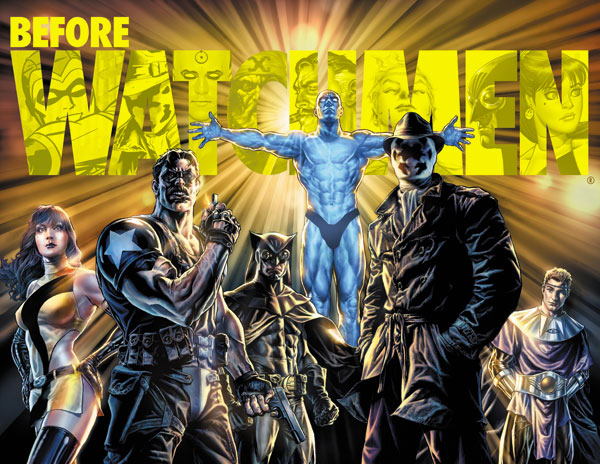
Preview: Before Watchmen

Guest post by Sean Korsgaard.

Few names in either comic books or alternate history carry as much reverence as Watchmen. The tale of a world on the brink of nuclear Armageddon, a world where masked vigilantes have existed since the 1930s, Vietnam is a US state and President Richard Nixon was just sworn in for his fifth term has been a magnum opus of both mediums since its publication back in 1986, for the striking artwork of Dave Gibbons, the dark and compelling story by Alan Moore, and for a dozen different details and nuances which have made the series a classic. Few works of any genre or medium can claim to have had the impact or legacy of Watchmen.

So it should come as little surprise given its golden reception (and revenue) that publisher DC comics had been trying to do a prequel/sequel almost literally since the original got off the presses, with ideas ranging from Rorschach’s Journal to the Comedian’s War Diary, to one following the Minutemen, with the one thing holding up such projects being Moore and Gibbons refusal to return to Watchmen. Even that would only keep DC at bay for so long from trying to hatch a few more gold eggs, and after months of rumors and speculation, last February, DC Comics announced they were launching a number of prequel miniseries:

Before Watchmen: Minutemen (6 issues) – Writer/Artist: Darwyn Cooke
Before Watchmen: Silk Spectre (4 issues) – Writers: Darwyn Cooke and Amanda Conner. Artist: Amanda Conner
Before Watchmen: Comedian (6 issues) – Writer: Brian Azzarello. Artist: J. G. Jones
Before Watchmen: Nite Owl (4 issues) – Writer: J. Michael Straczynski. Artists: Andy and Joe Kubert
Before Watchmen: Rorschach (4 issues) – Writer: Brian Azzarello. Artist: Lee Bermejo
Before Watchmen: Dr. Manhattan (4 issues) – Writer: J. Michael Straczynski. Artist: Adam Hughes
Before Watchmen: Ozymandias (6 issues) – Writer: Len Wein. Artist: Jae Lee
Before Watchmen: Epilogue (One-Shot) - Writers: Various. Artists: Various

To say the least, the move has attracted a great deal of controversy and attention, with most people either furious that DC would have the gall to add on to what is widely hailed as the greatest comic book of all time, or cautiously optimistic at the possibility of further enhancing it. I myself am one of the latter, with DC’s New 52 having rekindled my childhood interest in comics somewhat, and for your reading pleasure, I shall be handing Weekly Update’s look at the return to one of alternate history’s most acclaimed and beloved works. I will be giving issue-by-issue reviews, looks back at the original Watchmen comics and movie, discussing the impact of the original, and of course, letting you know if Before Watchmen is worth looking into every step of the way.

Who watches the (Before) Watchmen? For now, I do, and I’ll let you know if you should too!

[Editor's Note: Sean has posted a review of the issues he has read.]

*          *          *

Soldier, scholar, writer and web-voyeur, Sean CW Korsgaard has been active in the alternate history community since 2006, and was recently elected to succeed Mitro as President of the Alternate History Online Facebook group. In addition to his contributions at the Alternate History Weekly Update, he writes for several websites, including his own, which can be found here.

Monday, September 5, 2011

Weekly Update #18

Editor's Note

This week is nuclear war themed.  I will be posting a review of the Sidewise award winning novel When Angels Wept: A What-If History of the Cuban Missile Crisis by Eric G. Swedin and interviewing the author himself.  I will also be doing a showcase on one of my favorite online alternate histories: 1983: Doomsday.

We got 2,397 page views for the month of August, a new record!  We also have new first-time readers from Turkey and Myanmar (or Burma depending on your preference).  Welcome!  More importantly, we are only one Facebook fan away from reaching 50 Facebook fans.  If you have enjoyed Alternate History Weekly Update and have a Facebook account, than please help us reach this important milestone.

And now the news...

Update on Cornell's Counterfactual Class

Last week I discussed a history class at Cornell University that used counterfactuals to teach history.  Well I did not give you the complete story, but thankfully PhD Candidate Irene Vrinte straightened me out:

It is not a regular course, however, but a First-Year Writing Seminar. Cornell offers dozens of these each semester, and all freshmen are required to enroll in two of them. Only freshmen are allowed to enroll, and there is a strict cap on the number of people allowed to enter the course. As a writing seminar, about 50% of my time is spent teaching students writing skills, and during the other 50% my teaching is more content-related. My course is by no means a coverage course in (alternative) history that any Cornell student who wants to can enroll in, as your article on the blog may lead people to think.

She also explained what the class attempts to take a neutral stance on the importance of using counterfactuals in an academic setting:

...although I hope and believe that "imagining otherwise" can help my students further develop their critical thinking and creative writing skills (the main aims of the course), we also read extensively on the counterarguments academics have offered against using thought experiments. In my class we "respect" counterfactual history, in other words, but that does not mean we can never be critical of it.

So there you have it, a description of "What Ifs": Counterfactual History and the American Century that is probably more informative than anything I could write.  Good luck this year Irene and I hope your dissertation goes well.

President Al Gore

Have I ever talked about the problems of alternate US presidential elections?  Well the last week has given me several articles that proved my point: it is a very easy way to produce sub-par alternate history.  The character featured in this alternate history debate is President Al Gore.

Al Gore after George W. Bush concedes the 2000 presidential election.

Brent Budowsky at The Hill produced an argument on why the United States would be better off if Al Gore was elected president in 2000.  Budowsky paints a world in where President Gore prevents 9/11, won the war in Afghanistan by 2003, never invades Iraq, never makes the same tax cuts as Bush, improves the economy and win a Nobel Prize for the environment (for his actions take to improve the environment as President).  The entire article reads like a Gore-wank, where he can magically do no wrong.  Yet consider America's decision to go to war with Iraq.  Steve Kornacki of Salon makes a credible argument that President Gore might have gone to war as well.

Critics of Budowsky's vision, however, make the same mistake that he did.  Bill S at RedState posted a review of Budowsky's article.  With comments such as "rife with silliness", Budowsky implies that President Gore would create a world with a crippled American economy and much worse terrorism problem.  His only support for some of these predictions was a link to an article published by a magazine with a convervative bias, though at least he made an attempt to provide some support for his argument unlike Budowsky.

Political alternate histories are the examples of when an author's political bias really shines.  They do not attempt to produce a plausible alternate history, they instead are preaching their beliefs...usually to the choir.  A good alternate historians will use these articles I posted above not as the truth of a President Gore timeline, but as sources for their own alternate history where Al Gore wins the 2000 United States presidential election.  A good alternate historian listens to both sides and ignores his own bias.

If you would like to see some other alternate Al Gore, the Alternate History Wiki has a good list.

Fan Expo Canada Updates

We have two updates coming out of Fan Expo Canada that should make both comic book fans and alternate historians happy.

First, Andy Stanleigh, Chief Visual Engineer at Alternate History Comics Inc., has informed me that Titan: An Alternate History got a huge response at the Fan Expo Canada and they expect the debut the sequel to Titan in August 2012.  If you would like more information regarding this excellent piece of alternate history, you can check out my review or go to the book's website.

Second, Dan DiDio of DC Comics announced that James Robinson and Nicola Scott are working on a new Justice Society of America book that takes place on Earth-Two.  Prior to Crisis on Infinite Earths, the entire DC universe was divided into an infinite multiverse, but following Crisis that multiverse was replaced by just one Earth to make the DCU more accessible to new readers.  Recent mini-series have reestablished the multiverse

The Justice Society of America right before they destroy a city block.

The problem with major comic book companies is that their massive continuity and numerous retcons turns these universes into printed soap operas that are difficult to get caught up if you are new reader or someone who stopped reading comics for a short period.  If you do not believe me, check out this article on Newsarama as they struggle to find a name to call the post-Crisis period.

Reminder: Stirling in Portland

I mentioned this before, but just a friendly reminder that for any of my readers in the Pacific Northwest, you can meet author S. M. Stirling at Powell's Books at Cedar Hills Crossing, Beaverton, OR on September 7th at 7 pm.  He will be reading from the next installment of the Emberverse series: The Tears of the Sun.  I already have it pre-ordered for my Kindle and I am looking forward to reading it when it comes out this Tuesday.

Links to the Multiverse

Books

Review of Island in the Sea of Time by S. M. Stirling at The Archaeologist's Guide to the Galaxy.. by Thomas Evans.

Video Games

Alternate History Moments in Gaming, 1 at The War Blog.

Resistance: Burning Skies Interview at IGN.

Articles

Explainer: String theory by Dean Rickles at Explainer.

Imagining the Rolling Stones Without Keith Richards by Ben Ratliff at The New York Times.

That's oil she wrote at The Economist.