Friday, June 29, 2012

Review: "Broken Souls: Volume I" by Alex Davidson

Grade: F
A common problem with self-publishing is that stories are published before they are ready to be read.  Manuscripts that are not peer reviewed or edited are rushed onto Amazon, Smashwords or elsewhere and subjected to the critiques of their readers.  Broken Souls: Volume I by Alex Davidson suffers from these problems.

The first volume of this serialized novel follows two teenagers, Icarus and his older friend Kay.  Both are "steamworkers" who tend the steam generators that keep their city running. They are assisted by Donna, a strange girl who appeared out of nowhere several years ago.  She does not talk and does not do her work, but both Icarus and Kay are obsessed with finding more about her.

I say obsessed because no rational reason is ever given to explain why they would risk so much tracking down info on Donna's history.  There was a short line about the "boss" asking them to do it, but when it comes clear that digging into Donna's past becomes dangerous they proceed in their mission, inspired by some unknown motivation.  Nevertheless, it is not difficult to foil the antagonists they run across.  One was kind enough to tell the pair he was going to kill them and even answered a couple of questions before our heroes dispatched him.  Other antagonists capture them, but are incompetent enough to leave them armed or give them easy means of escape.

The characters are inconsistent.  When they hear that people have disappeared after asking for newspaper clippings from the date Donna appeared (which was told to them quite matter of fact) they shrug it off.  Yet when they are searching through office records and hear footsteps out in the hallway, but find no one there, they immediately come to the conclusion that someone is trying to kill them.  Icarus himself has no issues with killing, shooting a librarian in the stomach just because she was not being helpful.  When you cannot empathize with the main character it can make the story difficult to read.

The book is very implausible, even for steampunk.  In 1900, it was discovered that steam works the same as oil and guns are designed to pull particles from the air to create bullets and the energy necessary to fire them.  There is a magic system in place, which could explain the bizarre use of steam.  Killing a "part" of your soul allows you to use magic, but it makes little sense to the larger story.  

Politically the world changed in 1939 when the British assassinated Hitler and the Nazis just disappeared.  To prevent the rise of another dictator like Hitler the world nations agreed to unite under a world dictator.  Considering the different national interests and ideologies present in 1939, it is hard to imagine the entire world voluntarily giving up their sovereignty without a fight, even with the initial changes to the laws of nature.

The book is filled with typos and errors (the Greek god Ares is confused with the island of Crete), which just adds to the plot issues of Broken Souls: Volume I.  Perhaps time with a writing group and a good editor can save the story, but I cannot recommend the current incarnation of the story.

*       *       *

Matt Mitrovich is the founder and editor of Alternate History Weekly Update, a volunteer editor for Alt Hist and a contributor to Just Below the Law. His fiction can be found at Echelon PressJake's Monthly and his own writing blog. When not writing he works as an attorney and enjoys life with his beautiful wife Alana.

Interview: Robert G. Pielke

I now present my interview with Robert G. Pielke, author of A New Birth of Freedom: The Visitor.  Enjoy:

Can you tell us a bit about yourself?

Sure can…and a lot of it will be true…..only kidding……  ;-)

Where are you from?

Baltimore, Maryland – just outside the northeast corner of the city limits, on US 1….a.k.a. Belair Road [the home of Edgar Allan Poe, Frederick Douglass, John Wilkes Booth, H.L. Mencken, Frank Zappa, Upton Sinclair, Billie Holliday, Johnny Unitas, Tom Clancy, George Herman Ruth, Cab Calloway, Dru Hill, Joan Jett, Connie Chung, Tupac Shakur and, of course, John Waters.]

Why did you go into teaching?

Ah…yes…a good question, one that I never stopped asking myself:

It all began with the “Gulf of Tonkin Resolution” that gave Pres. Johnson the authority to perpetrate a limitless and aimless war in Southeast Asia. I was in Advanced AFROTC in college at the time. Although I had a lot of interest in history, philosophy and political theory, I could see no useful employment following  college with that kind of degree. [I only took philosophy courses to meet girls!] Basic ROTC [Army or AF] at that time was a requirement for land grant universities and so was military service – the draft was universal. So why not do my time as an officer? That meant applying for Advance ROTC. Not too long thereafter, in one of my Air Science classes, our instructor gave us a “pop quiz” – which we all failed. We were to identify “Ho Chi Minh,” “Saigon,” “Hanoi,” “Viet Cong.” “Dien Bien Phu,” “Ngo Dinh Diem” and “Madam Nhu.” None of us had a clue! Whereupon our instructor commented that we were going to learn these answers the hard way….intimately…within a year.

Well, after doing some research and some thinking and re-thinking, and after noting the controversies beginning over the Tonkin Resolution, I decided that there was something wrong with this foreign adventure – and I wanted no part of it. So, I turned to one of my specific interests in history and philosophy – the study of religion. [Not practicing it…studying it.] Could I do this in grad school? That would get me out of the draft for a while. Sure, but you had to have good grades for grad school. [I was floating along with a rather weak “C” average.] How about going to a seminary for the background stuff then grad school after that? I wrote to numerous seminary instructors around the country and many advised me to go for it. [I was Lutheran and the closest seminary was in Gettysburg!] Ok! I had a plan….and once in Seminary, the draft board mistakenly thought I was a ministerial student, and assigned me a permanent deferment!  [I never got around to correcting their error.]

My opposition to the war was initially pretty much based on “saving my own skin” But soon, when seeing the social activism of many seminary profs and other students, it grew in a socio/political/moral  opposition, and that carried through to graduate school afterwards.

Now, what can a person do with a BA in history/political thought and a M.Div. in theology and a Ph.D. in Social Ethics? You got it….exactly nothing….except teach! One application for an assistant prof in Philosophy at George Mason University and I had a job. [There was only one other applicant….times were different.] And…having taken precisely zero courses in education, I had to sort of develop my own pedagogy. And I was pretty happy with it.

Sorry your asked????? Hahahahah

What did you teach as a professor?

Even though I was a history major in college, I also had a heavy concentration in philosophy – almost enough to have a double major. And after my succeeding  years in various levels of “schoolage”  I wound up  teaching courses in philosophy – mainly intro stuff, like phil 101 [ugh], logic [yea], ethics [yea also] but also some advanced courses – usually in the ethics, political philosophy and social ethics areas. Early on “doing my stretch” in Academia, I also taught some courses in philosophy of religion and even a few world religions courses.

While I did manage to get tenure and promotions within the academic world [I published rather than perished], I was always a “trouble-maker” in terms of my approach to education and learning. Students either loved it or hated it….but most eventually got into the “hang” of what I was doing. [Hardly any of the faculty did – and none of the administrators! Hahahaha]

Did you ever check out your profile on Rate My Professor?

Of course! Many times – and as I’ve said, there were few if any neutral students about my approach – I never pleased all of the people – or even most – just some [and not all of them all of the time]…and that’s ok… My student surveys we a lot more positive, since most of the people who hated my approach had dropped the course before the surveys were taken!

What got you interested in alternate history?

I went to the movies every week as a kid – before we had a 13 inch Mad-Man Muntz TV and afterwards as well. So I saw pretty much everything, and a lot of what was playing were cheap-o “Westerns” [Johnny Mac Brown, Hopalong Cassidy and the like], but there were some major productions as well. What interested me most were the stories that involved “Indians” – and they had a distinct flavor: good cowboys and bad Indians. Oh sure, there were a few that countered this prevailing image, and I particularly liked them, like Broken Arrow [sometime in the ‘50s].

My father was an avid reader of western novels and he introduced me to the idea that Indians might not be all evil, and might have been justifiably angered at the Europeans stealing their land. He wasn’t nearly as open to change when it came to other ethnicities, but this mere possibility let to me “supposing” different scenarios….like “what if” all the competing tribes were to have united to keep the Europeans at bay until some kind of equitable arrangement with the new settlers could have been achieved. I didn‘t put it in these words at the time – I was about 7-10 years old! But I did try my hand at writing a novel, White Cloud, about an Indian who achieved this kind of unity among all the tribes. [It was three pages long with one paragraph.] Ever since, I’ve always had a “what if” in my mind when watching movies or TV as well as when reading fiction or nonfiction.  [I used this scenario in my first SF/TT/AH novel [The Mission].

I’m still a sucker for alternate history stories, but there is always a part of these stories that gives me pause: the “shift” from the history as we know it to the alternate course of history. Not all writers deal with this, but it’s what I find most fascinating. Without a concentration on this, these stories are not much different from the kind of run-of-the-mill speculations that historians do routinely. A lot of WWII and Civil War novels just proceed on a different path without explaining why or how the shift took place. Historians don’t have to deal with this – they’re just speculating – but storytellers must deal with it. It’s what differentiates mere historical speculation from speculative fiction.

BTW I differentiate between Alternate History and Alternate Universe stories. The latter take place in an entirely alternate reality where no “shift” takes place, like a lot of [most?] Steam Punk.

In genuine Alternate Histories something has to be introduced to accomplish the “shift.” Two “shift” inducers have always appealed to me: time travel and alien contact. There are others of course: natural catastrophes, nuclear war, global warming, etc. But as they use to say – that’s not “my bag.”

What is A New Birth of Freedom: The Visitor about?

It’s the first book of a trilogy [The Translator and The Historian] will complete the series. And The Translator is going to be released this coming November – hopefully the 19th!.  It combines alternate history, time travel and double first contact themes. [This caused editors and agents who read early proposals to shy away from my project – “too many genre!” “I see coherence problems!” “Why are you doing this to yourself!” But I had a theme in mind that – to me – brought these things into harmony. Obviously the title of the trilogy [prior to the colon] is “lifted” from Lincoln’s Gettysburg Address, and in a very real sense, that’s what the book is about – the assumptions and implications of that phrase.

I’ve always been intrigued by Lincoln’s gradual “evolution” from a state of pretty much total ignorance about that “peculiar institution” of his times to the state of a full blown abolitionist. It had a lot to do with his encountering actual slaves as well as well-educated freed men. [Fredrick Douglass, for example – yup…two “s”s]  It also had to do with his similar encounters and evolution with native Americans. The beliefs he was raised with about the inferiority of these other races was gradually wiped away [picture personal waste removal and cleansing here] by these encounters. And the essence of these encounters was communication…unexpected, intelligent and provocative communication.

There’s a “subtext” or two that runs throughout the trilogy, and I sort of had this in mind from the beginning. I never say anything about them, of course – that’s why they are “sub-ed.” They are not really necessary for the plot or story, but that doesn’t mean they’re not important. One has to do with the belief that some people have that in-depth communications with other species is inherently impossible. [Noam Chomsky, for example] I reject this notion completely. Also, there is a more recent belief that communications with other-worldlies should be avoided at all costs…forever. [Stephen Hawking, for example] I reject this too.

So, that’s what the trilogy is all about….unexpected communication. Book Two is subtitled The Translator! [I will be released in November, 2012.]

What else inspired you to write the novel?

Along with my fascination with Lincoln, something did happen – as a catalyst – to suggest a venue and time frame. It began with my interest in America’s Civil War. [I care little whether others might prefer something akin to “War of Northern Aggression” – I can live with that – as long as others remember that sometimes aggression is justifiable.]

After a trip our class took to Gettysburg – I think the 6th grade [my memory cells have been severely challenged throughout the years and there’s no “Scotty” to fumble around with substitute Dilithium Crystals], I wanted to know more about the battle. And, although not a “Southern boy fourteen years old,”  I could imagine that third day of the battle when it’s not yet two o’clock, and Pickett’s Charge “hasn’t happened yet, it hasn’t even begun yet, it not only hasn’t begun yet but there is still time for it not to begin…” [quotations from Faulkner’s Intruder in the Dust]

So I imagined….what if Longstreet hadn’t nodded for Pickett to proceed….and why  would he have done that….I needed a “shift point.” And “the Pests” provided one.

American Civil War alternate histories are very popular.  Why do you think that is?

First of all, “history” is never a thing of “the past” – it always has to do with how we perceive and understand certain events now. Historicism is “nowism”!  When I reflect on the Viet Nam War, for example [called “the American War” in Viet Nam] or the Peloponnesian War,  my reflection is taking place in the present. It’s never an “ago” thing – it’s always a “now” thing.

As for the American Civil War, hell, that never had an end! It’s still going on! It has taken  many different twists and turns and embodiments, but it’s with us today – and it’s personalities, places, events, issues and the like have achieved an iconic and/or symbolic status. Our interest in the ACW is not a look backward….it’s a look at ourselves today. The Civil Rights Movement a few years ago was a manifestation of its continued viability, as are the issues surrounding federal vs. state authority in health care today. Even the debates over the Second Amendment are part its continuance. The very name of this “imbroglio” is up for grabs. “War of Northern Aggression”? “Civil War”? “War of Southern Rebellion”? “War to End Slavery”? The only thing that’s changed is the “weaponry” and the kind of battles being fought.

And the “what if” of alternate history feeds into all of this.  Books are written and movies are made, and all of them are the results of us looking at ourselves today….

What is the future like before the Pests arrived?

Book three [The Historian] will deal with this...and more. I thought the story would “play better” if I, in a sense, worked backwards. Plus it makes the furtherance of the protagonist’s plans complicated. The paradox problems of time travel and the infamous “butterfly effect” make his mission all the more risky. In other words, “plot complications” abound – and I like that!

BTW – I’m at the plotting stage for book three at this time, and the gaps of the first two will indeed be filled in.

Who designed the cover?

The publisher of the first book [She prefers to go by “Crystalwizard”] – Altered Dimensions Press, an imprint of Cyberwizard Productions.

I suggested the Civil War photo [a widely recognized one] and the idea to replace the original third person [General McClernand] with my protagonist in a way to suggest a time travel theme. She did the photo-shopping and the character creation. [The guy on the left is Alan Pinkerton]

If you could go back in time, when would it be and what would you do?

Well there are a lot of things I did and said that l’d like to correct…or do and say more, but I suspect you are asking an alternate history question. In that case, I have to put on my logic professor’s hat and point out that if my reason for “going back” is to change something, then the old time travel paradox kicks in – If I wind up changing it, then my very reason for “going back” is negated…and I would thus never have gone back in the first place!  ;-)

Do you have any other projects you are working on?

After the trilogy, I want to do a long form science fantasy novel involving communication with dolphins. I’m also doing some preliminary plotting on this book.

Then, I’ve been working on a story involving the contemporary relationships between former Viet Nam vets and Anti War Protesters. This would be a straight literary novel. [I’ve already got the title: Don’t Mean Nothin’]

Have you ever thought of returning to White Cloud? Native Americans are such an untouched topic in alternate history.

I used the scenario in my book The Mission….and make use of a rather noteworthy Native American in my current trilogy. But White Cloud itself…it’s an open question. I’m always interested in the “shift” when doing alternate history – why does it happen. If I get a satisfactory answer to that….who knows????

What are you reading now?

Like a lot of writers, I can’t read any kind of book while writing. I asked Harry Turtledove about this at the last Worldcon in Reno, and he too confessed this same incapacity. Others agreed.

I am surprised to hear about authors not reading when they are writing.  What benefits does it bring and don't you find it difficult?

Actually, I thought I was pretty much alone in this…but it seems that most authors feel this to one degree or another. If I were to pick up a book for reading enjoyment – while writing – I would inevitably find myself thinking as an editor. [“That could be written better…or more clearly…or maybe not at all”….and so on. And there’s always the possibility of being unconsciously influenced by someone else’s writing.] Writers really are much more isolated than you might think….most of us isolate ourselves  from the very thing we are doing. Kind of ironic, huh?  [Films are a different kind of medium…and they pose none of these problems.]

Do audiobooks apply to your ban on reading while writing?

Yup….I don’t like audiobooks anyway. I like to supply my own “voices” when I read. Besides, I like the process of reading vs. listening. I like to look at the words. Plus, I’d still find myself wondering if I could improve on the story and how it’s being told. But – I guess somewhat ironically – I can watch films. I can even analyze them and not have it affect my writing. For example, both my book and Abraham Lincoln: Vampire Hunter use William Johnson as a character, but we use them differently. And I’m not in any danger of having the latter affect my use of him. There’s something about the media themselves that makes a difference to me [a la Marshall McLuhan – whom I rely on heavily in my book about rock music in American Culture].

Do you have any other advice for would-be authors?

Sure….write every day! If you suffer from something called “writer’s block,” then in all likelihood you have nothing to say. I really dismiss this whole “writer’s block” thing as nothing more than a recognition that someone wants “to be a writer” more than she/he wants to write. The writing itself should be enjoyable…even if no one ever reads it  or knows about it.

Thursday, June 28, 2012

Review: "Vampire Romance" by Kim Newman

Grade: B+
Like many men who have a significant other that enjoys the Twilight franchise, I have been subjected to what counts as "vampire romance" in this day of age.  Despite the RiffTrax commentary that I plug into, I have been unable to escape the sheer banality of it.  So you can guess how happy I was when I found out that Kim Newman decided to take a stake to the recent trends in vampire fiction.  What he gave us is an amusing mystery with some social commentary.

Published in the new, Titan Books printing of The Bloody Red Baron, "Vampire Romance" is set in 1923.  The Central Power have been defeated and Dracula has been exiled to an island where the sun never sets.  This has left a power vacuum in the vampire community.  Elders gather at Mildew Manor to pick the next "King of the Cats", but the Diogenes club would rather the position remain empty.  They have tasked their agent Edwin Winthrop to recruit Geneviève Dieudonné and have her pose as a claimant to observe the proceedings and what influence the costumed criminal "Crook" has on the next vampire king.  If his choice gets elected it could make his criminal organization (and nascent political movement that has similarities with the anti-vampire Nazis in Germany) a threat to the Empire.  Of course all this backroom dealings means nothing to the resident vampire-loving, teenage girl who is convinced that one of the vampires present is her soul mate from a past life.  Add an unexpected murder, a Japanese schoolgirl vampire and an ancient dictator and you got yourself a novella.

The story was very funny and I enjoyed Newman's response to the hunky vampires of the 21st century.  To me Newman's vampires are more realistic then what you usually find in fiction.  Despite their immortality and powers, they are still human.  They can be petty, stupid and vicious...but also loyal, intelligent and reasonable.  The twist at the end when the killer is revealed is also a nice touch, but the entire story probably should have been published outside of The Bloody Red Baron.  After reading about an elder American vampire turning into mist so he could enter a German tank and slaughter its crew only to be incinerated by a giant flame thrower, the more humorous (even if dark) "Vampire Romance" did not mesh with the horror present in the novel that preceded it.  The beginning chapter where Geneviève gets a haircut probably could have been shorter, even if it did set the scene.

Despite some small issues, "Vampire Romances" was a delightful commentary on how horror is presented to the masses and if you do get a copy of the Titan Books printing of The Bloody Red Baron then I recommend that you keep reading into 1923.

*       *       *

Matt Mitrovich is the founder and editor of Alternate History Weekly Update, a volunteer editor for Alt Hist and a contributor to Just Below the Law. His fiction can be found at Echelon PressJake's Monthly and his own writing blog. When not writing he works as an attorney and enjoys life with his beautiful wife Alana.

The Maple Leaf (Not Quite) Forever: Canada in Alternate History

Guest Post by Tyler Bugg.

As a proud Canadian, I can’t help but look forward to see how the second largest nation on Earth does in alternate histories. However, I’m usually left with a sinking feeling, mostly because my home and native land seems to be a favorite stomping ground, and always toward the top of the “To Conquer” list in American dominate AH’s, or an unlucky pawn in different British Empires and the rest of the world, and, if the Nazi’s won the Second World War, you can be sure of one of two things: a) it’s the refuge of a fleeing British Monarchy and government, or b) yet another colony of Hitler’s. Well, maybe that would be better than the United States of North America, I dunno.

Often times, the nation is a fraction of its current, gargantuan size, composed of only the original provinces of Ontario, Nova Scotia, New Brunswick and Quebec (unless the latter broke away), or, rarely, even larger. The War of 1812, the Oregon Crisis (54° 40° or Fight!), the Trent Affair, and plan old Manifest Destiny are popular POD’s, though, of course, the butterflies and Bats from Space that are Aliens would cause damage for any POD around the world…

I don’t mind too much, as its all fiction. But it seems to me that when Canada is involved, there are three categories that it can be divided into:

1. “Greater Canada”: This is primarily a “Canada wank” TL, where the Thirteen Colonies that became America instead joined Canada to become a massive, continent spanning Dominion of the British crown, or simply that Canada invades the US and, somehow, improbably, wins (though, listening to this song, you may think we’re one step away from following in our former Colonial Master’s shoes) Of course, these TL’s are rare, although I would consider Harry Turtledove’s The Two Georges as a “Greater Canada” TL (even including an RCMP analogue, the Royal American Mounted Police!)

2. “Lesser Canada”: Canada doesn’t stretch into the Great Plains, much less British Colombia and often times Quebec will be independent. Basically, only OTL Ontario would be “Canada”, as the Maritime Provinces might have either become part of the US, or simply remained colonies of the British Empire. I made a “Lesser Canada” in my major Timeline “French Trafalgar, British Waterloo,” the rest of OTL Canada becoming the republics of Assiniboia (Manitoba, Saskatchewan, Alberta, North West Territories and Nunavut) and Alyseka (Russian Alaska, BC and Yukon), only later to have my “lesser Canada” become “No Canada” after a Civil War a la Spanish Civil War, replaced by, you guessed it, Quebec.

3. “WTF is Canada?”: No change, most likely because the writer either doesn’t think Canada is that important: just another nation on the list, right beside Nepal, Sierra Leone and Tibet that exist; or simply, isn’t interesting and says that the butterflies have no effect north of the 49th Parallel, even if the US became a Neo-Nazi, Commie Hippie, tree hugging dystopia. This, sadly, is the most often seen one, especially on the Alternate History Wikia, the one place I frequent more often than anything else counterfactual historically related.

One of the most notable Canada’s in Alternate History is, once again, from Harry Turtledove. While Mr. Turtledove does add Canada in many of his stories, such as an angry Union attacking the defenseless nation after the succession of the Confederacy in The Guns of the South, one of the most inhospitable territories conquered by the Race (and later given back!) in the WorldWar and Colonization series, the largest involvement in a Turtledove story is in the Timeline-191 (or Southern Victory) series. Six of the multitude of viewpoint characters are either from the north or spent some time there, from farmer/saboteur Arthur McGregor (from my home province of Manitoba, no less!), and his daughter Mary, to American pilot/lawyer Jonathon Moss, whose wife and daughter are killed by a bomb sent to them by Mary. Having a setting in Canada, especially the contrast between the resistant English settlers of the west, and the Quebecois in the east, given their own nation under American “protection” is a nice touch, and one that, as a Canadian, makes me wonder “What if the US did march on Canada?”

Either way, Canada is mostly an unimportant player in Alternate History, mostly due to its proximity to the US, and a much, much smaller population (as of right now, Canada is only a breath away from 35 million: the US is well passed the 300 million mark) and the general feeling Canada is either a “Polite American” or “America’s Hat.” Of course, I can’t say too much bad about the United States, if for the fact that I’m only 20 miles from the border…

*          *          *

Tyler “Tbguy1992” Bugg is a Canadian History Student currently on summer break, and, if he can find time in between video games (ALTERNATE HISTORY video games, mind you), work and such, he tries to write. If he could find a job writing for a video games company for an Alternate History story set in Canada, the world will most likely stop turning for a moment while everyone comprehends it.

Wednesday, June 27, 2012

Review: Abraham Lincoln, Vampire Hunter

Grade: A-
What was brilliant about The Zombie Survival Guide by Max Brooks was how serious he took the subject of preparing for the inevitable zombie apocalypse.  He did not stop every other page to remind us that "zombies are not real", he left that to the CDC.  Instead he gave honest advice on how to deal with attacks by the undead.  This tongue-in-cheek humor turned the Guide into a hit, launched another novel, a comic book, collectibles and a movie deal.

In the summer of 2012, one film embodies the entertainment value of the Guide.  In Abraham Lincoln, Vampire Hunter, we begin by seeing the future American president, Abraham Lincoln, as a small boy.  After witnessing the murder of his mother by Jack Barts, young Abe vows revenge but his father makes him promise not to retaliate.  Eight year later, after his father dies, Abe decides to carry out his long-awaited revenge but is uprepared when he learns the truth about Barts: he is a vampire.  At the last second Abe is saved by an experienced vampire hunter, Henry Sturgess.

He explains that vampires have been infiltrating America since the beginning under the leadership of Adam, the father of all vampires in America.  Using the institution of slavery, vampires have managed to finally sate their blood lust by feeding off the slaves brought to work in the South.  The vampires, however, are starting to expand north and Sturgess needs disciples to fight them.  Abe pleads with Sturgess to train him how to fight, but only after Sturgess makes him promise to fight vampires on his terms and not carry out his own revenge schemes.  

After his training is complete, Lincoln moves to Springfield, IL where he gets a job working as a shopkeeper while studying the law.  This boring life is only a cover for his true mission: to eradicate the vampire presence in the town.  Lincoln comes to the realization, however, that it is not enough to behead one or two vampires.  As long as slavery exists in America, the vampire infestation will never disappear, so Lincoln breaks with his mentor to seek a career in politics.  He reaches for the White House to eradicate vampires once and for all...even if it means splitting the nation apart into a civil war.

Abraham Lincoln, Vampire Hunter was a delightful film blending the best of a summer action flick with a unique horror element.  The best part, however, were the laughs.  People who know their 19th century American history will find plenty to chuckle about, even if the rest of the audience misses the joke completely.  I lost count how many times I burst out laughing to a virtually silent theater, though I was not embarrassed because their were a couple of voices joined with mine to express their mirth.  Nevertheless, knowledge of history can hurt your ability to enjoy film at times.  For example, the film seems to imply that Lincoln had only one child.  Facts like that are annoying to those who know Lincoln, but are likely missed by the general audience.

Though I have not read the
novel by Seth Grahame-Smith that the film is based on, I have read his first mash-up novel, Pride and Prejudice and Zombies.  Smith, who also wrote the screenplay of the film, managed to duplicate his tongue-in-cheek humor that so identifies his style of writing and translate it into a different medium.  The film stayed serious at all times.  I can see why Jeff Greenfield is worried that kids will grow up thinking one of the greatest American presidents spent his time in office fighting vampires.

Sadly the film has been poorly reviewed by critics (Ebert did give it a good review) and has had disappointing box office numbers.  Despite high audience ratings, Abraham Lincoln, Vampire Hunter will likely be remembered as a flop.  Nevertheless, people who can embrace the absurd will find an enjoyable summer blockbuster and watch as the Great Emancipator is turned into the Dark Knight.  More importantly, you will regain your faith in vampire films after this.
GO ABE GO!

*       *       *

Matt Mitrovich is the founder and editor of Alternate History Weekly Update, a volunteer editor for Alt Hist and a contributor to Just Below the Law. His fiction can be found at Echelon PressJake's Monthly and his own writing blog. When not writing he works as an attorney and enjoys life with his beautiful wife Alana.

Musings on an Independent Confederacy, Part 3

Guest post by Chris Nuttall.

Writing a response to a response is always a tricky problem, but I do think that there are several points that should be made.

I believe that I did note that there were differences between the North and South, although I didn’t give them as much attention as Richard.  However, some issues – like geography – remain fairly consistent throughout history and others – like economics and military technology – change rapidly.  The fact of the matter is that the CSA was an agricultural state that did not share the Northern industrial base prior to the war and had to struggle quite hard to accomplish as much as it did.  I am in no way disagreeing that the CSA had a remarkable level of success; my point is that the CSA could not hope to keep up with the North over a long period (and certainly never managed to match the North for the four years of warfare in OTL).

This happened, at least partly, because the political dominance of the South was in the hands of people who had invested heavily in land and farming (and slaves.)  It was not in their interests, prior to the war, to invest in industrialisation and there is no reason to believe that they would change their attitude very willingly in an independent South.  There are several separate reasons for that, but the main one (IMHO) was that the South’s aristocracy (in all, but name) would not want to reward workers as extensively as the North could and did.  They would see an industrial class as a threat to their power – and slaves make poor industrial workers.  It would be very difficult for them to translate their power from slave plantations to industrial complexes.

I mention slavery quite extensively because it WAS the stone around the CSA’s collective neck.  I agree that the people of that era saw nothing wrong in slavery, but as the years wore on slavery became less and less efficient whatever the political structure of the USA/CSA.  While slavery has been in existence since earliest times, there were significant differences between Roman slavery (for example) and the kind practiced by the CSA; specifically, slavery being largely restricted to blacks.  A roman slave had a good chance of freedom and even rising to a prominent position in society; a black freedman in the south was held in bondage even after he was manumitted by his owner.  Leaving aside modern morality, this was not a system for getting the best from one’s population.  There was nothing the average black in the CSA could do to escape the curse of being born black.

Even in OTL, the South managed to push blacks down under Jim Crow laws; I can think of no good reason for assuming that they would do less if the CSA managed to become independent.  At the very least, the slaves would remain enslaved for years – again, not something conductive to social development.  The average Southerner thought of ‘niggers’ as a separate subhuman race, not as fellow human beings.  They were property.  ‘Niggers’ were demonised to an extent that would shock us today.  The thought of black men having sex with white women (but not the reverse, provided it was just an affair (or rape)) was horrifying to them.  They simply did not see the black man as human.

But it doesn't really matter WHAT the South thought of slavery.  The economics of the situation don’t change, short of something happening to alter them from the outside.

Give up slavery?  The slaveholders would demand compensation for their lost property.  Make compensation?  But who would pay for the slaves?  And even if they do, the blacks are not suddenly going to become full citizens of the CSA.  My bet is that they’d be treated as a subhuman underclass right from the moment they were declared ‘free.’

It is impossible to say what would have happened if the South had become independent.  All I can do is point to trends that existed within the South and how they might have developed if the CSA had been allowed to leave the Union.  I do not believe that the South enjoyed a basis for true independence AND stability, at least in the long-term.  In some ways, it would be like India in 1947, rather than America in 1776; there would be serious social strains right from day one.  How would the CSA cope as the world changed around it?

I don’t think they could do very well, unless they managed to give their black (and Hispanic) underclass(s) a stake in the system.  And that was probably beyond them.  The Southern Culture was unable to adapt to the idea of black equality for years in OTL.  Their culture was also ill-adapted to face the modern world, but that’s a different issue.

Allowing modern morality to infest history is a valid problem.  Slavery was not the be-all and end-all of the origin of the war.  However, I did my best to put morality aside and stick to the facts (and how they might be extended if the CSA won the war.)

Thank you for writing the response.  I rarely get such interesting feedback.

*      *      *

Chris Nuttall blogs at The Chrishanger and has a website by the same name. His books can be found on Amazon Kindle.

Tuesday, June 26, 2012

Preview: "The Houdini Specter" by Daniel Stashower

"This is charming...it might have amused Conan Doyle." 
- The New York Times

"In his first mystery, Stashower paired Harry Houdini and Sherlock Holmes to marvelous effect." - Chicago Tribune

"Stashower's clever adaptation of the Conan Doyle conventions - Holme's uncanny powers of observation and of disguise, the scenes and customs of Victorian life - makes it fun to read."
-Publishers Weekly

The third thrilling adventure for the legendary magician from award-winning author Daniel Stashower! IN THE HARRY HOUDINI MYSTERIES: THE HOUDINI SPECTER (Titan Books, June 2012) the Great Harry Houdini is still struggling to make a name for himself in turn-of-the-century New York. He sees an opportunity for glory in exposing the tricks of the medium Lucius Craig - if only he can work out how the medium managed to conjure a "spirit" while tied to a chair by Houdini himself or how the apparition was able to stab an audience member to death and then disappear!

Daniel Stashower www.stashower.com is a novelist and magician. A two-time Edgar Award-winning author of Teller of Tales: The Life of Arthur Conan Doyle and (co-author) Arthur Conan Doyle: A Life of Letters. His works also include Elephants in the Distance, The Beautiful Cigar Girl, the Sherlock Holmes novel, The Ectoplasmic Man and (as co-author) the Sherlock Holmes anthology, The Ghosts of Baker Street. He resides in Bethesda, MD.

The good people at Titan Books were kind enough to give me a review copy of The Houdini Specter and I should be posting a review next week.  Stay tuned.

*       *       *

Matt Mitrovich is the founder and editor of Alternate History Weekly Update, a volunteer editor for Alt Hist and a contributor to Just Below the Law. His fiction can be found at Echelon PressJake's Monthly and his own writing blog. When not writing he works as an attorney and enjoys life with his beautiful wife Alana.

New Releases 6/26/12

New Paperbacks

The Austin Job: Lost DMB Files #18 by David Mark Brown

Description from Amazon.

With the world embroiled in the Great War, power-hungry forces threaten to tear apart the state of Texas in a secret plot to rule the resource that will fuel the future. In The Austin Job, James Starr, bronc rider turned politician, stumbles into a high stakes game of power and lies that he must master before it masters him.

Exploding with double-fisted, cheek-puckering action, including the world's first parkour stunt horse, The Austin Job dares you to cinch your saddle to a bolt of Lone Star lightning and hold on for dear life.

Through this continuation of the Lost DMB Files, dime novelist David Mark Brown (disappeared during the 30's) invites the reader into a world illuminated by human torches and moonlight towers, an underground Austin inhabited by machine and monster alike. Lastly, it's a world where what you don't know can get you killed--or just really, really messed up.

The War That Came Early: The Big Switch by Harry Turtledove

Description from Amazon.

In 1941 Winston Churchill was Hitler’s worst enemy. Then a Nazi secret agent changed everything.

What if Neville Chamberlain, instead of appeasing Hitler, had stood up to him in 1938? Enraged, Hitler reacts by lashing out at the West, promising his soldiers that they will reach Paris by the new year. Instead, three years pass, and with his genocidal apparatus not fully in place, Hitler barely survives a coup, while Jews cling to survival, and England and France wonder whether the war is still worthwhile. The stage is set for World War II to unfold far differently from the history we know—courtesy of Harry Turtledove, wizard of “what if?,” in the continuation of his thrilling series: The War That Came Early.

Through the eyes of characters ranging from a brawling American serving with the Abraham Lincoln Brigade in Spain to a woman who has seen Hitler’s evil face-to-face, The Big Switch rolls relentlessly forward into 1941. As the Germans and their Polish allies slam into the gut of the Soviet Union in the west, Japan pummels away in the east. Meanwhile, in the trenches of France, French and Czech forces are outmanned but not outfought by their Nazi enemy. Then the stalemate is shattered. In England Winston Churchill dies suddenly, leaving the gray men wondering who their real enemy is. And as the USSR makes peace with Japan, the empire of the Rising Sun looks westward—its war with America about to begin.

Exiled: Clan of the Claw by Harry Turtledove, S.M. Stirling and others

Description from Amazon.

First entry in a new series with four big all new linked novellas from multiple best-sellers Harry Turtledove, John Ringo & Jody Lynn Nye, S.M. Stirling, and Michael Z. Williamson!  After the extinction asteroid DOESN’T strike Earth, the dinosaurs keep evolving – but so do the mammals.  We mammals have achieved human-like shapes, but now it’s cold-blooded, magic-using reptiles against the hot-blooded, hot-tempered descendants of cats.

In a heroic, Bronze Age world similar to 300, the Mrem Clan of the Claw and its sister warbands are expanding their rough-and-tumble territory, but now they face the Lishkash, masters of a cold-blooded empire of slave armies and magic.  It’s mammalian courage and adaptation against reptile cunning in a clash of steel and will that determine who shall inherit the Earth.

New E-books

Grantville Gazette Volume 39 by Eric Flint and Paula Goodlett

Description from Amazon.

This edition of the Grantville Gazette Volume 39 is derived directly from the on-line edition at http://www.grantvillegazette.com.

It is different than the editions provided by Baen and webscriptions, has somewhat different content and different formatting.

As always with anything related to 1632, it is provided entirely without DRM of any kind. We hope you enjoy it.

Grantville Gazette Volume 40 by Eric Flint and Paula Goodlett

Description from Amazon.

This edition of the Grantville Gazette Volume 40 is derived directly from the on-line edition at http://www.grantvillegazette.com.

It is different than the editions provided by Baen and webscriptions, has somewhat different content and different formatting.

As always with anything related to 1632, it is provided entirely without DRM of any kind. We hope you enjoy it.

Jumping Jim and The Jubilee Line (Book Two) : A Science Fiction Parallel World Fantasy by Ian C.P. Irvine

Description from Amazon.

What would happen, if during your normal commute to work, you accidentally stepped from one world into another? If you accidentally ‘Jumped’ into a parallel world where all your day dreams were real, and where your real world was now the daydream?

Where, instead of a Product Manager, you were now a high flying advertising executive, and you were married to the woman that you had fantasised about for ten years?

But what would happen if you realised that dreams are sometimes best left as dreams,...and that the life you had before, was the life you really wanted?

Would you be able to find your way home back to your real wife and your real life?

This is what happens to James Quinn: one day he discovers he has the ability to jump from one reality to another. The only problem is...can he jump back?

This book was written for the commuter, for anyone who sits for hours every day travelling back and forward to work, and wondering...'is this the life I should be living? Have I made the right choices? ' ...and then wished for something else...

The new alternative to The Time Traveler's Wife, this is a must read for everyone, regardless of what city you work in, or in which country you live. People the world over will identify with the story told within these pages. As the story progresses, some will feel guilty, some will cry, some will laugh, ...but all will follow the plight of James Quinn, a man who is not unlike so many of us all.

If you read this book, your commute to work on the train, metro, tube, or underground may never be quite the same again...

Liahona (City of the Saints) by D. J. Butler

Description from Amazon.

1859; war looms over the United States.

Intelligence agents converge on the Kingdom of Deseret in the Rocky Mountains. Sam Clemens, leading the U.S. Army's expedition aboard his amphibious steam-truck the Jim Smiley, has a mission: to ensure that the Kingdom, with its air-ships and rumored phlogiston guns, brain children of the Madman Orson Pratt, enters on the side of the United States and peace.

Can he outrace and outmaneuver his British competitors, anxious to protect their cotton trade? And where are the agents of the treasonous, clandestine Confederate leadership? And why does the Madman seem to be playing his own game?

Liahona is Part the First of City of the Saints, a four-part steampunk gonzo action adventure tale.

To fans, authors and publishers...

Do you want to see your work given a shout out on our New Releases segment? Contact Mitro at ahwupdate at gmail dot com.  We are looking for works of alternate history, counterfactual history, steampunk, historical fantasy, time travel or anything that warps history beyond our understanding.

*       *       *

Matt Mitrovich is the founder and editor of Alternate History Weekly Update, a volunteer editor for Alt Hist and a contributor to Just Below the Law. His fiction can be found at Echelon PressJake's Monthly and his own writing blog. When not writing he works as an attorney and enjoys life with his beautiful wife Alana.

Monday, June 25, 2012

The Art of Steampunk #2

Some of my favorite steampunk art from last week:

A nautical-themed keyboard, to go with...
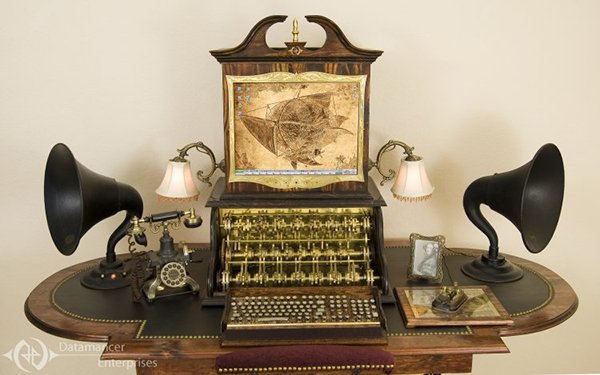
...this steampunk desktop!
An awesome shirt...
...but these ladies dress a lot better!
A werewolf hunter...

...and a couch he can sit on when he is done hunting lycanthropes.  Sorry, not the best transition.

If you have steampunk art you would like to showcase on Weekly Update, email them to ahwupdate at gmail dot com.

*       *       *

Matt Mitrovich is the founder and editor of Alternate History Weekly Update, a volunteer editor for Alt Hist and a contributor to Just Below the Law. His fiction can be found at Echelon PressJake's Monthly and his own writing blog. When not writing he works as an attorney and enjoys life with his beautiful wife Alana.

Weekly Update #60

Editor's Note

So this is the final week of double posting for me.  It has been an educational experience.  I never realized how easy it is to write when you really set your mind to it.  Plus it has been very rewarding.  We have already broke our monthly page view record and we just passed the 7000 barrier.  At this rate we should surpass 8000 page views by the end of the month.  Thanks!

The Mitro Media Empire has grown with the addition of my new writing blog.  With "A Perfect Hell on Earth" about the be published, I decided it was finally time to create that new blog I mentioned earlier in the month.  This new project serves the dual purpose of keeping my fans updated on my writing and gives me experience using WordPress, in case I decide to transfer Weekly Update to that engine.

Got some great stuff coming this week.  We have New Releases and I preview the newest book I am reading.  Chris Nuttall returns with his rebuttal in "Musing on an Independent Confederacy, Part 3".  There are bunch of reviews and hopefully an interview with Robert G. Pielke, author of A New Birth of Freedom: The Visitor, posted this week as well.

And now the news...

Abraham Lincoln, Vampire Hunter

Last week Abraham Lincoln: Vampire Hunter premiered to theater audiences.  An action fantasy horror film based on the 2010 mashup novel of the same name, the film was directed and co-produced by Timur Bekmambetov, along with Tim Burton. The novel's author, Seth Grahame-Smith, wrote the adapted screenplay. Though more secret history than alternate history, the film follows Abraham Lincoln, the 16th President of the United States (1861–1865), and the double-life he leads as a vampire hunter. Filming began in Louisiana in March 2011 and the film was released in 3D on June 20, 2012 in the United Kingdom and June 22, 2012 in the United States.

Reviews of the film have been mixed.  Charlie Jane Anders at io9 said "Anyone who wants to see quite how wrong and pointless vampire stories can get should definitely rent Abraham Lincoln at some point."  Tough criticism, but Anders' opinion seems to be in the majority among critics.  The film only has a 37% rating on Rotten Tomatoes.  Ouch.

There have, however, been some positive reviews.  Derrick Bang on his blog said "Abraham Lincoln: Vampire Killer (sic) may be pulp nonsense, but it’s a lot of fun nonetheless."  Friend of Weekly Update Sean Korsgaard said the film was "solid and entertaining...for anyone who can say the title without sneering."  Meanwhile, film audience have rated the film higher then critics on Rotten Tomatoes, giving the film a 75%.

So what is my recommendation?  Stay tuned later this week when I write my own detailed review of the film.

Get your Punk on!

Steampunk aficionados have some upcoming events to look forward to.  The Airship at Vapor Station, a steampunk musical, is playing in Nashville, TN until June 30th.  Follow a young woman as she goes on an adventure set in a world where silk is in high demand, children start work at the age of 12 and a group called "The Quorum" makes all the laws.

Go a little farther east and you will find the Macon County Library in Franklin.  They are holding a Steampunk Jewelry & Creations Workshop on June 28th from 5 to 8 pm.

Have fun!

Links to the Multiverse

Articles

5 Famous People Who Secretly Had Awesome Second Careers by Evan V. Symon at Cracked.

Niall Ferguson: admirable historian, or imperial mischief maker? by Jeevan Vasagar at The Guardian.

Two hundred years ago today, Sergeant Pepper taught the boys to play… by Ian C. Racey.

Victorianism Without Victoria: On Mexican Steampunk by Hodson at Racialicious.

Westernpunk by Maeve Alpin at Steamed!

Interviews

Cherie Priest at Indy Week.

Ian Tregillis at Orbit.

Books

Review of Carpathia by Matt Forbeck done by Billzilla at Flames Rising.

Review of Dies the Fire by S.M. Stirling done by Post Apocalyptic – Books, Movies, Television.

Review of The Houdini Spectre by Daniel Stashower done by Marleen at More Than a Reading Journal.

Review of Leviathan by Scott Westerfeld done by Matt Heckler at Android Dreamer.

Television

Here’s one way televised SF can kick the police procedural habit by Brad Rowe at Cape Breton Post.

Video Games

ARGO Online: Introducing a new arena system at Gamasutra.

*       *       *

Matt Mitrovich is the founder and editor of Alternate History Weekly Update, a volunteer editor for Alt Hist and a contributor to Just Below the Law. His fiction can be found at Echelon PressJake's Monthly and his own writing blog. When not writing he works as an attorney and enjoys life with his beautiful wife Alana.

Friday, June 22, 2012

"A Perfect Hell on Earth" to be published by Jake's Monthly

Good news everyone, my short story "A Perfect Hell on Earth" will be published by Jake's Monthly in their upcoming alternate history themed anthology.  Editor Jake Johnson has informed me that the anthology should be out during the first week of July, though I will make sure to inform you of the exact date it is to be published.  You can pick up a copy of the anthology at Smashwords, which will publish the e-book in several formats including Kindle, Nook, Sony, PDF, HTML, JavaScript, plain text, Palm, Kobo and iPad.

Jake's Monthly is run by 16-year old Jake Johnson who has committed himself to publishing an anthology of short stories every month for a year.  Each anthology focuses on a different genre or subgenre, and will be published on Smashwords for the low price of $0.99.  If you would like to check out some reviews of his previous anthologies you can find two done by Allen Taylor or read about the success of the Lovecraftian Horror Anthology.

My story, "A Perfect Hell on Earth", is the diary of a Child Development Trooper leaving for his first assignment in Europe.  In this story you will learn what humanity has done to survive an unending period of violence and destruction.  The anthology also includes five other short stories:

"For Want of a Dollar" by Michael A. Kechula
"All Quiet" by Ross Baxter
"Wild Geese Have the Sharpest Quills" by John H. Dromey
"Dark Glass" by James Wymore
"The Khan’s Sword" by Melissa Embry

I hope you get the chance to read and enjoy all of them.  Those interested in reviewing the anthology should contact me at ahwupdate at gmail dot com.

[Editor's Note: Hey it's been published! Go get your copy.]

* * *

Matt Mitrovich is a long-time fan of alternate history, founder and editor of Alternate History Weekly Update and a volunteer editor for Alt Hist magazine. His fiction can be found at Echelon PressJake's Monthly and The Masquerade Crew. When not writing he works as an attorney, enjoys life with his beautiful wife Alana and prepares for the inevitable zombie apocalypse. You can follow him on Facebook or Twitter (@MattMitrovich).

Review: "Visions of Victory" by Gerhard L. Weinberg

Guest post by Chris Nuttall.
Cambridge: Cambridge University Press, 2005. xxiv + 292 pp. Maps, notes, bibliography, index. $25.00 (cloth), ISBN 0-521-85254-4.

Gerhard L. Weinberg is well known for producing A World At Arms: A Global History of World War II.  In Visions of Victory, he takes on the dangerous - some would say impossible - task of studying the victory plans of eight World War Two leaders; Hitler, Mussolini, Tojo, Stalin, Churchill, DeGaulle, Chiang and Roosevelt.  (For some reason, neither Truman nor Mao are mentioned.)  Their dreams of victory have their effect upon the outcome - and some of his conclusions may surprise you.

But no matter.  Weinberg begins with the Axis leaders, starting with Hitler, who apparently intended to keep a solid European base for his empire, including Britain.  Both France and Britain would have gotten the boot - Britain in particular would have been firmly subordinated to the New Order, although if it would have been under Edward and Mosley, or someone else, is not determined.  France would have remained firmly subordinate to Germany; despite French attempts to gain influence within the Axis, they would have remained slaves.  Turtledove, it seems, had it right in Colonization; France would have remained under the Germans for the foreseeable future.

Weinberg makes some further predictions, including the resettlement of thousands of Germans and 'Aryans' into Russia, the crushing of any feminist movement and worse.  Hitler suffered from appealing ignorance about the world - apparently convinced that New Zealanders lived in trees (WTF?) - and used that to guide his speculation.  One would imagine that the performance of the ANZAC forces would have convinced him otherwise, but…ironically, some of the people who most benefited from Hitler's defeat were his own former comrades from WW1; the crippled, the deaf, and the other handicapped.

One thing stands out - a world with Hitler would have been one of endless war.

Mussolini's war aims have received much less scrutiny, not least because the Italians performed so badly in WW2.  Weinberg says much less about him, but considers him to be a gambler on a far greater scale than Hitler, a man who gambled, won slightly, and then threw it away.  His aims apparently included a major empire in Africa and major holdings in Malta, Corsica, Cyprus, Greece and portions of the French Riviera and southeast Switzerland - just how long they would have lasted if Hitler had to bail him out is questionable.  Hitler's admiration for Mussolini himself might have remained fairly strong, but he had certainly lost whatever he had once felt for the Italian armed forces.  Mussolini had no grand plan for Empire; he only wanted to take opportunities…and bit off much more than he could chew.

Tojo remains something of an enigmatic figure, not least because Japan never possessed a dictator.  Weinburg, however, is fairly confident that Japan held much of what it wanted in the Pacific in the six months following Pearl Harbour, although it lacked the economic power to actually hold them.  Assuming that America gives up the war, for whatever reason, the Japanese would have ushered in a world of amazing brutality across the 'Bamboo Curtain,' one that would have shocked the world.  There is an old Giles cartoon about Hitler complaining that the Japanese had invented some new atrocities and were showing the Germans up - "we'd better invent some new ones."  East Asia under Japanese rule would have been a nightmare.

(One of the odder little facts to pop up is a German-Japan division of the world; Japan would apparently have had Cuba and Alaska.)

Despite that, Japan lacked the capability to hold onto its empire.  Weinberg believes that the Japanese would have faced much more opposition from the natives over the coming years - China had gobbled up thousands of Japanese soldiers for no apparent benefit - and it would have collapsed.

Chiang has never been treated well by historians.  To some extent, this is unsurprising; China was never capable of being more than a punching bag for Japan.  The Chinese might have had more opportunity, had they not lost badly to Japan in 1944, which destroyed the best of Chiang's forces.  Even so, Chiang apparently was prepared to accept a disarmed Japan, provided that the Chinese were permanent members of the UN Security Council.  Chiang dared to hope that the Chinese would be able to recover Hong Kong before the British, but the failures within the Chinese military made that impossible.

Stalin's thinking on the war was, naturally, very different from everyone else's thinking - with the possible exception of Hitler.  Stalin seems to have intended to take advantage of the 'Capitalist War' by securing the USSR's borders, including Finland and Romania.  Other than that, he wanted to remain out of the war and was reluctant to believe that Hitler genuinely meant him harm, something that cost the Red Army its chance at an early victory.  Once Hitler had started the war, however, Stalin seems to have been willing to discuss a peace with Germany, even as late as 1944 - is anyone else thinking of Fox on the Rhine here?  Stalin was, perhaps, the most successful of the allied leaders in WW2, at least in the short term.  In the longer term, the new territories of WW2 cost the USSR its existence.  Stalin's demands, however, were for security and he was willing to pay any price to ensure that the USSR was secure.

Churchill and DeGaulle seem to have been two sides of the same coin.  Both of them, according to Weinberg, seem to have considered the war in terms of gaining more territory for their empires, unaware that the time for that had drifted past.  Weinberg is wrong here - Stalin did gain territory for his empire - both the French and the British simply lacked the power to do so.  DeGaulle, despite the major weakness of the French forces, attempted to gain additional territory and to 'restore French pride,' something that infuriated the other Allies.  France, they thought, was in no position to make demands.  Churchill, who had much more manoeuvring room, did better, but in the end the British Empire had been slain by its own economy.  The best that can be said about that was that the British avoided an Algeria or a Vietnam.  Churchill might not have believed that that language of the Atlantic Charter applied to British possessions, but Britain didn't have the power to make that vision stick.  Stalin did.

Finally, Roosevelt.  Roosevelt remains as enigmatic as he always was - on one hand, he was a pragmatic politician, on the other, he was a dreamer without any grip on reality.  Roosevelt's vision for the future - the UN, the global network, the collapse of the colonial empires - came closest to fruition, but at the same time Roosevelt was unable or unwilling to recognise some of the problems in his global vision.  It was preposterous to believe that Stalin, much less Churchill and DeGaulle, would meekly accept a permanent American monopoly over the atomic bomb - it was downright impossible to imagine that the rest of the world would accept only the 5 great powers having weapons!  Roosevelt, as a man who had been in power for years, should have understood the limits of power - there were times when he seemed to believe that power has no limits.  Stalin was not impressed by anything, but power, and Roosevelt's willingness to embrace the Soviet Union cost Eastern Europe its freedom.  Despite that, Roosevelt's vision of the future came the closest to realisation, which has Weinberg considering him the hero of the book.  The real world is not neat and tidy - Roosevelt seemed to have missed that point.  American Empire was easy to recognise - except by Americans.

In conclusion, this is a fascinating book.  Its well worth a read.

*      *      *

Chris Nuttall blogs at The Chrishanger and has a website by the same name. His books can be found on Amazon Kindle.