Showing posts with label Captain America. Show all posts

Monday, April 20, 2015

Weekly Update #187

Editor's Note

I had these grandiose plans Thursday and Friday night to record a new video for the channel, do some writing for the blog or maybe even start the long process of cutting 40% of my Sideways in Time paper to meet their recently announced word count. Instead, on both days, I collapsed on the couch and drifted in and out of consciousness before moving to the bed and succumbing to sleep. Its tough having a full time job while trying to be a writer. Even the weekends are no longer the havens of free time because all the things I put off doing during the week that now need to be done before it is too late.

I realize complaining about how tough my life is causing a symphony of tiny violins to be played, but its really frustrating sometimes. The sick part is no one is making do the projects I mentioned above...well, no one except me. I want to do that work and I am putting the pressure on myself to get it done. Not sure how I feel about it exactly, its just a very weird experience. Thankfully I was able to get a few things done on Saturday. I hope you enjoy what I managed to produce.

And now the news...

Videos for Alternate Historians

Actually, except for Liberland, there really isn't much to report from last week. So let's go straight to last week in videos. First up, everyone's favorite YouTuber (for now...*evil laughter*) Cody Franklin shows us what he think a world where the South won the American Civil War would like on the Alternate History Hub:
Speaking of America, lets take a look at all the different iterations of the first Avenger himself, Captain America, with Lindsay Ellis:
Let's be honest, beating Nazis is what America does best!

Links to the Multiverse

Books & Short Fiction


29th Arthur C. Clarke Award Shortlist Announced at Geek Syndicate.
Coming Soon: GESTAPO MARS by Victor Gischler at SF Signal.
Coming Soon: GHOSTS OF KARNAK by George Mann at SF Signal.
A few of my book synopses by Greg van Eekhout at Writingandsnack.com.
Free Extract of Battalion 202: Set Britain Ablaze by Jonathan Doering at Alt Hist.
Gideon Smith – the Graphic Audio productions at Postcards from the Hinterland.
Inspirations for the Steampunk World of The Diamond Conspiracy at B&N.
The Parallel Worlds of Poul Anderson’s Operation Chaos at Black Gate.
Review: We Install and Other Stories, by Harry Turtledove at Seattle Book Mama.
Review: William Shakespeare’s Phantom Of Menace by Ian Doescher at Bookish Antics.
Some comments on the Hugos and other SF awards by Eric Flint.

Counterfactuals, History & News

5 Creepy Crimes From History No One Can Explain at Cracked.
The Checklist Of What Had To Go Wrong For Apollo 13 To Fail Is Insane at io9.
The Dark Truth Behind California's Strangest Tax Exemption at io9.
The forgotten man who almost became president after Lincoln at Yahoo!
How the Ottomans Ruined the 20th Century by James A. Warren at The Daily Beast.
How the Walter Scott Shooting Would Have Been Reported if the Video Didn't Exist at NBC.
Men Are More Likely to Go Back in Time and Kill Hitler Than Women Are, Says Study at Vice.
MicroCon 2015: Dictators of the world unite at world summit of micronations at The Independent.
What If Lincoln Had Lived? by Eric Niiler at Discovery.
What is Spaceflight History? at DSFP's Spaceflight History Blog.

Film & Television

5 Reasons Conspiracy Shows Don't Work Today by C. Coville at Cracked.
The 10 Best alternate-reality episodes from non-sci-fi TV shows at io9.
Jonathan Strange Team on How the Project Ended up on TV at The Hollywood Reporter.
Quentin Tarantino’s ‘The Hateful Eight’ Opens Fire With Teaser Trailer at CBR.
Review: Outlander 1.10: A Glimmer of Paradox at Paul Levinson's Infinite Regress.

Graphic Novels & Comics

DC Comics Will Revive TV's Revolution For One Final Story at io9.
Why Do Big Comic Crossovers Always Have To Be About Alternate Universes? at io9.

Interview

Jonathan Barnes at My Bookish Ways.
Steven H Silver at The Qwillery.

Podcasts

Ratchet Retrocast Episode 49 – To Live Long and Prosper at The ESO Network.

* * *

Matt Mitrovich is the founder and editor of Alternate History Weekly Update and a blogger on Amazing Stories. Check out his short fiction. When not writing he works as an attorney, enjoys life with his beautiful wife Alana and prepares for the inevitable zombie apocalypse. You can follow him on Facebook or Twitter.

Monday, December 15, 2014

Map Monday: 1000th Post Special Edition

As I agonized over what to do for the 1000th post I found it easier just to give my readers what they seem to like the best: MAPS! Seriously, anything I post with a map in it you guys eat up, if my page view counter is to be believed. So for this Map Monday I just decided to showcase every single map that caught my eye. No honorable mentions today, everyone is a winner.

We start with a non-alternate history map that I found on io9. It is called "WikiGalaxy" and it is literally Wikipedia if all the pages were each a different star. This is a clip of what it looks like:
This was a seriously fun way of finding out information. If you got some time to waste, go and play with this galaxy. Start by typing in "alternate history" and see the list of related systems.

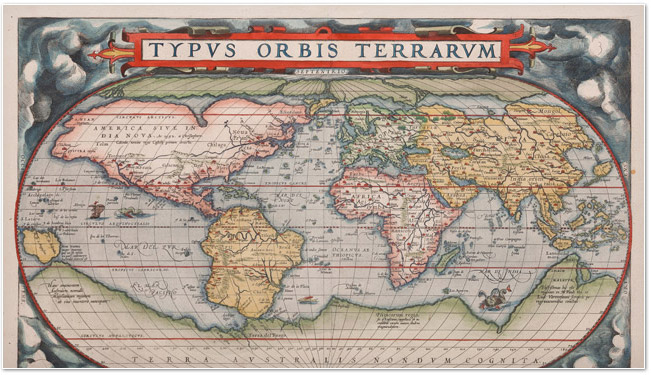
Next up, we have the blank map "Terra Australis" by Morraw:
It is based off this early map of Australia. Why did I like this map? Because I really want to see a timeline involving this map. Someone make it now. There are so many crazy alternate histories that can be made using this super Antarctica. What kind of animals would evolve on this continent? What would the indigenous culture be like? How would it be colonized by the northern hemisphere powers (or would it  be)? I will post it here on The Update if someone writes up a believable scenario. Do it!

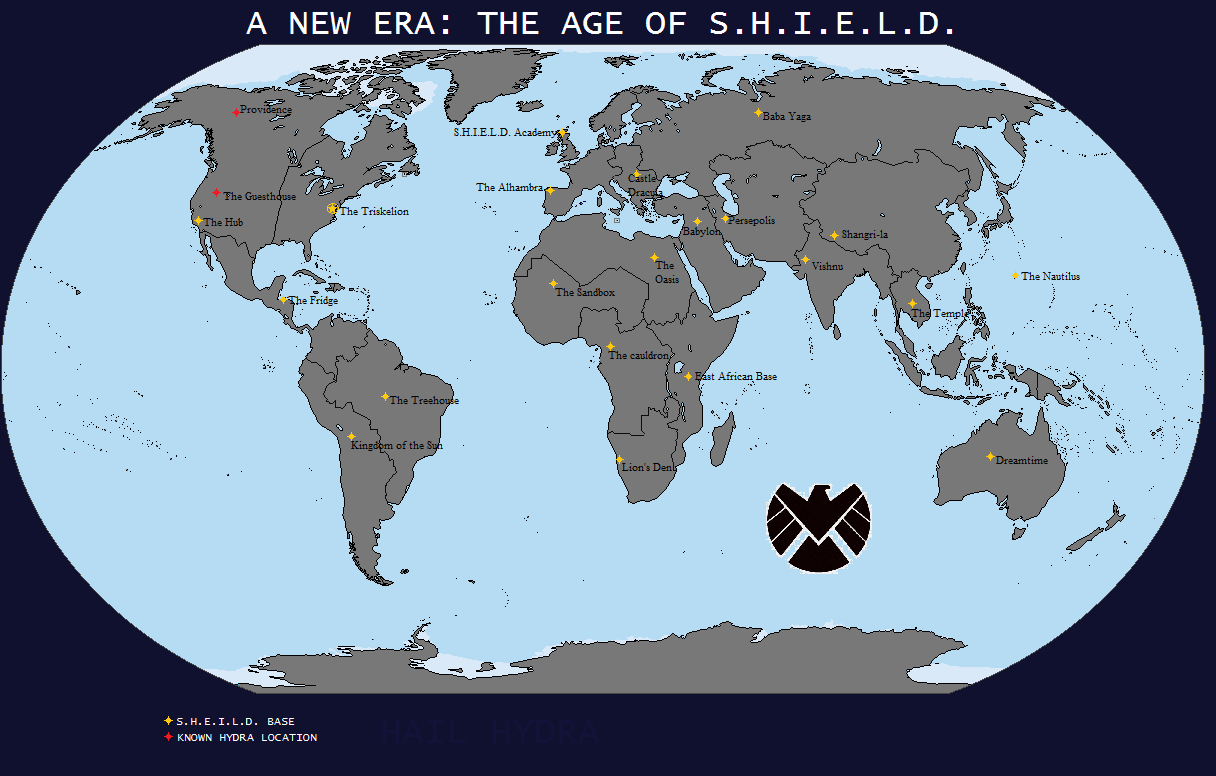
I finish with "A New Era: The Age of S.H.I.E.L.D." by Lost the game:
So what happens if Hydra wins in Captain America: Winter Soldier? Well it might look something like the scenario above. Hydra would probably use the crisis to take over the world, but they would remain under the guise of S.H.I.E.L.D. and blame the millions of dead on agents not under their control. They would also go as far as to call them Hydra, just to rub salt in the wounds. Hail Hydra!

Well thanks guys for loving Map Mondays and reading Alternate History Weekly Update. It is hard to believe I actually managed to write 1000 posts. One of the reasons I started this blog was to practice my writing and I certainly have gotten a lot of practice, although the jury is still out if I have gotten any better. I also want to thank all of the great guest bloggers who contributed to the 1000 posts.

Before I go you might want to check out Matthew Yglesias' 20 maps that never happened at Vox. There are a lot of alternate history maps on that list, some which you have probably seen already, but some that were new even to me. I also should point out that Lynn Davis (a.k.a. PlatoonSgt) has a Patreon page. So if you want to support alternate cartography, you should definitely check it out.

Thanks again guys for supporting the Update. Let's see if we can get to 2000!

* * *

Matt Mitrovich is the founder and editor of Alternate History Weekly Update and a blogger on Amazing Stories. Check out his short fiction. When not writing he works as an attorney, enjoys life with his beautiful wife Alana and prepares for the inevitable zombie apocalypse. You can follow him on Facebook or Twitter.

Monday, September 29, 2014

Weekly Update #162

Editor's Note

My paper on the history of the alternate history fandom is progressing nicely. I finished Evans' Altered Pasts, which I will be reviewing on Amazing Stories tomorrow, and I am wrapping up an interview with Ian Montgomerie. That's right, I will be posting an interview with Ian the Admin, founder of AlternateHistory.com, in the near future so stay tuned.

Also please check Daniel Bensen's podcast on alternate history. Yours truly was the guest and I had a great time speculating with Dan on wide range of topics.

And now the news...

What's Next for Scotland and America's Secessionists?

So Scotland's bid for independent failed, but the debate is far from over. There is the big question on what the British government is going to offer Scotland now that they stayed in the UK, which is being called the "devo-max" option, and how this will effect the rest of the country (consider what happens when England begins demanding their very own regional parliament). As British politicians prepare for future headaches, across the pond, American secessionists have not lost hope that the referendum could kickstart their own bids for independence.

A few days ago I started an informal poll in Alternate History Online asking members which American state or region they thought was the best candidate for independence. As I write this on Sunday night, Texas is in the lead with Hawaii in second and tied for third we have California and New England. Texas being the favorite isn't that far fetched as Annie Lowrey of Slate backs that up in her article on secession. That being said, perhaps we shouldn't be looking at the big states to bring down the Union, but instead focus on smaller states like New Hampshire according to Jason Sorens, founder of Free State Project, said in The Washington Post.

Truth be told, secession in the United States remains far-fetched. I will continue to keep an eye on the subject, however, because I know how much alternate historians like to balkanize the USA.

Outlander Wraps Up the First Half of Season 1

I am trying not to learn too much about Outlander, because I really want to watch the show and don't want anything spoiled. So here is what I will say: the mid-season finale of Outlander premiered last Saturday (catch a sneak peak here) and the show will return next April. Geek Syndicate and io9 had reviews for episode 7, while Paul Levinson and Geek Syndicate again had reviews for episode 8.

Phew! Really quick recap done and no spoilers.

Videos for Alternate Historians

This week in videos we begin with the First Doctor lecturing us about why we can't rewrite history:
Sorry wasn't paying attention. We follow that up with a history of the Metroid franchise done by the guys at The Game Theorists:
We end with Cinema Sins tearing about Captain America: The Winter Soldier:
Yeah not exactly alternate history, but with Cap having his own wing in the Smithsonian, I thought this may slide in just under the wire.

Links to the Multiverse

Books and Short Fiction


The book I read suddenly had an alternate history by Ghost in the Machine at io9.
Excerpt from Clockwork Secrets: Heavy Fire by Dru Pagliassotti - September 27, 2014 at The Qwillery.
Hilary Mantel hits back at critics of her Thatcher assassination short story by Matthew Weaver at The Guardian.
Mysterious Galaxy reading! Venusian Gambit pre-orders! Plus wikipedia! at Michael J. Martinez.
Review: The Boleyn Deceit by Laura Andersen at Writedge.
Review: The Clockwork Dagger by Beth Cato at NPR.
Review: The Golden Princess by S.M. Stirling at Bookworm Blues.
Review: Jani and the Greater Game by Eric Brown at Falcata Times.
Science Fiction Excerpt: Caveat Time Traveler at Scientific America.
Steampunk Fiction and the Women Who Write It by Rachel Cordasco at Book Riot.

Comics

REVIEW: Red Baron Vol. 1 at Geek Syndicate.

Counterfactuals, History and News

The 9 biggest alien invasion hoaxes in history by Evan Hoovler at Blastr.
Cowboys and Kalashnikovs: Comparing the Mexican-American War to the Conflict in Ukraine by Zach Dorfman at National Interest.
Denver area students walk out of school in protest by Colleen Slevin at Yahoo.
Life in the multiverse means endless possibilities at New Scientist.
Steampunk & Disability: Why I Find It’s A Better Fit Than Other Fandoms by M. Sally-Rouge Pax at Steampunk Tourist.
Trench Warfare in World War I Was a Smarter Strategy Than You Realize by George Dvorsky at io9.

Films and Television

8 Things That Prove Star Wars Actually Takes Place In Our Galaxy by Rob Bricken at io9.
The Black Widow Movie That Almost Happened by Gwynne Watkins at Yahoo.
Disney Movies In Order Of Their Historical Setting by Gergo Vas at Kotaku.
REVIEW: Doctor Who, S8, E5: Time Heist and E6: The Caretaker at Geek Syndicate.
Time-Travel Movies Are Garbage by Mike Pearl at Vice.

Games

11 things to think about before starting a time travel plot by David Ball at Ongoing Worlds.
There's A New Total War Game Coming, But Hrm by Luke Plunkett at Kotaku.

Interviews

Stefan Bachmann at Tor.
Alan Gratz at Tor.
Cherie Priest at Tor.

Podcasts

Almost Educational - EP 12: Alternate History Lesson at Podcast Garden.
The SF Signal Podcast (Episode 259): A Discussion of Social Science Fiction at SF Signal.
Show 14 – Four Weeks in the Trenches at Twilight Histories.

* * *

Matt Mitrovich is the founder and editor of Alternate History Weekly Update and a blogger on Amazing Stories. Check out his short fiction. When not writing he works as an attorney, enjoys life with his beautiful wife Alana and prepares for the inevitable zombie apocalypse. You can follow him on Facebook or Twitter.

Friday, February 15, 2013

Alternate History and Superheroes

Guest post by Ben Ronning.

Superheroes and alternate history are two subgenres of science fiction that have always appeared to compliment one another but very few writers ever dared to combine and exploit to its fullest. One reason for this is continuity, the holy grail of all comic book geeks. Ever since the debut of Superman in 1938 and the Fantastic Four in 1961, the Big Two of the comic book industry more or less rely on a floating timeline that prevents their characters from aging (though continuity is far murkier for DC after two major reboots and countless smaller retcons.) Superman could be BFFs with Joseph Kennedy in 1963 then be shaking hands with Ronald Reagan twenty years later without aging a single day. Another reason is because both companies, especially Marvel, pride themselves on verisimilitude by making their universe superficially similar to ours so neither company has fully addressed the social and geopolitical implications of the effective demigods in their midst until recent years with Marvel’s Civil War and DC’s 52.

However, one can consider Marvel’s What If? titles and DC’s Elseworlds line alternate history to some extent. These titles largely centered on the individual histories of their characters like “What if Spider-Man Joined the Fantastic Four?” or “What if Sgt. Nick Fury Fought World War II in Space?” rather than historical events from our world. Some scenarios such as “What if Captain America Were Revived Today?” from What If? (vol. 1) #44 possesses some trappings of alternate history. For example, Namor the Sub-Mariner took a different route when the Avengers pursued him in Avengers (vol. 1)  #4 so he never discovered the group of Inuit who worshiped a frozen Steve Rogers and thus never hurled Captain America into the ocean for the Avengers to find. The Avengers eventually disbanded without Captain America, but more disturbingly, a janitor working at a government facility awakened the mentally unstable 1950s Captain America and Bucky from suspended animation and convinced them that the United States was in danger from subversive elements. As such, the impostor Captain America and Bucky became involved with a political movement that transformed the United States into a police state until a crew of American sailors found the true Cap in the Arctic.

Marvel, aside from a dalliance with a robot Stalin, waited almost twenty years to dip their toe into the alternate history ocean with Neil Gaiman’s 1602. While not technically a What If? issue, the mini-series has a point of divergence (a Captain America from a potential future goes back in time to the failed Roanoke colony and aids in their survival) that causes various Marvel characters to appear nearly four hundred years before they should have. Instead of being the director of S.H.I.E.L.D. Nick Fury is Elizabeth I’s chief intelligence officer whose apprentice is Peter Parquagh, an ersatz version of a nameless friendly neighborhood webslinger. However, one of the more intriguing elements of Marvel 1602 is Gaiman weaved themes from X-Men into late Elizabethan history, particularly James I’s persecution of the “witchbreed” or mutants and how Magneto is ostensibly a grand inquisitor for the Spanish Inquisition but hides his illicit activities behind his position.

This fascination with alternate history continued with the fourth volume of What If? in late 2005. Unlike most issues of the title, which were largely self-contained worlds, this volume of the series took place within in a single timeline where Captain America’s genesis occurs in the American Civil War as opposed to World War II and the Fantastic Four were Russian cosmonauts. Being more of an aficionado of American history, I prefer the Captain America one and appreciate how Cap because more of a physical manifestation of the American spirit during one the nation’s most troubled periods rather than symbol. Because of this Cap’s presence shortens the Civil War, prevents Abraham Lincoln’s assassination, and his origins in Native American mysticism sparked a cultural craze that prevented the Indian Wars of the 1870s. Out of the six What If? (Vol. 4) one-shots, only Captain America and Fantastic Four address the broader strokes of alternate history whereas the other four are more character-focused. Unfortunately, Marvel did not revisit this timeline as they did Marvel 1602, but they are well worth the effort of searching through the odd long box for.

Meanwhile, DC, like their marvelous competition, has only dabbled in the realm of alternate history with its Elseworlds line but there are a few notable examples such as Batman: Holy Terror written by Alan Brennert and illustrated by Norm Breyfogle. The point of divergence for this story is that Oliver Cromwell lived ten years longer and the United States became a totalitarian, theocratic state. While I have never read the issue on account that it has been out of print for over twenty years, a cursory glance of the synopsis on Wikipedia was enough to pique my interest and should do the same for other alternate history enthusiasts. DC’s Tangent imprint, introduced in 1997, operates under a similar premise where there are not only vastly different versions of Superman, the Flash, the Atom, and even obscure characters like the Sea Devils but the presence of superpowered beings radically altered history from what we know. The central premise behind the imprint is that an alternate version of the Atom intervened in the Cuban Missile Crisis, which resulted in the destruction of Florida and Cuba. As such, Atlanta became an underwater city populated by merpeople, their technology advanced further than the mainstream DC Universe, and the hippie movement was in its infancy when the nineties rolled around.

Dan Jurgens, the man who killed Superman and the brain behind Tangent, justified this divergence when he told Comic Book Resources:
“While the DCU Earth is essentially the same as our own, no more advanced in terms of technology or communications despite the existence of those qualities within the super-powered community, Earth Tangent is greatly influenced by all of that. Earth Tangent's economic, geographic and political landscapes are defined by the superhero community, whereas in the DCU those aspects exist unaffected by the superhero community.”
Jurgens brings up an excellent point about a medium that birthed the trope, “Reed Richards is Useless.” Take the Flash’s rogues gallery for example, Captain Cold and his cohorts possess technology that can generate temperatures near absolute zero, alter weather patterns, and even transmute the 118 elements. Why did the scientists and business leaders not reverse engineer the technology after the Central City Police Department confiscated it? The Tangent imprint gives something of a look at such a world and is perhaps a blueprint for how ambitious writers should combine the two genres.

Some could argue that Superman: Red Son is an alternate history and I suppose it is to some extent. The premise is simple enough: baby Kal-L lands in Ukraine in 1938 instead of Kansas. However, my impression of the mini-series is that if it is alternate history, it is about squishy as bag full of marshmallows (or a Type X on Sliding Scale of Alternate History Plausibility.) Its writer, Mark Millar, makes reference to even greater civil unrest in the late 1960s under surviving JFK, a war against communists in the South Pacific in 1983, and a second American Civil War in 1986 without too much elaboration. Granted, there are constraints to the medium but it is clear that the focus is more on Superman as a seemingly benevolent leader of the Soviet Union and his rivalry with Lex Luthor than on the butterflies that a Soviet Man of Steel would create. That is not to say Red Son is not worth reading, it is more fantasy than alternate history.

Watchmen, by Alan Moore and Dave Gibbons, is the mirror image of Red Son in terms of realism and setting. In fact, the world of Watchmen could be a reflection ours until 1938 where the first appearance of Superman in Action Comics #1 inspired a wave of costumed vigilantes, and again in 1959 with the creation of Dr. Manhattan. Alternate history is one portion of Watchmen’s complexity that Moore executes extremely well. Dr. Manhattan essentially gave the United States the strategic advantage in the Cold War and practically won the Vietnam War single-handedly but that also becomes a disadvantage because he is also the lone reason why the Soviet Union stays in check. Hence, Moore makes the consequences of his departure realistic as evidenced by the Soviet invasion of Pakistan and bringing Earth closer to the brink of Nuclear War. However, there are also several other economic and cultural consequences as well. The good doctor’s ability to synthesize lithium allows for the mass production of electric cars, hence reducing the United States’ dependence of foreign petroleum, and the appearance “real” superheroes essentially led to the death of the medium in the late forties so pirate comics like “The Tales of the Black Freighter.” (Though I wonder how Indian fast food became so popular with the American public instead of McDonalds.) Watchmen is practically required reading for all comic book fans, but to read it again from the prism of an alternate historian demonstrates how well the two genres blend.

One of the things I admire about alternate history is that it posed a question Marvel asked when they released a new title in February 1977, “what if?” Personally, I am not as interested in the typical “What if the Axis won World War II?” or “What if the Confederacy won the American Civil War?” as I am interested in smaller events like “What if a more moderate candidate sought the democratic nomination in 1972” or “What if Lucille Ball decided not to sell Desilu Studios to Gulf+Western?” because even the smallest pebble can create many ripples. Marvel 1602, Tangent Comics, and Watchmen demonstrate that alternate history can blend with the fantastic as peanut butter tends to do with chocolate, and they are only the tip of the glacier. In a universe populated by gods, aliens, and immortal cavemen who could alter the flow of history well before the 20th century, the myriad of scenarios to use as story fodder is practically endless. Is there a writer ambitious enough to push this hybrid genre to its creative limits?

Only time will tell.

* * *

Aspiring writer and platypus enthusiast Ben Ronning has lurked the AH.com boards since June 2006. When he is not roaming the multiverse, he can be found at his blog, Thoughts of a Platypus.