Showing posts with label Mark Appleton. Show all posts

Thursday, June 30, 2016

How to Write a Realistic Atompunk Timeline

Guest post by Mark Appleton.

Atompunk is a subgenre of science fiction.   The simplest way to describe it is that atompunk is to Asimov and the 1950's as steampunk is to Verne and the 19th century: a retrofuturism inspired by the dreams and fears of the early Cold War.   Like steampunk, atompunk is not so much about content as it is about style: chrome, jumpsuits, fins, rockets, flying cars, monsters mutated by atomic testing.   The world is powered by atomic energy, computers are the size of houses, and the moon is this year's hot vacation destination.

Unfortunately, atompunk hasn't enjoyed as much success (yet) as its steam-powered cousin.   The quintessential modern exemplar is the Fallout series, and the Venture Brothers cartoons sometimes venture into atompunk territory, but for other examples we mostly have to go back to the '50s and '60s: the novels of Asimov and Heinlein, the Tom Swift Jr. young adult books, and the original Star Trek series.

The common belief is that atompunk is, in retrospect, implausible.   Space travel and atomic energy are a lot harder, and a lot more expensive, then they seemed in 1950s pulp science fiction, and by this point it's pretty clear that Mars is not home to green-skinned space babes eager to meet some Intrepid Explorers.   Technology gave us iPods and the internet instead of moon colonies and atomic cars.

That perception is not totally wrong – radiation causes cancer, not gigantism – but it's not totally right, either.   Something close to the classical atompunk world is not impossible – it's not a likely outcome of the last seventy years of history, but it's not impossible.   And I'm here to tell you how it could have happened, at least in fiction: how to write a technically realistic atompunk timeline.   I'm going to tell you about atomic-powered airplanes, atomic excavation, cheap atomic power, and more about radiation then you ever wanted to know.

Buckle in, folks.

Aesthetics

Let's start with the easy stuff: the look.   Like I said, a lot of atompunk is about style: a car with giant chrome fins and a bubble canopy is pretty atompunk even if it burns gasoline instead of uranium.   And that sort of thing is at the whimsy of trends which could easily have run in an atompunk direction.   Dress everybody up in jumpsuits and goggles, make everything out of aluminum, and periodically pause to stare towards the rising sun with your chin jutting out: this will take you a long way towards your goal.

Also, consider language.   You can capture a lot of style by using deliberately archaic word choices from the 1950s.   A computer is a “logic”.   A satellite is a “sputnik”.   A nuclear-powered submarine or ship is an “A-sub” or “A-ship.”   And don't ever say nuclear: always say “atomic.”   Proper attention to language – making your story sound like it comes from the 1950s – will help a lot to make your reader feel like it's from the 1950s, or at least the future as the 1950s imagined it.

Radiation

But like I said, that's the easy stuff.   Now let's talk about the hard stuff, and let's begin in the obvious place: radiation.   The conventional wisdom is that the discovery of radiation, and the fact that it's bad for you, is why the 747 isn't powered by an atomic engine.   This conventional wisdom is not exactly wrong, but the full truth is a lot more complicated then most people think.

Most of what we know about how radiation effects human health comes from studying the victims of the Hiroshima and Nagasaki bombings.   Because the vast majority of radiation produced by the bombs was produced all at once at a single point, we can calculate how much radiation each victim was exposed to, based on where they were when the bombs went off.   By comparing the radiation exposure to the victims' medical histories, we get a pretty good idea of what happens to someone when they are exposed to a lot of radiation all at once.

For this article, I'm going to use millisieverts (mSv) as the measure of radiation.   In the data from the bombing victims, we begin to see people suffering radiation sickness above 1,000 milliSieverts (mSv) exposure, and we see an increase in cancer risk above 100 mSv exposure, at a rate of about 1% per 100 mSv.   So someone exposed to 300 mSv has a 3% increase in cancer risk, 600 mSv means 6%, etc.   Since roughly the mid-70s, we have assumed that we can extrapolate the risk downwards: so 10 mSv exposure means a 0.1% increase in cancer risk, etcetera.   We have also assumed that the rate of exposure doesn't make a difference to cancer risk: absorbing 100 mSv in a second is the same as absorbing it over a year.    This is based on the simple assumption that cancer risk is caused by DNA damage, and the amount of damage is directly proportional to the amount of ionizing radiation you absorb.   This is called the Linear No-Threshold hypothesis, or LNT.

But we don't actually know that LNT is correct.   Below 100 mSv exposure, we cannot distinguish an increase in cancer risk from the random fluctuations found in any statistical data.   And we know the body does have mechanisms for repairing DNA damage.   There's an alternative hypothesis, usually called Linear Threshold or LT, that there's some threshold of radiation dose where the body can handle the radiation without an increase in your cancer risk.   What the threshold is depends on who you ask, but it's usually estimated at somewhere between 10 mSv and 50 mSv.   And the more time the dose is spread out over, the higher the threshold.

The reason this matters is that, in a radiation accident like Chernobyl or Fukushima, the vast majority of victims will be exposed to very small doses of radiation spread out over a very long period of time.   In a reactor accident, very few people will be exposed to a radiation dose of more than 50 mSv, and it will be delivered over weeks or months.   Even under the LNT hypothesis, the individual risk is very low – but many thousands or millions of people will be exposed to that risk.   If you expose a million people to a 10 mSv dose, and the LNT hypothesis is correct, then 1,000,000 times 0.1% equals 1,000 people will get cancer, and about half will die of it.   That's why atomic technology is regulated so tightly – the individual risks are very small, but the collective risks can be very large.

But this assumes LNT is correct. If the LT hypothesis is right, and you expose a million people to 10 mSv of radiation, then the result will be: absolutely nothing.   But, right now, there's really no way to tell which hypothesis is correct.   There are no reliable studies of how many people died as a result of Chernobyl or Fukushima based on actual death statistics – the numbers thrown around are based on estimating radiation doses, and then using your choice of hypothesis to translate those doses into numbers of deaths.   Except for a small number of people at Chernobyl who worked in the reactor zone itself and were exposed to massive radiation doses, the variations in cancer incidence are so small that epidemiologists cannot distinguish them from random noise.   That doesn't mean that Fukushima or Chernobyl didn't kill people, just that – except for those few at Chernobyl – we can't prove that they did.   The only real hope of definitively resolving the controversy is by developing a better understanding of cellular biology, of how DNA damage and repair works in the body, and that is not going to happen in the near future.

In the meantime, Western regulatory agencies are sticking with the LNT hypothesis out of an abundance of caution.   And, in the real world, I think that is the right decision.   If we regulate based on LNT, and we're wrong, then we've wasted a lot of money.   If we regulate based on LT, and we're wrong, then people die.

But we're not talking about the real world.   We're talking about fiction.   In fiction, we can make whatever assumptions we want.   And if we assume the LT hypothesis is true, then a reactor meltdown is just an industrial accident – it's not a good thing, but it's no worse then any other accident involving toxic chemicals.   And this is the key to making an atompunk world possible.

And a lot of the wild atomic technology imagined in the '50s really is viable if we make that assumption.   Electricity from fission really can be cheap.   Atomic-powered airplanes and spaceships really can be safe and practical.   We really can dig canals with hydrogen bombs.   Some things still aren't feasible, and there are still question marks attached to some of these ideas that have nothing to do with safety or economics.   But a lot of seemingly crazy things suddenly become good ideas.

The A-Plane

The first of these technologies I'd like to talk about is the atomic-powered airplane, which is even cooler then it sounds.   I'm going to call it the A-plane, by analogy to the A-bomb, because I think it sounds cooler that way.   Even in our own world, the Aircraft Nuclear Propulsion (ANP) program was an enormous undertaking.   It lasted fifteen years, from 1946 to 1961, and cost the equivalent of about $20 billion in today's money.   The goal was to build an atomic-powered bomber, able to remain aloft for weeks.

Today, at first glance, the idea seems insane.   What if the thing crashes?   But this is where the distinction between LNT and LT comes in.   Under the LT hypothesis, if an A-plane crashes, only the immediate area around the crash site is going to have to worry about radioactive contamination.   Again, under the LT hypothesis, a radiation accident is just an industrial accident like any other: not good, but not a major catastrophe.   And since, in the '50s, the atomic energy community was tacitly or explicitly operating under the LT hypothesis, that's why they were willing to pursue this concept.
The Air Force and Atomic Energy Commission studied two approaches: the direct cycle, in which air from the jet intake passes directly through the reactor, and the indirect cycle, in which heat from the reactor is carried by molten metal or pressurized gas to a heat exchange in the jet.   The direct cycle had the advantage of relative simplicity, and came closest to flying – several prototype direct-cycle turbojets were static-tested at the National Reactor Test Station in Idaho.   The indirect cycle had the potential for higher performance: a sodium- or gas-cooled reactor could be smaller then an air-cooled reactor, and therefore have a higher thrust/weight ratio.

And the thrust/weight ratio was very important.   One of the big problems with the ANP program was that, even if you count the fuel in a conventional turbojet as part of the “engine”, an atomic engine is usually going to weigh more then a conventional engine and produce less thrust.   By the end of the program, ANP knew how to build an atomic-powered airplane, but that airplane would have been big, expensive, and slow – not what you'd want penetrating Soviet airspace.   A big part of the problem was that the Air Force could never make up its mind whether or not they really wanted the plane – they were perpetually ramping up and cutting back funding, shifting into crash priority mode and then downscaling to feasibility studies.
But, while the A-plane wouldn't make a good bomber, there are other roles it could be very effective in.   For example, an A-plane could be a very effective missile carrier: it could remain airborne for long periods, and therefore immune to a Soviet first strike, and launch its payload from outside of Soviet airspace.   After the initial exchange, it could also perform follow-up reconnaissance and strikes, after the fuel supplies of conventional aircraft had been exhausted.   ANP engineers did suggest this idea during the program, which they called the CAMAL – a rather awkward acronym allegedly standing for “Continuous Airborne Alert Missile Launcher and Low-Level Penetration Airplane”.   But the Pentagon wasn't interested.

Let's suppose that the Pentagon provides reliable support for the A-plane instead of our own timeline's oscillation.   This could be accomplished by just changing Eisenhower's Secretary of Defense – part of the problem for the program historically was that Secretary Quarles thought the whole idea was absurd.   The really interesting part is not what could be built in the 1950s, but where this would push airplane technology in the '60s and '70s.

The thrust/weight ratio of an atomic engine improves – a lot – as the weight of the airplane increases.   A heavier airplane needs a more powerful engine.   The power of an atomic engine is proportional to its volume.   But the weight of that engine is dominated by the weight of its radiation shielding, which is proportional to its surface area.   And the ratio of surface area to volume decreases as the volume increases – so the thrust/weight ratio improves as the engine gets bigger.   For a big enough plane, the thrust/weight ratio of an atomic engine is better then a conventional engine.

How big?   That depends a lot on the specifics of your reactor.   But we're typically talking about a plane north of a million pounds takeoff weight, and the bigger the better.   NASA studies in the '60s and '70s envisioned civilian A-planes of ten to twenty million pounds takeoff weight.   The heaviest plane that has ever flown in our world, the Antonov An-225 Mriya, has a maximum takeoff weight of about 1.4 million pounds.   So these are enormous aircraft – but for us, that's an asset, not a liability.   Imagine a monster flying wing, thirty times the size of the 747 – big enough to carry a Saturn-V rocket – slowly cruising past the sunset.   Lockheed, at one point, floated the idea of an atomic-powered flying aircraft carrier based on this concept.   How much cooler can you get?
And it's not just about style.   We can't really accurately estimate the cost of machines so distant from anything we've built historically, airplanes big enough that we'd have to rebuild most of the nation's airports to handle them.   But the NASA studies claimed that, in the ten to twenty million pound region, these monster machines could transport cargo at a cost competitive not just with conventional aircraft, but with trucks.   Even if they don't reach that mark, they could mean a world where vastly more of our cargo travels by air, where our entire economy is oriented around air transport instead of highways.

But where things get really interesting is when we start looking at what we could do with an atomic turbojet on the ground.

Too Cheap to Meter

The original “too cheap to meter” comment was actually talking about fusion, not fission, but it's too iconic a comment to pass up.

Historically, the cost of atomic energy has been, at best, disappointing.   Even in places where atomic energy is competitive with coal and gas, it's only competitive.   It was supposed to mark a new industrial revolution, where cheap energy would make all manner of new goods and services possible.   Maybe we can't get quite that far, but we can get a lot closer then we did.

To begin with, let's talk a little bit about the history of atomic energy.   The vast majority of the atomic reactors in the West evolved from reactors developed to power submarines, called Light Water Reactors, or LWRs.   These reactors use solid fuel elements made of enriched uranium oxide ceramic, cooled and moderated by pressurized water, with the heat turned into electricity in a steam turbine.   These designs were chosen for for two reasons: first, because they're (relatively) simple, and second, because they could piggy-back off of the enormous amount of research that had already been done on these designs for submarines.

But, in retrospect, these weren't necessarily the best kind of reactor we could have chosen to use to make electricity.   There are a lot of ways to split an atom; I once tried to make a list of all of the seriously proposed types, and stopped after I hit forty.   To illustrate, let's break our reactors down on fuel type, coolant, and moderator – a vast over-simplification if ever there was one:


Fuel
Coolant
Moderator
Uranium Oxide Ceramic
Water
Solid Metal Alloy
Heavy Water
Carbide or Nitride Ceramic
Carbon dioxide
Unmoderated
Molten Metal Alloys
Helium
Graphite
Molten Fluoride Salts
Molten sodium
Metallic Beryllium
Molten Chloride Salts
Molten lead
Beryllia Ceramic
Uranium Hexafluoride Gas
Hydrocarbons
Sulfate Salts Dissolved in Water
Molten Salts
Uranium Plasma
Molten Sulfur


We could also break it down on how we turn the heat into electricity: if we use a steam turbine, gas turbine, or something more exotic, like direct energy conversion or a reciprocating engine.   We can also break it down on whether we use uranium or a breeding cycle like uranium/plutonium or thorium/uranium.   And a lot of those entries could be split up further – there's a big difference, for example, between the highly dilute uranium fuel alloy of Brookhaven's Liquid Metal Fueled Reactor concept, and the concentrated plutonium alloy of the Los Alamos Molten Plutonium Reactor Experiment.   There are many, many ways to split an atom.

A lot of these proposals can be discarded because, in retrospect, they were clearly bad ideas.   But many of them might have been good ideas, possibly better ideas then the LWRs we ended up building.   But it takes a lot of money to turn a reactor concept into a working prototype, and then even more money to turn a prototype into a design that can be rolled out commercially.   And that money just wasn't there for most of these proposals – as I mentioned, a big part of why the LWR became the dominant reactor type was because a huge amount of money had already been spent by the Navy.   For the followup to the LWR, the US Atomic Energy Commission chose the liquid-metal-cooled fast breeder reactor (LMFBR), and the cost of trying to build a commercial LMFBR prototype led to the cancellation of their other reactor research programs.   But the LMFBR was a massive flop – far too expensive to compete, and with questionable safety characteristics (the coolant is flammable).   When congress finally killed the LMFBR in the '80s, research into other alternatives was already long dead in the United States, it has only recently begun to tentatively revive.

But we were just talking about the A-plane.   If A-planes fly, then a second class of reactors is going to get that same kind of development subsidy, this time from the Air Force.   A direct-cycle atomic engine could be used as the basis for a gas-cooled power reactor, and in the long run, such a machine could have significant advantages over a light water reactor.   Power from these reactors probably wouldn't be “too cheap to meter”, but, between lighter radiation regulations and a better base reactor technology, they could be much cheaper then the LWRs we have today – cheap enough to out-compete coal and gas.

And that has its own implications, most of which are beyond the scope of this essay.   To mention a few, though: cheap electricity means cheap plastic trinkets are replaced with cheap aluminum trinkets.   Large-scale desalination is feasible as a solution to water shortages.   Carbon emissions are radically lower – we'd still burn gasoline in our cars, but we would see natural gas drastically decline, and coal perhaps eliminated altogether.   Cheap, clean energy would have enormous, and to some extent unforeseeable, implications.

The Atomic Shovel
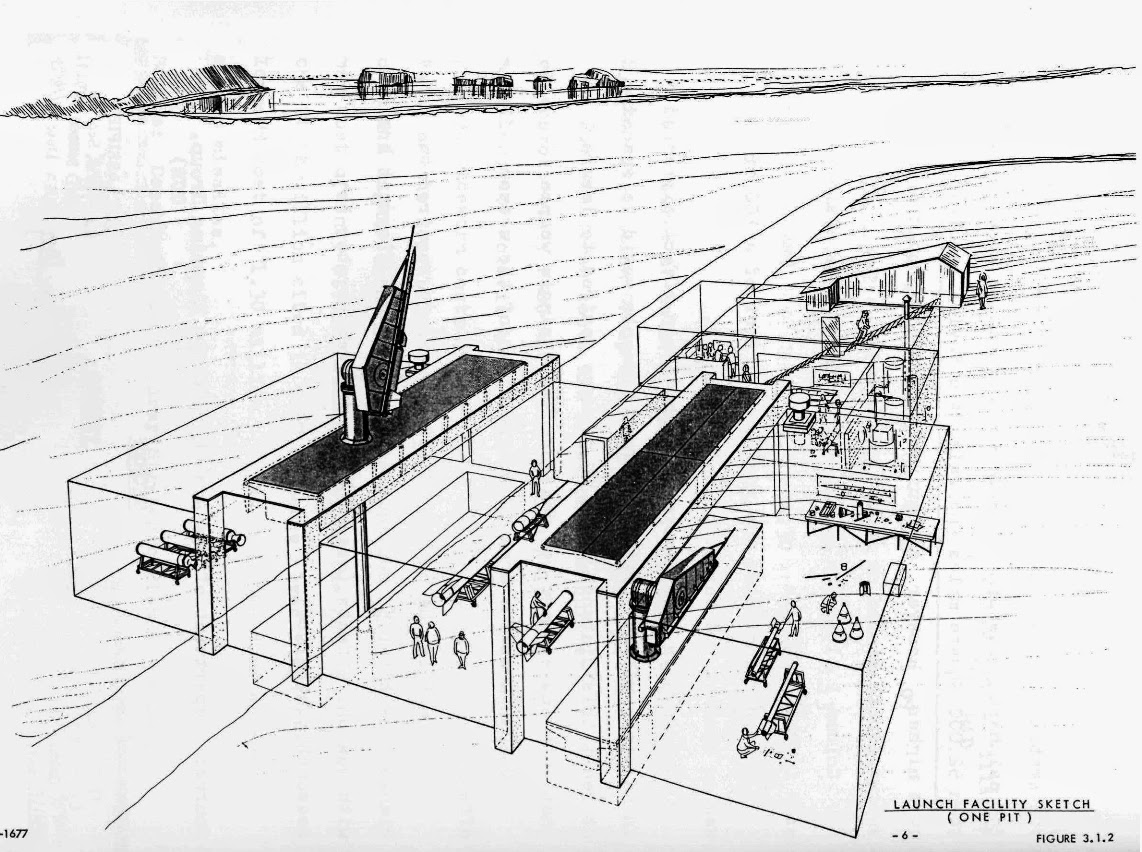
Like the atomic-powered airplane, Project Plowshare was a massive program in its day that, now, is largely forgotten.   Running from roughly 1958 to 1975, its aim was to find peaceful uses for atomic explosives.   Plowshare looked at a lot of possibilities – they actually set off more bombs for peaceful scientific research than for any other purpose, a fact which even most historians of the program overlook – but it is mostly known, then and now, for its plans for “geographical engineering”: earth-moving on a massive scale.   Edward Teller, the project's foremost backer, joked that “if your mountain is not in the right place, drop us a card.”   Plowshare engineers hoped to use atomic explosives to excavate harbors, mountain passes, mines, and, most famously, canals – for much of the project's life, its primary justification was to dig a new, sea-level “Pan-Atomic” Canal to replace the too-narrow Panama Canal.

Frankly, even in a world where radiation isn't a big deal, it's not at all clear that atomic geographical engineering is practical.   There are two main issues.   The first is economic: even in a world using the Linear Threshold hypothesis, an area where atomic excavation is being used is going to have to be evacuated for about two years until the initial radiation dies down.   Plus, ground shock means that any buildings in the area will suffer serious structural damage.   These two facts mean that you can't use atomic excavation anywhere near where lots of people live – but if not many people live there, what's your new canal for?   There are a few places where it might make sense – such as excavating harbors for mines in remote locations – but it's unclear if there are enough such places to justify the cost of developing the technology in the first place.
But, let's assume this issue can be overcome.   The Russians apparently overcame it in our own world.   Their equivalent of Plowshare continued until they ended nuclear testing in 1990, and they apparently found it economically useful, though they primarily used it for less-glamorous tasks like deep seismic sounding, excavating underground storage tanks, and stimulating oil and gas production.   So it's not impossible that this could make economic sense.

A more subtle problem, but in the long run more dangerous, is proliferation.   If the United States is using atomic devices for excavation, it becomes much more difficult to tell other countries that they can't have them.   Even in our own timeline, this was a serious problem – India, for example, initially insisted that its first atomic test was for peaceful purposes, and the Nuclear Non-Proliferation Treaty includes a clause guaranteeing that the weapons states will provide “peaceful nuclear explosives” to non-nuclear states on request.

But states aren't the only problem.   We're talking about building and detonating dozens – perhaps hundreds – of atomic explosives per year, and shipping them all over the world for industrial use.   I would be concerned about one of them disappearing, and then reappearing inside a crowded city.   Now, the NATO militaries – and probably the Russians – did keep large numbers of tactical nuclear weapons in relatively insecure facilities for decades without losing any (that we know of), but it seems like pushing one's luck.

Project Orion

I'm going to keep this section brief, because Project Orion is one of the few historical atompunk concepts that is fairly well-known.   For those who haven't heard of it, Orion would have used atomic bombs to launch spacecraft.

An Orion spaceship would consist of a gigantic metal plate.   Atomic bombs would be dropped through a hole in the plate and detonate underneath, and the shockwave would push the ship forward.

On paper, such a ship is an extremely efficient way both to launch material from Earth into space, and to move it around in space once it gets there.   In fact, in a purely technical sense, it is by far the best space drive by almost any measure that could be built with present technology.   A single Orion launch could lift thousands of tons of cargo into orbit at a low cost per kilogram, and, once in orbit, could carry it to anywhere in the solar system.   A world using Orion drives would have had a manned expedition to Mars by now at the very least.

In our world, Orion was killed by the Partial Test-Ban Treaty of 1963, which effectively prohibits atomic detonations in the air or in space.   The PTBT was primarily driven by concerns over the health effects of atomic testing, so in a world using the LT hypothesis, it will not be signed – and it is quite possible that Orion will fly.

That said, I would like to point out that there are still a number of unanswered questions about Orion's technical feasibility, particularly regarding whether the energy from the explosions can be properly directed, whether the pusher-plate will hold up to repeated detonations, and just how much all this will cost.   Still, compared to the other assumptions we've made, these are relatively small, and the technical hurdles for Orion are no worse than for any other proposed way to get into space for dollars per kilogram.

What We Can't Do

So what parts of the atompunk dream aren't possible, at least not in the 20th century?

Well, atomic-powered cars are definitely Not Happening.   It might just be barely theoretically possible to build a reactor small enough to power a car – maybe – but it definitely couldn't be built at a price anyone could afford, even a billionaire.   And you'd have to fuel it with weapons-grade fuel, which the government would presumably frown on.   So that's not going to happen.
Atomic-powered locomotives are technologically possible, barely, but they're unlikely to make economic sense even under the best possible assumptions.   Miniaturized reactors small enough to run a train could probably be built, but it's unlikely they could compete on cost with building the reactor by the side of the track and electrifying the line.

The traditional nuclear thermal rocket probably isn't practical either.   A nuclear thermal rocket (NTR) uses a nuclear reactor to heat a fluid – usually hydrogen – which is then used as exhaust.   Unlike an Orion, which looks like a gigantic plate on top of an explosion, an NTR would look like a “classical” rocket like the Saturn-V.   Like the A-plane, NTRs were the focus of a major AEC/NASA research effort in the '60s that is now largely forgotten.   However, Orion drives outperform nuclear thermal rockets on every metric.   If you take Orion off the table, it is theoretically possible to build a nuclear thermal rocket with a thrust/weight ratio high enough for Earth launch, but it requires either liquid oxygen augmentation – which eliminates almost all of the efficiency advantage – or materials that don't exist today, and probably won't exist in this half of the 21st century.   The most we might see would be a nuclear-powered upper stage with a conventional lower stage, like the TIMBERWIND proposal in the 1980s, but it's tough to make that make sense economically.   Even once you reach orbit, nuclear thermal rockets might have a niche, but it won't be a big one – nuclear- or solar-powered ion drives can do most of the same things, but better.   So, all in all, it's tough to see them finding a role to play.   Which is a shame, because I really prefer the aesthetics of the nuclear rocket to the Orion – a gleaming, needle-nosed rocket is such a classic atompunk motif.

Concluding Remarks

I hope that this essay has sparked some ideas.   Before I leave you, though, I'd like to call back to something I mentioned at the start.

The Linear Threshold hypothesis really might be true.   We don't know and we can't know right now, but scientists continue to work on understanding how ionizing radiation effects human cells.   And someday, we may finally figure it out, we may prove one of these dueling hypotheses.   And the right answer might turn out to be the Linear Threshold hypothesis.

We may wake up one morning, turn on the internet, skim through the science news – and discover that quietly, subtly, the world has changed.   That a lot of regulations we thought were necessary really weren't.   That atomic energy really can be cheap, and that Orion ships really can be built without killing people.   That we really can have the world our parents dreamed of.

This isn't just alternate history.   It's a possible future.

So keep an eye on the science news.   Because you never know.

* * *

Mark J. Appleton blogs on atompunk history at Atomic Skies.

Monday, March 23, 2015

Alternate Nuclear Wars

Guest post by Mark Appleton.
The Cold War going hot is one of the classic alternate histories, behind only the Nazis winning World War II and the CSA winning the Civil War.  Piles and piles of books were written between 1945 and 1992, back when it was future history instead of alternate history, and the influx hasn't ended with the fall of the Soviet Union.  Most of these books follow a common formula, at least for the war itself: a thirty-minute mutual suicide.

Now, I'm not saying that that is an inaccurate depiction of a nuclear war (though most of these books get a lot of the details wrong, especially about how radiation works), but it's not necessarily accurate, either. If you dig through the old strategic literature of the Cold War, you can find a remarkable panorama of ideas about how to fight, survive, and even win a nuclear conflict.

I've compiled a list of some of the more interesting beliefs about what a nuclear war would look like.   These have all been seriously proposed at various times, by well-informed, intelligent people. That doesn't mean I personally believe they're plausible, but these concepts were put forth by strategists who devoted far more of their lives to thinking about this problem than either you or I have. They might be right and they're certainly interesting.

The Nuclear Blitz

This one is already fairly well-known within the alternate history community, although it's still obscure in the wider culture. This was the US Strategic Air Command's war plan through the 1950s: an overwhelming nuclear attack on all aspects of Soviet society, to both destroy both their economy and their ability to retaliate.

For most of the 1950s, the Soviets had very few aircraft able to carry atomic bombs across intercontinental distances. A US surprise attack would have a good chance of wiping out most or all of these aircraft. This is part of why Curtis LeMay and other American generals were so bellicose during the Cuban Missile Crisis – they believed a war with the Soviet Union was inevitable, and wanted to fight it while the US could still win it. A nuclear blitz, if it worked, would be a genuine victory for the United States. The US would likely not get off completely scot-free, especially later in the 1950s, but probably only a few cities and military bases would be lost – “only” a few million American citizens killed. It would be a genuine, if costly, American victory.

The world afterwards would resemble the world after World War II, only on a far greater, more terrible scale, and without the Soviet Union as a threat to unify the Western nations. It's difficult to imagine NATO occupying more than a token patch of the Soviet Union and China. At the same time, they could not allow any government to emerge there that might pose a future threat to the West, and with the nuclear taboo permanently broken, I expect that Strategic Air Command would be kept busy after the war “policing” the shattered remains of the Communist bloc. While the US would win the war, it's hard to see how they could win the peace.

Disarming First Strike

Over time, the nuclear blitz evolved into the disarming first strike. The idea is simple: the only rational goal in a nuclear war is to minimize the number of nuclear weapons that fall on your own people. Murdering your enemy's civilians does not benefit you in any way; but destroying his bomber bases, missile silos, and submarines keeps him from using them against your civilians.   In fact, surviving enemy civilians are an asset: you will probably not succeed in destroying all of your enemy's nuclear weapons, but you can hold his surviving people hostage to demand a surrender, promising to spare them if he refrains from firing his remaining weapons. Although the most notorious proponent of the concept was Herman Kahn, the disarming first strike is a concept found in the works of many nuclear strategists.

After the mid-1960s, the Soviet nuclear arsenal was big enough that an American disarming strike would be unlikely to succeed – but that's not quite the same thing as impossible. Supposedly, in the late 1970s the US discovered a critical vulnerability in the Soviet strategic communications network, which would allow the US to disable their communications long enough to execute a first strike. The possibility was studied in the 1980s by a small group under the Joint Chiefs of Staff, under the code name CANOPY WING. A copy of the study found its way to the Soviets via East Germany, and the flaw was fixed. I said this “supposedly” happened because our only source of information on CANOPY WING is documents from East German intelligence, leaked after the fall of the Berlin Wall via memoirs of East German intelligence officers trying to justify their careers, so it's possible the story is a hoax – but it does seem to be taken seriously by historians.

Skipping over the problems with any attempt to keep a nuclear war “limited”, let's assume that Russia or the US launches a successful disarming first strike against the other. What does the world look like afterwards? While fallout would kill many people – the usual estimates are in the millions – the number of dead would be comparable to World War II in the Soviet Union. After a few years the radiation would die down enough that the contaminated farmland could be used again. So the world would have gotten away with relatively little damage, compared to what could have happened.

Perhaps that would inspire a great revulsion against nuclear weapons and a determination to rid the world of the menace – but I doubt it. The losing side in the nuclear war would have suffered enormous casualties and lost tremendous power and prestige – but in a limited nuclear war, “surrender” would mean giving up on the issue at hand and making concessions. The loser would still have too many weapons left for the winner to demand unconditional capitulation. Instead they would have to be left alone to nurse their wounded pride, and dream of revenge. The Cold War would resume the day after World War III ended, and with it the arms race – but, this time, one party would no longer be content with detente or peaceful coexistence. A disarming first strike would most likely set up a World War IV a few decades down the road, just as World War I set up World War II.

Protracted Nuclear War

The protracted nuclear war is an extension of the logic of the disarming first strike. By the 1970s, both sides had arsenals big enough that, even after absorbing a first strike, the victim would still have enough weapons left to destroy the attacker. But, the logic continues: the victim gains nothing from retaliating against the attacker's civilians. Would it not be more rational for him to launch a disarming strike of his own?  This back-and-forth might continue for a long time – months, perhaps even years – as each side slowly used up its arsenal. Eventually, one party would run out of weapons, and concede. That's the idea, anyway. Protracted nuclear wars have actually been portrayed in fiction a few times – it's the premise of David Mace's Fire Lance, and is part of the background of John Varley's Gaea trilogy.

I have a hard time believing that any prohibition on hitting cities would last. Actually, I think it offers one of the few visions of Armageddon that is worse than a thirty-minute mutual suicide: a nuclear war that does not end. Nuclear strategy is premised on the rationality of the decision-makers, but after years of apocalypse, would the goal still be negotiating a favorable peace – or would it be to finally destroy whatever is left of the enemy? There might never be a formal end to the war, an official ceasefire – instead it would slowly stutter to a halt as the stockpiles are exhausted, the shattered survivors never knowing if that was really the last weapon or if tomorrow destruction will visit them once again.

Tit-for-Tat War

The tit-for-tat war is a different version of a lengthy nuclear war. In the protracted nuclear war, the goal is to destroy the enemy's weapons. In the tit-for-tat war, the goal is to destroy their resolve, by the careful, precise destruction of cities, one at a time.

Conceivably, the war might be relatively bloodless. There's no reason to not give fair warning before the strike, to give the enemy time to evacuate: killing people would only harden his determination.   So issue an ultimatum, allow a week to clear the city, then nuke it. Repeat until someone concedes.

It's hard to imagine anyone being happy with the conclusion of a tit-for-tat war. The losers would have lost both cities and the war. The winners might have won the war, but I doubt they would view Berlin, or whatever else was at stake, as worth the loss of New York, Los Angeles and Dallas – or Moscow, Leningrad and Minsk. Both governments would probably end up overthrown, either by the military or the populace.

Catalytic Nuclear War

As I've said before, the only rational goal in a nuclear war is to keep your enemy's nuclear warheads from landing on your soil. The best way to do that is to get your enemy to shoot them at someone else. A catalytic nuclear war is a war between two powers started by a nominally neutral third power, who has launched an attack on one or both of the belligerents designed to appear as if it came from the other. The first two powers then destroy each other, leaving the third power to inherit the Earth. The concept has been portrayed in a number of works of fiction, including Tom Clancy's Sum of All Fears and Peter George's Commander-1. Kenneth Sewell, in Red Star Rogue, claimed this actually almost happened with the Soviet submarine K-129, with rogue KGB operatives trying to trigger a US-China nuclear exchange, though that book could charitably be described as implausible.

This is trickier to pull off than novels sometimes make it seem. You can't just nuke Moscow and Washington and assume they'll launch on each other, but aside from that, a state that is both powerful enough and antagonistic enough to try to do something like this is probably going to be hit in the exchange as well and even if they aren't, congratulations: you get to rule over a bombed-out, glowing ruin of a world. Have fun with that.

Preemptive Surrender

You're in a nuclear war. As a good nuclear strategist, your goal is to minimize the number of nuclear strikes on your country. Whatever weapons your enemy has already launched cannot be recalled.   There's nothing that can be done about them now; your concern is how to keep his remaining weapons on the ground. The best way to do that is to surrender.

This is about the only way I can imagine something like the classic “USSR occupies the US” situation happening – an American president deciding to surrender rather than fight a nuclear war. Any such occupation would be little more than a token in practical terms, given the size of the US, and I doubt it would end any better for the occupier than it does in the many books on the subject.

Conclusion

I actually have quite a few more than this – Mutually Really Assured Destruction, Defensive Advantage, the Nuclear Coup – but I think this is long enough. The permutations of nuclear strategy are virtually endless, especially if you expand your vision to encompass conflicts between state and non-state actors, or between elements of a single state.

What I'm hoping you'll take away from this isn't that a tit-for-tat war or a preemptive surrender is likely. They aren't. In particular, most of these concepts rely heavily on the twin assumptions that political leaders will continue to be rational and able to effectively command their military forces even in the midst of a nuclear holocaust, which, bluntly, they probably wouldn't.

My point, rather, is that we don't know what would happen in a nuclear war. The fact that so many very intelligent people could propose such wildly different visions for how a nuclear war would unfold is evidence for that. I don't really know that presidents and premiers wouldn't think with ice-cold logic even as their people are cut down by the millions. No one in the history of the world has ever been in that position, so we can't truly know how they would respond.

Nevertheless, that is one of the least of the uncertainties. We don't know how reliable or accurate the missiles really are. We don't know how military officers controlling nuclear weapons would react if they were cut off from higher orders. We don't know how the civilian population would react. We don't know what the real targeting plans are. We don't know how bad nuclear winter would be. We don't know how bad the EMP effects would be. We don't know how bad the damage to the ozone layer would be. We don't know if there would be enough industrial base left to piece together a working economy afterwards.

There are so many things we don't know about this vitally important subject, so many things we can't know. All we can really say for sure is that a nuclear war would be the greatest disaster in the history of the human race, a step into an abyss whose true depth we cannot now fathom. Some would argue that it doesn't really matter as long as it doesn't happen, and, well, they have a point, but as long as these weapons continue to exist – and they show no signs of evaporating – there will remain a risk that they will be used. If we are to think rationally about nuclear weapons and nuclear war, we need to realize the gaps in our knowledge.

Also, on a lighter note, these ideas are interesting in and of themselves, and I hope they'll spark some entertaining thoughts among the readers. A tit-for-tat war or a preemptive surrender is possible even if it's unlikely, and they're fertile material for fiction.

Finally, if you want to see my personal hunch for what a nuclear war would look like, read "Protect & Survive". Not only is it magnificently well-written, but it is as realistic as any story of an event that never happened can be, which is all we can really ask for.

* * *

Mark J. Appleton blogs on atompunk history at Atomic Skies.

Wednesday, April 9, 2014

Atomic Machines: An Atompunk Sampler Part 2

Guest post by Mark J. Appleton. Check out Part 1.

I present, for your reading pleasure, further excerpts from the stranger side of atomic history.

Project A119
What: A top-secret proposal by the US Air Force to drop an atomic bomb on the moon – specifically, a 1.7-kiloton W25 warhead.   Allegedly, the regolith thrown up by the blast would provide insights into lunar geology, but mostly the Air Force wanted to do something to respond to the Sputnik launch and show the US wasn't going to be left behind in the Space Race.

When: May 1958 through January 1959.

How Far: A119 never left paper, although most of the components for the project were being developed anyway for other programs.

Why Not: At some point, someone realized that while nuking the moon is impressive, it's not necessarily the sort of impression you want to make.

How It Could Happen: It probably couldn't, but if for some reason the US government suffered a fit of collective insanity, it would certainly be technically feasible by the early 60's at the latest.   Alternatively, if you're willing to take a somewhat broader view, the Plowshare program did briefly investigate using underground nuclear explosions to extract water from the lunar regolith, as Project MOSES.

Further ReadingUS planned one big nuclear blast for mankind.

Nuclear Hurricane Steering
What: Detonating twenty-megaton hydrogen-bombs in the eyes of hurricanes, so that the heat would loft air into the upper atmosphere, reducing the hurricane's power. Yes, really. Preliminary calculations by Dr. Jack W. Reed of Sandia Laboratory suggested that one bomb could slow a 150-knot hurricane to 120 knots, and a 100-knot hurricane to 50 knots.
When: Dr. Reed first proposed the idea in 1956, and continued pushing it until 1961.   Shortly afterwards the signing of the Partial Test Ban Treaty made it illegal.

How Far: Some very low-level theoretical work was done, but no real work on hardware.

Why Not: Even in the 1950s, modifying the weather with hydrogen bombs was a little too Buck Rogers-ish to be taken seriously.

How It Could Happen: It's not clear if this would actually work (although as of 2004 Dr. Reed still believed it would). But a world that had already embraced the other Plowshare programs for nuclear earth-moving and resource extraction might give this a go as well.

Further Reading: Nuking Hurricanes.

The X-12 Atomic Locomotive
What: A nuclear-powered locomotive. The X-12 was a class project for a group of nuclear physicists at the University of Utah, under the instruction of Prof. Lyle Borst, a Manhattan Project alum. It would be powered by a 6 MWe aqueous homogenous reactor, running on weapons-grade uranium and producing 7,000 horsepower, and would need a separate radiator car to dispose of waste heat. Massing 720,000 lbs., at the time it would have been the fifth biggest locomotive ever built, and the third most powerful.
When: The class was held in 1953 and the results published in 1954. Articles appeared on the concept in Life, Popular Science, and other major magazines.

How Far: Borst took out a patent for the proposal in 1955, and claimed Babcock & Wilcox were interested in developing the concept, but it never seems to have gone any further.

Why Not: The class's economic analysis claimed that a nuclear-powered locomotive could be competitive with diesels, but pretty much no one else agreed with them. A more plausible estimate by a railway engineer, Bruce Gunnel, in 1955, concluded an atomic engine would be about two and a half times as expensive as a diesel to operate, even without taking into account safety and liability issues – even the engineers of the 1950's were uncomfortable with the thought of nuclear trains cruising the railways of Middle America.

How It Could Happen: The atomic locomotive is most cost-effective over very long routes, preferably through barren regions. It also helps if diesel fuel is very, very expensive. That's a mix that's not likely to happen historically, but might in a post-apocalyptic future or an alternate world. Alternatively, in 1955 Senator John Butler proposed that the Atomic Energy Commission build a nuclear-powered “freedom train” as a public relations exercise, a locomotive equivalent of the NS Savannah nuclear-powered merchant ship; that's unlikely to lead to widespread use of the technology, but it might conceivably be built as a one-off demonstration.

Further ReadingTo Peoria by Atom.

The Nuclear-Powered Swimsuit
What: It's technically not nuclear-powered, nor a swimsuit, but that sounds better than a “radiothermally heated wetsuit”. The suit had a network of small tubes woven through it, connected to a small capsule worn on the diver's back.   Ocean water would be heated by the radioactive decay of a small charge of plutonium-238 – this is not the stuff in bombs, it's the material that powers the Mars rovers – and then circulated by a small pump through the tubes, keeping the diver warm even in the briny deeps.
When: Mid- to late 1960s.

How Far: A full prototype was built and tested.

Why Not: It didn't work. Specifically, it didn't produce enough heat to keep the diver warm. That problem could probably be overcome with a larger Pu-238 charge, but that stuff is expensive.

How It Could Happen: We decide to spend the money. A Pu-238 wetsuit heater will never be cheap, but if the military wants it badly enough, it could happen and the price of Pu-238 could probably be brought down if we decided to produce it in quantity.

Further ReadingThe Nuclear-Powered Swimsuit.

Lockheed CL-1201-1
What: See those little things hanging off the wings? Those are fighter jets. It's a nuclear-powered flying aircraft carrier.
The CL-1201-1 would be a massive flying wing, weighing about 5,500 tons – about eight and a half times more than the Antonov An-225 Mri.ya, the biggest airplane ever built. Flight power would be provided by a 1.8 GW nuclear reactor, linked by liquid-sodium coolant loops to four gigantic turbofans on the back of the wing; these could be augmented by 182 conventional jet engines that would pop out of the hull to allow it to take off vertically. 22 jet fighters would be carried under the wings, with another 2 in a central hangar, plus 10 “long-range missiles” of unspecified type and “defensive laser weapons.”

A typical mission would see a CL-1201-1 escorting seven CL-1201-3's – a troop transport version of the monster plane – to conduct combat operations in areas far removed from US bases or aircraft carriers. The “-3” suggests there were other types proposed as well, but unfortunately the original study has been lost.

When: 1969.

How Far: Paper only.

Why Not: Do I really need to explain?

How It Could Happen: If the Aircraft Nuclear Propulsion program was successful...and if that lead to the construction of gigantic super-planes due to economies of scale...and if the US Navy, for whatever reason, lost a whole lot of budget battles to the Air Force...maybe, maybe then.

Extinguishing Gas Well Fires with Hydrogen Bombs
What: In 1963, a team of Russian gas drillers lost control of well number 11 in the Urtabulak gas field in southern Uzbekistan.   By lost control I mean it created a blaze so massive they were unable to extinguish it.
Over the next three years 12 million cubic meters of gas burned each day – enough to supply the entire city of Leningrad. Since all normal means of extinguishing the fire failed, and Russia was starting to get interested in this “peaceful nuclear explosions” thing the Americans had been going on about, they decided to try nuking it.
A diagonal hole was drilled from the surface to within 35 meters of the uncontrolled well hole. A 30-kiloton nuclear bomb from the Arzamas laboratory was inserted down the hole and detonated. Twenty-three seconds later the flow of gas stopped – the shock wave from the blast had pinched the well shut.   The project was so successful the Russians did it four more times.

When: The first was in 1966, the last in 1981.

How Far: All the way.

Why Not: Unfortunately, English-language information on the program is pretty scanty. The Russian version of the Plowshare project continued until the collapse of the Soviet Union, so it wasn't that. The final shot, PYRITE, apparently failed to stop the leak, and that may have been the reason why they stopped doing it.

How It Could Happen: It did.

Further ViewingAn Atomic Bomb will stop the Gulf Oil Leak, LOOK!

Project ICEWORM
What: A network of tunnels excavated in the northern Greenland icecap, covering 52,000 square miles – about the size of Alabama. 600 Iceman ballistic missiles would shuttle through the complex on mobile launch vehicles, controlled from sixty nuclear-powered control centers. Since the Soviet Union would not be able to detect the missiles through the ice, they wouldn't be able to destroy them.
When: 1960 through 1962.

How Far: Two paper studies were done. In addition, although this may not have been directly related to ICEWORM, the military operated an underground camp in the ice sheet, Camp Century, for several years, to develop techniques for living and working under the ice.

Why Not: One of the things the Army discovered at Camp Century is that the ice is not actually stable. It shifts. A lot. The tunnels would have to be continuously re-excavated to keep them from pinching shut, which made the whole project impractical.

How It Could Happen: It couldn't. Even if the ice didn't keep moving, the Danes would never agree to basing hundreds of nuclear missiles on their territory. However, while ICEWORM is impossible, a modified version of the idea using tunnels dug in rock is quite feasible, though expensive. It was one of the ideas proposed for basing the MX Peacekeeper in the late 70s and early 80s, and with some change in circumstances might well happen.

Further ReadingNukes on Ice: ICEWORM and the Army's Quest for Strategic Nuclear Weapons.

The Schoharie Valley Townsite
What: Dubbed “A Protected Community for the Nuclear Age”, the Schoharie Valley Townsite was a project by a class of graduate architecture students to design a factory town that could maintain war production while under nuclear attack. The town was not designed to withstand a direct hit, but would (they hoped) be able to keep the production lines running after a detonation by a 20-megaton hydrogen-bomb at a three mile distance. The community of 9,000 would feature a network of underground shelters linked by a “seatway” network, an electronics factory dug into a limestone cave, and, of course, a nuclear reactor for power.

When: The class itself was in 1959. The professor teaching the class, F. W. Edmondson, presented it at conferences into at least 1961.

How Far: They made some models and diagrams.

Why Not: Schoharie Valley was always just a class project. Besides that, though, the concept occupies an uncomfortable position between being too hardened to be cheap, but not enough to survive a direct attack.

How It Could Happen: Something like Schoharie Valley could easily happen if the US was more interested in civil defense – it would be a considerable piece of engineering, but not on the Olympian scale of the Manhattan Shelter Study. Perhaps if Nelson Rockefeller, who was a strong supporter of civil defense, was elected president we might see projects like this happen.

Project ROCKSITE
What: Undersea bases built by digging a vertical shaft into the sea floor, installing an airlock in the shaft, and then keeping on digging down. Powered by small nuclear reactors, ROCKSITE installations would provide one-atmosphere shirt-sleeve environments under thousands of feet of water. Proposed uses included petroleum and mineral mining, submarine resupply depots, scientific laboratories, and sonar and weapon installations.
When: Mid to late 1960s.

How Far: Paper studies only.

Why Not: There's still enough ore deposits on land that we don't need to mine underwater. I'm not sure why the scientific and military applications weren't pursued, unfortunately. I've found one statement that an undersea base project was dropped after a review by outside researchers concluded that they were radically underestimating the cost (which was compared unfavorably to the Apollo project), but I'm not sure if that is referring to ROCKSITE. A simpler explanation may just be that nobody wanted an undersea base badly enough to build one.

How It Could Happen: While undersea mining is currently too expensive to bother with, that may not be true forever. Once oceanic mining becomes cost-effective, ROCKSITE might be a viable approach.

Project EXCALIBUR
What: An X-ray laser for shooting down incoming Soviet missiles.   Specifically, an X-ray laser deriving its energy from an exploding hydrogen-bomb.

The details of the project are still deeply, deeply classified. What we know is that a nuclear explosive, either pre-placed in orbit or launched on quick-reaction ballistic missiles, would be used to “pump” a cluster of X-ray lasing rods. Each EXCALIBUR bomb would, in theory, be able to shoot down multiple incoming warheads – possibly as many as fifty.

When: The 1980s, with the project shut down in 1992.

How Far: There were at least ten underground nuclear tests.

Why Not: It's not entirely clear to me why the project was abandoned. A popular explanation is that it didn't actually work, and that may well be true – there are good reasons to be skeptical of whether the system could even theoretically do what its backers claimed, but the end of the program also coincides with the US moratorium on nuclear testing, and that may be the real reason it was shut down.

How It Could Happen: It depends on if it could actually work or not. If it could, all we need is for the Cold War to go on a bit longer. An ABM system that is even partially effective against a massive missile barrage would be irresistible to either side.

That's all for now. I hope you've enjoyed this tour through atompunk history, and remember: the atom is your friend.

* * *

Mark J. Appleton blogs on atompunk history at Atomic Skies.

Thursday, January 30, 2014

Atomic Machines: An Atompunk Sampler

Guest post by Mark J. Appleton.

The dawn of the atomic age in 1945 inspired myriad proposals for ways to apply this terrifying new force.   Some of these – power plants, ships, and submarines – were actually built.   Many more were not.

As a connoisseur of atompunk – retrofuturism based on the 50s and 60s, standing to Robert Heinlein and rocketships as steampunk is to Jules Verne and zeppelins – I have collected some of the more entertaining possibilities thrown up in those heady early years.   I've decided to limit my selection to American proposals for the moment, but similar projects were launched in other countries as well.   These were not merely the musings of fanciful journalists, but serious proposals put forth by scientists and engineers that, with a change in circumstances, might perhaps have been built.

The Aircraft Nuclear Propulsion Program
What: ANP aimed to build a plane with jet engines powered by heat from a nuclear reactor instead of burning oil.   The massive radiation shielding needed meant the A-plane would be expensive, slow, and huge – more than twice the size of the B-52 – but it could potentially stay aloft for weeks.   A nuclear-powered airplane could orbit over the oceans continuously, beyond the reach of Soviet attacks, and then approach and strike its targets from any direction.

When: 1945 to 1961, with some research continuing into the early 70s.

How Far: Convair installed a low-power nuclear reactor in a B-36 and flew it 47 times – followed by a plane carrying paratroopers.   If the NB-36 crashed, their job was to jump down and secure the wreckage – the 2 MWth reactor was too small to contaminate a large area, but the intense radioactivity would make the crash site extremely dangerous for unprotected onlookers and would-be rescuers.
GE also built and static-tested three nuclear-powered turbojets in Idaho, known as the Heat Transfer Reactor Experiments.   HTRE-3 was essentially a prototype of a flyable atomic jet engine.
And Oak Ridge National Laboratory built and briefly operated a prototype molten-salt-fueled reactor for a more advanced indirect-cycle propulsion system, although it wasn't connected to a jet engine.

Why Not: The Air Force kept changing their mind through the 1950s about whether or not they actually wanted a nuclear airplane; the resulting oscillations in the budget seriously delayed development.   By the time Kennedy was elected the government had spent $2 billion on the project – more than $15 billion in modern money – and expected to spend a lot more before an A-plane could see combat.   Secretary of Defense Robert McNamara decided that the money could be better spent on intercontinental ballistic missiles.

How It Could Happen: The simplest point of divergence would be more consistent support from the Pentagon; with stable funding, a low-power prototype could fly before 1960, although it would not be suitable for combat.   It's harder to find a way to keep A-planes flying, given the obvious safety and environmental problems, but they could perhaps find roles as ballistic missile carriers and airborne command/communications posts.

Further Reading: Giving Wings to the Atom

Project PLUTO
What: A nuclear-powered cruise missile.   Actually, it was more like a nuclear-powered unmanned bomber – powered by a direct-cycle nuclear ramjet, and without the need for any wussy “radiation shielding”, the Supersonic Low-Altitude Missile (SLAM) could reach Mach 3.   Boosted to its operating speed by strap-on solid rockets, the SLAM would penetrate Soviet airspace at treetop height, carrying 12 hydrogen bombs and spraying radioactive fission products behind it.

When: 1957 through 1964.

How Far: Two nuclear ramjets, Tory-IIA and -IIC, were static-tested in Nevada.   Tory-IIC reached 513 MWth power for five minutes, cooled by pressurized air supplied by 25 miles of oil well casing.
Why Not: PLUTO, like ANP, found itself outclassed by cheaper, simpler ballistic missiles.   An extra problem was that no one could figure out a way to test such a machine without running the risk of the guidance computer going haywire and, say, taking it on a tour of downtown Los Angeles, spraying fallout behind it.   One engineer proposed flying it over Nevada tied to a gigantic tether.

How It Could Happen: Stall the development of ballistic missiles long enough and PLUTO might have a chance.   PLUTO was as fast as the planned B-70 Valkyrie, could remain on airborne alert for weeks, and could penetrate Soviet airspace via circuitous routes at low altitude.   Perhaps if the Nazis had put the money for the V-2 into more V-1's instead, leading to less post-war support for ballistic missiles, ballistic missiles could be delayed long enough for PLUTO to fly.

Further Reading: The Flying Crowbar

Project Orion
What: A spacecraft propelled by nuclear explosions.   The ship would be mounted on top of a giant “pusher plate”; small hydrogen bombs would be ejected out the back, and the ship would ride the shockwave.   An ideal spaceship drive has both a high thrust, so that it can push out of the Earth's gravity, and a high fuel efficiency, so that it does not need a massive fuel tank.   Existing spaceship drives can only achieve one or the other; Orion is one of the few proposals that could offer both.   Project engineers envisioned 10,000-ton spaceships making three-year cruises of the Saturn system or putting thousands of tons of payload into Earth orbit.
When: Although first proposed in 1946, real development work began in 1958 and continued until 1964.

How Far: Several small model-scale demonstrators using conventional explosives were flown; one reached a height of 56 meters.

Why Not: Orion always faced a number of challenges, but the proximate cause of the project's demise was the Partial Test Ban Treaty of 1963, which forbade nuclear explosions that were not contained deep underground.

How It Could Happen: It's not entirely clear even today if Orion would actually work – several serious technical problems remained, such as pusher plate ablation, misfire recovery, and coping with the EMP generated during launch.   Leaving those aside, the simplest way to get Orion flying is for the human race to need to launch a lot of payload into space as quickly as possible.   Say, if aliens showed up, or we discovered the Earth is going to explode.

Further Reading: Project Orion

The Pan-Atomic Canal
What: A new canal excavated through central America with hundreds of hydrogen bombs.   The new canal would be wider than the Panama Canal, allowing bigger ships to cross, and located at sea level, so it would not need the Panama Canal's complicated system of locks to carry ships over the mountains.
When: The late 50s through mid 60s.

How Far: Several nuclear cratering tests were conducted at the Nevada Test Site, most famously the 100-kiloton SEDAN test.
Why Not: Like Orion, the project was scuppered by the Partial Test Ban Treaty.   Work continued for some time after the PTBT was signed, since the Atomic Energy Commission hoped the Soviets might agree to a revision of the treaty for “peaceful nuclear explosions”, but this was not to be.   Besides this, it was rather questionable if the US could find a partner in Central America willing to host several hundred thermonuclear detonations.   Panama was certainly not interested – in addition to the obvious issues, a new sea-level canal would mean the thousands of Panamanians employed operating the existing canal lock system would be laid off.

How It Could Happen: Not only do you need a very different public attitude towards radiation, but also a reason for why the Panama canal could not be used.   That means somehow detaching Panama from the American orbit and attaching it to someone else's, presumably Russia.   A communist-aligned Panama under the Soviet nuclear umbrella, though implausible, would definitely lead to a new canal of some kind.

Project PACER
What: Electrical power generated from nuclear fusion has been a holy grail for physics since the mid-1950s, but so far we've only been able to produce fusion energy in bombs.   So a group of Los Alamos scientists proposed a simple solution to the problem: detonate hydrogen bombs in enormous underground chambers filled with steam, and use the heat produced to drive a turbine.   Two 50-kiloton blasts per day would power a 2 GWe generating station, enough to power 1.6 million American homes.

But electricity would really be a side-benefit; PACER's main product would be neutrons from the blast, which would transmute thorium into fissile uranium-233 to power conventional nuclear reactors.   The U-233 would produce ten times as much energy as the PACER machine itself.

When: The concept was proposed in 1957 and studied off-and-on by the Plowshare project.   PACER itself lasted from 1972 to 1974.

How Far: One nuclear test in 1961, GNOME, had power generation as a secondary purpose, but PACER itself was largely limited to computer modeling and nuclear charge design.

Why Not: PACER would only be cost-competitive if it could produce U-233 fuel more cheaply than conventional uranium fuel could be mined – and an outside review in 1975 concluded the price of uranium would have to rise by a factor of eight before that happened.

How It Could Happen: It probably couldn't happen historically – but it's imaginable it might come into use some time in the far future, if all other resources are depleted and no better alternative is found.

The Manhattan Shelter Study
What: A system of underground bomb shelters deep enough to survive (hopefully) a direct hit with a high-yield thermonuclear weapon and the ensuing radioactive fallout.   Although the study used Manhattan as a case study, the plan was to build them in every major urban area in the country, with space for 200 million people in total – the system would make Fallout's Vaults look like broom closets.   The Manhattan shelters would have enough supplies for two months of underground living, and be powered by four submarine reactors.

When: 1956 through 1958.

How Far: A preliminary study with some concept art.

Why Not: It would be insanely expensive – the study estimated their proposed national shelter system would cost $1.6 trillion in 2012 dollars, and I have it on expert authority that that is likely an underestimate by a factor of six.   Also, one in every ten people in the country would be recruited as quasi-military “civil defense cadres”, and the Eisenhower administration was unwilling to endorse such a permanent militarization of American society.

How It Could Happen: Given the titanic resources demanded for such a project, it will only happen if the US government and populace believe nuclear war is not just possible, but actually imminent.   My suggestion would be that continued US neutrality in World War II allows the Nazis to defeat Russia; by 1960 the US has woken up to the threat and is furiously building up for an anticipated nuclear war with a genocidal Third Reich led by an increasingly unstable Hitler.

Further Reading: Rock to Hide Me

The Subterrene
What: A tunneling machine that would drill through the Earth by melting the rock in front of it with heat from a nuclear reactor.
When: 1970 through 1976.

How Far: Small-scale versions using electrical heating elements instead of an atomic reactor were built and successfully tested.   Patents were filed on the nuclear version, but no serious development work was done.
Why Not: I haven't found any record for the specific reason, but the 1970s were not a good time to be proposing new and exciting uses for the atom.   The Atomic Energy Commission was transforming into the Department of Energy and nuclear energy wasn't sexy anymore; there was no appetite in Washington for the effort needed to turn this into a working technology.

How It Could Happen: There's likely no way to rescue the subterrene in the '70s.   But a world that saw significantly more use of nuclear energy in general, and a public more tolerant of radiation hazards, could perhaps see the machines be built.   And even if it was never used on Earth, there have been several proposals to use it in space, such as on a probe to melt through the Europan ice cap to the ocean underneath.

Further Reading: The Atomic Subterrene

Thermal Radiation Attenuating Clouds (TRAC)
What: Massive smoke generators would cover cities with dense banks of smog.   The smoke would absorb the pulse of heat from an atomic bomb detonation, attenuating it and reducing the damage.   A bomb would still damage a TRAC-protected city, but to a lesser degree.

When: 1951 through the late 60s.

How Far: Prototype smoke generators were built and tested in two nuclear tests in the 1950s.
Why Not: I have not found a specific reason for TRAC's cancellation, but I suspect it was cancelled because while it did work, it only reduced (not eliminated) the damage, and only one type of damage – TRAC did nothing to shield against blast or radiation.

How It Could Happen: Like the Manhattan Shelter Study, TRAC is only likely to happen if the United States believes that a nuclear war is imminent, and is desperately trying to do anything it can to minimize the damage.

Chrysler TV-8
What: It's a nuclear-powered tank.   Yes, really.

When: 1955.

How Far: They made a really cool-looking scale model.   The TV-8 was a speculative tank design proposed more as a thought experiment than anything else.   The nuclear engine was just one possibility listed among a number of other propulsion options, and most of the work was on the unusual (and bizarre) hull design intended to resist near-misses by tactical nuclear weapons.

Why Not: It was determined the TV-8's unusual design did not actually offer any advantages.

How It Could Happen: It probably couldn't.   Even if the TV-8 was somehow built, it wouldn't have a nuclear engine – I'm skeptical a reactor could even be made small enough to move such a vehicle using 1950s technology.   It certainly could not be done at a price even the Pentagon would be willing to pay.

Further Reading: The Chrysler TV-8 Concept Tank

Nuclear Gas and Oil Stimulation
What: Using deeply-buried hydrogen bombs to break up rock to release natural gas or oil – think of it as nuclear fracking.

When: The late 50s through early 70s.

How Far: Three natural gas stimulation shots were conducted (GASBUGGY, RULISON, and RIO BLANCO), as well as several tests at the Nevada Test Site to develop nuclear explosives that would produce less radioactive contamination in the gas.

Why Not: Three reasons: because of worry about nuclear proliferation, because the biggest experimental test failed to actually produce much gas due to mistakes in site selection, and because by the early 70s people no longer thought that a little radiation in the morning put hair on your chest.

How It Could Happen: The Russians actually did it, setting off 25 oil and gas stimulation shots, so it apparently can be cost-effective (English-language reports disagree about whether the gas produced was radioactive).   However, widespread use of nuclear stimulation goes against the strong anti-proliferation inclinations of the US government since the 60s, and as long as simpler, less nukey options are available it's very unlikely the technology would be deployed even if radiation was not a concern.   Perhaps if the US became extremely desperate for oil it might be deployed.

Check out Part 2!

* * *

Mark J. Appleton blogs on atompunk history at Atomic Skies.