
Friday, September 30, 2011
Thursday, September 29, 2011
Review: "Kaiserfront" by Heinrich von Stahl
 |
| The cover. It should have been warning enough... |
Review - Kaiserfront: Die Schwarze Macht
Bede-duuduu, bede-duduuu... welcome to The Twilight Zone.
You know, from time to time I come across novels that are just so way out there, I find them hard to categorize. How far out, you may ask? Well, far enough for my reaction to be:
Oh, fuck me, why the hell do I keep doing this?
That's what I've been asking myself since the very first moment I opened this book's cover. Well, I know why... but still, why?!
The most important qualification up front: this piece of fiction has been published solely in German so far, and if heaven choses to smile down on us, that's where it will remain, meaning 90% of the people reading this review will never have to suffer through the real thing. Consider this a look into the little shop of horrors eastwards across the Atlantic Ocean. It's also a sad indicator for the state of the whole German-speaking AH-scene.
Alternate history in is a genre producing a rather scarce supply for the German market, with few of the international greats being even translated, so I chose to take what I could get. And, in fact, the basic idea behind the book is as simple as it is intriguing for an alternate history scenario: what if the German Empire won the Great War, and what if there's still a Kaiser in power in 1949?
There's so much potential in that idea, so much space for the butterflies to play in. Perhaps 1918's Michael Offensive worked? Maybe the Italians didn't switch sides? Maybe Austro-Hungary remained united and started somehow solving its problems?
Of course not. This is going to be long and painful, so steel yourselves. Take a deep breath. ...ready?
In 1917, the Kaiser abdicates in favor of his son, who creates "Kastrup" (Kaiserliche Schutztruppe), which is basically the SS only for Imperial Germany. Over the coming two years, they shoot socialist workers left and right, beat down strikes, and generally make sure that any attempt of a socialist/democratic revolution in Germany drowns in its own blood. Because that works so well, Germany starts a spring offensive in 1919 (Home Fleet has lost 90% of its strength in a last grand battle with the High Seas Fleet, which it annihilated), breaking through the lines with new armored fomations. By April, France has surrendered, monarchy is restored, with the new king Louis I sweaing fealty to the Kaiser. In July, Italy surrenders. Austro-Hungary is merged with the Reich in November.
In 1921 the Kaiserreich lands 800,000 men in Egypt, beginning the conquest of the whole of British Africa, which is finalized in 1924. In 1926 the Nordic League is founded, soon encompassing basically the whole of northern and central Europe under Germany's leadership. The year 1941 sees the detonation of the first nuclear bomb in German-Lybia.
And all the while I thought: If I had posted such a timeline on AH.com, they would have ripped me to shreds, and with good reason.
 |
| Europe in the drug-induced reality of the "Kaiserfront" setting. |
1949. Well, the story starts with a German bomber squadron sent out from Iceland to destroy the American nuclear facilities in California (because only Germany can be trusted with nuclear weapons) while a German moon mission is underway. Each of their Horten B1s can carry 50 tons of bombs, and they are to drop 450 tons of cluster bombs on the Silverlake installations. Naturally, they succeed, but witness that almost at the same time someone firebombs the nearby town of Rosamond, killing most of the 10,000 inhabitants. One of the German bombers gets shot down, the crew captured.
Chestbeating macho-monarchists that they are, the "Kastrup" and the Reich come up with an ingenious plan: bomb the crap out of the base the prisoners are held at, land paratroopers there to break them free, then return to Germany. Naturally, they succeed. Again.
Chestbeating macho-monarchists that they are, the "Kastrup" and the Reich come up with an ingenious plan: bomb the crap out of the base the prisoners are held at, land paratroopers there to break them free, then return to Germany. Naturally, they succeed. Again.
Wednesday, September 28, 2011
A look back at Othertimelines.com
 Like so many other obscure hobbies and subcultures, alternate history began to fully come into its own among the fertile grounds of the world wide web. Over the years, we have seen the rise and fall of many sites and forums dedicated to the genre, with most of the online alternate history community gathering around a few central places such as Alternatehistory.com or the Alternate History Online Facebook group. As Mitro pointed out however, from time to time, there have been other places for the AH faithful to gather online, and I shall focus on one such site today, Othertimelines.com.
I had just begun my freshman year of high school, and having read my well-thumbed copy of What if? yet again, and during a spell in the library, rather than focus on my assignment, I decided to Google 'alternate history' and see what came up. The first site was obviously Alternatehistory.com, which just as it is now, is the web's largest AH related site - having your forum named after the genre of focus tends to do that. However, as a relative newcomer to the Internet, I had never used a forum, so I instead dove into the more web page based Othertimelines.com. From there, I was hooked.
The site was very distinct compared to other web based AH communities, both before and after, one such distinction being it was a more formal website rather than a forum. In addition, whereas most of the other communities have strings of history book like posts, as the name might imply, Othertimelines focused more on creating timelines, with the level of detail varying per TL. One other interesting aspect was that creation of timelines was a largely communal effort, with anyone who desired to contribute toward a TL being allowed to add to them. While this had it's downsides, and likely was a reason behind the sites eventual fall (more on that later) it was unique in AH circles, and helped attract newcomers like myself.
The fruit of all of this was the extensive TL library, that still remains on the site. While compared to the mature efforts of AH.com, many of them may seem raw and underdeveloped, and there is a fair amount of crap (I lost count of how many TLs had then-President Bush killed/impeached/raped by boars/etc) it also allowed for some of the most creative scenarios I've yet come across, allowing for plausibility to be overcome by the rule-of-cool on occasion. Some of my favorite examples of the site include:
-Sailor Monks: A group of early Christians flee persecution in the Roman Empire and eventually settle in New Zealand, forming what becomes a strong Pan-Oceanic Empire.
-Lee of the Union: Robert E. Lee fight for the Union, resulting in an early end for the Civil War, a peaceful end to slavery and start to racial integration, and a far more Utopian American society.
-Alamo Samurai: A Japanese samurai fights and dies at the Alamo. In the years that follow, you see a heavily Japanese-influenced Republic of Texas, an expanding Empire of Japan, an independent Hawaii and California, and a USA that just conquered Canada.
-The Ussuri River War: A massive TL that follows the expansion of the Sino-Soviet conflict into WWIII, with the USSR and USA fighting as allies against Maoist China. The best TL on the site, and easily an under-rated AH classic.
Of course, then there were the members forums. Though small compared to the utterly massive AH.com, or even Conterfactual.net or the AHO Facebook group, the site had a dedicated core membership, any of whom would go on to contribute elsewhere in the AH community. At least in my own case, it would prove to be my first time interacting with folks online (this was before Facebook after all) and proved quite the learning experience - the chief lesson of which being I was not the only one who spent many a day pondering ways history might have been different.
Of course, like many alternate history sites and forums that came before and after it, it would fall and fail. In the annals of the close knit online AH community, the fall of Othertimelines.com would become a legend of sorts. Around late 2006, the site began to be flooded by hackers and spammers, and thanks to the head admin doing little to stop them, they would in the end completely overrun the site. Following this, much of the site's more dedicated members (myself included) would set up a forum called OTL-in-Exile (the abandoned remnants can be found here) before moving on to Alternia, which as Mitro explained, would be torn apart by tensions between members. The OTL.com members who weathered the storm would eventually set up another forum called Different Worlds; most others, myself included, would finally give in and joined AH.com.
In it's time, Othertimelines.com was one of the more lively, successful, and creative alternate history projects on the Internet. Today, the site still stands, empty and abandoned, standing as a relic of the web, and its past added to the colorful history of the alternate history community. For all of you who desire to see the derelict of Othertimelines.com, you can see its bones on display for all to witness here. Though the site lies abandoned, its forums closed, there among the ruins are some true gems of online alternate history - as well as the scattered memories and humble beginnings for many of the genre-faithful, your humble narrator included.
Soldier, scholar, writer and web-voyeur, Sean CW Korsgaard has been active in the alternate history community since 2006, and was recently elected to succeed Mitro as President of the Alternate History Online Facebook group. In addition to his contributions at the Alternate History Weekly Update, he writes for several websites, including his own, which can be found here.
Tuesday, September 27, 2011
The Fall of Alternia
This post is not about some fantastical kingdom located in-between realities (though that would have been cool). Alternia was actually an alternate history forum that was not in any way related to AH.com (Gasp!). I know it is hard to believe, but AH.com was not always the behemoth of relatively polite discussion it is today. At one point it had challengers for the crown of largest and most popular alternate history discussion group on the Internet, and Alternia was one of them.
Now AH.com does have their own story on the history of their unknown rival, but it is an incredibly bias and unfair history of the defunct community. As someone who was there during the collapse, I want to provide a different and friendlier perspective on this failed forum. While it may not be entirely balanced, perhaps after you have read my version of the events along with AH.com's version, you may leave with a better opinion of Alternia. Admittedly the entire story of Alternia is not known to me, however, I will do the best that I can to give you as detailed of history as possible.
There were three versions of Alternia: Alternia 1.0 (which was founded by TheAdmin), Alternia 2.0, (a.k.a. Free Alternia) and the final good version Alternia 3.0, which is also the one I had the most experience with. Believe it or not, Alternia was not a "wretched hive of scum and villainy" as some would lead you to believe. That label was gained after a troll by the name Hashemite somehow managed to gain a position of importance in one of the earlier versions of Alternia. He was later banned from both AH.com and Alternia. Exactly where he is now is unknown.
Alternia 3.0, whose hosting was provided by administrator Hey, was discovered by myself in 2007. I arrived after most of the members of OtherTimelines.com (which Korsgaard will speak of in more detail in a future post) merged with Alternia in April 2007. I discovered quickly that Alternia had some top quality posters. Among them were AH.com veteran Wendell, J. T. Tate, map maker Lord Sander and Changing the Times author Chris Oakley. Alternians were generally welcoming and provided constructive criticism of my own work. It was in this environment that I first introduced one of my more humorous creations: Sgt. Mitro. Sgt. Mitro was a stereotypical Space Marine who gave advice on a variety subjects, though his advice always ended with him suggesting that the advice seeker should join the Space Marines where they would likely end up either killed or horribly maimed.
During my tenure there was a sense of growth and optimism in the air. Alternia had absorbed several smaller forums and with OTL.com going defunct and being absorbed by Alternia, it was now the second largest alternate history forum on the Internet. For many there was nowhere Alternia could go but up and some believed that it was entirely possible for Alternia to one day surpass AH.com. Alternia continued to grow after the controversial banning of S. M. Stirling. AH.commers such as the famous map maker Diamond and Matt left to join Alternia in protest over the ban. Though Stirling did make one post on Alternia, he never became an active member as some claim. Nevertheless, the controversy over at AH.com furthered the drive of many Alternians to make their forum the most important alternate history forum on the web.
The problem was that many Alternians began to take their rivalry with AH.com too seriously. Alternia could be considered more right-wing in their politics then the more left-wing AH.com. It was these political differences that caused many Alternians to leave AH.com, but they took their issues with the larger forum personally. Anti-AH.com posts were very prevalent, and for a time I believed them. Worse, as time went by, people cared more about arguing politics, and later forum politics, then actually discussing alternate history. When an alternate history forum stops discussing alternate history, you know you are in trouble.
The largest and most successful was Different Worlds (later renamed Other Timelines), which was formed from among the OTLers. They ignored forum government issues and instead focused on alternate history again. Alternians like Hey and Dumbledore were given preemptive bans, yet Dumbledore's ban was eventually overturned. When a general science fiction forum created by TheAdmin was absorbed by Different Worlds, it was discovered that a poster by the name of Mithrandir was actually Dumbledore. Dumbledore was allowed to stay, however, since he had behaved himself while on the other forum and was unwilling to start anymore fights over forum governance.
Now AH.com does have their own story on the history of their unknown rival, but it is an incredibly bias and unfair history of the defunct community. As someone who was there during the collapse, I want to provide a different and friendlier perspective on this failed forum. While it may not be entirely balanced, perhaps after you have read my version of the events along with AH.com's version, you may leave with a better opinion of Alternia. Admittedly the entire story of Alternia is not known to me, however, I will do the best that I can to give you as detailed of history as possible.
There were three versions of Alternia: Alternia 1.0 (which was founded by TheAdmin), Alternia 2.0, (a.k.a. Free Alternia) and the final good version Alternia 3.0, which is also the one I had the most experience with. Believe it or not, Alternia was not a "wretched hive of scum and villainy" as some would lead you to believe. That label was gained after a troll by the name Hashemite somehow managed to gain a position of importance in one of the earlier versions of Alternia. He was later banned from both AH.com and Alternia. Exactly where he is now is unknown.
Alternia 3.0, whose hosting was provided by administrator Hey, was discovered by myself in 2007. I arrived after most of the members of OtherTimelines.com (which Korsgaard will speak of in more detail in a future post) merged with Alternia in April 2007. I discovered quickly that Alternia had some top quality posters. Among them were AH.com veteran Wendell, J. T. Tate, map maker Lord Sander and Changing the Times author Chris Oakley. Alternians were generally welcoming and provided constructive criticism of my own work. It was in this environment that I first introduced one of my more humorous creations: Sgt. Mitro. Sgt. Mitro was a stereotypical Space Marine who gave advice on a variety subjects, though his advice always ended with him suggesting that the advice seeker should join the Space Marines where they would likely end up either killed or horribly maimed.
During my tenure there was a sense of growth and optimism in the air. Alternia had absorbed several smaller forums and with OTL.com going defunct and being absorbed by Alternia, it was now the second largest alternate history forum on the Internet. For many there was nowhere Alternia could go but up and some believed that it was entirely possible for Alternia to one day surpass AH.com. Alternia continued to grow after the controversial banning of S. M. Stirling. AH.commers such as the famous map maker Diamond and Matt left to join Alternia in protest over the ban. Though Stirling did make one post on Alternia, he never became an active member as some claim. Nevertheless, the controversy over at AH.com furthered the drive of many Alternians to make their forum the most important alternate history forum on the web.
The problem was that many Alternians began to take their rivalry with AH.com too seriously. Alternia could be considered more right-wing in their politics then the more left-wing AH.com. It was these political differences that caused many Alternians to leave AH.com, but they took their issues with the larger forum personally. Anti-AH.com posts were very prevalent, and for a time I believed them. Worse, as time went by, people cared more about arguing politics, and later forum politics, then actually discussing alternate history. When an alternate history forum stops discussing alternate history, you know you are in trouble.
Alternia began to collapse shortly after I was chosen to be a moderator (trust me, neither event had anything to do with each other). Apparently there were issues between the forum management and TheAdmin. Though he was the original founder of Alternia, TheAdmin was not the highest ranking admin since he was no longer hosting the forum. Hey, nevertheless, gave him admin abilities out of respect for his seniority. Problems, however, arose between TheAdmin and other administrators who felt that he was somehow holding Alternia back.
What exactly TheAdmin was doing to stunt the growth of Alternia I never discovered because events began to spiral out of control from that point onward. Somehow a cabal of admins managed to convince Hey to remove TheAdmin's administrator abilities. TheAdmin responded with an angry post on the forum attacking the current Alternia leadership, which got him banned. The entire community erupted over this leading to more bans and people leaving the site voluntarily. All of this happened during a weekend I was in Wisconsin with my girlfriend (and later wife) enjoying my real life, unaware that my virtual life was in upheaval.
As it looked like the site was about to spiral out of control, Hey was convinced by a group of moderators to reinstall TheAdmin's privileges and ban the admin involved in the banning of TheAdmin. That, however, did not fix anything. The banning of TheAdmin opened a can of worms that tore Alternia apart. Issues with past decisions by Hey and the other admins were dug up and fought over. The most contentious issue was treating the members of OTL.com as a special minority by allowing them a unique color scheme for their user names and always making sure one of their members was in a position of authority. Others complained about how the forum was being administered and several people began proposing "constitutions", as if Alternia was a virtual state that needed to be governed. Hey, meanwhile, showed poor leadership by doing nothing to calm the growing discord among the community. In fact his participation on the forum dropped considerably.
A moderator by the name of Albus Dumbledore was the most vocal agitator during the chaotic collapse of Alternia. He was a major proponent of getting rid of the special status of OTLers, among other changes he wanted to make to the forum. He because very unpopular with members with his constant demands for change. Many accused him of being motivated solely for the sake of gaining more power in the forum, so Dumbledore resigned as moderator, but kept pushing his "reforms". I myself because so disgusted with arguing with him, which took away actual discussion of alternate history, that I resigned my post as moderator and began limiting my time at Alternia. Dumbledore's one positive contribution during this chaotic period was his crusade to end the tension between Alternia and AH.com. Sadly this goal became moot after the forum finally collapsed.
Though there were many factors that caused the collapse of Alternia, in my most humble opinion I feel they were made worse by Dumbledore's action. Perhaps he had the best intentions, but he caused fights over things that were better left ignored. When Dumbledore stopped posting for a couple of weeks to go on vacation, things began to return to normal. No one was writing posts on forum government and interest in alternate history increased. When Dumbledore returned, however, things became worse. Dumbledore's renewed calls for reforms reignited old arguments and the forum collapsed as users left to form successor forums.
What exactly TheAdmin was doing to stunt the growth of Alternia I never discovered because events began to spiral out of control from that point onward. Somehow a cabal of admins managed to convince Hey to remove TheAdmin's administrator abilities. TheAdmin responded with an angry post on the forum attacking the current Alternia leadership, which got him banned. The entire community erupted over this leading to more bans and people leaving the site voluntarily. All of this happened during a weekend I was in Wisconsin with my girlfriend (and later wife) enjoying my real life, unaware that my virtual life was in upheaval.
As it looked like the site was about to spiral out of control, Hey was convinced by a group of moderators to reinstall TheAdmin's privileges and ban the admin involved in the banning of TheAdmin. That, however, did not fix anything. The banning of TheAdmin opened a can of worms that tore Alternia apart. Issues with past decisions by Hey and the other admins were dug up and fought over. The most contentious issue was treating the members of OTL.com as a special minority by allowing them a unique color scheme for their user names and always making sure one of their members was in a position of authority. Others complained about how the forum was being administered and several people began proposing "constitutions", as if Alternia was a virtual state that needed to be governed. Hey, meanwhile, showed poor leadership by doing nothing to calm the growing discord among the community. In fact his participation on the forum dropped considerably.
A moderator by the name of Albus Dumbledore was the most vocal agitator during the chaotic collapse of Alternia. He was a major proponent of getting rid of the special status of OTLers, among other changes he wanted to make to the forum. He because very unpopular with members with his constant demands for change. Many accused him of being motivated solely for the sake of gaining more power in the forum, so Dumbledore resigned as moderator, but kept pushing his "reforms". I myself because so disgusted with arguing with him, which took away actual discussion of alternate history, that I resigned my post as moderator and began limiting my time at Alternia. Dumbledore's one positive contribution during this chaotic period was his crusade to end the tension between Alternia and AH.com. Sadly this goal became moot after the forum finally collapsed.
Though there were many factors that caused the collapse of Alternia, in my most humble opinion I feel they were made worse by Dumbledore's action. Perhaps he had the best intentions, but he caused fights over things that were better left ignored. When Dumbledore stopped posting for a couple of weeks to go on vacation, things began to return to normal. No one was writing posts on forum government and interest in alternate history increased. When Dumbledore returned, however, things became worse. Dumbledore's renewed calls for reforms reignited old arguments and the forum collapsed as users left to form successor forums.
The largest and most successful was Different Worlds (later renamed Other Timelines), which was formed from among the OTLers. They ignored forum government issues and instead focused on alternate history again. Alternians like Hey and Dumbledore were given preemptive bans, yet Dumbledore's ban was eventually overturned. When a general science fiction forum created by TheAdmin was absorbed by Different Worlds, it was discovered that a poster by the name of Mithrandir was actually Dumbledore. Dumbledore was allowed to stay, however, since he had behaved himself while on the other forum and was unwilling to start anymore fights over forum governance.
What lessons can we learn from Alternia's legacy? First, avoid becoming to enamored with off-topic discussions on politics and religions. If you are not careful they can spiral out of control and destroy your alternate history forum. Better that communities adopt a "No Cross, No Crown" policy and tell their users to seek debate on those topics elsewhere. Certainly the Internet has no shortage of such places so there really is no reason to sponsor them at your alternate history forum.
Second, the small size of the genre makes it very difficult to challenge an already entrenched institutions like AH.com, the AH wiki, Changing the Times and other alternate history communities. Unless your product is unique enough, it is unlikely to survive competition with another community that already exists. Better to be on the ground floor of bringing alternate history to a new medium (does Google Plus have an alternate history group yet?) then challenge something that already exists.
Believe it or not Alternia does still exist! Over at Zeta Boards you can find the little known fourth version of Alternia. Old Alternia veterans like Straha post there, but sadly nothing new has been added since July. Perhaps Alternia truly is defunct, which is likely for the best. I rather remember Alternia as it was, a welcoming community of alternate historians always willing to listen to a new idea.
Second, the small size of the genre makes it very difficult to challenge an already entrenched institutions like AH.com, the AH wiki, Changing the Times and other alternate history communities. Unless your product is unique enough, it is unlikely to survive competition with another community that already exists. Better to be on the ground floor of bringing alternate history to a new medium (does Google Plus have an alternate history group yet?) then challenge something that already exists.
Believe it or not Alternia does still exist! Over at Zeta Boards you can find the little known fourth version of Alternia. Old Alternia veterans like Straha post there, but sadly nothing new has been added since July. Perhaps Alternia truly is defunct, which is likely for the best. I rather remember Alternia as it was, a welcoming community of alternate historians always willing to listen to a new idea.
* * *
Mitro is founder, editor and contributor of Alternate History Weekly Update. When he is not busy writing about his passion for alternate history, he spends his time working as a licensed attorney in the state of Illinois and dreams of being a published author himself one day.
Breaking News: Digital Science Fiction #5 is Closed
I have been informed that I was mistaken about when Digital Science Fiction will be accepting new submissions in a previous post. The submissions for Anthology #5, which will be published in January 2012, have all been selected and will be edited when #4 is complete. On the other hand, submissions for Anthology #6, which will be published in April 2012, have not been selected and will be open for new submissions as soon as #4 out and #5 have been edited.
I apologize for my misunderstanding. Apparently I am not as omnipotent as I always tell myself ;-)
I apologize for my misunderstanding. Apparently I am not as omnipotent as I always tell myself ;-)
Monday, September 26, 2011
Interview of Rev. Col. J. Henry Martin
As promised here is the winner of the Oral History of Doomsday Contest. The below interview is set in the fictional 1983: Doomsday universe. Today we celebrate the actions of Stanislav Petrov, whose refusal to follow his orders prevented a computer glitch from starting World War III. Now without further ado, it is time to hear from Rev. Col. J. Henry Martin...
The following is based on what I personally may have experienced in the wake of Doomsday. The interviewer is Bob Jones IV, who in OTL actually was a journalist for World Magazine in the 1990's. I have not been able to locate him since 2008, though.
The interviewer:
Robert "Bob" R. Jones, IV, is a publisher and radio commentator presently living in Traveler's Rest, Republic of Piedmont. He is the son of Bob Jones III, the chancellor of Bob Jones University where his younger brother, Stephen is the president. However, Jones is better known as a legislature and one-term governor of the Republic. Leaving office in 2010, Jones returned to publishing as Managing Editor of ''World Magazine,'' a monthly News source serving the states of the Appalachian Alliance. He also speaks daily from the studios of WFBC, a radio station heard throughout the state and as far away as Asheville.

Today's guest:
The Rev. Col. J. Henry Martin, retired chaplain of the Piedmont Armed Forces. Rev. Martin now serves as Pastor of Calvary Presbyterian Church, located in Greenville County near Traveler's Rest. Martin is a graduate of Bob Jones University, having received his Masters of Divinity there in 1980. Martin's undergraduate degree is from the now destroyed University of Georgia at Athens, with family believed to be living in the state of Neonotia.
The interview was recorded in the church office of Calvery Presbyterian Church on September 13, 2011 for broadcast on the 28th anniversary of the Soviet attacks that nearly destroyed America on Sunday, September 25, 1983.
Jones: Thank you, Pastor, for allowing my crew and myself into your busy schedule.
Martin: The pleasure is all mine, Governor, I was disappointed when you decided to leave politics. And you can call me Henry.
Jones: Please, call me Bob, that chapter of my life is past. I think the Lord would have me just where I am now. But let's get to the interview, going back to that fateful day almost 28 years ago. Hard memories for all of us, but every year fewer are willing to speak of those trying times.
Martin: My story is boring beside yours, Gov.. I mean Bob. But those days are hard to forget. I had been working nights at the old Beth Eden Nursing Home, but I had most weekends off to allow me to preach in search for a call ...
Jones: Remind our listeners of how that works for Presbyterians.
Martin: Yes, as a Presbyterian, the local Presbytery - that's the leadership of all the churches of the PCA in the state or region - and my local Church in particular oversaw my search for a pastorate in the region. I was preaching about once a month all over the state of South Carolina.
Jones: So it is conceivable that you may have been in Columbia that night when the bombs fell.
Martin: Well, yes. The Lord was good, at least to me. I still ache recalling the certain death of some of the people that I had had the pleasure of serving in the low country.
Jones: So, tell us about your family, starting with how it was back in 1983.
Martin: Yes, my wife and I had celebrated our sixth anniversary in August, and her 29th birthday only a week before, just a day after our oldest son, Jimmy, celebrated his fifth birthday on Saturday. Children from Second Presbyterian Church, where we were members, and from kindergarden at First Baptist of Berea, where he had begun just weeks earlier, had a great time. I hope that the childhood memories of that party helped during that dreadful time.
Jones: So, you were 30 years old at the time, right? With three children.
Martin: Yes, two boys and a baby girl - Jim, Tim, and Rebecca. Little Rebecca, named after her grandmothers, was fifteen months old. That night I was putting the children to bed when the lights went out around 8:30.
Jones: And your wife ...?
Martin: She was at work as a nurse working at Greenville Memorial Hospital. She worked evenings and sometimes had to work on the weekends. She had the car and was half-way across town when the world changed forever.
Jones: Was the car operative after the EMP?
Martin: Yes, the Lord was good to us that way. I can't recall just what model, but I'm thinking it was a mid-seventies Ford. It had a simple ignition system, but lost its radio that night. However, we didn't see my wife Debbie until the next night.
Jones: I understand the hospitals were on emergency alert nonstop starting the next day.
Martin: Yes, my wife's problem was that no one showed up to relieve her that night. It took the police to find and persuade willing medical personnel to come to work on the 26th. Then the police had to escort her to our house to assure her safety. The first refugees from the Columbia area began to arrive in town by late Monday.
Jones: So what about your job? You said you worked at a nursing home.
Martin: Yes, and it was really sad what happened with most of those residents.
Jones: Can you tell us about it?
Martin: Well, as the hospitals were filling up, beds were needed for the severely injured. Before too long, we were having to discharge many of the healthier residents to make room for those in need of 24 hour attention. By winter, the terminal cases were also being transferred to homes that were available. There was.. there was..
Jones: I know its hard, even now, a quarter century later. But times were desperate.
Martin: I am sure families that could barely get by would agree with you. I quit my job in February to take care of our children while my wife worked 12 hour shifts at the hospital. We were moved to within two blocks of the hospital by the hospital administration in March of 1984.
Jones: So, you were an ordained minister, but out of work ...
Martin: No, I was "licensed" in lieu of a call. And since travel was almost impossible, churches tended to either keep their present pastors or consolidate with those that had one. Associate Pastors in some of the bigger churches began to fill the pulpits and accept calls to smaller churches.
Jones: Okay, so what did you do? Did your wife continue her career?
Martin: Well, we had hoped I would have a church soon, and then we found out we were expecting our fourth child.
Jones: You hadn't planned this, right?
Martin: No, times were hard, for sure, but then, the common easy 'birth control' available soon disappeared. We were own our honor, trying to time things right ...
Jones: Uh, yes ...
Martin: Sorry, too much information.
Jones: Perfectly alright, I've got several nieces, nephews and such living in town. My brother Stephen and his family, and then there's those out of town.
Martin: That's right, you're a bachelor.
Jones: Yep. No BJ the 5th on the radar.
Anyway, so your wife had to quit work?
Martin: Yes, just short of the first anniversary of Doomsday, actually. She was glad to get out of the high pressure job at the hospital anyway. I began to find odd jobs around town, and then my wife got hired at a doctor's office that serviced Bob Jones University.
Jones: Oh yes, my mother used to take Stephen and I there for check ups. Didn't your wife work the University hospital some when you were in school?
Martin: Right. And after she began at the doctor's office she sometimes helped out there. All four of our children were born there, you know?
Jones: Even the last one?
Martin: Yes, born in October of 1984.
Jones: So, with your wife employed by the University, your children had a chance at going to the school there.
Martin: Yes, Jim and Rebecca graduated from the University. Rebecca finished grad school there.
Jones: So, when did you finally enter the ministry"
Martin: My first call was to the Augusta Street Presbyterian Church to assist the struggling congregation there. Their pastor had become 'part time' and then had to find work nearer where he lived. He was an older man, so he retired from the ministry. That was in 1985. And then, the military made a call for chaplains during the Anderson-Taccoa War.
Jones: That was in 1987, I remember it well.
Martin: I began serving out of Donaldson, but saw some time in the field. Deborah continued to work at the University up through 2007, and I retired in 2008. That's when I took the call to Calvary.
Jones: Can you tell us some of your experiences in the war?
Martin: Well, the war was rather routine stuff. There was the occasional funeral, a few weddings for young soldiers anxious about surviving. But the tragedy of 1-1-1 had to be the biggest challenge.
Jones: Already a veteran of the war, your job had become an administrative one, right?
Martin: Well, I was a Lt. Colonel by then, and I oversaw the small chaplain corps that the Armed Forces maintained during the occupation of Anderson county. The demilitarized zone was working well, and nothing had been heard from Toccoa in over ten years..
Jones: Apart from sporadic terrorist attacks ...
Martin: Well, the military didn't consider those as war related, though the government did. Anyway, things were going well until the strike of Midnight the last day of 2000.
Jones: Uh, yes, I remember oh so well. Who could forget? We all lost someone in that terrorist attack. I was in the thick of the politics of that dreadful time.
Martin: Yes, I remember how that boosted your visibility and raise you out of your father's shadow.
Jones: Pastor, I think I am the interviewer here.Anyway, you had to deal with the trauma of hundreds of soldiers that had to do search and rescue in the ruins, correct.
Martin: That's right. It was a holiday, the first day of a new century according to the calendar 'purists' who carried the opinion of the day. And many of our finest soldiers were actually there when the auditorium crumbled around them. Few survived, and those that did pulled loved ones out with them.
Jones: Well, it looks like the tape is about to wind down. Thank you Col. Martin, for your time. For WFBC and World Magazine, this is Bob Jones.
* * *
The following is based on what I personally may have experienced in the wake of Doomsday. The interviewer is Bob Jones IV, who in OTL actually was a journalist for World Magazine in the 1990's. I have not been able to locate him since 2008, though.
The interviewer:
Robert "Bob" R. Jones, IV, is a publisher and radio commentator presently living in Traveler's Rest, Republic of Piedmont. He is the son of Bob Jones III, the chancellor of Bob Jones University where his younger brother, Stephen is the president. However, Jones is better known as a legislature and one-term governor of the Republic. Leaving office in 2010, Jones returned to publishing as Managing Editor of ''World Magazine,'' a monthly News source serving the states of the Appalachian Alliance. He also speaks daily from the studios of WFBC, a radio station heard throughout the state and as far away as Asheville.

Today's guest:
The Rev. Col. J. Henry Martin, retired chaplain of the Piedmont Armed Forces. Rev. Martin now serves as Pastor of Calvary Presbyterian Church, located in Greenville County near Traveler's Rest. Martin is a graduate of Bob Jones University, having received his Masters of Divinity there in 1980. Martin's undergraduate degree is from the now destroyed University of Georgia at Athens, with family believed to be living in the state of Neonotia.
The interview was recorded in the church office of Calvery Presbyterian Church on September 13, 2011 for broadcast on the 28th anniversary of the Soviet attacks that nearly destroyed America on Sunday, September 25, 1983.
Jones: Thank you, Pastor, for allowing my crew and myself into your busy schedule.
Martin: The pleasure is all mine, Governor, I was disappointed when you decided to leave politics. And you can call me Henry.
Jones: Please, call me Bob, that chapter of my life is past. I think the Lord would have me just where I am now. But let's get to the interview, going back to that fateful day almost 28 years ago. Hard memories for all of us, but every year fewer are willing to speak of those trying times.
Martin: My story is boring beside yours, Gov.. I mean Bob. But those days are hard to forget. I had been working nights at the old Beth Eden Nursing Home, but I had most weekends off to allow me to preach in search for a call ...
Jones: Remind our listeners of how that works for Presbyterians.
Martin: Yes, as a Presbyterian, the local Presbytery - that's the leadership of all the churches of the PCA in the state or region - and my local Church in particular oversaw my search for a pastorate in the region. I was preaching about once a month all over the state of South Carolina.
Jones: So it is conceivable that you may have been in Columbia that night when the bombs fell.
Martin: Well, yes. The Lord was good, at least to me. I still ache recalling the certain death of some of the people that I had had the pleasure of serving in the low country.
Jones: So, tell us about your family, starting with how it was back in 1983.
Martin: Yes, my wife and I had celebrated our sixth anniversary in August, and her 29th birthday only a week before, just a day after our oldest son, Jimmy, celebrated his fifth birthday on Saturday. Children from Second Presbyterian Church, where we were members, and from kindergarden at First Baptist of Berea, where he had begun just weeks earlier, had a great time. I hope that the childhood memories of that party helped during that dreadful time.
Jones: So, you were 30 years old at the time, right? With three children.
Martin: Yes, two boys and a baby girl - Jim, Tim, and Rebecca. Little Rebecca, named after her grandmothers, was fifteen months old. That night I was putting the children to bed when the lights went out around 8:30.
Jones: And your wife ...?
Martin: She was at work as a nurse working at Greenville Memorial Hospital. She worked evenings and sometimes had to work on the weekends. She had the car and was half-way across town when the world changed forever.
Jones: Was the car operative after the EMP?
Martin: Yes, the Lord was good to us that way. I can't recall just what model, but I'm thinking it was a mid-seventies Ford. It had a simple ignition system, but lost its radio that night. However, we didn't see my wife Debbie until the next night.
Jones: I understand the hospitals were on emergency alert nonstop starting the next day.
Martin: Yes, my wife's problem was that no one showed up to relieve her that night. It took the police to find and persuade willing medical personnel to come to work on the 26th. Then the police had to escort her to our house to assure her safety. The first refugees from the Columbia area began to arrive in town by late Monday.
Jones: So what about your job? You said you worked at a nursing home.
Martin: Yes, and it was really sad what happened with most of those residents.
Jones: Can you tell us about it?
Martin: Well, as the hospitals were filling up, beds were needed for the severely injured. Before too long, we were having to discharge many of the healthier residents to make room for those in need of 24 hour attention. By winter, the terminal cases were also being transferred to homes that were available. There was.. there was..
Jones: I know its hard, even now, a quarter century later. But times were desperate.
Martin: I am sure families that could barely get by would agree with you. I quit my job in February to take care of our children while my wife worked 12 hour shifts at the hospital. We were moved to within two blocks of the hospital by the hospital administration in March of 1984.
Jones: So, you were an ordained minister, but out of work ...
Martin: No, I was "licensed" in lieu of a call. And since travel was almost impossible, churches tended to either keep their present pastors or consolidate with those that had one. Associate Pastors in some of the bigger churches began to fill the pulpits and accept calls to smaller churches.
Jones: Okay, so what did you do? Did your wife continue her career?
Martin: Well, we had hoped I would have a church soon, and then we found out we were expecting our fourth child.
Jones: You hadn't planned this, right?
Martin: No, times were hard, for sure, but then, the common easy 'birth control' available soon disappeared. We were own our honor, trying to time things right ...
Jones: Uh, yes ...
Martin: Sorry, too much information.
Jones: Perfectly alright, I've got several nieces, nephews and such living in town. My brother Stephen and his family, and then there's those out of town.
Martin: That's right, you're a bachelor.
Jones: Yep. No BJ the 5th on the radar.
Anyway, so your wife had to quit work?
Martin: Yes, just short of the first anniversary of Doomsday, actually. She was glad to get out of the high pressure job at the hospital anyway. I began to find odd jobs around town, and then my wife got hired at a doctor's office that serviced Bob Jones University.
Jones: Oh yes, my mother used to take Stephen and I there for check ups. Didn't your wife work the University hospital some when you were in school?
Martin: Right. And after she began at the doctor's office she sometimes helped out there. All four of our children were born there, you know?
Jones: Even the last one?
Martin: Yes, born in October of 1984.
Jones: So, with your wife employed by the University, your children had a chance at going to the school there.
Martin: Yes, Jim and Rebecca graduated from the University. Rebecca finished grad school there.
Jones: So, when did you finally enter the ministry"
Martin: My first call was to the Augusta Street Presbyterian Church to assist the struggling congregation there. Their pastor had become 'part time' and then had to find work nearer where he lived. He was an older man, so he retired from the ministry. That was in 1985. And then, the military made a call for chaplains during the Anderson-Taccoa War.
Jones: That was in 1987, I remember it well.
Martin: I began serving out of Donaldson, but saw some time in the field. Deborah continued to work at the University up through 2007, and I retired in 2008. That's when I took the call to Calvary.
Jones: Can you tell us some of your experiences in the war?
Martin: Well, the war was rather routine stuff. There was the occasional funeral, a few weddings for young soldiers anxious about surviving. But the tragedy of 1-1-1 had to be the biggest challenge.
Jones: Already a veteran of the war, your job had become an administrative one, right?
Martin: Well, I was a Lt. Colonel by then, and I oversaw the small chaplain corps that the Armed Forces maintained during the occupation of Anderson county. The demilitarized zone was working well, and nothing had been heard from Toccoa in over ten years..
Jones: Apart from sporadic terrorist attacks ...
Martin: Well, the military didn't consider those as war related, though the government did. Anyway, things were going well until the strike of Midnight the last day of 2000.
Jones: Uh, yes, I remember oh so well. Who could forget? We all lost someone in that terrorist attack. I was in the thick of the politics of that dreadful time.
Martin: Yes, I remember how that boosted your visibility and raise you out of your father's shadow.
Jones: Pastor, I think I am the interviewer here.
Martin: That's right. It was a holiday, the first day of a new century according to the calendar 'purists' who carried the opinion of the day. And many of our finest soldiers were actually there when the auditorium crumbled around them. Few survived, and those that did pulled loved ones out with them.
Jones: Well, it looks like the tape is about to wind down. Thank you Col. Martin, for your time. For WFBC and World Magazine, this is Bob Jones.
* * *
Want to hear more about Martin's trials and tribulations following Doomsday? Read his personal log.
Weekly Update #21
Editor's Note
Big news this week is that Sebastian Breit, a.k.a. War Blogger, is now a contributor to Alternate History Weekly Update. He is going to be crossposting book reviews from his site on Thursdays. I hope you enjoyed his review of The Afrika Reich and as you wait for the next one you can check out Breit's novel Wolf Hunt. I also got my first readers from Austria and Iceland. Welcome!
We have a lot of good stuff coming this week. Later tonight I will be posting the winner of the 1983: Doomsday Oral History contest winner. Korsgaard and I will also be spotlighting some defunct alternate history forums and the legacy they left to the alternate history community as a whole. Plus I hope to publish an interview with author Guy Saville on Friday. Enjoy!
And now the news...
Call for Papers: Counterfactual History in German Literature
Perhaps it is ironic that shortly after the very German War Blogger begins contributing to Alternate History Weekly Update, we see this call for papers on counterfactual/alternate history in German literature.
In summary, the 43nd Annual Convention of the Northeast Modern Language Association (NeMLA) will be held at Rochester, New York from March 15-18 and will focus on the effects of alternate history in German literature and how such works that either re-write history or stage the re-writing of history raise intriguing questions about how we come to terms with our historical past, the nature of national memory, and the function of writing pasts that did not happen. According to the post, papers on alternate histories or literature making use of alternate history, as well as papers on the function of alternate history in German literature, are welcome.
If you want to enter you have to send a 250-300 word abstract to Kathleen Singles, but you have to be quick since the deadline is September 30. Anyone interested in entering should check out Uchronia's list of German language alternate history for some references.
What has S. M. Stirling been up to lately?

Do I talk about S. M. Stirling to much? Well he is one of my favorite author and since I am the editor of Alternate History Weekly Update, you will all just have to suck it up and deal with it.
Things have been good for Stirling lately, perhaps because his latest Emberverse novel The Tears of the Sun was recently released. The novel has sold well, reaching #12 at New York Times, #13 at Publishers Weekly. Reviews of the novel have been good, if not great. You can see my review of the novel and check out The Guilded Earlobe which gave the audio version of the novel a grade of B. As far as I know Stirling has not responded to either of these two reviews, though he does have a reputation of responding harsh reviews.
Stirling has been out and about promoting his new novel at a book signing in Oregon and at DragonCon in Atlanta. Thanks to Clinton Davis (he provided audio files from the Q and A in Oregon which I will share with you as soon as I find a cheap way of doing it) and Matthew Quinn, we have been able to get some information regarding these appearances. Here are the important points:
Links to the Multiverse
Articles
Observing the Multiverse with Cosmic Wakes by Matthew Kleban, Thomas S. Levi and Kris Sigurdson.
Books
Lois Tilton reviews Short Fiction, mid-September at Locus.
Review of The Big Switch by Harry Turtledove done by AJ.
Review of Witz by Joshua Cohen done by Geoffrey Edelstein.
Video Games
Review of Resistance 3 at the Boston Herald.
Big news this week is that Sebastian Breit, a.k.a. War Blogger, is now a contributor to Alternate History Weekly Update. He is going to be crossposting book reviews from his site on Thursdays. I hope you enjoyed his review of The Afrika Reich and as you wait for the next one you can check out Breit's novel Wolf Hunt. I also got my first readers from Austria and Iceland. Welcome!
We have a lot of good stuff coming this week. Later tonight I will be posting the winner of the 1983: Doomsday Oral History contest winner. Korsgaard and I will also be spotlighting some defunct alternate history forums and the legacy they left to the alternate history community as a whole. Plus I hope to publish an interview with author Guy Saville on Friday. Enjoy!
And now the news...
Call for Papers: Counterfactual History in German Literature
Perhaps it is ironic that shortly after the very German War Blogger begins contributing to Alternate History Weekly Update, we see this call for papers on counterfactual/alternate history in German literature.
In summary, the 43nd Annual Convention of the Northeast Modern Language Association (NeMLA) will be held at Rochester, New York from March 15-18 and will focus on the effects of alternate history in German literature and how such works that either re-write history or stage the re-writing of history raise intriguing questions about how we come to terms with our historical past, the nature of national memory, and the function of writing pasts that did not happen. According to the post, papers on alternate histories or literature making use of alternate history, as well as papers on the function of alternate history in German literature, are welcome.
If you want to enter you have to send a 250-300 word abstract to Kathleen Singles, but you have to be quick since the deadline is September 30. Anyone interested in entering should check out Uchronia's list of German language alternate history for some references.
What has S. M. Stirling been up to lately?
Do I talk about S. M. Stirling to much? Well he is one of my favorite author and since I am the editor of Alternate History Weekly Update, you will all just have to suck it up and deal with it.
Things have been good for Stirling lately, perhaps because his latest Emberverse novel The Tears of the Sun was recently released. The novel has sold well, reaching #12 at New York Times, #13 at Publishers Weekly. Reviews of the novel have been good, if not great. You can see my review of the novel and check out The Guilded Earlobe which gave the audio version of the novel a grade of B. As far as I know Stirling has not responded to either of these two reviews, though he does have a reputation of responding harsh reviews.
Stirling has been out and about promoting his new novel at a book signing in Oregon and at DragonCon in Atlanta. Thanks to Clinton Davis (he provided audio files from the Q and A in Oregon which I will share with you as soon as I find a cheap way of doing it) and Matthew Quinn, we have been able to get some information regarding these appearances. Here are the important points:
- The next book in the Emberverse series, The Lord of Mountains, will end the Rudi MacKenzie story arc...make of that what you will.
- Stirling is collaborating with John Birmingham on an Emberverse novel set in Australia.
- There is another Emberverse novel entitled Eric the Strong, which may involve the Norse culture that resides in Maine.
- There will be no shared world Emberverse anthology, the publisher shot that down.
- The Emberverse has been optioned as a TV show, but there is no guarantee it will be made.
- Stirling is working on an alternate history set in a world where Theodore Roosevelt won the 1912 election and he also may return to the Nantucket trilogy universe.
- He will be publishing a Time Patrol short story in a Poul Anderson tribute anthology.
- He is not interested in writing anything more about the Draka.
Links to the Multiverse
Articles
Observing the Multiverse with Cosmic Wakes by Matthew Kleban, Thomas S. Levi and Kris Sigurdson.
Books
Lois Tilton reviews Short Fiction, mid-September at Locus.
Review of The Big Switch by Harry Turtledove done by AJ.
Review of Witz by Joshua Cohen done by Geoffrey Edelstein.
Video Games
Review of Resistance 3 at the Boston Herald.
* * *
Mitro is founder, editor and contributor of Alternate History Weekly Update. When he is not busy writing about his passion for alternate history, he spends his time working as a licensed attorney in the state of Illinois and dreams of being a published author himself one day.
Saturday, September 24, 2011
Review: "The Afrika Reich" by Guy Saville

Review - The Afrika Reich
Reading The Afrika Reich is a a bit like watching a movie made from over-the-top elements of James Bond, Schindler's List, and Die Hard.
A shady businessman hires a crack team of mercenaries to assassinate the Governor General of the German Africa territories, SS man Walter E. Hochburg, and their leader Burton has a personal score to settle with the target. They apparently succeed in killing him, but from there on everything goes wrong for the group, and one by one, the members of the team are hunted down until only the old comrades Whaler and Burton remain, both veterans of the Foreign Legion. And now they have to slip out of thousands of square miles of SS-controlled Africa...
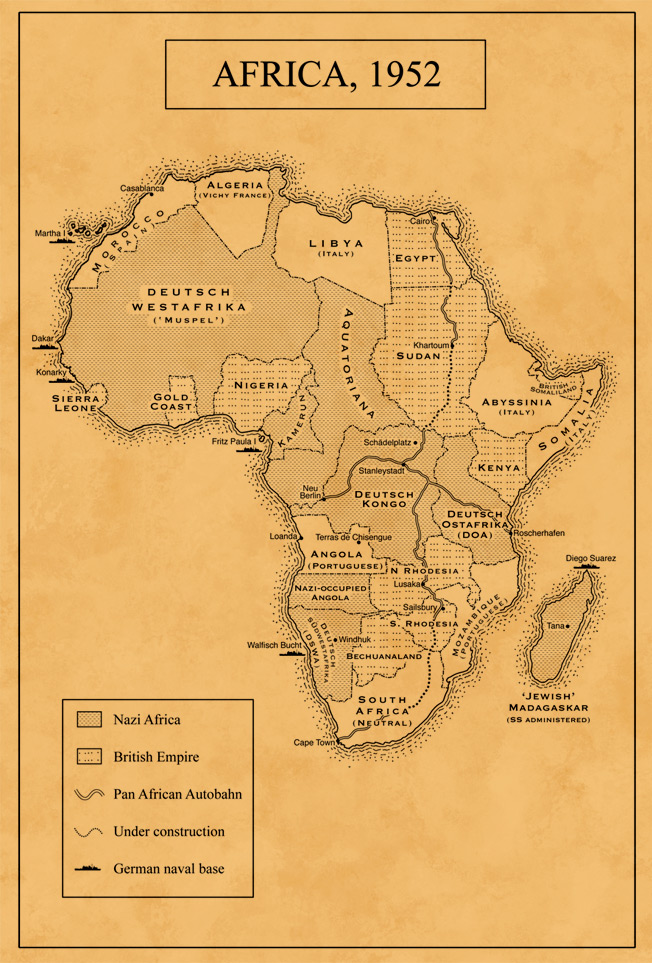
The Afrika Reich presents the reader with a steady stream of action in an alien and yet familiar world of a 1950s Africa where the Black population has almost completely vanished, shipped off to the so-called Muspel zone in the Sahara.
Before you ask: yes, I'm German, and no, I have no idea what Muspel is supposed to mean.
Before you ask: yes, I'm German, and no, I have no idea what Muspel is supposed to mean.
The enemy is evil, over the top evil in a mustache-twirling way befitting of that fine best spy of Her Majesty's secret service. In the same way, he truly is as gutwrenchingly, unflinchingly evil as he is in the character of Amon Goeth in Schindler's List. Walter E. Hochburg is Saville's Goeth. Nearly everything screams of psychotic megalomania.
The Germans themselves – except for Field Marshal von Arnim – are all ugly or brutish, and going by Saville's description, all the people in The Afrika Reich seem to eat are sausages, sauerkraut and strudel, the “holy trinity of German cuisine”. Considering the immense variety of German foods (and the actually limited number of dishes I know that contain either sausages or sauerkraut), that's like saying British cuisine consists of plum pudding and fish'n'chips, but really, that's an irritating yet minor point.
Quick excursus on German cuisine, because that's one clichee that just does not want to die: where I'm from, sauerkraut is usually served only in an old feastday menu, together with mashed potatoes and salted pork and mustard or horseradish sauce. The same basic menu in some variations (added white beans, liver dumplings) can be found across central west Germany. However, it's not something served everyday: it's an oldschool feastday menu, served, for example, at the parish fair. Sausage also really isn't that common (except you really broaden the definition of what you still consider a "sausage"), and strudel is a decidedly Bavarian and Austrian thing. Chances to see it everywhere in 1952, real history or The Afrika Reich: nil.
Quick excursus on German cuisine, because that's one clichee that just does not want to die: where I'm from, sauerkraut is usually served only in an old feastday menu, together with mashed potatoes and salted pork and mustard or horseradish sauce. The same basic menu in some variations (added white beans, liver dumplings) can be found across central west Germany. However, it's not something served everyday: it's an oldschool feastday menu, served, for example, at the parish fair. Sausage also really isn't that common (except you really broaden the definition of what you still consider a "sausage"), and strudel is a decidedly Bavarian and Austrian thing. Chances to see it everywhere in 1952, real history or The Afrika Reich: nil.
And then there's the Die Hard aspect: that of the hero(es) who, no matter the pain and injury inflicted, can get out of his cuffs and into the fight again, for what feels like a dozen times throughout the book.
 |
| Africa, 1952 |
The alternate history aspect is well-employed, taken as a matter of fact of how the world works. I feel this worked to the novel's advantage; delving deeper into the coming about of such backgrounds only opens the gates wide for doubts (like: where's the manpower just to control everything there coming from, why did the British still lose India so fast, etc.).
Some of the more cartoonish aspects of The Afrika Reich can be put down to an extrapolation of Himmler's schemes and the relative independence of Hochburg's Africa, but on the whole one gets the impression that there's really no reason why any sane German - or European in general - would want to live in The Afrika Reich, not with the pervasive presence of jackbooting thugs liable to ruin your day just because they think they can.
Final Verdict: B. Despite some flaws, The Afrika Reich is an entertaining first novel, both for Saville and for his planned trilogy. It's not perfect, coming across in parts more like an airport thriller in the tradition of Matthew Reilly rather than an alternate history novel. It does not question its setup and rolls with the flow, presenting the reader with non-stop action of heroes possessing over-the-top endurance, and with villains that would put Ernst Stavro Blofeld of James Bond fame to shame. You can check out the website of The Afrika Reich here. I, for one, am looking forward to more from Mr. Saville.
* * *
The War Blogger hails from his lair over at, unsurprisingly, The War Blog. He also runs a Blip.tv channel and has published his first alternate history novel Wolf Hunt in 2011.
Friday, September 23, 2011
Meet a Sidewinder #1: Texan in the Sea of Time
As promised here is my first (and hopefully not only) installment of "Meet a Sidewinder". In these segments I discuss people from alternate histories we find in our own timeline, who I call Sidewinders after Ken MacLeod Sidewise Award nominated short story "Sidewinders", which can be found in The Mammoth Book of Alternate Histories.
 Spend enough time around the Internet and you will discover some lost souls who believes that the flag of the state of Texas is the only state flag that can fly at the same height as the United States flag. They claim it is because they were an independent nation before joining the United States or because they negotiated this right before they were annexed. This is an intriguing idea, especially since their is almost no evidence in our history to support this claim.
Consider the United States Flag Code, which became the law of the country in 1923, which states that any state flag could be flown at the same height as the United States flag just as long as the United States flag is flown to the right (the viewer's left). Want more evidence? Nothing in the Ordinance of Annexation or the Texas Flag Code supports the claims above. Now I know what you are saying: "Mitro stop using those fancy, elitist words to prove your point!" I am sorry, I will make this easier for you:
So why do these people continue to claim that the flag of Texas is so special? Are they misguided Texan separatists? Do they put to much trust into PBS? Are they just trolls attempting to incite some digital anger? Are they just historically illiterate and too proud to admit they are wrong?
Or...are they from another timeline?!?! They are just like the Sidewinders from MacLeod's story, unable to control their insertion into alternate universes.
This can be the only logical reason for believing the flag of Texas is the only state flag to have the ability to fly at the same height as the United States flag. I certainly cannot think of another reason why a sane and normal individual would continue to stand by his ignorance in the face of this overwhelming evidence. Now the important question is what was the point of divergence for their timeline (or timelines since there seems to be some disagreement among the adherents of Texan specialness).
It probably is not simple enough to say that the point of divergence was sometime in the 1840s. It is unlikely that the OTL United States of the 1840s would allow a single state to claim such a special status over the other states. For this to be plausible, the point of divergence would have to happen much early then the annexation of Texas. In fact, I believe that the timeline(s) these Sidewinders came from was one where the states' rights adherents of pre-Civil War politics were much more successful.
How could the states' righters have done this, however, with the Constitution being the way it was? What point of divergence would allow this odd world? Here are some possible points of divergence:
Consider the United States Flag Code, which became the law of the country in 1923, which states that any state flag could be flown at the same height as the United States flag just as long as the United States flag is flown to the right (the viewer's left). Want more evidence? Nothing in the Ordinance of Annexation or the Texas Flag Code supports the claims above. Now I know what you are saying: "Mitro stop using those fancy, elitist words to prove your point!" I am sorry, I will make this easier for you:
 |
| The other flag pole must have been in the shop. |
So why do these people continue to claim that the flag of Texas is so special? Are they misguided Texan separatists? Do they put to much trust into PBS? Are they just trolls attempting to incite some digital anger? Are they just historically illiterate and too proud to admit they are wrong?
Or...are they from another timeline?!?! They are just like the Sidewinders from MacLeod's story, unable to control their insertion into alternate universes.
This can be the only logical reason for believing the flag of Texas is the only state flag to have the ability to fly at the same height as the United States flag. I certainly cannot think of another reason why a sane and normal individual would continue to stand by his ignorance in the face of this overwhelming evidence. Now the important question is what was the point of divergence for their timeline (or timelines since there seems to be some disagreement among the adherents of Texan specialness).
It probably is not simple enough to say that the point of divergence was sometime in the 1840s. It is unlikely that the OTL United States of the 1840s would allow a single state to claim such a special status over the other states. For this to be plausible, the point of divergence would have to happen much early then the annexation of Texas. In fact, I believe that the timeline(s) these Sidewinders came from was one where the states' rights adherents of pre-Civil War politics were much more successful.
How could the states' righters have done this, however, with the Constitution being the way it was? What point of divergence would allow this odd world? Here are some possible points of divergence:
- The Articles of Confederation was never repealed.
- Vermont, the first independent republic to join the United States, sets the precedent by negotiating their own special status within the United States.
- President John Adams is impeached over the Alien and Sedition Acts.
- South Carolina wins the game of chicken with President Andrew Jackson over the Nullification Crisis of 1832.
- Slavery ends earlier and more peaceful, removing its connection with states' rights proponents.
- The Supreme Courts rules differently on some key cases.
 |
| Thank you to Thande from Alternatehistory.com for allowing me to use his excellent map. |
Thursday, September 22, 2011
Breaking News: 5000 Page Views!
Yesterday, Alternate History Weekly Update surpassed 5,000 page views! This was a great milestone for the blog, especially since this was only started last June. In response to this accomplishment, and the fact that we just got our first reader from Israel, here is the current world map of our readers:


Our fan base is also growing. We have 19 Google followers, almost a quarter of the way to our goal of 100 fans by June 19, 2012. We also have 59 Facebook fans, 19 percent on the way to reaching our goal of 300 fans. We also have 7 Twitter followers and I am now announcing a goal of 50 Twitter followers by next year. Help us reach our goal by following us using your social networking account.
Once again, thank you to all of our fans. We will continue to provide quality content on alternate history as long as you continue to follow us.
Wednesday, September 21, 2011
Interview: Matthew Quinn
I now give you Matthew Quinn, author of the short story "Coil Gun":
Can you tell us a bit about yourself?
I grew up in Marietta, Ga. and attended the University of Georgia from 2003-2007. I earned two degrees, a bachelor’s in magazine journalism and a bachelor’s in history. I worked for three and a half years for The Griffin Daily News (in Griffin, Ga., which is south of Atlanta) and in January 2011, became the editor of The Johns Creek Herald, a weekly newspaper in one of Atlanta’s northern suburbs.
I have been sending out short stories for publication in magazines since 2001. My first acceptance was in 2007, a short horror story entitled “I am the Wendigo” published by the now-defunct webzine Chimaera Serials. In 2008, I sold two short fantasy stories, “Nicor” and “Lord Giovanni’s Daughter,” to the print magazine Flashing Swords, which went under before they could be published. In 2009, I sold “Skirmish at the Vale’s Edge,” a piece of licensed BattleTech fiction, to the BattleCorps web-site. “Coil Gun,” which I sold to Digital Science Fiction over the summer of 2011, is my first professional-level sale.
What got you interested in alternate history?
When I was in middle school, I read Harry Turtledove’s The Guns of the South on a Scout trip on AMTRAK. By high school — not sure when — I was interested enough to type alternatehistory.com into a web browser and I liked what I found. After lurking for a bit, I joined the site and have been there ever since, commenting on other people’s timelines and scenarios and posting my own for comment.
What is your short story "Coil Gun" about?

It takes place during the opening night of World War III in a timeline where the Dutch settled South Africa 200-odd years earlier than in our own history and their territorial expansion was not restricted by the Dutch East India Company. The end result is a Cold War between the United States and the Afrikaner Confederation, an apartheid-like regime that spans most of the Indian Ocean basin. The chief controller of an American satellite-launch field (which uses the titular coil guns) is trying to replenish orbital assets lost in the Afrikaner first-strike while an Afrikaner intelligence officer down in a bunker watches the progress of the war on an enormous screen and tries to identify trends the Afrikaner military and political higher-ups should know about.
What inspired you to write "Coil Gun"?
On the alternatehistory.com discussion forum, the user whose handle is "reddie" posted an alternate-history challenge. The challenge was to create a scenario where the U.S. is in a cold war with “a realistic quasiDraka”--the “apartheid juggernaut.” Rather than being Anglo-Saxon like S.M. Stirling’s Draka, the oppressive African superpower’s white-supremacist ideology should emerge from Afrikaner culture. I wrote several versions of a timeline with a point of divergence during the Dutch war of independence against Spain. Once I had a world, it was just a matter of writing stories taking place in it.
How did you come up with the title?
The story revolves around the coil-guns used to launch satellites, so the title made sense.
How did you get it published in Digital Science Fiction?
I’d been sending it out and revising it when it got rejected for quite some time—definitely more than a year. I took it through two writing groups I’m a member of, one in Kennesaw, Ga. and the other in Duluth, Ga., and greatly revised the American Carl Sanderson’s sections to strengthen his character. I found Digital Science Fiction on Ralan.com, sent it in, and it was accepted.
What are you reading now?
I’m re-reading Island in the Sea of Time by S.M. Stirling for a book-club meeting. I also started reading The Wolf Age by James Enge, which I purchased from Pyr Science Fiction and Fantasy at DragonCon, but I haven’t gotten very far.
What are your current projects?
My goal is to finish my novel Battle for the Wastelands, which I describe as “a post-apocalyptic steampunk Western” by Veterans’ Day this year. That’s looking less likely to happen, so I’ve set a secondary deadline of “by the end of 2011.” I’m also writing two villain-protagonist superhero short stories for an anthology my Kennesaw-based writing group is putting together. I had the idea for a new science-fiction universe at the 2011 DragonCon and I just started writing a short story set in it. Humans are part of an empire ruled by alien pterodactyl-analogues and that empire is falling…
I also blog at http://www.accordingtoquinn.com/.
Do you have any upcoming works set in the "Coil Gun" universe?
I have a completed espionage story I intend to submit to the next issue of DSF, as well as an unfinished story also set during the opening night of WWIII.
Do you have any advice for other writers?
Read a lot and write a lot. If you have access to a public library, you should be able to find a lot of how books on how to write there. The Cobb County public-library system I grew up using had a whole bunch of books on things like characterization, plot, setting, etc., as well as more interesting stuff like The Writer’s Complete Fantasy Reference.
If there’s a writer’s group that meets near you, join one. “Near” can be relative — I joined both of my groups while living forty minutes to an hour away. If there isn’t, start one, and if you don’t, join an online group like Critters. None of the stories I’ve sold haven’t had critique from other people before they were submitted. “Coil Gun” and “Skirmish” went through each of my writing groups twice, while “Wendigo” was critiqued by UGA professor Dr. Barry Hollander, several people from Critters, and some people who lived in my dorm. “Nicor” and “Lord Giovanni’s Daughter” were also critiqued by Dr. Hollander and people from Critters.
If you can go to conventions, be sure to do so — they’re golden opportunities to network. If I hadn’t gone to DragonCon in Atlanta, I wouldn’t have known BattleTech was still going, let alone that I could write fiction for it. Nor would I have found a publisher who seems interested in Battle for the Wastelands.
Be sure to look for markets. The big Writer’s Market book (and its affiliated Web site) and Ralan.com and Duotrope.com are good places to look, as are the conventions.
Also, although Internet forums can be good sources for inspiration and sounding boards for ideas, don’t spend too much time on them. There’s an XKCD web-comic depicting a haggard man up at an ungodly hour of the night and when his wife or girlfriend asks him to come back to bed, he tells her he’s doing something important—“SOMEONE IS WRONG ON THE INTERNET!” That is something to avoid — there’s not much benefit to winning an argument on a message-board and you could be doing so much else in the meantime. This applies to other Internet-based distractions as well, but I used forums as an example because for me, they’re the worst.
----
Check out Korsgaard's review of "Coil Gun" here.
Can you tell us a bit about yourself?
I grew up in Marietta, Ga. and attended the University of Georgia from 2003-2007. I earned two degrees, a bachelor’s in magazine journalism and a bachelor’s in history. I worked for three and a half years for The Griffin Daily News (in Griffin, Ga., which is south of Atlanta) and in January 2011, became the editor of The Johns Creek Herald, a weekly newspaper in one of Atlanta’s northern suburbs.
I have been sending out short stories for publication in magazines since 2001. My first acceptance was in 2007, a short horror story entitled “I am the Wendigo” published by the now-defunct webzine Chimaera Serials. In 2008, I sold two short fantasy stories, “Nicor” and “Lord Giovanni’s Daughter,” to the print magazine Flashing Swords, which went under before they could be published. In 2009, I sold “Skirmish at the Vale’s Edge,” a piece of licensed BattleTech fiction, to the BattleCorps web-site. “Coil Gun,” which I sold to Digital Science Fiction over the summer of 2011, is my first professional-level sale.
What got you interested in alternate history?
When I was in middle school, I read Harry Turtledove’s The Guns of the South on a Scout trip on AMTRAK. By high school — not sure when — I was interested enough to type alternatehistory.com into a web browser and I liked what I found. After lurking for a bit, I joined the site and have been there ever since, commenting on other people’s timelines and scenarios and posting my own for comment.
What is your short story "Coil Gun" about?

It takes place during the opening night of World War III in a timeline where the Dutch settled South Africa 200-odd years earlier than in our own history and their territorial expansion was not restricted by the Dutch East India Company. The end result is a Cold War between the United States and the Afrikaner Confederation, an apartheid-like regime that spans most of the Indian Ocean basin. The chief controller of an American satellite-launch field (which uses the titular coil guns) is trying to replenish orbital assets lost in the Afrikaner first-strike while an Afrikaner intelligence officer down in a bunker watches the progress of the war on an enormous screen and tries to identify trends the Afrikaner military and political higher-ups should know about.
What inspired you to write "Coil Gun"?
On the alternatehistory.com discussion forum, the user whose handle is "reddie" posted an alternate-history challenge. The challenge was to create a scenario where the U.S. is in a cold war with “a realistic quasiDraka”--the “apartheid juggernaut.” Rather than being Anglo-Saxon like S.M. Stirling’s Draka, the oppressive African superpower’s white-supremacist ideology should emerge from Afrikaner culture. I wrote several versions of a timeline with a point of divergence during the Dutch war of independence against Spain. Once I had a world, it was just a matter of writing stories taking place in it.
How did you come up with the title?
The story revolves around the coil-guns used to launch satellites, so the title made sense.
How did you get it published in Digital Science Fiction?
I’d been sending it out and revising it when it got rejected for quite some time—definitely more than a year. I took it through two writing groups I’m a member of, one in Kennesaw, Ga. and the other in Duluth, Ga., and greatly revised the American Carl Sanderson’s sections to strengthen his character. I found Digital Science Fiction on Ralan.com, sent it in, and it was accepted.
What are you reading now?
I’m re-reading Island in the Sea of Time by S.M. Stirling for a book-club meeting. I also started reading The Wolf Age by James Enge, which I purchased from Pyr Science Fiction and Fantasy at DragonCon, but I haven’t gotten very far.
What are your current projects?
My goal is to finish my novel Battle for the Wastelands, which I describe as “a post-apocalyptic steampunk Western” by Veterans’ Day this year. That’s looking less likely to happen, so I’ve set a secondary deadline of “by the end of 2011.” I’m also writing two villain-protagonist superhero short stories for an anthology my Kennesaw-based writing group is putting together. I had the idea for a new science-fiction universe at the 2011 DragonCon and I just started writing a short story set in it. Humans are part of an empire ruled by alien pterodactyl-analogues and that empire is falling…
I also blog at http://www.accordingtoquinn.com/.
Do you have any upcoming works set in the "Coil Gun" universe?
I have a completed espionage story I intend to submit to the next issue of DSF, as well as an unfinished story also set during the opening night of WWIII.
Do you have any advice for other writers?
Read a lot and write a lot. If you have access to a public library, you should be able to find a lot of how books on how to write there. The Cobb County public-library system I grew up using had a whole bunch of books on things like characterization, plot, setting, etc., as well as more interesting stuff like The Writer’s Complete Fantasy Reference.
If there’s a writer’s group that meets near you, join one. “Near” can be relative — I joined both of my groups while living forty minutes to an hour away. If there isn’t, start one, and if you don’t, join an online group like Critters. None of the stories I’ve sold haven’t had critique from other people before they were submitted. “Coil Gun” and “Skirmish” went through each of my writing groups twice, while “Wendigo” was critiqued by UGA professor Dr. Barry Hollander, several people from Critters, and some people who lived in my dorm. “Nicor” and “Lord Giovanni’s Daughter” were also critiqued by Dr. Hollander and people from Critters.
If you can go to conventions, be sure to do so — they’re golden opportunities to network. If I hadn’t gone to DragonCon in Atlanta, I wouldn’t have known BattleTech was still going, let alone that I could write fiction for it. Nor would I have found a publisher who seems interested in Battle for the Wastelands.
Be sure to look for markets. The big Writer’s Market book (and its affiliated Web site) and Ralan.com and Duotrope.com are good places to look, as are the conventions.
Also, although Internet forums can be good sources for inspiration and sounding boards for ideas, don’t spend too much time on them. There’s an XKCD web-comic depicting a haggard man up at an ungodly hour of the night and when his wife or girlfriend asks him to come back to bed, he tells her he’s doing something important—“SOMEONE IS WRONG ON THE INTERNET!” That is something to avoid — there’s not much benefit to winning an argument on a message-board and you could be doing so much else in the meantime. This applies to other Internet-based distractions as well, but I used forums as an example because for me, they’re the worst.
----
Check out Korsgaard's review of "Coil Gun" here.
Tuesday, September 20, 2011
Review: Coil Gun by Matthew Quinn
It is every would-be-writer's dream to see his work in print. I know it has been mine since I first took up the pen as a school boy, and though I am somewhat closer to achieving that goal as I write articles for an increasingly diverse number of websites, the end goal of seeing one of my fictional works published has remained constant through the tide of years. So when a friend of mine tells me that he recently made the first pro-level sale of his career, I take notice.
Known in various AH circles as MerryPrankster, Matthew Quinn is a writer, journalist and fellow blogger who has proven more than happy to give me both tips about my blog and advice on how to better my own writing career. In addition, he put in a good word for me at the Dudeletter which resulted in me getting my first writing job outside of my blog (with this site being my second). So imagine my surprise when Quinn tells me he just made his first professional level sale of his writing career.
Turns out his short story Coil Gun will be headlining the most recent issue of Digital Science Fiction, and even was the inspiration behind the cover. Knowing his work from his blog and various other projects, I knew that his story alone would be reason enough to pick up the recent copy of Digital Science Fiction. The question I'm sure many of you are asking, is it worth your money? Fear not dear readers, I, your humble narrator, am here to review it for you.
 The story itself, though in a science fiction setting, is primarily an alternate history. You can find the entirety of that world's divergent past here, but the abridged version is a group of Dutch Calvinists settle on the Cape Coast in Africa around the late 1500s, and in the following centuries expand into becoming one of the world's preeminent superpowers, dominating much of the Indian Ocean rim, and is locked in a Cold War with the USA and its allies - a Cold War that over the course of the story, erupts into WWIII, with nuclear weapons and kinetic bombardment - the titular 'coil guns' - devastating both sides.
The story follows the folks inside two control centers - one Afrikaner, one American - as they coordinate the attack on the enemy and contemplate the effects the war will have on them and their homeland. Coil Gun depends a great deal on it's superbly done characterization, and makes you truly care about what happens to the folks on both sides of the conflict - no small feat when one side of the war is made up of Afrikaners bent on racial and religious superiority. The technology and tactics used are well described, as are passing events, yet not too overly detailed as a lot of writers fall weakness to. It's well-paced and tense, as any story about WWIII should be, and unlike a lot of short stories I've read, it felt wholly satisfying on its own, without need to go further in depth.
So in the end, I have to tip my hat to Quinn - if Coil Gun is any indication of his abilities as a writer, Quinn is someone we all will need to keep on our radar, and for the moment, Coil Gun is a superb little short story. With that, I can wholly say that Pressure Suite, as the latest issue if Digital Science Fiction is titled, is well worth picking a copy up. Having read the rest of the anthology, I can say its well worth a read, and Quinn and his Coil Gun are a big reason why.
Soldier, scholar, writer and web-voyeur, Sean CW Korsgaard has been active in the alternate history community since 2006, and was recently elected to succeed Mitro as President of the Alternate History Online Facebook group. In addition to his contributions at the Alternate History Weekly Update, he writes for several websites, including his own, which can be found here.
Known in various AH circles as MerryPrankster, Matthew Quinn is a writer, journalist and fellow blogger who has proven more than happy to give me both tips about my blog and advice on how to better my own writing career. In addition, he put in a good word for me at the Dudeletter which resulted in me getting my first writing job outside of my blog (with this site being my second). So imagine my surprise when Quinn tells me he just made his first professional level sale of his writing career.
Turns out his short story Coil Gun will be headlining the most recent issue of Digital Science Fiction, and even was the inspiration behind the cover. Knowing his work from his blog and various other projects, I knew that his story alone would be reason enough to pick up the recent copy of Digital Science Fiction. The question I'm sure many of you are asking, is it worth your money? Fear not dear readers, I, your humble narrator, am here to review it for you.
The story itself, though in a science fiction setting, is primarily an alternate history. You can find the entirety of that world's divergent past here, but the abridged version is a group of Dutch Calvinists settle on the Cape Coast in Africa around the late 1500s, and in the following centuries expand into becoming one of the world's preeminent superpowers, dominating much of the Indian Ocean rim, and is locked in a Cold War with the USA and its allies - a Cold War that over the course of the story, erupts into WWIII, with nuclear weapons and kinetic bombardment - the titular 'coil guns' - devastating both sides.The story follows the folks inside two control centers - one Afrikaner, one American - as they coordinate the attack on the enemy and contemplate the effects the war will have on them and their homeland. Coil Gun depends a great deal on it's superbly done characterization, and makes you truly care about what happens to the folks on both sides of the conflict - no small feat when one side of the war is made up of Afrikaners bent on racial and religious superiority. The technology and tactics used are well described, as are passing events, yet not too overly detailed as a lot of writers fall weakness to. It's well-paced and tense, as any story about WWIII should be, and unlike a lot of short stories I've read, it felt wholly satisfying on its own, without need to go further in depth.
So in the end, I have to tip my hat to Quinn - if Coil Gun is any indication of his abilities as a writer, Quinn is someone we all will need to keep on our radar, and for the moment, Coil Gun is a superb little short story. With that, I can wholly say that Pressure Suite, as the latest issue if Digital Science Fiction is titled, is well worth picking a copy up. Having read the rest of the anthology, I can say its well worth a read, and Quinn and his Coil Gun are a big reason why.
Soldier, scholar, writer and web-voyeur, Sean CW Korsgaard has been active in the alternate history community since 2006, and was recently elected to succeed Mitro as President of the Alternate History Online Facebook group. In addition to his contributions at the Alternate History Weekly Update, he writes for several websites, including his own, which can be found here.
Monday, September 19, 2011
Weekly Update #20
Editor's Note
No theme this week, but I do have some related posts coming up. You will have to scroll down to the next section in the post to find out more about that. I will be starting a new segment this week called "Meet a Sidewinder", which will feature stories about people from alternate timelines who inhabit our own reality! Sounds unbelievable, huh? Well you will just have to wait to find out more.
Korsgaard and Kier both promise more posts in the future and as you may have heard, War Blogger has promised to share some his novel reviews with this blog, which is awesome.
Remember that you still have time to enter The Oral History of Doomsday Contest. We have one entry so far and he is going to win by default unless you send in your submission. Send all entries to ahwupdate at gmail dot com.
Meanwhile, we got our first reader from Uruguay. Welcome!
And now the news...
Digital Science Fiction
Thanks to Korsgaard, I recently discovered a book series titled Digital Science Fiction. It is quarterly collection of original science fiction short stories from professional writers and storytellers. Every Digital Science Fiction Anthology is published electronically for Amazon Kindle and Smashwords. They are also available in regular print versions approximately three weeks after the digital publication date.
Pressure Suite, the third anthology in the series, is relevant to our blog because it will include an alternate history short story. That story is called "Coil Gun" and it is written by Matt Quinn. According to Digital Science Fiction's President Michael Wills, "Coil Gun" will be the series' first alternate history and has described Matt as "a great asset to our book series...both in terms of his story contribution and his efforts in promoting our label." Anyone looking for more information on "Coil Gun" can check out Matt's blog here.
Korsgaard and I will be providing more information to you about this story. I will be interviewing Matt and Korsgaard will be posting a review of the story this week. So stay tuned for more information. Also if anyone is interested in being the second person to publish an alternate history with Digital Science Fiction, Michael informs me that they are still accepting submissions for the fifth anthology.
More on a World Without 9/11
Thank you to Korsgaard and Henry Martin for their comments on my counterfactual essay on a world without 9/11. Yes I think it is safe to say that in a world where the terrorist attacks on the World Trade Center and the Pentagon never happened, the political career of Barack Obama would have been very different and he would likely never have been nominated over Hillary Clinton in the 2010 presidential elections.
It looks like, however, that I was not the only one inspired by the ten year anniversary of 9/11 to write an alternate history about it. Moeed Yusuf at the International Herald Tribune and Faheem Haider at the Foreign Policy Association both wrote intriguing articles about how the history of Afghanistan and Central Asia would progress without 9/11. This is in contrast to the slide show Alternate History No 9/11 that has the United States being invaded by China in the near future. Perhaps you should avoid watching that implausible piece of garbage and check out instead Osama by Israeli science fiction author Lavie Tidhar. You can see a review of it here.
If someone can help me figure out where I can purchase said book, that would be great.
Coming Soon: The Domination

Domination, the omnibus volume containing the first three books of the Draka series, will be released as an ebook by Baen Dec 2011. The Draka series is S. M. Stirling's controversial alternate history about the Loyalists from the American Revolution settling in South Africa instead of Canada. They go on to create the Domination of Draka, a slave owning superpower that makes Apartheid South Africa look like Care-a-lot. What is even more horrifying is that at one point you find yourself rooting for the Nazis to win!
Links to the Multiverse
Articles
The Complete History of Time Paradoxes by Charlie Jane Anders and Gordon Jackson, at io9.
Counterfactual States of America: On Parallel Worlds and Longing for the Law by
Interviews
Interview with Sidewise nominee Jay Lake at Locus.
Book
Review of 1632 by Eric Flint at Avallanath.
Review of The Big Switch by Harry Turtledove at lunarhunk.
Video Games
Review of Resistance 3 at Complex.
Media
Photos from the DragonCon 2011 Alternate History Track
No theme this week, but I do have some related posts coming up. You will have to scroll down to the next section in the post to find out more about that. I will be starting a new segment this week called "Meet a Sidewinder", which will feature stories about people from alternate timelines who inhabit our own reality! Sounds unbelievable, huh? Well you will just have to wait to find out more.
Korsgaard and Kier both promise more posts in the future and as you may have heard, War Blogger has promised to share some his novel reviews with this blog, which is awesome.
Remember that you still have time to enter The Oral History of Doomsday Contest. We have one entry so far and he is going to win by default unless you send in your submission. Send all entries to ahwupdate at gmail dot com.
Meanwhile, we got our first reader from Uruguay. Welcome!
And now the news...
Digital Science Fiction
Thanks to Korsgaard, I recently discovered a book series titled Digital Science Fiction. It is quarterly collection of original science fiction short stories from professional writers and storytellers. Every Digital Science Fiction Anthology is published electronically for Amazon Kindle and Smashwords. They are also available in regular print versions approximately three weeks after the digital publication date.
Pressure Suite, the third anthology in the series, is relevant to our blog because it will include an alternate history short story. That story is called "Coil Gun" and it is written by Matt Quinn. According to Digital Science Fiction's President Michael Wills, "Coil Gun" will be the series' first alternate history and has described Matt as "a great asset to our book series...both in terms of his story contribution and his efforts in promoting our label." Anyone looking for more information on "Coil Gun" can check out Matt's blog here.
Korsgaard and I will be providing more information to you about this story. I will be interviewing Matt and Korsgaard will be posting a review of the story this week. So stay tuned for more information. Also if anyone is interested in being the second person to publish an alternate history with Digital Science Fiction, Michael informs me that they are still accepting submissions for the fifth anthology.
More on a World Without 9/11
Thank you to Korsgaard and Henry Martin for their comments on my counterfactual essay on a world without 9/11. Yes I think it is safe to say that in a world where the terrorist attacks on the World Trade Center and the Pentagon never happened, the political career of Barack Obama would have been very different and he would likely never have been nominated over Hillary Clinton in the 2010 presidential elections.
It looks like, however, that I was not the only one inspired by the ten year anniversary of 9/11 to write an alternate history about it. Moeed Yusuf at the International Herald Tribune and Faheem Haider at the Foreign Policy Association both wrote intriguing articles about how the history of Afghanistan and Central Asia would progress without 9/11. This is in contrast to the slide show Alternate History No 9/11 that has the United States being invaded by China in the near future. Perhaps you should avoid watching that implausible piece of garbage and check out instead Osama by Israeli science fiction author Lavie Tidhar. You can see a review of it here.
If someone can help me figure out where I can purchase said book, that would be great.
Coming Soon: The Domination

Domination, the omnibus volume containing the first three books of the Draka series, will be released as an ebook by Baen Dec 2011. The Draka series is S. M. Stirling's controversial alternate history about the Loyalists from the American Revolution settling in South Africa instead of Canada. They go on to create the Domination of Draka, a slave owning superpower that makes Apartheid South Africa look like Care-a-lot. What is even more horrifying is that at one point you find yourself rooting for the Nazis to win!
Links to the Multiverse
Articles
The Complete History of Time Paradoxes by Charlie Jane Anders and Gordon Jackson, at io9.
Counterfactual States of America: On Parallel Worlds and Longing for the Law by
Interviews
Interview with Sidewise nominee Jay Lake at Locus.
Book
Review of 1632 by Eric Flint at Avallanath.
Review of The Big Switch by Harry Turtledove at lunarhunk.
Video Games
Review of Resistance 3 at Complex.
Media
Photos from the DragonCon 2011 Alternate History Track
Friday, September 16, 2011
Creating Parallel Universes: A History of ISOT
 ISOT (pronounced "eye-sot") is an acronym for the plot device used both in published and online alternate histories. The term originated from S. M. Stirling's 1998 novel Island in the Sea of Time, the first of the three alternate history novels known as the Nantucket or Islander trilogy. The novel describes the events following "The Event", which transported the island of Nantucket, its inhabitants and a nearby United States Coast Guard ship Eagle to the 1250s BC.
Following the publication of the novel, the term began to appear in many online discussion groups, probably the earliest being the alternate history newsgroup soc.history.what-if. ISOT became a verb meaning "to move a large area of land through time to another era". Though ISOT often stands for the title of Stirling's novel, it also has been defined to mean "Island Sea Of Time" and sometimes "In Sea Of Time". The term also references the event which cased the time travelling, if the author uses another name for the event. Due to the implausibility of such an event, it usually appears in the ASB section of many online forums. There also exists an online role playing game which has run continuously since 2000 called SHWI-ISOT with a POD in 1800. Players act as characters sent from the 21st century back to an alternate early 19th Century.
The ISOT plot device does not apply solely to travel through time. In 2000, Eric Flint published 1632, the initial novel in the shared world series (also known as The Assiti Shards series). The premise involves a the fictional American town of Grantville, West Virginia being sent back to April 1631 in the middle of the Holy Roman Empire during the Thirty Years War (caused by an event known by the characters as the "Ring of Fire"). This reader learns in a prologue about the alien Assiti who can be blamed for removing Grantville to the past because their "artwork" often alters time and space.
In both series, the event transports the land Nantucket and Grantville replaced to the present day. The geographical location transported to the present rarely makes an impact to the story following the switch and can be ignored. The setting for Stirling's Emberverse series, however, involves the same timeline Nantucket of the Nantucket series originated from. In the series the Bronze Age Nantucket causes an event known as the "Change" which alters the laws of physics to prevent the use of high technology (with disastrous consequences for humanity).
Unlike the other famous term popularized by alternate historians, alien space bats, ISOT has yet to appear in any published literature. The term alien space bats has appeared in many novels (Dies the Fire, Without Warning, Outrageous Fortunes), but not ISOT. Perhaps the absence of the term can be explained by the lack of people who have actually read Island in the Sea of Time or visit online alternate history forums. Meanwhile, the term and proper use of "alien space bats" can be appreciated without ever reading another novel.
Despite originating as a device to move land masses and their populations to other time eras, the term has evolved to cover time travel by a single or multiple individuals without the need to move large land masses. This evolution actually makes sense since time travel and alternate history have long been intertwined with each other before Stirling published his novel The time traveler s) create a new timeline due to their actions in the past. Authors rarely state what happened to the original timelines, but readers usually assume it exists parallel to the new timeline created by the traveler(s), as I tried to express in my Back to Multiverse series of posts.

L. Sprague de Camp's 1939 can be credited with writing one of the influence alternate history/time travel novel: Lest Darkness Fall. The novel influenced many alternate history authors who began their careers in the 1980s, including S. M. Stirling. In 2005 he published the short story sequel to Lest Darkness Fall: "The Apotheosis of Martin Padway". The story provides glimpses of what might have become of the reality Padway altered. Pehaps de Camp deserves some credit for creating the ISOT plot device, since Stirling may never have wrote the novel which gave the plot device the name if he had never heard of the time travelling Padway.
ISOT can be applied to travels to the future. In Harry Turtledove's 1987 novel The Misplaced Legion, a Roman legion and Celtic prince from the Gallic Wars (58-51 BC) accidentally transport themselves and a Roman legion to a parallel, fantasy universe modeled after the 11th century Byzantine Empire. While continents and naturals laws may be different, the story nevertheless provides an example on how people from the past can effect people from their future.
This brings us to a major criticism of the ISOT plot device: most ISOT stories can too easily become wankfests. As expressed in Max's First Law which states: the greater the technological and social advantage of the changed societies in question, the greater the wank. The creator of the law lists three reasons why an ISOT story can become a wank:
- Technological Advantage: A society or group from the future knows how to do more things more efficiently than people in the past do.
- Foresight: A society or group from the future knows what happens in the past, at least before the butterfly effect becomes dominant. Thus with advanced knowledge, the time traveler s) can profit from their advanced knowledge of events.
- Access to Increased Resources: Past societies have more non-reusable resources available than are available in the present time of the time traveler s). This means more oil, coal and other resources can be used by the time traveler(s) and their allies.

Nevertheless, people have objected to this tendency to become a wankfest as "time-ism", or the irrational belief of the inherently superiority of people from the future compared to people of the past. This anti-time-ism theme appears in both the 1632 series, Harry Turtledove's 1992 novel The Guns of the South and several online alternate histories.
Despite the criticism, however, the plot device remains popular in the alternate history community and will probably remain so for some time.
* * *
Matt Mitrovich is the founder and editor of Alternate History Weekly Update and a volunteer editor for Alt Hist magazine. His fiction can be found at Echelon Press, Jake's Monthly and The Were-Traveler. When not writing he works as an attorney, enjoys life with his beautiful wife Alana and prepares for the inevitable zombie apocalypse. You can follow him on Facebook or Twitter.